Genetics and Evolution Exam 1
 Studied by 1 person
 Call with Kai
 Learn
Learn Practice Test
 Spaced Repetition
 Match
Match Flashcards
 Knowt Play
1/198

There's no tags or description
Looks like no tags are added yet.
Name | Mastery | Learn | Test | Matching | Spaced | Call with Kai |
|---|
No study sessions yet.
199 Terms
Characteristics of Genetic Material
must contain complex information
must replicate faithfully
must have the capacity to vary.'
must encode the phenotype
Structure of DNA
Primary: nucleotide structure and joining (A,C,T,G)
Secondary: stable 3-dimensional configuration (helical phosphodiester structure; major/minor grooves)
Tertiary: supercoiling into chromosomes
Prokaryotes vs. Eukaryotes
Prokaryotes: less base pairs, very short DNA, circular tertiary structure
Eukaryote: much longer base pairs, highly coiled and condensed chromosomes
Chromosomes
storage for DNA
central to inheritance patterns
Chromatin
DNA + Histones
Histones
protein found in eukaryotes that associates with DNA to form chromosomes
Why do chromosomes have to be packed tightly?
Eukaryotic DNA is so long (2 meters in each cell)
Genome
complete set of DNA within an organism
all of your chromosomes together
Genomics
study of many genes or whole genomes at once
Single Locus Genetics vs. Genomics
Single Gene vs. Many Genes/Genome
What is the genome made of?
genes
exons and introns
regulatory regions
transcription factors
gene expression control
“Junk” DNA
??
What percent of the human genome codes for proteins?
1.5% ; 20,000 genes
Importance of Junk DNA
contains many elements critical for gene expression
Transposable Elements
portion of Junk DNA that actually participates in gene expression processes
discovered by Barbara McClintock
Human Chromosomes
23 pairs
22 autosome pairs (both copies are the same)
1 pair of sex chromosomes
XX/XY
not the same in every organism
What does it mean when its said that pairs of chromosomes are “homologous”?
Pairs of chromosomes are similar with each one coming from each parent
Karyotype
physical examination of the chromosomal structure of an individual
Ploidy
the number of copies of the genetic code
n= number of genome copies
Diploid
2n
almost every in the human body
Haploid
1n
gametes/sex cells
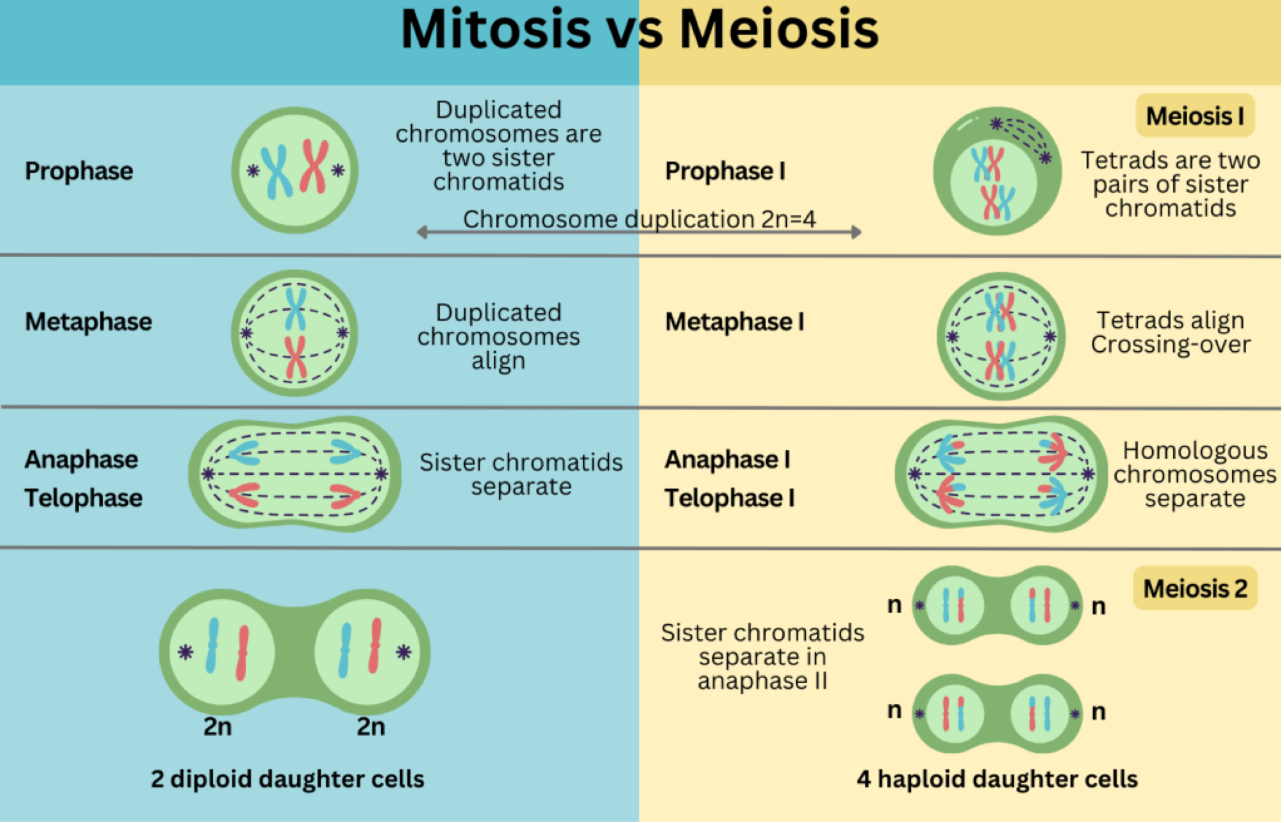
Meiosis
turns 1 diploid (2n) cell into 4 haploid (1n) cells
Central Dogma
DNA → RNA → Protein
Genotype
complete genetic makeup of an organism
“what is in the book/coded”
Phenotype
set of observable traits in an organism
“what you see”
also difference in the amount of proteins
determined by multiple genes
Is every person unique because they have different genes?
False!
Everyone has the same genes but different alleles
Characteristics of Genes
a segment of DNA that codes for something specific
mostly proteins
ALWAYS codes for a phenotype
Allele
one of a number of variations of a gene
one gene with multiple variations
one of two or more alternative versions or variations of the same gene, found at the same specific location
ex: a diploid individual has 2 alleles (copies) of each gene
Locus
physical location of a gene on chromosome
plural = loci
What are the three different types of chromosome mutations?
Rearrangements (leads to same ploidy)
Aneuploidy (one chromosome has extra pair)
Polyploidy (all chromosomes have an extra pair)
Polyploidy
duplication of the entire chromosomal set
Triploid- 3N
tetraploid- 4N
Real-Life Examples of Polyploidy
many foods are polyploid
removes seeds to make sterile
increases yield of edible portion
Aneuploidy (Trisomy)
when a single chromosome duplicates
Trisomy 21
Down’s Syndrome
extra copy of chromosome 21
most commonly diagnosed chromosomal mutation
Are parents carriers of aneuploidy?
No. Aneuploidy is caused by errors in meiosis
What are the 4 types of chromosomal rearrangements?
duplication
deletion
inversion
translocation
Chromosomal Duplication
when a section of the chromosome is duplicated
the duplicated chromosome has to loop out to maintain alignment of the DNA sequences
What are the consequences of chromosomal duplication?
Imbalances in gene product
overexpression of genes due to gene dosage (extra copies of genes)
ex: relative dosage of pigment can be changed
Chromosomal Deletion
loss of a chromosomal segment
What are the consequences of chromosomal deletions?
no copy of specified gene (imbalance of gene product)
Pseudodominance
Haploinsufficiency
Pseudodominance
expression of a normally recessive gene
Haploinsufficiency
when a single functional copy of the gene doesn’t produce enough gene product to bring about a wild-type condition
number of possible chromosome combinations in gametes equation
2n=
Chromosomal Inversion
a segment of a chromosome is reversed end-to-end through breakage and rearrangement
Loops (Chromosomal Inversion)
A loop is formed in the area where the chromosome has the inversion
Is recombination possible with chromosomal inversions
No
Chromosomal Translocations
sections of chromosomes are moved to non-homologous chromosomes
or within the same chromosome (very rare)
What is the key to chromosomal translocation?
movement is not between homologous chromosomes, but anywhere else
Recombination
sections of chromosomes are moved to homologous chromosomes
What is required for genetic variation?
Mutations
What are the 2 major classes of mutations?
germ-line mutations and somatic mutations
Germ-line mutations
DNA change in reproductive cells (sperm or egg) that gets passed from a parent to their child
mutation is present in every cell of the offspring's body and can be inherited by future generations
everyone has 70-100 germ-line mutations
Somatic mutations
mutations in all other cells
everyone has millions to billions of somatic mutations
De-novo mutations
mutations that are not in your parents
Effects of Mutations
may lead to downstream consequences on proteins
may but not always lead to phenotypic change
What is the degeneracy of the genetic code?
There are 64 codons but only 24 amino acids
changes to codons mean the same thing
Does the degeneracy of the genetic code bad?
It is a feature that saves you!
allows many mutations that have no consequences
Synonymous mutation
when a base change results in the same amino acid product
Nonsynonymous mutation
when a base change leads to a different amino acid product
leads to a phenotypic change
Somatic nonsynonymous mutation
cell could do its job wrong or still work properly
cell can die or cancer starts
cancer is rampant somatic mutation
Somatic synonymous mutation
no effect
Germ-line synonymous mutation
no effect on offspring
Germ-line nonsynonymous mutation
mutant offspring
different protein; phenotypic change
What are the three gene mutations in primary structure?
base substitutions
insertions and deletions (indels)
expanding nucleotide repeats
Base Substitution (point mutation)
a nucleotide pair gets replaced with a different nucleotide pair
A is substituted with a G
creates a G-T mismatch temporarily that gets fixed
Transition mutation
substitution of like base
Pyrimidine switches with a pyrimidine
C switches with a T (vice versa)
Purine switches with a purine
G switches with an A (vice versa)
4 options
Transversion mutation
a purine is switched with a pyrimidine (vice versa)
A switches with C or T
C switches with A or G
T switches with A or G
G switches with C or T
substitution of unlike base
What is the ratio of transversion to transition in humans?
1:2 Transversion to Transition
What is more likely to be synonymous, transitions or transversions and why?
Transitions because have no functional difference most of the time
3rd codon position codes for the same base most of the time (chemically redundant)
pyrimidines (C and T) are more similar structurally
Insertions
mutation in which extra base pairs are inserted into a new place in the DNA
Deletions
mutations in which a section of DNA is lost, or deleted
Are insertions and deletions (indels) tolerable?
Yes for the most part
What occurs if the indel is a multiple of 3?
it adds/subtracts an amino acid
Frameshift mutation
caused by indels of a number of nucleotides in a DNA sequence that is not divisible by three
alters the reading frame of all codons downstream of the indel
Expanding nucleotide repeats
mutation that leads to runaway repeats in one copy
hairpin loops forms and causes part of the template strand to be replicated twice
increases the number of repeats
Fragile X
expanding repeat mutation that causes a fragile site at the ends of the X chromosome
Missense mutation
nonsynonymous mutation that converts an amino acid into a different amino acid
Nonsense mutation
nonsynonymous mutation where a sense codon turns into a stop codon
translation stops prematurely
Silent mutation
a synonymous mutation where codon turns into a codon that produces the same amino acid
Why are most mutations recessive?
Most mutations are loss-of-function mutations where a gene product can’t do its job anymore
Loss-of-function mutation
gene product becomes partially or wholly inactivated
deletion of all or part of a gene and a amino acid substitution that inactivates the protein
allele has a complete loss of function
ex: lactose intolerance
not always bad
Gain-of-function mutation
rare dominant mutation
an altered gene product has a new function or pattern of gene expression
usually caused by expression in a new tissue type or time of expression
not always good
What is an example of a Gain-of-function mutation?
Ectopic expression in fruit flies (drosophila)
expression of an eye on the elbow of the fly
technically not good
Supressor mutation
a second mutation that reverts the phenotypic effects of an already existing mutation
restores the phenotype seen prior to the original background mutation
Intragenic suppressor
occurs in the same gene as the mutation
often reverts amino acid or restores a frameshift
ex: first a mutation of A and then a second mutation of A
Intergenic suppressor
mutation in a second gene separate from the gene of the original mutation
changes how much mRNA is translated
ex: mutation in A and then a another mutation in B
Example of an intergenic suppressor
(a) The wild-type sequence produces a full-
length, functional protein.
(b) A base substitution at a site in the same
gene produces a premature stop codon,
resulting in a shortened, nonfunctional
protein.
(c) A base substitution at a site in another
gene, which in this case encodes tRNA,
alters the anticodon of tRNATyr; tRNATyr
can pair with the stop codon produced by
the original mutation, allowing tyrosine to
be incorporated into the protein and
translation to continue.
Mutation Rate
frequency with which a wild type allele at a locus turns into a mutant allele
Do all organisms have the same mutation rate?
No, different organisms have different mutation rates
rates can vary with a species and within the genome
even different parts of the body have different mutation rates
Are mutations intentional?
No, they are random and not for adaptive benefit
Spontaneous mutations
arise from a variety of sources
errors in DNA replication
spontaneous lesions
transposable genetic elements
Induced mutations
caused by damage to DNA through exposure to ultraviolet/ionizing radiation or chemical mutagens
Mutagen
any agent that causes an increase in the rate of mutation above the spontaneous background
UV (pyrimidine dimers)
ionizing radiation
chemical mutagens
X-rays
Effects of radiation and mutagens
causes DNA damage that interferes with repair mechanisms
increasing rates of mutation
True or False: Every individual of the same species would have chromosomes that appear similar in karyotype
True, generally have the same number, size, and shape of chromosomes, so their karyotypes appear similar.
Do additional copies of a gene cause cellular problems?
Sometimes
Are germ-line and somatic mutations both passed on to offspring?
No, only germ-line mutations (in eggs or sperm) can be inherited. Somatic mutations occur in body cells and are not passed on to offspring.
Somatic and germline mutations are classified based on
tissue type