8a. Protectionism - Tariffs.
 Call Kai
 Learn
Learn Practice Test
 Spaced Repetition
 Match
Match Flashcards
 Knowt Play
1/20

There's no tags or description
Looks like no tags are added yet.
Name | Mastery | Learn | Test | Matching | Spaced | Call with Kai | Chat |
|---|
No analytics yet
Send a link to your students to track their progress
21 Terms
Name some main forms of protectionism.
1. Tariffs
2. Quotas
3. Export subsidies
4. Government controls:
- Import licensing
- Exchange controls
- Legislation
What is a tariff?
A tax imposed by a government on imported goods to raise the cost of imports.
Why may tariffs be used?
1. To protect domestic industries.
2. To discourage foreign competition.
3. As a source of government revenue.
4. To decrease demand for foreign goods.
Explain how tariffs work.
1. They are likely to raise the final price for the consumer.
2. This leads to a fall in demand.
3. Consumers will then switch consumption to domestic goods.
What are quotas?
Limits set by the government on the amount of value of a specific good that can be imported/ exported during a given time period.
Why may quotas be used?
1. To restrict the supply of foreign goods.
2. To support domestic production by limiting foreign competition.
What are export subsidies?
Financial assistance provided by the government to domestic firms.
Why may export subsidies be used?
1. To help domestic producers sell goods at lower prices.
2. To help make producers goods more globally competitive.
Name the main types of government controls.
1. Import licensing
2. Exchange controls
3. Legislation
What is import licensing?
A requirement for businesses to obtain permission before importing certain goods.
Why may import licensing be used?
1. To regulate the quantity/ type of goods entering a country.
What are exchange controls?
Regulations to limit/ manage the amount of foreign currency and gold that can be bought or sold.
Why may exchange controls be used?
1. To stabilize a country's currency.
2. To protect the economy from excessive foreign exchange fluctuations.
What is legislation?
Specific laws and regulations that control the import and export of goods.
Give some examples of legislation as a form of protectionism.
1. Health and safety standards.
2. Environmental regulations.
3. Technical standards that must be met before goods are allowed to enter the country.
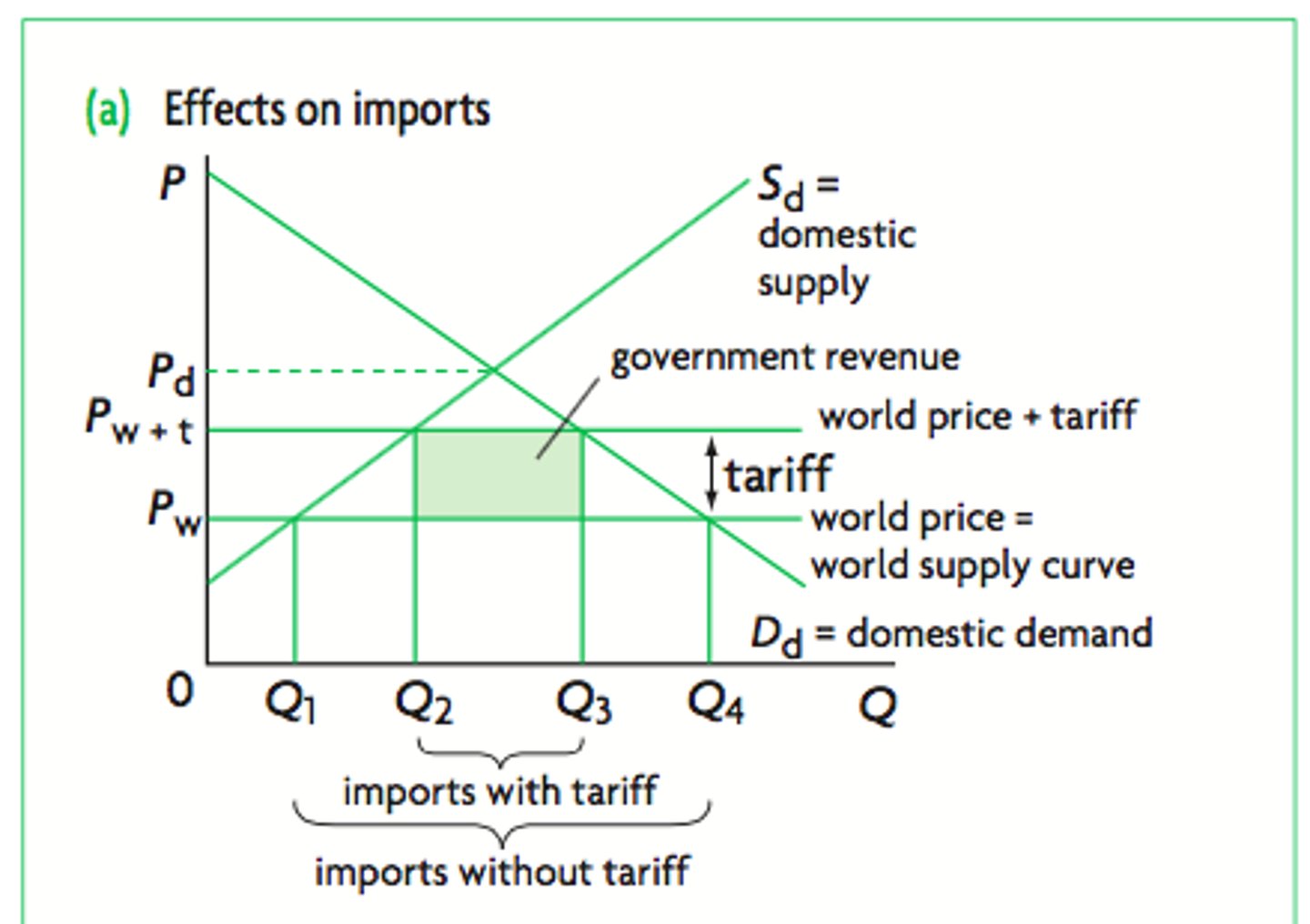
Draw a supply and demand diagram of a country without a competitive advantage with a tariff.
1. Consumer surplus shrinks (top left).
2. Producer surplus expands (bottom left)
3. Deadweight loss (around tariff revenue)
Define deadweight welfare loss.
The reduction in economic efficiency/ measure of harm caused to society that occurs when a market is inefficiently not in equilibrium.
Explain the effects of a tariff using the diagram.
1. Imported quantity shrinks.
2. Domestic production increases.
3. Price rises.
4. Import revenue falls.
5. Domestic revenue increases.
6. Government receives tax revenue.
7. Welfare loss occurs.
Give some advantages of a tariff.
1. Encourages domestic production.
2. Protects domestic jobs.
3. Increases government revenue.
4. Protects industries.
5. Restricts dumping.
Define dumping.
When foreign companies sell goods at artificially low prices to gain market share.
Give some disadvantages of a tariff.
1. Higher prices for consumers.
2. Economic inefficiency and structural issues.
3. Deadweight loss.
4. Potential for retaliation.
5. Lack of pressure to innovate.