TDP: 1st Practical (MSK)
 Call Kai
 Learn
Learn Practice Test
 Spaced Repetition
 Match
Match Flashcards
 Knowt Play
1/32

There's no tags or description
Looks like no tags are added yet.
Name | Mastery | Learn | Test | Matching | Spaced | Call with Kai | Chat |
|---|
No analytics yet
Send a link to your students to track their progress
33 Terms
What are the 8 steps to performing MSK exams?
Inspect
Palpate
ROM
Special maneuvers
Sensation
Motor tests
Deep tendon reflexes
Gait (& Coordination)
not included in Upper/Lower Extremity
Inspect the patient’s spine standing up
Look for swelling, deformity, atrophy, muscle spasm, and signs of discomfort (in addition to the following)
Front: Alignment & Symmetry
Head position
Shoulders
Trunk
Pelvic
Muscle bulk
Back: Spinal Alignment & Musculature
Spine
Shoulder & Scapula
Pelvic
Muscle bulk
Muscle spasm (tightness, contracted)
Skin & Soft tissue (scars, swelling, deformities)
Side: Posture & Spinal Curvature
Head posture
Cervical lordosis
Thoracic kyphosis
Lumbar lordosis
Overall
Palpate and percuss the patient’s spine
Look for warmth, swelling, masses, nodules, or erythema (in addition to the following)
Spinous processes
tenderness, alignment, step-offs, deformity, pain
Interspinous spaces
tenderness, widening, narrowing
Paravertebral muscles bilaterally
tenderness, muscle spasm, hypertonia, asymmetry, or atrophy
Posterior ribs bilaterally
tenderness, asymmetry, deformity, crepitus (popping)
Sacrum and sacroiliac
tenderness, asymmetry, deformity, or pain
Check patient’s ROM of neck and spine
Neck (active > passive if needed)
Flexion
Extension
Rotation
Side bending
Spinal column (active > passive if needed)
Flexion
Extension
Rotation
Side bending
Perform the cervical compression test (Spurling)
Patient: sits, looks over shoulder and up at ceiling
You: press down on head behind patient
ask pain?
Positive test: cervical radiculopathy

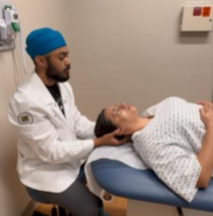
Perform the cervical distraction test
Patient: supine
You: ask pain?
place both hands on the occiput
pull
ask pain relieved?
Positive test: cervical radiculopathy
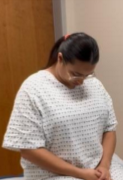
Perform the Lhermitte sign/Barber chair phenomenon
Patient: flex neck down
You: ask shock sensation (extending down spine and/or limbs)
Positive test: cervical affected (multiple sclerosis, spinal cord compression, radiculopathy)
Perform the Adson test
Patient: extend elbow
You: palpate radial pulse
while palpating, abduct and laterally rotate
ask take deep breath and hold
check pulse
Positive test: decreased vigor of pulse; Thoracic Outlet syndrome (compression b/t anterior and middle scalene muscles)

Perform Adam’s forward bend test
Patient: expose back and stand straight
You: stand behind at eye level
ask slowly bend forward to touch toes
inspect any asymmetry
Positive test: rib or paraspinal hump; scoliosis
Perform the straight leg raise test
Patient: supine
You: place one hand on ankle and other above knee
flex the extended leg
ask pain (shooting down leg)
dorsiflex and ask pain again
Positive test: sciatica

Perform sitting knee extension test
Patient: sit at side of bed
flex neck (chin to chest)
You: fix thigh on bed while extending leg with other hand
ask pain?
dorsiflex and ask pain again
Positive test: sciatica

Inspect the patient’s gait
Ask patient to walk barefoot. Instruct them to 1) walk away, 2) return on tiptoes, 3) away on heels, and 4) return walking heel-to-toe
Inspect from all sides
Arm swing (symmetrical, hands relaxed, joint position)
Head and trunk (midline, smooth, vertical excursion of head)
Pelvis (level, anterior/posterior rotation bilaterally)
Hip motion (flexion/extension, shifts, lateral excursion from hip)
Knee (flexion/extension, genu valgus or varus)
Ankle and foot (plantar/dorsiflexion, alignment/position, calcaneal varus/valgus)
Overall gait (stride length, frequency)
width heel-to-heel (2-4 in)
Shift of pelvis
Flexion of knee
Inspect the patient’s upper extremities
Ask for all parts of upper extremities to be exposed. Compare both sides.
Symmetry and positioning (shoulder, arm, elbow, wrist, finger, posture)
Scapulae and shoulder girdle (asymmetry, positioning, prominence, scapular winging)
Arms relaxed at sides and slowly raising/lowering both
Wall push-up test:
Hands on wall at shoulder height
Perform push-up
Positive test: 1 scapula protrudes away from chest wall
Muscle bulk and contour (asymmetry, atrophy, muscle wasting, prominence)
Skin and soft tissues (scars, lesions, rashes, bruising, discoloration, swelling, edema)
Joint contours and alignment (swelling, enlargement, deformity, position, prominence)
Hands and fingers (ulnar, swan neck deformity, boutonniere deformity, mallet finger, trigger finger, or Dupuytren contracture, Janeway or Osler lesions)
Nails (clubbing, koilonychia, pitting, splinter hemorrhages, Beau lines, Terry nails, Muehrcke lines, paronychia, subungual hematoma)
Palpate the patient’s bony landmarks and joints
For joints, compare both sides. Palpate 1 joint above/below the affected joint.
Palpate area of concern last. Identify location of max tenderness
While palpating, note: tenderness, swelling, temperature (use back of hand), crepitus (cracking), effusion (fluid buildup), nodules, spasms, and step-offs
Using fingers, identify and assess
Clavicle
Acromion
Scapula
Humerus
Medial and lateral epicondyles
Radius
Ulna
Shoulder
Elbow
Wrist
Carpals
Metacarpals
Phalanges
Palpate the patient’s muscles and tendons
Compare both sides.
Palpate area of concern last. Identify location of max tenderness
While palpating, note: tenderness, swelling, temperature (use back of hand), crepitus (cracking), effusion (fluid buildup), nodules, spasms, and step-offs
and tightness, atrophy, tendon thickening
Using fingers, identify and assess muscles and tendons of
Shoulder
Arm
Forearm
Wrist
Hand
Palpate the patient’s soft tissues
Compare both sides.
Palpate area of concern last. Identify location of max tenderness
While palpating, note: tenderness, swelling, temperature (use back of hand), crepitus (cracking), effusion (fluid buildup), nodules, spasms, and step-offs
and edema, erythema, cysts
Using fingers, identify and assess
surrounding soft tissues
Perform range of motion tests on the patient
Active > Passive (if needed)
Shoulder (flexion, extension, AB/ADduction, I/E rotation)
Elbow (flexion, extension, supination, pronation)
Wrist (flexion, extension, ulnar deviation, radial deviation)
Fingers (flexion, extension, AB/ADduction)
Thumb (flexion, extension, AB/ADduction, opposition)
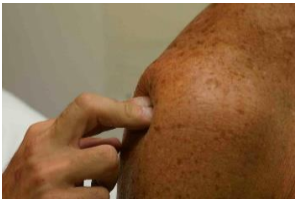
Perform subacromial palpation
You: find acromion (by following spine of scapula)
palpate
ask pain?
Positive test: inflammation of tendon/bursa
Pain provocation test
Perform the Neer impingement sign
You: one hand on scapula, other on forearm
internally rotate forearm (thumb down)
flex shoulder
position hand over head
ask pain?
Positive test: Rotator cuff (subacromial impingement or tendinitis)
Pain provocation test
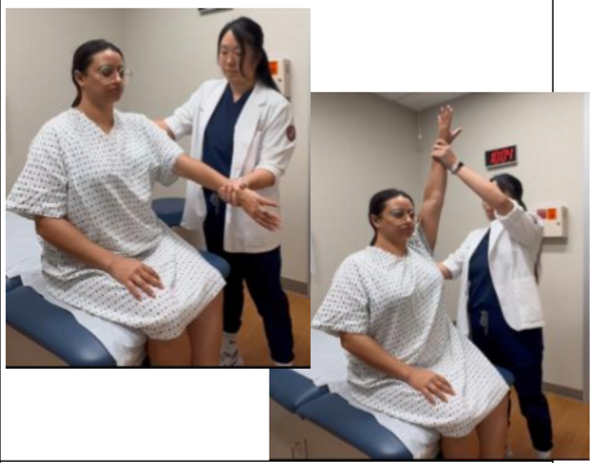
Perform the Hawkin’s impingement sign
You: elevate arm, and forward flex 90 degrees
rotate internally (thumb down)
ask pain?
Positive test: Rotator cuff (subacromial impingement or tendinitis)
Pain provocation test

Perform the empty can/Jobe’s test
You: elevate arm, and forward flex 90 degrees
internally rotate
ask to resist as you press down on arms
ask pain or weakness?
Positive test: supraspinatus muscle problem
Composite test

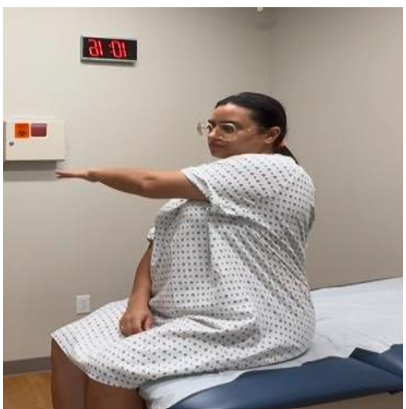
Perform the drop arm test
Patient: fully abduct arm at shoulder level
lower slowly
Positive test: Arm drops suddenly (supraspinatus muscle tear)

Perform the external rotation resistance test
Patient: abduct shoulders slightly
flex elbows at 90 degrees
lateral rotation (thumbs up)
You: place hands on outside forearm
ask push arms out
ask pain?
Positive test: Infraspinatus or teres minor problem
Composite test

Perform the external rotation lag test
Patient: flex arm 90 degrees
palm up
You: rotate into full external rotation
ask to hold it
Positive test: inability (supraspinatus, infraspinatus disorder)
Strength test

Perform the internal rotation lag test (Gerbers’ lift off test)
You: place dorsum of hand to their lower back (elbow at 90 degrees)
grip wrist and lift hand off back (internal rotation)
release hand and ask hold it
Positive test: inability (subscapularis problem)
strength test
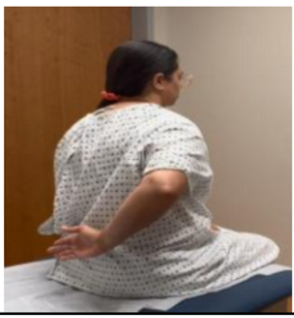
Perform the Apley scratch test
Patient: touch opposite scapula from above and below
You: ask pain?
Positive test: shoulder rotation problem (rotator cuff disorder or adhesive capsulitis)
Pain provocation test

Perform the crossover or crossed body adduction test
Patient: adduct arm across chest
You: ask pain?
Positive test: problem with acromioclavicular joint
Pain provocation test
Perform the shoulder apprehension test or anterior apprehension test
Patient: supine
You: abduct arm to 90 degrees
flex elbow to 90 degrees
one hand to support elbow, and the other with wrist
slowly externally rotate humerus
any reluctance?
Positive test: problem with anterior shoulder instability
Apprehension test

Perform the thumb movement (Finkelstein) test
Patient: grasp thumb against palm
adduct wrist
You: ask pain?
Positive test: de Quervain tenosynovitis
Pain provocation test

Perform the carpal tunnel tests
Thumb abduction: pt raise thumb up as you press down
Positive test = median nerve (thenar) weakness
Tinel sign: hold patient’s hand and tap firmly over median nerve
Positive test = aching, tingling, numbness (median)
Phalen sign: hold both wrists and elbows in flexion for 60 sec
Positive test = pain, numbness, or tingling (median)
Perform sensation test on patient
Touch patient’s chest wall to let pt know how it feels = baseline
Patient’s eyes closed
Lightly touch extremities and trunk (and immediately compare opposite side)
Ask if sensation felt?
If sensation feels like baseline?
Bilateral sensation the same?
For any abnormalities, perform a focused exam for those
Test all/multiple dermatomes
What are you assessing in the muscle groups of upper and lower extremities?
Bulk (size, contour)
atrophy, hypertrophy, asymmetry, fasciculations/fibrillations
Tone (resistance)
patient relaxes
hold extremity and move through ROM
check resistance (normal, spasticity, rigidity, flaccid)
Muscle strength
0: no contraction
1: slight
2: complete w/o gravity
3: complete against gravity
4: (3 but with some resistance)
5: (4 but with full resistance)
Perform the deep tendon reflexes
Check biceps (C5/6), brachioradialis (C5/6), triceps, (C6/7), patellar (L2-4), ankle (S1)
Grading
4+: hyperactive
3+: slightly hyper-reflexive
2+: normal
1+: lower
0: none