Week 2 - Oil and Gas
 Call Kai
 Learn
Learn Practice Test
 Spaced Repetition
 Match
Match Flashcards
 Knowt Play
1/251

There's no tags or description
Looks like no tags are added yet.
Name | Mastery | Learn | Test | Matching | Spaced | Call with Kai | Chat |
|---|
No analytics yet
Send a link to your students to track their progress
252 Terms
In the United States, individuals can privately own the minerals beneath their land rather than having all mineral resources owned by
the government
One major consequence of private mineral ownership is:
· fractionalization.
Fractionalization occurs when ownership of the mineral estate becomes
divided into increasingly smaller shares over time. Ex: · For example, one person might originally own 100% of the minerals.
· When that person dies, the mineral interest might pass to several children.
· Those children may later divide their interests among their own children.
· Over several generations, the original mineral estate can become divided into many extremely small fractional interests.
· The professor said that these tiny undivided interests are very common in mineral estates.
· They are less common with surface estates.
Undivided Interests and Co-Tenants
The professor gave an example where everyone in the class, including him, owns Blackacre together.
Suppose there are 45 owners and each person owns:
1/45 undivided interest in Blackacre.
An “undivided” interest means that each person owns a fractional interest in the entire tract rather than owning one particular physical piece of it.
So nobody owns a specific 1/45 slice of Blackacre.
Instead, all 45 people co-own the whole tract.
Because they are co-tenants, all of them generally have
an equal right to enter and use Blackacre.
Suppose one of the 45 co-tenants decides to develop the property.
That person may have the right to do so, but that person would generally be subject to an accounting to the other co-tenants.
An accounting means that the developing co-tenant may have to
account to the other owners for their respective shares of the benefits from the property.
So if one co-owner develops the minerals and makes money, that owner generally cannot simply
keep all of the proceeds while ignoring the other co-owners.
The professor briefly reviewed Property terminology and asked whether the 45 owners could be joint tenants. Are they?
Yes because each person own and equal share. The main Oil & Gas point, however, is the existence of many co-owners with fractional interests.
Before an oil and gas company leases a tract, it needs to determine who actually owns the minerals.
Because mineral ownership may have been divided among many people over many generations, figuring that out can be difficult and expensive.
The professor said an oil company generally wants to get all, or as many as possible, of the mineral owners under lease.
To do that, the company first has to identify those owners.
This creates an entire specialized area of legal practice involving:
title work
What is a title opinion?
A title opinion tells the oil company who owns the relevant mineral interests. The lawyer reviews the chain of title and determines who owns what percentage of the minerals.
Another complication is the existence of: unrecorded instruments. (X)
(X)
An instrument is a legal document affecting property rights, such as a
deed
Normally, when someone buys real property, the deed is recorded in the public property records.
But in the mineral context, instruments sometimes are not recorded.
That creates a problem because someone searching the public records may have difficulty discovering the true ownership history.
The professor joked that Property students often wonder:
“Who would ever fail to record a deed?”
His answer was that it happens frequently in mineral ownership. (X)
(X)
Another title problem involves: blanket instruments or blanket conveyances.
A blanket conveyance transfers all of a person’s property within a specified geographic area without individually describing every tract.
Example:
“I convey to you all real property I own in Bastrop County, Texas.”
That can be legally effective even though the document does not individually identify Blackacre, Whiteacre, or every other tract.
The conveyance simply transfers everything the grantor owns within that county.
Texas generally uses a:
grantor-grantee index.
That means property records are indexed according to:
grantor, the person transferring property
grantee, the person receiving property
Texas does not generally use a comprehensive tract index where every instrument is automatically organized according to the specific piece of property affected.
That becomes a problem with blanket conveyances.
If a deed says:
“I convey everything I own in Bastrop County,”
the deed might never specifically mention Blackacre.
A lawyer researching Blackacre therefore may not immediately discover that the blanket conveyance affected it.
You may need to know which people to search for in the grantor-grantee index.
That can make title work much more difficult.
Oil companies may need title opinions quickly because they want to lease and develop property. His point was that title work can take significant time, especially when ownership is complicated.
There can therefore be tension between:
the oil company’s desire to move quickly
the lawyer’s need to thoroughly investigate title (X)
(X)
Private Mineral Ownership Creates Leasing Problems
Once the oil company identifies the mineral owners, it still has to get those owners to sign leases.
This creates another major logistical problem:
difficult leasing logistics.
If the mineral estate has been fractionalized among many people, the company may need to locate and negotiate with a large number of individual owners.
Landmen
Oil and gas companies often use:
landmen.
Landmen locate mineral owners and negotiate oil and gas leases with them.
The professor said successful landmen need to be:
resourceful
charismatic
good at talking with people
They may have to find people scattered across different locations and persuade them to sign leases.
The professor joked that a Texas landman may need to be able to talk about things like:
bird hunting
college football
The broader point is that leasing involves a significant human and negotiation component. (X)
(X)
Getting Valid Signatures
The oil company also needs to make sure that the correct people sign the lease.
This can become especially important when the mineral interest may be community property.
Suppose a married person says:
“These minerals are my separate property. My spouse doesn’t own any part of them.”
The professor’s practical advice was:
Get both spouses to sign anyway.
Why?
Because people may incorrectly believe property is separate property when legally it is actually community property.
Getting both signatures can reduce the risk of a later title dispute. (x)
(X)
Negotiating Lease Terms
Even after the mineral owners have been located, the parties still have to negotiate the lease terms.
Different mineral owners may demand different terms.
The professor noted that this can become especially competitive among family members.
For example, siblings who each own part of the same mineral estate may try to negotiate a better deal than one another.
One sibling may want to say:
“I got a better royalty or bonus than you did.”
So leasing a fractionalized mineral estate can become a complicated negotiation process. This is about the:
Oil and Gas Lease
The Problem of Unleased Interests
A major problem occurs when the oil company cannot get every mineral owner to sign a lease.
Suppose everyone in the class owns a fractional mineral interest in one tract.
The oil company successfully leases everyone’s interest except one owner.
That final owner has disappeared on a six-month trip to Myanmar and cannot be located.
The oil company may not want to wait six months
an unleased mineral owner
If the oil company holds leases from the other mineral owners but one mineral owner remains unleased, the oil company and that unleased owner may effectively be
co-tenants with respect to mineral development
This matters because the unleased owner retains significant rights.
If the well succeeds, the unleased owner can potentially demand an accounting from the oil company.
The unleased owner may also have the right to participate in development.
The professor said that the unleased owner could potentially go out and drill their own well.
That means even one missing or holdout owner can create significant complications for the oil company. (x)
(x)
Once a mineral owner signs an oil and gas lease, the owner generally gives the lessee the
development eights associated with that interest
The mineral owner then primarily waits to receive the economic benefits reserved under the lease, such as royalty.
So from the oil company’s perspective, leasing the mineral owner greatly simplifies the relationship.
The professor essentially said:
If you are under lease, you are largely “out of the picture” operationally.
The oil company does not need to deal with you as a competing developer.
Instead, it owes you whatever benefits the lease provides.
That is why oil companies generally want to obtain leases from as many mineral owners as possible. (X)
(x)
A: holdout is a
mineral owner who refuses or fails to sign the lease while the other mineral owners have agreed.
Holdouts can create significant problems because the oil company cannot completely
consolidate the development rights.
Similarly:
unleased interests
can complicate drilling and production. A holdout is a type of unleased interest.
So:
unleased interest = any mineral interest that has not been leased to the oil company
holdout = an unleased mineral owner who is specifically refusing to sign or is holding out for better terms
Severing Minerals From the Surface Creates Conflict
Private mineral ownership also means that the mineral estate may be owned separately from the surface estate.
This can create conflict because:
the surface owner physically possesses and uses the land
the mineral owner owns the minerals beneath it
The mineral owner generally has the right to reasonably use the surface to develop the minerals.
If the mineral owner leases those rights to an oil company, the oil company generally acquires that surface-use right for purposes of mineral development. (x)
(x)
Professor’s Surface-Owner Hypothetical
Suppose the oil company has valid mineral leases giving it the legal right to enter the property and drill.
But the surface owner is standing at the entrance with a shotgun and refuses to let the oil company personnel onto the property.
Legally, the oil company may have the right to enter.
The mineral owners gave the company permission through their leases, and the mineral estate carries the common-law right to reasonably use the surface to develop the minerals.
But there is an obvious difference between:
having the legal right to enter
and:
actually driving onto the property while someone is pointing a gun at you.
The professor joked that company personnel generally choose not to test that distinction. (X)
(x)
Instead, the workers may sit on the county road and wait for law enforcement to resolve the situation.
Meanwhile, those workers may continue charging the oil company a:
day rate
A day rate is the amount they charge for the day even though they may not actually be able to perform their work because access is blocked.
This means a surface-access dispute can create:
delay
additional expenses
negotiation
possible law-enforcement involvement
The professor emphasized that the sheriff may also have practical political concerns because the sheriff is an elected official.
So even when the legal rule appears clear, enforcing that right in practice may take time. (X)
(x)
Why Government-Owned Minerals Can Be Different
The professor ended by contrasting this with countries where the government owns the minerals.
If the government owns the mineral resource, it may face fewer problems locating dozens of private mineral owners, obtaining hundreds of signatures, or negotiating with fractional owners.
The professor jokingly said governments also have “this thing called the army.”
His broader point was that private mineral ownership creates distinctive legal and practical complications in the United States. (x)
(x)
Why Government-Owned Minerals Can Be Different
The professor ended by contrasting this with countries where the government owns the minerals.
If the government owns the mineral resource, it may face fewer problems locating dozens of private mineral owners, obtaining hundreds of signatures, or negotiating with fractional owners.
The professor jokingly said governments also have “this thing called the army.”
His broader point was that private mineral ownership creates distinctive legal and practical complications in the United States. (x)
(x)
U.S. Public Ownership of Natural Resources
The federal government owns a significant amount of land and mineral rights in the United States.
The professor said that the federal government owns:
about 30% of the land area of the 50 states
oil and gas rights beneath about 37 million acres of privately owned surface land
So sometimes the surface can be privately owned while the federal government owns
the mineral rights in the United States
Offshore Mineral Ownership
The federal government also owns mineral rights beneath offshore waters on the Outer Continental Shelf.
The professor described the Outer Continental Shelf, or OCS, as the offshore area extending generally from about 3 miles offshore to about 200 nautical miles offshore.
Generally:
from the shoreline/low-tide line to about 3 miles offshore = state ownership
beyond that, generally out to about 200 nautical miles = federal ownership (x)
(X)
Texas is an important exception.
Texas owns offshore minerals out to approximately three leagues, which the professor described as about 10 miles offshore.
This gives Texas a substantial strip of state-owned offshore mineral rights extending along the Gulf Coast.
The professor noted that this generates significant revenue for the state and may also become important for underground CO₂ injection and climate-change mitigation. (x)
(X)
Federal Land Ownership
The professor then discussed a map showing federal land ownership.
Some western states have very large amounts of federally owned land.
He gave Nevada as an extreme example, stating that approximately 87% of Nevada is federally owned.
Texas, by comparison, has relatively little federally owned land. (X)
(X)
Some federal lands, including national forests, can have what the professor called:
checkboard ownership
That means ownership is mixed together in alternating tracts.
For example, within one general area there may be:
federal land
state land
privately owned fee land
So the ownership pattern may look like squares on a checkerboard rather than one continuous block of federal ownership. (X)
(X)
Different Categories of Federal Land
The professor identified several categories of government-controlled land, including:
military land
American Indian lands
national forests
national parks
Bureau of Land Management land
He noted that substantial oil and gas resources may exist beneath American Indian lands.
Bureau of Land Management
Much of the federal land that does not fall into a more specialized category is managed by the:
Bureau of Land Management, or BLM.
The BLM is part of the U.S. Department of the Interior.
The federal government can lease federally owned minerals to private parties for development.
So even though the federal government owns the minerals, private oil and gas companies may obtain leases allowing them to develop those minerals. (X)
(X)
Different Categories of Federal Land
The professor identified several categories of government-controlled land, including:
military land
American Indian lands
national forests
national parks
Bureau of Land Management land
He noted that substantial oil and gas resources may exist beneath American Indian lands.
Bureau of Land Management
Much of the federal land that does not fall into a more specialized category is managed by the:
Bureau of Land Management, or BLM.
The BLM is part of the U.S. Department of the Interior.
The federal government can lease federally owned minerals to private parties for development.
So even though the federal government owns the minerals, private oil and gas companies may obtain leases allowing them to develop those minerals. (X)
(X)
When the government originally transfers land into private ownership, the document transferring that land is called a:
patent
The professor described a patent as essentially:
the deed from the government
What is the Greatest-Estate Theory?
The basic idea is:
If a deed conveys property without reserving something, the conveyance is generally interpreted to transfer the greatest estate the language permits.
So if the government conveyed the land without reserving the minerals, the minerals generally went with the conveyance.
“If you don’t reserve it, out it goes.”
Once the property has been validly conveyed, the government cannot simply
take it back because it later regrets the conveyance. There may be exceptions involving things like:
fraud
forgery
lack of capacity
But ordinarily, once the property is transferred, the transfer stands.
Now we will talk about land descriptions (X)
(X)
Two important systems discussed were:
metes and bounds
township and range
Texas uses a somewhat hybrid system because of its unusual historical development. (X)
(X)
A metes-and-bounds description identifies property by describing its
boundaries
The professor said this system is especially common in:
the original 13 states
states that developed directly out of those original states 9X)
(X)
A metes-and-bounds description generally begins at a specific starting point and then describes the boundary of the property
segment by segment until it returns to the starting point.
Example:
Start at Point A.
Then travel:
100 feet northwest
then another specified distance in another direction
then another direction
eventually return to Point A
Together, those instructions trace the
perimeter of the property
Each individual segment in a metes-and-bounds description is called a:
call
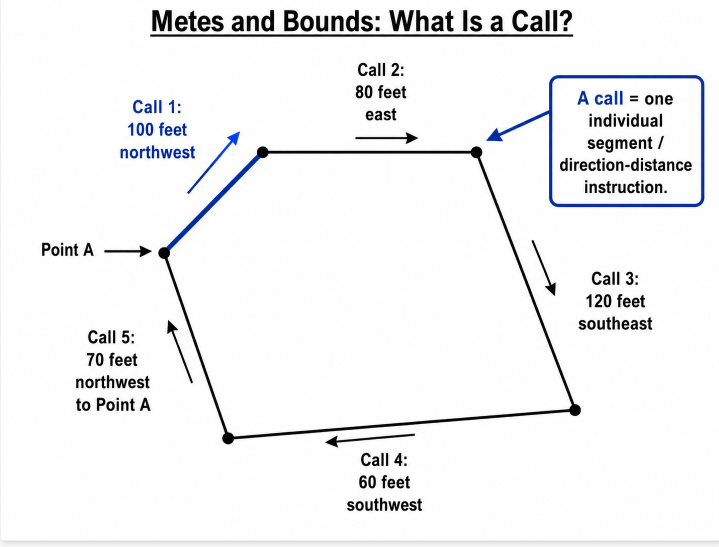
A call does not necessarily have to be a straight line.
It might:
follow a creek
follow a road
form an arc
use a specified direction and distance
Texas Property Descriptions are Unusual, The professor described Texas as generally using metes-and-bounds concepts but also relying heavily on
localized surveys
So Texas property descriptions may function as a hybrid between:
metes and bounds
survey-based descriptions
The professor then introduced another major property-description system:
township and range
The township-and-range system is another way of legally describing land.
Unlike metes and bounds, which describes land by tracing its boundaries using directions and distances, the township-and-range system divides land into an organized survey grid.
The professor described the system as beginning with a central reference point, somewhat like the Greenwich meridian concept. (X)
(X)
Each survey area has:
an initial point
a principal meridian
a baseline
The principal meridian runs
North to South
The baseline runs
east to west
Oil and gas companies need very precise property boundaries because the location of mineral ownership and wells can have major
legal consequences
Distinction between metes-and-bounds descriptions and section-based descriptions is something to know. - Powerpoint - tbd
tbd
A property instrument must contain a proper legal description of the land.
If the property description is legally insufficient, the instrument can violate the Statute of Frauds.
The professor said that if the description fails, the instrument is void.
Thus, the township-and-range system provides one way of creating a
legally sufficient property description
A particular township is identified according to how far north or south it is from the baseline and how far east or west it is from the principal meridian.
For example:
Township 2 South, Range 3 West
means the tract is:
two township rows south of the baseline
three range columns west of the principal meridian (X)
(x)
Once you identify the proper township and range, the next step is identifying a section.
Each township is divided into:
36 sections
The sections are numbered:
1-36
Section Numbers “Snake”
This is specifically important for the exam.
The numbering begins in the northeast corner.
The first row runs across:
1 through 6
Then the numbering drops to the second row and reverses direction.
Instead of beginning again from the same side, it “snakes” back across the grid.
So the numbering moves back and forth from row to row.
The professor emphasized:
Do not assume the numbering works like a typewriter where every new row begins on the same side.
It snakes.
If you incorrectly place Section 7 because you forgot the snaking pattern, you may get the question wrong.
The professor joked that he usually catches one or two students with this exam question. (x)
(X)
One full section: _____ acres
640
Zooming Further Into a Section
The professor continued his airplane analogy.
First, you identify the township and range.
Then you “fly lower” and identify the particular section.
Example:
Township 2 South, Range 3 West
Then:
Section 14
Now you can divide Section 14 into even smaller pieces. (X)
(X)
Quarter Sections
Remember:
1 section = 640 acres
If you divide the section into four equal quarters, each quarter contains:
160 acres
For example:
NE 1/4 of Section 14
means the northeast quarter of Section 14.
Because:
640 ÷ 4 = 160
the NE 1/4 contains:
160 acres.
(x)
Half Section
Half of a section contains:
320 acres
Because:
640 ÷ 2 = 320
Forty-Acre Tracts
A 160-acre quarter section can itself be divided into four equal parts.
Each of those smaller pieces contains:
40 acres
So:
640-acre section
→ four 160-acre quarter sections
→ each quarter can be divided into four 40-acre tracts
The professor said 40 acres is one of the basic building blocks that repeatedly appears in American land descriptions. (x)
(x)
Important Numbers to Know
For the exam and oil and gas practice, know:
640 acres = 1)
320 acres = 2)
160 acres = 3)
40 acres = 4)
The professor said that numbers like 640, 320, 160, and 40 come up repeatedly in oil and gas.
1) one full section
2) one-half section
3) one-quarter section
4) one-quarter of a quarter section
Texas and the 40-Acre Concept
Texas has its own modified survey system at the state level.
However, the professor noted that Texas oil and gas practice still frequently uses concepts involving:
640-acre blocks
40-acre tracts
So even though Texas does not simply use the classic federal township-and-range system everywhere, these acreage concepts still appear frequently. (X)
(X)
Big Picture
The easiest way to understand the township-and-range system is to follow the professor’s airplane analogy.
Start very high above the land and gradually zoom in:
Township and Range
then
Section
then
Quarter Section
then
40-Acre Tract
Example:
Township 2 South, Range 3 West
Section 14
NE 1/4
That description tells you exactly where within the survey grid the property is located.
(X)
(x)
Describing Smaller Tracts Within a Section
When using the township-and-range system, the professor emphasized that you describe the property by starting with the smallest subdivision and then working outward.
For example, suppose the tract is the north half of the southwest quarter of Section 14.
The legal description would be:
“North half of the southwest quarter of Section 14, Township 2 South, Range 3 West.”
In abbreviated form:
N 1/2 of SW 1/4 of Section 14, T2S, R3W
That is a legally sufficient description of that tract.
Start Small and Work Outward
The professor repeatedly emphasized:
Start small.
So if the tract is a smaller piece inside a larger piece, identify the smallest piece first and then move outward.
Example:
“Southeast quarter of the northwest quarter of Section 14, Township 2 South, Range 3 West.”
You do not start with the township and work inward.
You start with the smallest tract and then identify the larger units containing it. (X)
(X)
Acreage Calculations Within a Section
Remember:
One section = 640 acres.
Therefore:
1/2 section = 320 acres
1/4 section = 160 acres
1/2 of a quarter = 80 acres
1/4 of a quarter = 40 acres
So:
North half of the southwest quarter
means:
1/2 × 1/4 × 640 acres = 80 acres.
The professor said these numbers will become familiar because they appear frequently in oil and gas property descriptions. (X)
(x)
Texas History and Land Grants
The professor then shifted to Texas history and how land ownership patterns developed.
Historically, Texas was larger than its current boundaries.
When Texas entered the United States, portions of its former territory were separated from Texas.
The broader point was how governments encouraged settlement of western land.
Using Land to Encourage Western Settlement
Governments often had large amounts of land but limited money.
To encourage settlement and infrastructure development, governments could use land itself as payment.
One major example involved railroads.
The government might tell a railroad company:
“If you build the railroad, we will give you land on either side of the completed railroad.”
Instead of paying the railroad entirely in cash, the government compensated the railroad with property.
Railroad Land Grants
The result was that railroad companies acquired long strips of land running alongside their rail lines.
In Texas, these railroad surveys became an important part of the state’s land-description and ownership system.
The professor described them as something like Texas’s own version of the township-and-range system, although based heavily on railroad surveys. (X)
(X)
Railroads Often Received the Minerals Too
An important Oil & Gas point is that the original land patents to the railroads often did not reserve the oil and gas.
That meant the railroad companies received:
the land
the mineral estate beneath the land
As railroads crossed West Texas, they therefore acquired large amounts of land that later turned out to contain extremely valuable oil and gas resources. (x)
(x)
Why Texas Has a “Railroad Commission”
Texas’s main oil and gas regulatory agency is called the:
Railroad Commission of Texas.
Despite its name, the Railroad Commission today regulates oil and gas and does not primarily regulate railroads.
The professor explained that the name is connected to Texas’s historical relationship between railroads, land, and natural-resource development.
Other major producing states have agencies with different names.
For example:
North Dakota = Industrial Commission
Oklahoma = Corporation Commission
Texas is unusual because its oil and gas regulator is still called the Railroad Commission.
Why the Name Has Not Been Changed
The professor said there have been attempts to change the name of the Railroad Commission.
But changing the agency’s name requires going through Texas’s political and administrative process, including review involving the Sunset Commission.
Because the Texas Legislature meets on a limited schedule, proposals can simply run out of time.
The result is that efforts to rename the agency have repeatedly failed, so the name “Railroad Commission” remains. (X)
(X)
Railroad Companies and Oil & Gas Subsidiaries
Railroad companies often ended up owning valuable mineral acreage.
Some large railroad companies eventually had subsidiaries specifically dedicated to oil and gas development.
The professor mentioned examples such as:
Burlington Northern Natural Resources
Union Pacific Natural Resources
Some of these natural-resource subsidiaries were later spun off or acquired by other companies.
Del Monte Mining
The professor then introduced the first case in the next part of the chapter:
Del Monte Mining.
It is a United States Supreme Court case from 1898.
The professor said Supreme Court cases are relatively unusual in this course because most oil and gas law develops at the state level.
Basic Issue in Del Monte Mining
The professor gave a simplified hypothetical.
Suppose:
you own Navy Blueacre
another person owns Whiteacre
Can you dig underground from Navy Blueacre and remove ore located beneath Whiteacre?
No.
Doing so would be a trespass.
The fact that your digging begins on your own property does not give you the right to cross the underground boundary and take minerals beneath your neighbor’s land. (X)
(X)
Ore
Ore is a solid material containing valuable minerals that can be extracted.
The professor used ore because Del Monte Mining involved hard-rock mining rather than oil or gas.
The property principle, however, is important for understanding subsurface ownership. (X)
(X)
Ad Coelum Doctrine
Del Monte Mining also introduces the:
ad coelum doctrine.
The professor described this as the:
“heaven-and-hell” theory of property ownership.
The traditional idea is that when you own land, your ownership extends:
upward into the airspace above the tract
downward into the earth beneath the tract
Conceptually, you own a vertical column associated with your property.
Ownership Extends Underground
Under the traditional ad coelum concept, the property line does not stop at the surface.
It extends downward.
So if Alice owns Whiteacre, the rock and minerals beneath Whiteacre are within Alice’s property column, subject to the applicable rules of mineral ownership.
That is why a person cannot simply tunnel horizontally underneath the property boundary and take another person’s solid minerals. (X)
(X)
Practical Limits of the Doctrine
The professor emphasized that the ad coelum doctrine is not applied literally without limits.
Humans cannot realistically use every inch of space from the center of the Earth to infinite airspace.
The law has therefore developed
exceptions
Even within states generally associated with survey-based systems, there can be areas that continue using
metes and bound descriptions
Do not assume that an entire state uses only
one type of legal description. There can be enclaves of older metes-and-bounds descriptions within a state that otherwise uses township and range.
The professor then used airspace to show that ad coelum is not absolute.
Suppose you own a house.
Traditional ad coelum language might suggest that you own the airspace indefinitely above your land.
But a commercial jet flies thousands of feet above your house.
Can you sue the airline for trespass every time a plane crosses the airspace above your property?
No.
Modern law recognizes that aircraft must be able to travel through navigable airspace.
Practical Limitation on Airspace Ownership
The professor described this as essentially a judicially created accommodation or easement for modern air travel.
At sufficiently high altitudes, aircraft may pass over private land without committing actionable trespass.
However, if an aircraft comes so low that it substantially interferes with the owner’s use and enjoyment of the property, the situation may be different.
The professor used low-flying helicopters and paparazzi as an example.
If helicopters fly extremely low and create physical interference with the property, there may be a viable claim. (x)
(x)
CO₂ Sequestration and Deep Subsurface Trespass
The professor compared this issue to airplanes flying high above private property.
The legal question becomes whether the owner realistically had any use for or economic expectation concerning that extremely deep subsurface space.
If CO₂ is stored around 15,000 feet underground, the surface owner may never have had any practical intention or ability to use that particular subsurface space.
The professor suggested that courts may therefore recognize some kind of limitation or exception to traditional trespass principles in that context. (X)
(X)
Frontier of Oil & Gas Law
The professor described deep subsurface CO₂ storage as a current frontier of property law.
The basic tension is:
Traditional ad coelum doctrine:
you own the subsurface beneath your land.
Modern practical reality:
society may need to use extremely deep underground formations for things like carbon sequestration.
Courts and legislatures therefore have to determine how far traditional property rights extend when the owner has little or no realistic use for the extremely deep subsurface.
The professor characterized this as an area of law that is still developing. (X)
(X)
Del Monte-Type Question: Crossing Underground Boundaries
The professor returned to the same basic problem raised by Del Monte Mining.
Suppose:
Sam owns Redacre.
Alice owns adjacent Blackacre.
Sam is mining a seam of gold-bearing ore beneath Redacre.
The underground property boundary extends downward and separates the column of rock beneath Redacre from the column of rock beneath Blackacre.
If Sam physically crosses that underground boundary and begins mining gold beneath Blackacre, he is trespassing.
The reason is straightforward:
Gold-bearing ore is solid. What is it?
It does not naturally move from Alice’s property onto Sam’s property.
So Sam cannot physically cross the boundary and take it.
Solid Minerals vs. Oil and Gas
This distinction is important.
Solid minerals, like gold ore, stay where they are.
Oil and natural gas can move underground.
The professor asked:
What if Sam does not physically drill across the property boundary, but oil or gas migrates from Alice’s side into Sam’s well?
That is a very different question.
If Sam’s well stays entirely on Sam’s property and the oil or gas naturally migrates toward his well, the
rule of capture may allow Sam to produce it.
Horizontal Wells and Trespass
Suppose Sam drills a horizontal well.
If the actual wellbore crosses the underground property line into Alice’s property, that
trespass
The professor emphasized that the physical borehole itself cannot cross the boundary without legal authority.
So:
wellbore stays on your property =
wellbore physically crosses into neighbor’s property =
1) potentially okay 2) trespass
The professor then raised a harder modern question.
Suppose the wellbore itself stays entirely on Sam’s property.
But Sam hydraulically fractures the rock, and some of those fractures extend across the underground property boundary into Alice’s tract.
Is that trespass?
The professor said this is an area the law is still wrestling with.
So the distinction is:
wellbore crosses boundary =
fractures cross boundary while the wellbore stays put =
clear trespass; much harder legal question
A student asked about the “bottom” of a slanted or horizontal well.
For a vertical well, the bottom is normally the deepest point.
For a horizontal well, the professor said the endpoint is typically called the:
toe. That endpoint may not necessarily be the deepest point of the entire well, but it is the end of the drilled hole.
The professor also referred to:
TD = total depth.
Suppose you drill a lawful well entirely on your own property.
The well does not cross your neighbor’s property line.
But because oil and gas can migrate through the reservoir, some oil or gas that was physically beneath your neighbor’s tract flows toward your well and is produced.
Under the rule of capture, that production is
generally allowed
Your neighbor cannot simply sue you and say:
“You took my oil.”
Why?
Because the oil or gas was not yours in a legally captured sense until you actually reduced it to possession.