Somatic Symptom and Psychosexual disorders
0.0(0)
Studied by 1 person Call Kai
 Learn
Learn Practice Test
 Spaced Repetition
 Match
Match Flashcards
 Knowt Play
Card Sorting
1/53

Earn XP
Description and Tags
Last updated 11:49 PM on 11/2/22
Name | Mastery | Learn | Test | Matching | Spaced | Call with Kai | Chat |
|---|
No analytics yet
Send a link to your students to track their progress
54 Terms
1
New cards
Factors that may contribute to somatic symptom and related disorders
Genetic/ biological vulnerability
Early traumatic experience
Learned behaviors
Social/ cultural norms
Early traumatic experience
Learned behaviors
Social/ cultural norms
2
New cards
Somatic symptom disorder
One or more somatic sxs that are actually present and are distressing or result in significant disruption in daily life
Excessive thoughts, feelings, or behaviros related to sxs that are disproportionate and persistent thoughts about seriousness of ones sxs, persistently high level of anxiety about health or sxs, or excessive time/ energy devoted to those concerns
Excessive thoughts, feelings, or behaviros related to sxs that are disproportionate and persistent thoughts about seriousness of ones sxs, persistently high level of anxiety about health or sxs, or excessive time/ energy devoted to those concerns
3
New cards
Somatic symptom disorder is often occurs with...
concurrent medical illness
4
New cards
Associated features of somatic symptom disorder
Attribution of normal bodily snesations to physical illness
Worry about illness
Fear that physical activity may damage body
Checking body for abnormalities
Repeated seeking of medical help
Worry about illness
Fear that physical activity may damage body
Checking body for abnormalities
Repeated seeking of medical help
5
New cards
MC sxs in somatic symptom disorder in children are...
headache, fatigue, abdominal pain
6
New cards
Somatic sxs disorder is often missed in...
elderly
7
New cards
Illness anxiety disorder
Preoccupation with having or acquiring a serious illness
Somatic sxs not present, or if present they're mild
Preoccupation is clearly excessive or disproportionate
Performs excessive health-related behaviors or maladaptive avoidance
Present for at least 6 months
Somatic sxs not present, or if present they're mild
Preoccupation is clearly excessive or disproportionate
Performs excessive health-related behaviors or maladaptive avoidance
Present for at least 6 months
8
New cards
Specifiers for illness anxiety disorder
Care-seeking
Care-avoidant
Care-avoidant
9
New cards
Illness anxiety disorder patients typically have elevated rates of medical utilization but do not over-utilize....
mental healh services
10
New cards
Illness anxiety disorder risk and prognostic factors
Precipitated by major life stress or threat to one's health
History of child abuse
History of serious childhood illness
History of child abuse
History of serious childhood illness
11
New cards
Conversion disorder
-One or more sxs of altered voluntary or sensory function
Clinical findings provide evidence of incompatability between sxs and recognized neuro/ medical conditions (necessary for dx)
Sxs not better explained by another medical/ mental disorder
Sx or deficit causes clinically significant distress (patient not faking)
Clinical findings provide evidence of incompatability between sxs and recognized neuro/ medical conditions (necessary for dx)
Sxs not better explained by another medical/ mental disorder
Sx or deficit causes clinically significant distress (patient not faking)
12
New cards
To make the diagnosis of conversion disorder, what must be present?
Clinical findings that show clear evidence of incompatibility with neurologic disease
13
New cards
la belle indifference
a French term descriptive of the lack of concern for their (imagined) medical problem sometimes shown by people with conversion disorders
14
New cards
Risk and prognostic factors for conversion disorder
Temeramental: maladaptive personality traits
Environmental: History of childhood abuse/ neglect
Genetic/ physiological
Environmental: History of childhood abuse/ neglect
Genetic/ physiological
15
New cards
Psychological factors affecting other medical conditions
Something going on psychologically (anxiety, depression, etc) and symptoms from that disorder negatively affet an acutal medical condition
16
New cards
Factitious disorder (Imposed on self or another)
Falsification of physical or psychological s/sxs or induciton of injury/ disease, associated with identified deception
Deceptive behavior is evident even in abscence of obvious external rewards (your attention could be that reward- could be malingering)
Deceptive behavior is evident even in abscence of obvious external rewards (your attention could be that reward- could be malingering)
17
New cards
pseudocyesis
false pregnancy (a woman who believes she is pregnant - this may be a psychological condition or related to underlying pathology, such as a uterine tumor)
18
New cards
Treatment for somatic sx disorders
Treat comorbid psychiatric conditions
Therapy
Therapy
19
New cards
Delayed ejaculation
Either must be present at least 75% of partnered sexual activity
-Marked delay in ejaculation
-Marked infrequency or absence of ejaculation
Sxs are causing distress/ not better explained by relationship distress/ significant stressor
-Marked delay in ejaculation
-Marked infrequency or absence of ejaculation
Sxs are causing distress/ not better explained by relationship distress/ significant stressor
20
New cards
Delayed ejaculation treatment
What meds can help?
What meds can help?
Psychotherapy (Wellbutrin, amantadine, and buspirone can help)
21
New cards
Erectile disorder
At least one of the following must be experienced in 75% of sexual encounters
-Marked difficulty in obtaining an erection during sexual activity
-Marked difficulty in maintaining an erection until the completion of sexual activity
-Marked decrease in erectile rigidity
-Marked difficulty in obtaining an erection during sexual activity
-Marked difficulty in maintaining an erection until the completion of sexual activity
-Marked decrease in erectile rigidity
22
New cards
Risk and prognostic factors for erectile dysfunction
Anxiety disorders
Submissive personality
Age
Tobacco use
Sedentary lifestyle
Medical conditions
Submissive personality
Age
Tobacco use
Sedentary lifestyle
Medical conditions
23
New cards
Treatment of erectile disorders
Therapy
PDE5 inhibitors
PDE5 inhibitors
24
New cards
Diagnostic testing for erectile disorders
Nocturnal tumescence testing
Lipid panel
Serum glucose
Thyroid function
TST levels
Lipid panel
Serum glucose
Thyroid function
TST levels
25
New cards
Female orgasmic disorder
>75% of sexual encounters
-Marked delay in/ infrequency of/ absence of orgasm
-Markedly reduced intensity of orgasmic sensations
-Marked delay in/ infrequency of/ absence of orgasm
-Markedly reduced intensity of orgasmic sensations
26
New cards
Female orgasmic disorder treatment
What meds may help?
What meds may help?
Therapy
Wellbutrin and PDE5 inhibitors may help
Wellbutrin and PDE5 inhibitors may help
27
New cards
Female sexual interest/ arousal disorder
Lack of or significantly reduced sexual interest/ arousal
-Absent/reduced interst in sexual activity, sexual thoughts, reduced initiation of sexual activity, reduced genital/ non-genital sensations during sex
-Causes significant distress
-Absent/reduced interst in sexual activity, sexual thoughts, reduced initiation of sexual activity, reduced genital/ non-genital sensations during sex
-Causes significant distress
28
New cards
Female sexual interest/ arousal disorder treatment
Therapy
Addyi
Vyleesi
Addyi
Vyleesi
29
New cards
Genito-Pelvic Pain/ Penetration disorder
Persistent/ recurrent difficulty with one/ more of following:
-Vaginal penetration during intercourse/ penetration (tampon even)
-Marked vulvovaginal/ pelvic pain during intercourse/ penetration
-Marked fear/ anxiety from problems
-Marked tensing/ tightening of pelvic floor muscles during attempted penetration
-Vaginal penetration during intercourse/ penetration (tampon even)
-Marked vulvovaginal/ pelvic pain during intercourse/ penetration
-Marked fear/ anxiety from problems
-Marked tensing/ tightening of pelvic floor muscles during attempted penetration
30
New cards
Risk and prognostic factors for Genito-Pelvic Pain/ Penetration disorder
Sexual and/or physical abuse
Pain sometimes begins as vaginal infection but persists after infection resolves
Pain sometimes begins as vaginal infection but persists after infection resolves
31
New cards
Genito-Pelvic Pain/ Penetration disorder treatment
Therapy
Physiotherapy (pelvic floor therapy)
Anesthetics/ Botox (no indication)
Physiotherapy (pelvic floor therapy)
Anesthetics/ Botox (no indication)
32
New cards
Male hypoactive sexual desire disorder
Persistently/ recurrently deficient sexual/ erotic thoughts or fantasies AND deficient desires for sexual activity
-causes significant distress
-causes significant distress
33
New cards
Male hypoactive sexual desire disorder treatment
Therapy
34
New cards
Premature (early) ejaculation
Persistent/ recurrent pattern of ejaculation occuring during partnered sexual activity within approximately 1 minute following vaginal penetration and before the individual wishes
-Causes distress/ impairment
-Causes distress/ impairment
35
New cards
Premature ejaculation treatment
Therapy
Behavior techniques
Analgesics, antidepressants, PDE5 inhibitors
Behavior techniques
Analgesics, antidepressants, PDE5 inhibitors
36
New cards
Paraphilia
Any intense and persistent sexual interest other than sexual interest in genital stimulation or foreplay with phenotypically normal, physiologically mature, consenting partners
37
New cards
Voyeuristic disorder criteria
Recurrent and intense sexual arousal from observing an unsuspecting person who is naked/ term or engaging in sexual activity
-Can manifest by fantasy, urge, or behavior
-Individual has acted on these sexual urges with a non-consenting person or sexual urges cause clinically significant distress
Individual must be 18+
-Can manifest by fantasy, urge, or behavior
-Individual has acted on these sexual urges with a non-consenting person or sexual urges cause clinically significant distress
Individual must be 18+
38
New cards
Other specificed sexual dysfunction
Sxs present and causing distress but do not fully meet diagnostic criteria
MUST specify why presentation does not meed diagnostic criteria
MUST specify why presentation does not meed diagnostic criteria
39
New cards
Voyeuristic disorder in full remission years required
At least 5 years
40
New cards
Most common of potentially law-breaking sexual behaviors
Voyeuristic disorders
41
New cards
Risk and prognostic factors for voyeuristic disorder
Childhood sexual abuse
Substance misuse
Hypersexuality
More common in males
Substance misuse
Hypersexuality
More common in males
42
New cards
Exhibitionistic disorder
Recurrent/ intense sexual arousal from exposure of one's genitals to an unsuspecting person
Manifested by fantasies, urges, behaviors
Individual has acted on these sexual urges with a non-consenting person or sexual urges cause clinically significant distress
Manifested by fantasies, urges, behaviors
Individual has acted on these sexual urges with a non-consenting person or sexual urges cause clinically significant distress
43
New cards
Risk and prognostic factors for exhibitionistic disorder
Antisocial personality disorder
Alcohol use disorder
Pedophilia
Hx of childhood sexual and emotional abuse
Hypersexuality
Alcohol use disorder
Pedophilia
Hx of childhood sexual and emotional abuse
Hypersexuality
44
New cards
Frotteuristic disorder
Recurrent and intense sexual arousal from touching or rubbing against non-consenting person
Manifested by fantasies, urges, behaviors
Individual has either acted on these urges on non-consenting person or urges cause sig. distress
Manifested by fantasies, urges, behaviors
Individual has either acted on these urges on non-consenting person or urges cause sig. distress
45
New cards
Sexual masochism disorder
Recurrent/ intense sexual arousal from act of being humiliated, beaten, bound, or otherwise made to suffer
Manifested by fantasies, urges, or behaviors that cause clinically sig. distress
Manifested by fantasies, urges, or behaviors that cause clinically sig. distress
46
New cards
Sexual sadism disorder
Recurrent/ and intense sexual arousal from physical or psychological suffering of another person
Manifested by fantasies, urges, behaviors that cause sig. distress
Manifested by fantasies, urges, behaviors that cause sig. distress
47
New cards
Unique specifier with sexual masochism disorder
asphyxlophilia
48
New cards
Pedophilic disorder
How old must individual be/ distance from children's age?
How old must individual be/ distance from children's age?
Recurrent/ intense sexually arousing fantasies, urges, or behaviors involving sexual activity with prepubescent child/ children (generally 13 and younger)
Individual has either acted on these urges or urges cause sig. distress
Individual is at least 16 years of age and at least 5 years older than the child/ children
Individual has either acted on these urges or urges cause sig. distress
Individual is at least 16 years of age and at least 5 years older than the child/ children
49
New cards
Fettishistic disorder
Recurrent/ intense sexual arousal from either the use of nonliving objects or a highly specific focus on non-genital body parts
Fantasies, urges, or behaviros that cause sig. distress
Fantasies, urges, or behaviros that cause sig. distress
50
New cards
Transvestic disorder
Recurrent/ intesnse sexual arousal from cross-dressing
Fantasies, urges, or behavior that cause sig. distress impairment
Fantasies, urges, or behavior that cause sig. distress impairment
51
New cards
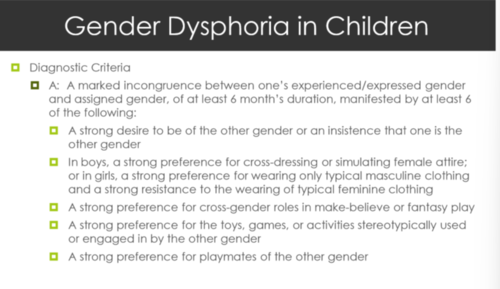
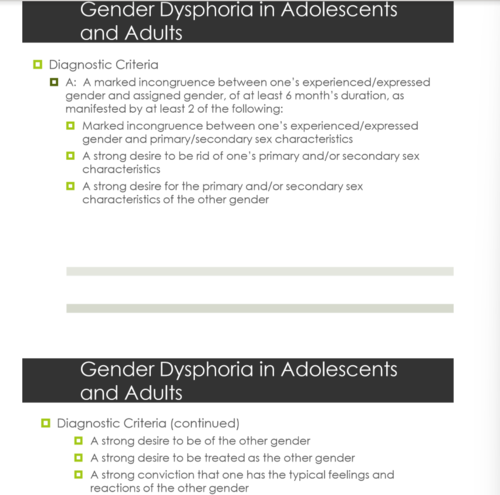
Gender dysphoria
Distress that may accompany the incongruence between one's experienced or expressed gender and one's assigned gender
52
New cards
Gender dysphoria in children diagnostic criteria
Plus...
-In boys, strong rejection of typically masculine toys/ activities
-Strong dislike of one's sexual anatomy
-Strong desire for the primary and/or secondary sex characteristics that amtch one's experienced gender
-Sx cause sig. distress
-In boys, strong rejection of typically masculine toys/ activities
-Strong dislike of one's sexual anatomy
-Strong desire for the primary and/or secondary sex characteristics that amtch one's experienced gender
-Sx cause sig. distress
53
New cards
Gender dysphoria in adolescents and adults diagnostic criteria
54
New cards
Treatment for paraphilic disorders and gender dysphoria
Therapy/ support groups