Unit 1 Practice Test
 AP Practice
 Call Kai
1/14

Earn XP
Description and Tags
Name | Mastery | Learn | Test | Matching | Spaced | Call with Kai | Chat |
|---|
No analytics yet
Send a link to your students to track their progress
15 Terms
Which one of the following situations is not possible? A) A body has an instantaneous velocity of zero and non-zero acceleration. B) A body travels with a positive velocity and a positive acceleration. C) A body travels with a positive velocity and a negative acceleration. D) A body travels with a constant velocity and a time-varying acceleration.
D) A body cannot have a constant velocity while simultaneously experiencing any acceleration, as acceleration indicates a change in velocity.
Starting from rest, a particle is accelerated at a constant rate of 5.0 m/s² . Which one of the following statements accurately describes the motion of this particle? A) The particle travels 5.0 m during each second. B) The particle has a constant speed of 5.0 m/s. C) The velocity of the particle increases by 5.0 m/s during each second. D) The acceleration of the particle increases by 5.0 m/s² during each second.
C) The velocity of the particle increases by 5.0 m/s during each second, as the particle is accelerated at a constant rate.
A fast llama walks 12 km north, then 16 km east. The journey takes him 2 hours. Determine the llama’s average velocity. A) 14 km/h B) 28 km/h C) 20 km/h D) 10 km/h
D) 10 km/h
4. An elevator is moving upward with a speed of 11 m/s. Three seconds later, the elevator is still moving upward, but its speed has been reduced to 5.0 m/s. What is the average acceleration of the elevator during the 3.0 s interval? A) 2.0 m/s² upward B) 2.0 m/s² downward C) 5.3 m/s² upward D) 5.3 m/s² downward
B) 2.0 m/s² downward
A tennis ball approaches a tennis racket at 32 m/s. The tennis ball rebounds in the opposite direction at 24 m/s. The ball is in contact with the racket for .1 s. What is the acceleration of the ball while it is in contact with the racket? A) 280 m/s² B) 80 m/s² C) 560 m/s² D) 154 m/s
C) 560 m/s²
A fighter jet lands on an aircraft carrier at a velocity of 𝑣. The jet requires a distance, D, to stop on the aircraft carrier. How long does it take the jet to stop after it lands? A) 𝐷/2𝑣 B) 𝐷²/𝑣 C) 𝐷/𝑣 D) 2𝐷/v
D) 2D/v
Johan just goes and throws his physics textbook in the air at speed v. Wow, what a rebel. He finds that the book reaches a maximum height of 𝐻. How high would the book go if he instead were able to throw the book upwards with a speed of 4v? A) 8H B) 4H C) H D) 16H
D) 16H
In order to train to fight Vegeta, Goku trains on King Kai’s planet, a planet with ten times Earth’s gravity; meaning the planet has an acceleration due to gravity of 10𝑔. Goku drops a dragon ball King Kai’s planet (which has 10 times gravity) and the dragon ball falls a height H in one second. How long would the same dragon ball fall in 1 second on Earth? A) H B) 10H C) H/100 D) H/10
D) H/10
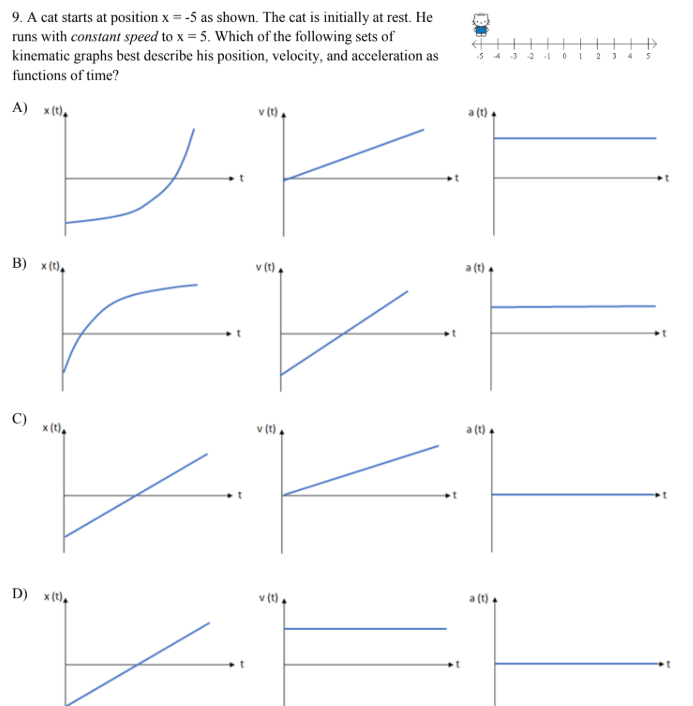
A cat starts at position x = -5 as shown. The cat is initially at rest. He runs with constant speed to x = 5. Which of the following sets of kinematic graphs best describe his position, velocity, and acceleration as functions of time?
D)
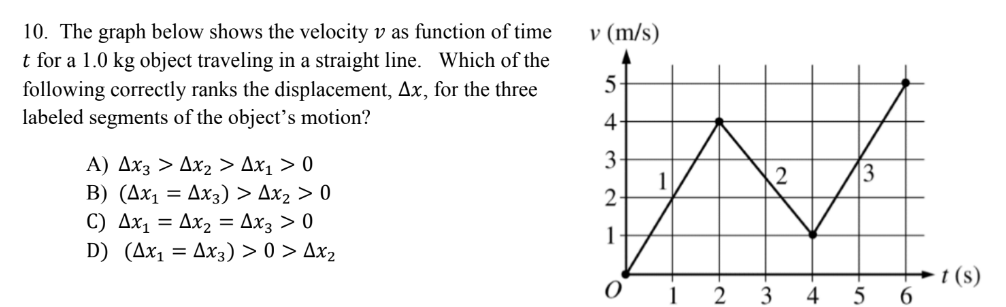
The graph below shows the velocity v as function of time
t for a 1.0 kg object traveling in a straight line. Which of the
following correctly ranks the displacement, ∆x, for the three
labeled segments of the object’s motion?
A)
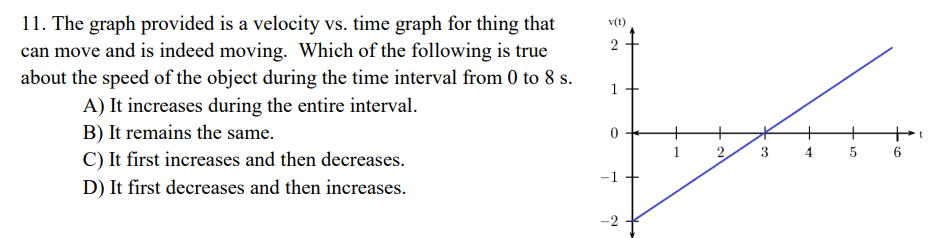
The graph provided is a velocity vs. time graph for thing that can move and is indeed moving. Which of the following is true about the speed of the object during the time interval from 0 to 8 s. A) It increases during the entire interval. B) It remains the same. C) It first increases and then decreases. D) It first decreases and then increases.
D)
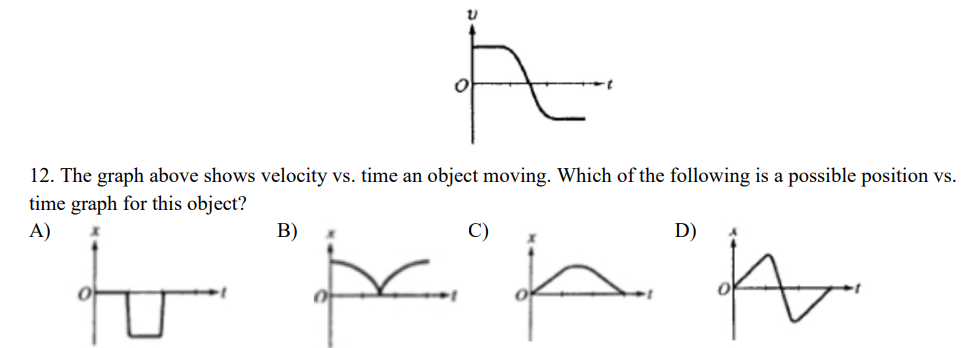
The graph above shows velocity vs. time an object moving. Which of the following is a possible position vs. time graph for this object?
C) starts with a constant positive slope (straight line up), curves smoothly to a peak (slope = 0when velocity is 0), and ends with a constant negative slope (straight line down).

Given the graph of the velocity vs. time of a penguin flying due south for the winter. At what point did the penguin stop its forward motion? A) A B) B C) C D) D
D)
In which of the following cases would an airplane have an eastward acceleration? A) The airplane travels eastward at constant speed. B) The airplane travels westward and slows down. C) The airplane travels westward and speeds up. D) The airplane travels eastward and slows down.
B)
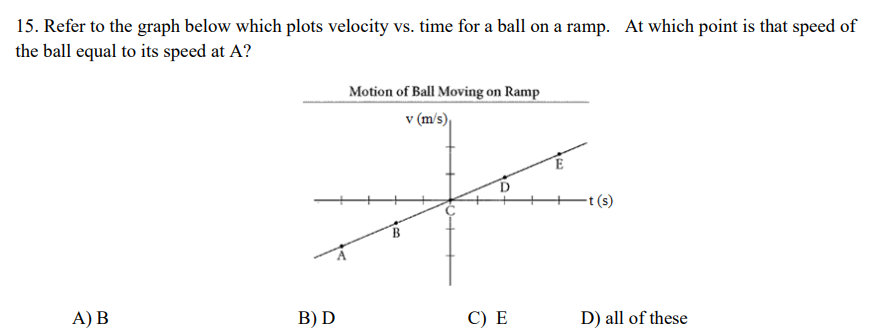
Refer to the graph below which plots velocity vs. time for a ball on a ramp. At which point is that speed of the ball equal to its speed at A? A) B B) D C) E D) all of these
C) E