bpsych exam 1
 Call Kai
 Learn
Learn Practice Test
 Spaced Repetition
 Match
Match Flashcards
 Knowt Play
1/63

There's no tags or description
Looks like no tags are added yet.
Name | Mastery | Learn | Test | Matching | Spaced | Call with Kai | Chat |
|---|
No analytics yet
Send a link to your students to track their progress
64 Terms
central nervous system
the body’s processing center which contains the brain and spinal cord
peripheral nervous system
the structure that connects the central nervous system to the rest of the body and contains nerves, ganglions and glia
somatic nervous system
part of the PNS that interacts with external environment by processing sensory information and controlling voluntary movement
autonomic nervous system
part of the PNS that regulates the body’s internal environment and controls involuntary bodily functions
blood brain barrier
a protective border of tightly packed endothelial cells that controls what moves between the CNS and the blood
what is an advantage and disadvantage of the blood brain barrier?
advantage: keeps out harmful immune cells (and other toxins) that could cause widespread cell death
disadvantage: keeps out nutrients and large/electrically charged molecules thus requiring channels and different transportation methods
neurons
cells that receive, conduct and transmit electrochemical signals to other cells

identify all the structures on the reduced cell structure
dendrites: receives information from other cells
soma: the cell body
nucleus: contains all genetic information
axon: the point of trigger for an action potential
axon hillock: where the action potential originates
pre-synaptic (axon) terminals: the point where the axon releases the action potential
nodes of ranvier: interruptions of the myelin sheath cot taking voltage gets ion channels that the action potential jumps over
myelin sheath: fatty lining of the axon that speeds up transmission
synapse: the gap between the pre-synaptic and post-synaptic terminals where electrochemical signals cross

identities all the structures of the enlarged neuron
cell membrane: structure that separates the inside of the cell from the external environment
nucleus: contains genetic information
mitochondrion: performs metabolic activity
endoplasmic reticulum: network of tubes that transports synthesized proteins
ribosomes: site of cell synthesis of protein molecules
what are the aspects of neuronal variability?
neurons vary across shape, size, function, cell body projection and dendritic branching
what is the difference between afferent and efferent neurons?
afferent neurons are neurons that carries sensory signals from the body to the CNS while efferent neurons carry motor commands away from the CNS
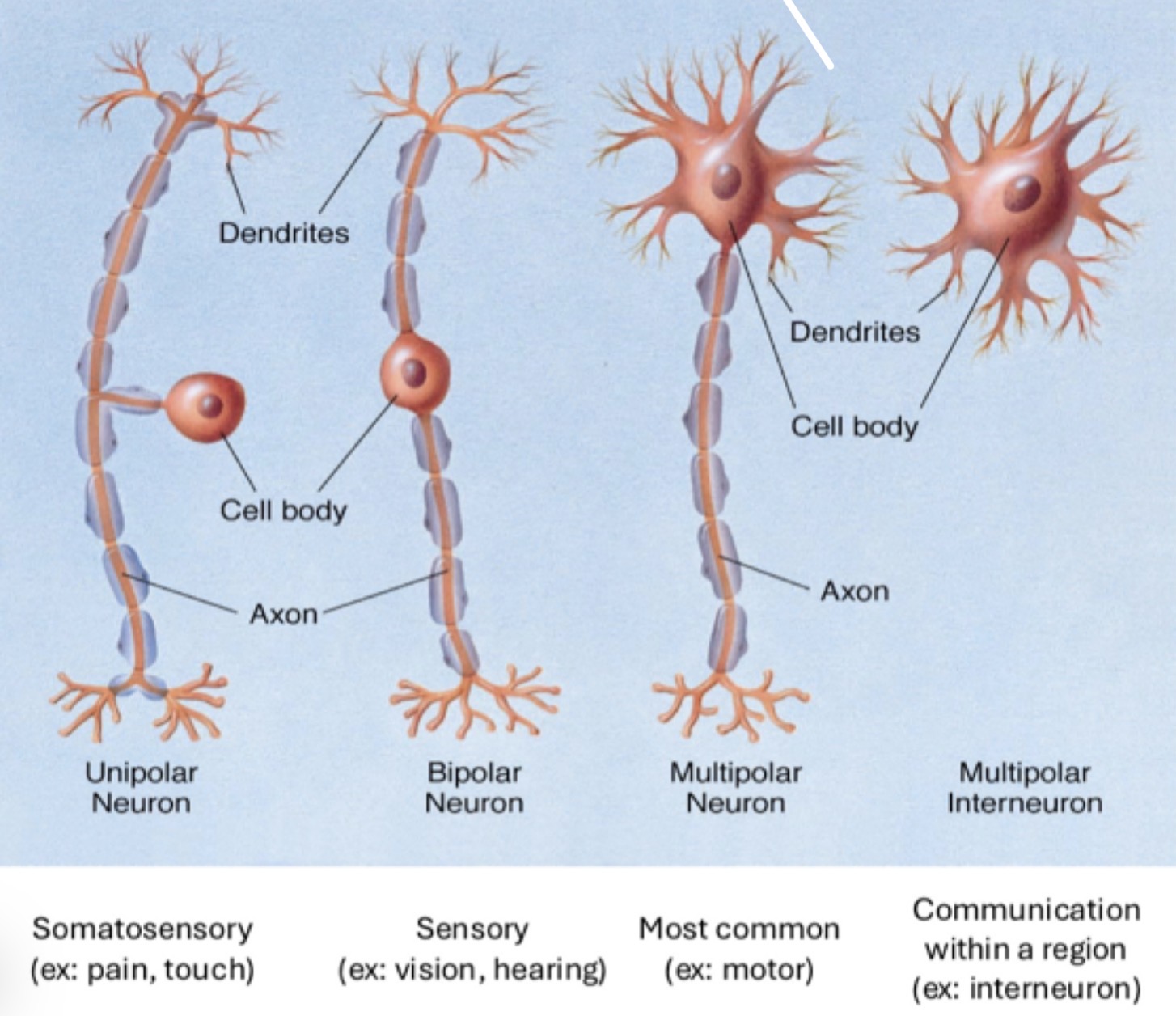
neural anatomy: unipolar neurons
neurons where the cell body are separate from the axon to allow quick relay of somatosensory signals to the CNS

neural anatomy: bipolar neuron
neurons where the cell body is in the middle of the axon to preserve information and prevents interference from other signals
sensory neuron
neurons that receive input information from the external environment and sends output information to the CNS

neural anatomy: multipolar neuron
neurons where the cell body is before the axon to allow information to be gathered simultaneously
motor neuron
receives input from the CNS and sends output information to the muscles
interneuron
specialized nerve cells that connect motor and sensory neurons that receive sensory messages and responds instantly without waiting for the brain’s command
glia
cells that provide a variety of support and a intense functions for the nervous system
oligodendrocytes
produces multiple myelin sheath segments in the CNS
schwann cells
produces one myelin sheath segment in the PNS and guides regrowth for attached axon
microglia
functions as part of the immune system by triggering inflammatory response, removing waste and proliferating in areas of brain damage
radial glia
guides neuronal growth of axons and dendrites during embryonic development
astrocytes
synchronizes activity of axon by wrapping around pre synaptic terminal and taking up chemicals released by axon
provides nourishment by dilating blood vessels
anchors neurons
digest cell debris
creates scar tissue
what function do microglia and astrocytes have together?
they prune ineffective synapses and adjust the effectiveness of others
what’s the difference between cations and anions?
cations have a positive charge and anions have a negative charge
voltage potential
a difference in electrical charge
resting membrane potential
the difference in charge between the inside and outside of the cell when neurons are at rest; typically -70 mv
what is the ionic basis for membrane potential?
sodium enters the cell due to attraction to negative proteins and attraction to lower concentration of sodium which leads to an influx of sodium; potassium enters the cell due to attraction to negative proteins and exits the cell due to attraction to lower concentration which leads to an almost balanced force where potassium leaks out at rest
passive selective membrane permeability
provides a barrier that allows uncharged chemicals to enter the cell but prevents positive ions from entering to depolarize the cell
active sodium potassium pump
protein complex that transports 3 sodium out of the cell and 2 potassium into the cell which is required for the body’s restoration
post synaptic potentials
changes of electrical charge that occurs in a post synaptic neuron’s membrane after neurotransmitters bind to receptors on the post synaptic cells’ membrane
depolarization
when the resting membrane potential decreases by moving towards zero mv
hyperpolarization
when the resting membrane potential increases by moving away from zero mv
graded potentials
membrane potentials that varies in magnitude in relation to the intensity of the stimulus
excitatory post synaptic potentials
a graded post synaptic depolarizations that increase the likelihood of the neuron firing
inhibitory post synaptic potentials
a graded post synaptic hyperpolarization that decreases the likelihood of the neuron firing
explain the net effect of post synaptic potentials
post synaptic potentials at one single synapse have little effect, so neuronal firing is dependent on the balance between EPSP and IPSP
spatial summation
multiple post synaptic potentials that occur at the same time at different spots of the neuron and combine at the trigger zone
temporal summation
multiple post synaptic potentials that occur successively that combine at the trigger zone
action potential
the rapid depolarization and reversal of the resting membrane potential that allows the cell to send signals

explain the basis of an action potential
sodium channels open and sodium rushes in, causing the interior to become increasingly positive and moves towards 0mv
potassium starts flooding out of the cell because the polarity of the cell membrane is reversed
voltage gated sodium channels shut due to the increased positive charge of the interior cell
the potassium channels close slowly causing potassium to leak out of the cell (aka hyperpolarization); when channels close, the original polarity is reached so the sodium potassium pump works to return the ions to original concentrations
absolute refractory period
the point in time when a neuron cannot produce an action potential
relative refractory period
the point in time when the neuron can produce an action potential but requires more stimulation that usual
all or nothing principle
the idea that for a neuron the strength and speed of an action potential are independent of the stimulus that initiated it
explain the propogation of the action potential
action potential begins at the axon hillock
as the action potential rises, sodium ions enter the axon
positive ions move towards the patch of neighboring axon with negative charge
voltage gated sodium channels open on the patch of membrane
a new action potential is generated
process is repeated down the axon unchanged in magnitude
saltatory conduction
the action potential jumps from node to node which requires less energy and allows faster propagation of the action potential
explain the process of saltatory conduction
saltatory conduction works where sodium enters through channels at each node of ranvier, passively diffuses to the next node, depolarizes the membrane and regenerates the action potential
multiple sclerosis
a neurodegenerative disease where the myelin sheath is broken down and sodium channels are destroyed making it impossible for the action potential to communicate; symptoms include tremors, loss of coordination, vision problems and cognitive impairment
neurotransmitters
chemical messengers in nervous system used to carry signals between neurons or to target cells
sequence of chemical transmission
neuron synthesizes neurotransmitters
action potential travels down the axon and opens calcium channels
calcium floods in and releases neurotransmitters into synaptic cleft
neurotransmitters bind to receptors on post synaptic membrane
neurotransmitters separate from receptors and are either inactivated or are taken up into the pre synaptic cell
ligand gated
ion channels that that open or close when specific chemical messengers bind to them
post synaptic receptors
ligand gated protein channels embedded in the membrane with neurotransmitter binding sites
ionotropic receptors
ligand gated ion channels that cause fast/short term effects by inducing post synaptic potentials (EPSP: sodium moves into post synaptic cell and IPSP: potassium moves out/chlorine moves into)
metabotropic receptors
neurotransmitter binds causing a sequence of metabolic events (a G protein is released and activates a messenger that open/close ion channels or DNA binding/expression) of slow/long lasting effects
inactivation
when neurotransmitters are broken apart in synapse by enzymes and the inactive elements are recycled to recreate neurotransmitter
reuptake
when neurotransmitters remain active but detach from receptors and are brought back into the pre synaptic cell where they’re reused
auto-receptors
a component of negative feedback that are located in the presynaptic terminal and keep track of whether the neurotransmitter has been released by binding and stopping neurotransmitter release
retrograde transmission
a component of negative feedback where some post synaptic cells respond to stimulation by releasing chemicals in the pre synaptic cells where the neurotransmitter release is inhibited
electrical transmission
when the membranes of two cells directly touch since the gap junction channels are always open/aligned causing quick transmission of signals
(note: found in neural systems requiring fast responses like defense reflexes)
amino acid: glutamate
the principle excitatory and depolarizing neurotransmitter that comes from glutamic acid; involved in learning/memory and excess amount causes seizures
amino acid: GABA
the principles inhibitory and hyper-polarizing neurotransmitter that regulates neuronal excitability with its calming effect; an excess amount can lead to coma
(note: can be synthesized from glutamate)
monoamines: catecholamines: dopamine
neurotransmitters that