Psych 201 Test 2
 Call Kai
 Learn
Learn Practice Test
 Spaced Repetition
 Match
Match Flashcards
 Knowt Play
1/23

There's no tags or description
Looks like no tags are added yet.
Name | Mastery | Learn | Test | Matching | Spaced | Call with Kai | Chat |
|---|
No analytics yet
Send a link to your students to track their progress
24 Terms
What is the final period of prenatal development? And what weeks is it, conception and gestational?
Fetal Period: 9-38 weeks post conception, 11-40 weeks gestational
When is the gestational week of viability? How is viability defined?
Viability: The point in pregnancy when a baby has a reasonable chance of surviving outside the uterus but with advanced medical care.
50% chance of survival at 24 weeks gestational. (5 ½ months)
Youngest survivor: 21 weeks, lungs never devolved.
Premature birth can cause many complications when birthed.
When is the gestational week of legal brain waves in response to stimuli?
25 weeks gestational.
What does it mean for a brain to be “masculinized”? Name the 2 outcomes. When does this happen, what is “brain customization”, what hormone is playing in here?
Brain customization: 20-30 weeks gestational. The brain will start to respond to testosterone at around 20 weeks. The more testosterone the fetus is surrounded by, the more masculine the brain will be which means that
1) more lateralized (specific skills will be assigned to the right brain and some will be assigned to the left brain.
2) sexual attraction to females
What does it mean to say that the female brain/body is the default?
The female brain/body is how every man and woman start to develop in the womb, and it’s not until the chromosomes and testosterone come in and start to play a role that the body develops into a male.
What are 2 specific impacts of maternal stress on a fetus? What are the hormones involved, and what does it do?
Cortisol, which is a stress hormone and when there is to much of that in the womb, it leads to higher infant reactivity and bonding difficulties.
High maternal stress is associated with..
1) Less testosterone production by XY fetuses
2) More cortisol in the womb.
What are the approximate percentage of miscarriages for embryonic and fetal (KNOWable) pregnancies?
Embryonic: 8%
Fetal: 2%
*ASK GUNNOE
What are teratogens? What are the 3 reasons why timing is important?
Teratogens: Any outside agent (usually measurable, wouldn’t usually call stress a factor.) that adversely affects prenatal measurement.
1) Many teratogens impact specific organs
2) Worst impact is during the organ’s critical period
3) General principle: period of rapid development = period of high vulnerability
What are the 4 methods of teratogenic influence and best influences of each?
Passes through the umbilical cord: Fetal Alcohol Spectrum Disorder (FASD)
Brain cells pass their intended destination, a good analogy for this would be like a drunk driver.
Critical period 1-4 months
Constrict the umbilical cord: Nicotine
Suppresses hunger, which leads to restricted nutrients which leads to LBW (low birth weight)
Infect while infant passes through the birth canal: HIV
preventable with a C section
Damage the sperm: A deformed sperm will lead to chromosomal defects/epigenetic tags
eg. Pesticides leading to birth defects, cannabis use leading to autism.
What is FASD? What is the critical period for basic physical structure of brain, migration of neurons/failure to stop
FASD: Fetal Alcohol Spectrum Disorder
Critical Period; 1-4 months
The migration of neurons fails to stop at their destined destination: analogy of a drunk driver.
What are the FASD problems with the brain that are visible just by sight?
Smaller size of brain
Bigger ventricles (holes in the brain)
Fewer/flatter gyri (brain squiggles)
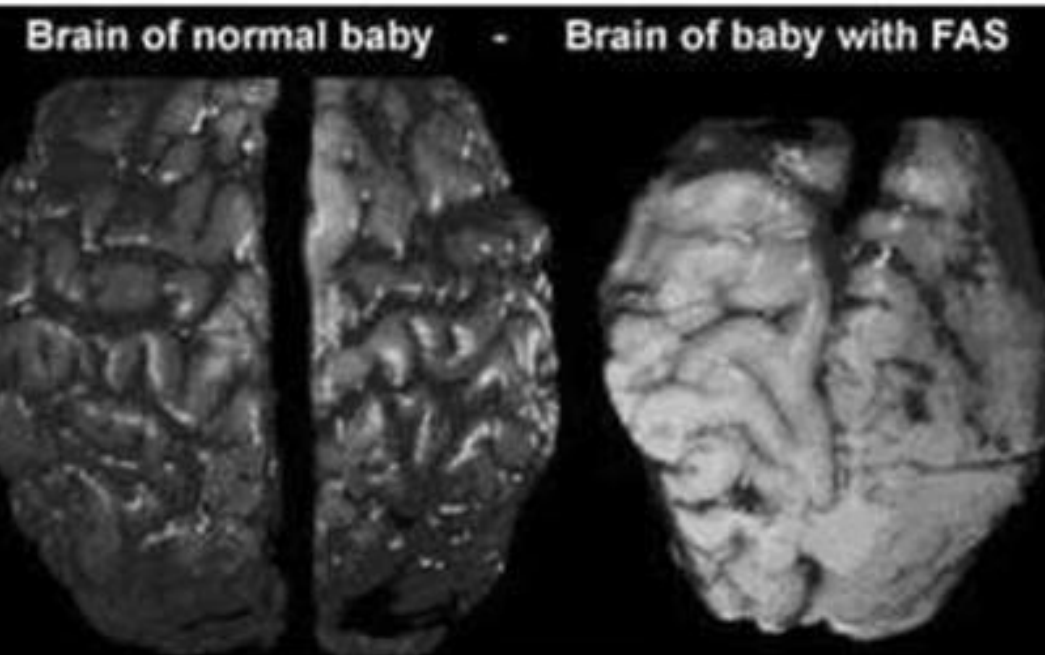
What is Gyri? Why are they important?
Gyri are raised ridges/bumps on the surface of the brain. They are important because they increase the brain’s surface area, which allows more neurons which therefore leads to doing more complex tasks.
What are the 5 categories of verses used in the abortion debate? What are the verses in each category? You need to be able to recognize all the verses discussed in class and match it to their category.
Prohibitions against murder
Genesis 9:6: Whoever sheds the blood of a human, by a human shall that person’s blood be shed, for in his own image God made humans
Exodus 20:13: You shall not murder
Poetry
Pslam 139:13&15: It was you who formed my inward parts; you knit me together in my mother’s womb. My frame was not hidden from you, when I was being made in secret, intricately woven in the depths of the earth.
Particular purpose for a specific individual
Jeremiah 1:5 Before I formed you in the womb I knew you, and before you were born I consecrated you; I appointed you a prophet to the nations.
Origins Narratives
Genesis 2:7: the Lord God formed man from the dust of the ground and breathed into his nostrils the breath of life, and the man became a living being.
Laws for the Israelites
Exodus 21:22-24 and 28-32: When people who are fighting injure a pregnant woman so that there is a miscarriage and yet no further harm follows, the one responsible shall be fined what the woman’s husband demands, paying as much as the judges determine. If any harm follows, then you shall give life for life, eye for eye, tooth for tooth, hand for hand, foot for foot.. If an ox kills a man or a woman, the ox shall be stoned and its owner shall be put to death, if it gores a boy or a girl, the owner shall be dealt according to this same rule. If the ox gores a male or female slave, the owner shall pay to the slaveowner thirty shekels of silver, and the ox shall be stoned.
Numbers 5:12-22 If any man’s wife goes astray and is unfaithful to him.. and he is jealous of his wife who has defiled herself.. then the man shall bring his wife to the priest. The priest shall take holy water in an earthen vessel, and take some of the dust that is on the floor of the tabernacle and put it into the water.. if she has defiled herself and has been unfaithful to her husband, the water that brings the curse shall enter into her and cause bitter pain, and her womb shall discharge.
What is the definition and purpose of dendritic bursting? What is density, or neural network? When during the lifespan is the neural network the most dense?
Dendritic Bursting: a rapid connection of neurons. (neural network: like a spider web of neurons, all kinds of connections being made.)
From birth and up until 15 months, the brain hits maximum density and is prepared for anything that could happen and will be bursting with all types of neural connections.
Purpose: This is to ensure survival for any kind of environment, and create pathways for all kinds of environment.

What is dendritic pruning? What is the definition, purpose of, and role of nature and nurture in pruning? What’s some examples?
Dendritic Pruning: when the brain after 15 months breaks off (lets die) neural connections that aren’t going to be made.
Purpose: specialize the brain to have higher efficiency in a specific environment.
Nature: when and where
Nurture: what
eg.
1) child with indian language. before 15 months the baby can distinguish the 2 different sounds, but after 15 months the baby can no longer discern the difference.
2) rats, once the whiskers are cut off from the mice then the connections in the brain are cut.
3) ASD (autism spectrum disorder) When looking at the same neuron in a individual with ASD and someone without, the individual with ASD has less pruned connections therefore, the individual with ASD is getting a lot more neural connections compared to someone without which is why they can sometimes be “overstimulated”
What is plasticity? When does it happen/how does it carry throughout life? What are the benefits and costs of it? What is an example?
Plasticity: The brain’s ability to reorganize itself.
-Highest in 1st 3 years of life, the brain is very malleable
-Big decline at puberty (eg. harder to learn languages)
-Some plasticity is retained throughout life
Benefits:
1) Maximally equipped for early environment
2 ) There’s not much wasted: eg. a blind person who isn’t going to use cells for perceiving visual cues, those cells will be used elsewhere like for stronger sensory cues or stronger hearing.
Costs:
1) Slower processing for all kids, many connections towards the target that sometimes the inefficient path is taken.
2) For kids in deprivation: the brain will prune off perceptual, cognitive, and emotional capacities that are helpful for future environments.
Example: 6 year old girl who had half of the right hemisphere of her brain removed, because of brain plasticity she was able to have a surprising mental capacity.
What is the inverse relationship between plasticity and efficiency?
Plasticity and efficiency is always a tradeoff.
(high on one = low of the other)
What is myelination? What is the definition and purpose of it? What is a good analogy for it?
Definition: insulating the axon with a fatty sheath that permit electrical activity to go faster. In babies, their brains are mostly grey matter.
Purpose: more faster and more complex thoughts and actions
Like remodeling a house, doing the most essential work done.
How does poor vision at birth facilitate survival? What is a baby’s vision like at 1 month? 3 month? 1 year? How is myelination adaptive?
Poor vision at birth facilitate survival because it allows connection and bonding with mother and baby.
At birth: babies can only see sharp contrasts of black and white and red.
By 3 months, they have more coordinated vision and can track more objects and the images from 2 eyes are merged into 1.
By 1 year, they have vision that is similar to adults
Myelination is adaptive in this context because it is the last out of 5 senses to develop.

What is the definition and research example used to support Nativism? Who was the psychologist and philosophers that supported this? What is the evidence for this?
Nativism is also called the core knowledge approach and places a heavy emphasis on Nature.
Nativism believes in “built in” knowledge such as attentional preferences (infants stare longer at face-like arrangement and procedural preferences (already being able to organize incoming experiences)
Psychologist Piaget, Philosophers Plato and Descartes
Research example: a specific cell that fires to recognize faces means that the brain appears to be biologically prepared to analyze and organize information that comes in. OR critical periods for language development , the brain appears to be prepared to learn a new language within a particular development window.
Research evidence:
From birth, babies have a preference for faces. Infants will stare at face-like arrangements.
We have a specific cell that fires for intact faces.
What is the definition and research example used to support Empiricism? Who was the psychologist and philosophers that supported this? What is the evidence for this? What is John Locke’s blank state?
Empiricism places heavy emphasis on experience and what the environment provides.
Psychologists Watson and FILL IN BLANK and philosopher Locke.
John Locke stated his tabula rasa “blank state” which he said that humans are born without any built in or innate ideas similar to a blank sheet of paper.
Evidence: Experience dramatically changes the brain. Eg. taking away mouse whiskers leaves a “unfurnished” place in brain.
What are 2 reasons why Piaget is considered a nature theorist?
Drives to understand and maintain cognitive equilibrium (person’s schemas match and explain the new information they experience in their life. eg. a child who thinks all 4 legged animals with fur are dogs, so when they see a bear they would call it a dog. another eg with muslims)
Cognitive gains are genetically scheduled (maturational timetable), qualitative and in stages (4 for Piaget)
What is the little scientist analogy?
Piaget used the little scientist analogy to describe how children learn because he believed that children construct their own understanding of the world through continuous experimentation, trial and error, and observation.
Children are curious.