RPD 04 - Components Part 2 (Quiz 2)
 Call Kai
 Learn
Learn Practice Test
 Spaced Repetition
 Match
Match Flashcards
 Knowt Play
1/95

There's no tags or description
Looks like no tags are added yet.
Name | Mastery | Learn | Test | Matching | Spaced | Call with Kai | Chat |
|---|
No analytics yet
Send a link to your students to track their progress
96 Terms
Indirect retainers
Define the following:
Framework components that assist the direct retainers in preventing displacement of distal extension denture base away from the supporting tissues by resisting lever action from the opposite side of the fulcrum line
fulcrum line
Define the following:
An imaginary line that crosses the most distal rests of a retainer
greater
the further away an indirect retainer is from the fulcrum line, the _______ the retention
indirect retainers
All of the following are factors influencing the effectiveness of _______:
- Distance from the fulcrum line
- Perpendicular to and as far from the fulcrum line
- Rigidity of the connector
- Supporting tooth structure
- No tooth incline/weak tooth
- Accurate and definite contact with properly designed horizontally oriented rest seats
Indirect retainers
What should be perpendicular to and as far from the fulcrum line as possible?
retention
Indirect retainers participate in stability, retention AND support. But what is the PRIMARY function?
- Aid in stabilization
- Support major connector
- Facilitating stress distribution
- Indicator for relining
What are the auxiliary functions of a indirect retainer?
Major connectors
What has the following characteristics:
- Connect all parts of the partial denture together
- Must be rigid to transmit force equally to all areas and structures
- Must be properly located in relation to gingiva and movable tissue
- Must not impinge on gingiva
Support
What is the MAIN function of a maxillary major connector?
maxillary major connectors
What has the following characteristics:
- Usually a plate that touches the tissue
- No relief
- Provides support
Maxillary major connector
What has the following characteristics:
- 6 mm from the gingival margins
- Parallel to the gingival margin
- 90 degrees to palatal midline
- Not extend onto the soft palate
6mm
maxillary major connectors borders must be ___mm from the gingival margin
parallel
maxillary major connectors borders must be __________ to the gingival margin
90°
maxillary major connectors borders must be _____ degrees to the palatal midline
soft palate
maxillary major connectors borders must not extend onto the ________
rugae (run through valleys to reduce the sensation of foreign object)
when fabricating a maxillary major connector, you should open the ______ area to allow for better speech
beading
What accommodations are being made for this maxillary major connector:

0.5mm
when fabricating a maxillary major connector, beading anteriorly and posteriorly for better tissue contact to prevent food entrapment should be ___mm deep with a rounded channel
6mm
when fabricating a maxillary major connector, the material should fade away within ___mm from the gingival margin of the remaining teeth
irritation/inflammation
when fabricating a maxillary major connector, the channel depth should be reduced in areas of thin tissue coverage such as mid- palatine raphe or a palatal torus to prevent ________
Palatal torus or a prominent median suture line
Relief should NOT be used under the maxillary major connector, except in the presence of what?
Kennedy Class III with short edentulous span
When fabricating a maxillary major connector, palatal straps are most common for which Kennedy Class?
8-15mm
when fabricating a maxillary major connector, the width of a palatal strap must be between ____-____mm for good support and rigidity
palatal strap
ID the type of maxillary major connector:
- Good support and rigidity
- Most comfortable

Palatal plate/extended strap
ID the type of maxillary major connector:
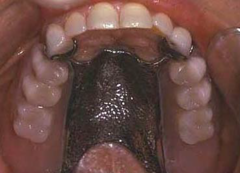
palatal plate/extended strap
This type of maxillary major connector is:
- For any classification when edentulous support needed (keep rugae open when possible)
- Periodontally compromised remaining teeth
- Patient has no interfering torus
- Enhances thermal conductivity
anterior palatal strap/Horseshoe
ID the type of maxillary major connector:

anterior palatal strap/Horseshoe
this type of maxillary major connector is least desirable due to poor support and rigidity:
anterior palatal strap/Horseshoe
This type of maxillary major connector is:
- Least desirable due to poor support and rigidity
- May be used for Kennedy Class IV or III w/ anterior modification
- Good for patient with palatal tori
antero-posterior palatal strap
ID the type of maxillary major connector:

antero-posterior palatal strap
This type of maxillary major connector is:
- Used for any classification with strong abutment teeth and excellent residual support
- Good support, excellent rigidity
- Maybe not acceptable by patient due to the multiple borders
- Both straps should be at least 8mm in width
8
when fabricating a antero-posterior palatal strap, the width of both anterior and posterior straps must be at least ___mm for good support and rigidity
complete palatal plate
ID the type of maxillary major connector:

complete palatal plate
This type of maxillary major connector is:
- With poor abutment support, poor ridge conformation, and weak periodontal support, palatal support becomes very important
- Patients do NOT have interferring tori
- Location and size of edentulous area
- Amount of support available
- Patient preference
- Future tooth loss
- Fulcrum line
What are the 5 selection criteria for selecting a maxillary major connector?
half pear shaped
What is the shape of a Lingual Bar mandibular major connector?
5mm
A lingual bar should have a height of ___ mm
2mm
A lingual bar should have a thickness of ___ mm
3mm
The superior border of a Lingual Bar should sit ___mm away from the gingival margin
8mm
In order for a patient to receive a lingual bar, they must have a functional depth of at least ___mm of lingual vestibule
lingual bar
ID the type of mandibular major connector:

lingual bar
ID the type of mandibular major connector:
- Half pear shaped: 5 mm high, 2mm thick
- Superior border: 3mm from the gingival margin
- At least 8 mm of functional depth of lingual vestibule (vertical space between gingival margins of teeth and floor of mouth)
- Most comfortable
lingual bar
What is the most common and most comfortable type of mandibular major connector?
lingual bar
What mandibular major connector is contraindicated for patients with mandibular tori?
Lingual border molding to fit bar into the lingual sulcus like a denture border
When fabricating a mandibular lingual bar major connector, the final impression should include...
Blocking salivary ducts
When designing a mandibular lingual bar, care must be taken to avoid what?
lingual bar OR lingual plate (Linguoplate)
A patient that needs a mandibular denture and has 8mm of space between the gingival margin of the anterior teeth and the lingual sulcus. What is the patient eligible for?
lingual plate (linguoplate)
A patient that needs a mandibular denture and has less than 7mm of space between the gingival margin of the anterior teeth and the lingual sulcus. What is the patient eligible for?
lingual plate (linguoplate)
ID the type of mandibular major connector:

lingual plate (linguoplate)
ID the type of mandibular major connector:
- Used for patients with less than 7mm lingual vestibule
- Contacts teeth just above cingulum rests at each end
- Scalloped appearance for patients with close interproximal spaces
- Good for patients with weak periodontal support requiring splinting
- Good for patients with mandibular tori
- Patients with future loss of teeth
- Steps back for diastemas
- Can interfere with speech
Double lingual bar (Kennedy bar or Split bar)
ID the type of mandibular major connector:

Double lingual bar (Kennedy bar or Split bar)
ID the type of mandibular major connector:
- Similar to lingual plate except for large open space between two bars
- 2-3mm in height (incisogingival)
- About 0.6-1mm thick (faciolingual)
- Rests at each end
- Risk of food trapping, especially in crowded dentition
- Can cause tongue irritation
- Interferes with speech
- Indicated when open embrasures exist
2-3mm
the height of the most superficial bar of a Double lingual bar (Kennedy bar or Split bar) is between ___-___ mm inciso-gingivally
0.6-1mm
the width of the most superficial bar of a double lingual bar (Kennedy bar or Split bar) is between ___-___mm faciolingually
labial bar
ID the type of mandibular major connector:
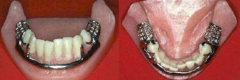
labial bar
ID the type of mandibular major connector:
- Patients with severely lingually inclined teeth
- Used for patients with VERY large tori
swing lock
ID the type of mandibular major connector:
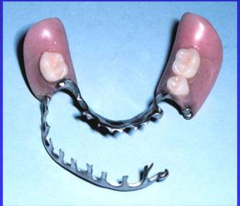
swing lock
ID the type of mandibular major connector:
Used for patients with:
- Unfavorable tooth contour
- Unfavorable soft tissue contour-tori
- Teeth with questionable prognosis
swing lock
Which mandibular major connector has a gate, latch and hinge?
- Location of edentulous area
- Functional depth of lingual vestibule
- Anticipated loss of natural teeth
- Inclination of remaining teeth
What are the 4 selection criteria for selecting a mandibular major connector?
minor connectors
These connect parts of the partial denture to the major connector such as:
- Indirect retainers or auxiliary rests
- Clasp assemblies (rests, retentive arms, bracing arms)
- Mesh that retains denture base, esthetic and occlusal components
stability
IMPORTANT: What is the primary function of minor connectors?
Minor connectors
What has the following characteristics:
- Acts as a stability element
- Transfers functional stress to abutment teeth
- Must be rigid
- Crosses gingival margin at right angle
- Junction to major connector is slightly curved
5mm
IMPORTANT: Minor connectors positioned in embrasure spaces should have at least ___mm between two minor connectors
3mm
There should be ___mm space between the gingival margin and the mandibular minor connector
open lattice or ladder like design
ID the design of denture base minor connector:

mesh design
ID the design of denture base minor connector:

loop design
ID the design of denture base minor connector:

beads
ID the design of denture base minor connector:

retentive posts
ID the design of denture base minor connector:
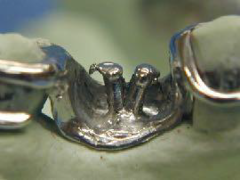
mesh and loop
Which design for the denture base minor connectors have very good retention?
As far posteriorly as is practical
In a maxillary RPD, where should the denture base minor connector extend to?
2/3 the length of the residual ridge
In a mandibular RPD, where should the denture base minor connector extend to?
minor connector
Are tissue stops considered a major or minor connector?
tissue stops
What part of the minor connectors stabilize the framework during resin packing and processing; indicator for the fit, contact the oral mucosa?
tissue stops
ID what the arrows are pointing at:

1mm
on the buccal side, the denture base minor connector extension should be about ___mm over the residual ridge crest
2mm
the lingual side, the denture base minor connector extension should be about ___mm short of the denture border in the lingual aspect
finish line
What has the following characteristics:
- < 90° butt joint (internal angle) between major connector and minor connector for mechanical retention
- Smooth transition between denture base metal and acrylic
2mm
The external finish line for the maxilla, should be _____mm palatal to the palatal surfaces of adjacent teeth
Guide plate
The external finish line for the mandible, should be continuous from the _________
Palatal
when establishing the internal finish line for the maxilla, it should be slightly more ______ to the external finish line
mesial
when establishing the internal finish line for the mandible, it should be______ to the external finish line
maxilla's external finish line
The left arrow denotes the location of what finish line?

mandible's external finish line
The arrow denotes the location of what finish line?

maxilla's internal finish line
The purple line in the picture denotes the location of what finish line?

maxilla's external finish line
The blue line in the picture denotes the location of what finish line?

mechanical retention
What is the purpose of finish lines?
snowshoe principle (distribution of forces to as large as an area as possible)
Define the following:
The broader coverage of the denture base, the more support with the least load per unit area (more forces distributed per surface area)
Denture bases
What has the following functions:
- Support the artificial teeth
- Transfer the functional forces to supporting tissues
- Functional stability and comfort
- Snowshoe principle
- Cosmetic effect of the replacement
- Stimulation of underlying tissue the residual ridge
- Secondary retention via intimate contact with the underlying tissue
support
What is the PRIMARY function of denture bases?
resin denture base
ID denture base type:
- Restoration of anatomic contour, occlusion, and esthetics
- Anticipated need to reline or adjust the base
- Variety of shades
- Poly-methyl-methacrylate (PMMA)
metal denture base
ID the denture base type:
- Short-span tooth supported
- Limited vertical height
- Cast metal pontic
- Maximum strength
- Better tissue adaptation
- More accurate form
- Enhanced thermal conductivity
- Less bulk
- Inability to relining or rebase poorly fitting areas
metal denture base
What kind of denture base should be used for well healed and ideally contoured residual ridges?
- Acrylic resin (mostly use this)
- Porcelain teeth
- Reinforced acrylic pontics
What are the options for replacement of anterior teeth on a RPD ? (3)
- Acrylic resin
- Composite resin
- Porcelain teeth
- Metal pontics
- Tube tooth
What are the options for replacement of posterior teeth on a RPD ? (5)