NEUR Midterm
 Call Kai
 Learn
Learn Practice Test
 Spaced Repetition
 Match
Match Flashcards
 Knowt Play
1/87

There's no tags or description
Looks like no tags are added yet.
Name | Mastery | Learn | Test | Matching | Spaced | Call with Kai | Chat |
|---|
No analytics yet
Send a link to your students to track their progress
88 Terms
What did Santiago Ramon y Cajal discover about neurons, and nerves? How did he find out? (Method?)
Nerve cells remain separated. Used the Golgi method, a sliver staining technique.
One limitation to the golgi method?
Stains a limited amount of nerve cells

What are dendrites?
Fibers with synaptic receptors that receive information from other neurons.

What is the highlighted area called?
Dendrites

What is the name of the highlighted area?
Axon

what is the axon?
Long fiber that conveys impulses towards other neurons, organs, or muscles

What’s the highlighted region?
Cell body or soma

What is the Cell body/Soma
Most of the neurons metabolism happens here. They also might have synapses
What is a synapse? (2 defitions)
Passing on messages between cells. Also a small junction between two nerve cells where signals can pass.
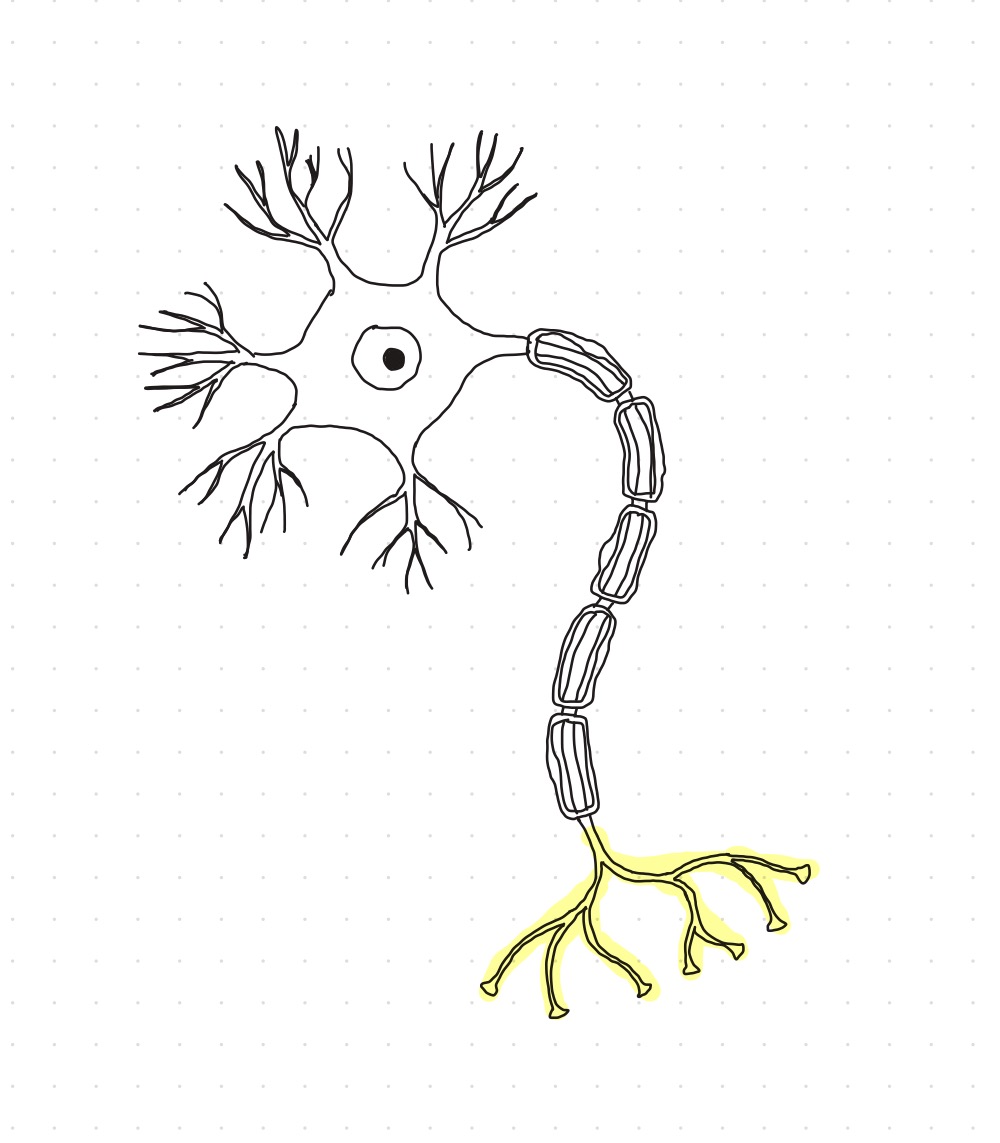
Presynaptic terminal
At this point the axon releases chemicals that cross through the junction from one neuron and the next

What is the highlighted region?
Presynaptic terminal

How many neurons are in the cerebellum
70 billion

How many neurons are in the cortex?
12 to 15 billion

How many neurons are in the spinal cord?
1 billion
Motor neuron (efferent) structure, and function?
For motion, and speech. The structure includes the soma in the spinal cord and conducts impulse along its axon to a muscle.
Sensory (afferent): Structure and function
For light, sound, or touch. Soma is connected to spinal cord.
Intrinsic neurons
Inside brain. There is a lot of this. To bring information around the brain.

Multipolar Nuerons and for what?
Many dendrites and one axon. For the Motor

Unipolar or monopolar and used for what sensory?
Have an axon that branches in two directions. At the ends it can have dendrites, and axons. Used for most sensory neurons

Bipolar
One dendrites and one axon. Direct path, (quick signals). Uncommon. Found in sensory neurons very rare.
Neurons main activity is…
Receive and share information
Nucleus job?
stores, cooies, and send genes to other parts of of the cell
Name the Processes of genes turning into proteins?
Chromosomes changing to expose a gene to be transcribed into RNA, then RNA is translated using ribosomes (genetic code is read into amino chain then chain forms proteins)
What is Glia cells?
Supporting cells that provide firmness and structure for the brain (using connective tissue). (Glue in Greek)
Does the Brain have more glia cells or neurons? And which one is smaller?
Gila cells
List functions of gila cells (regardless of type) (6 functions)
Help with the migration of neurons, forms myelin, helps with synapse formation + maintenance, supply oxygen + nutrients, remove dead neurons, keep correct K+ concentrations
Name the main 2 types of gila cells
Macroglia, and Microglia
Name 2 types of Marcoglia cells
Astrocytes and Oligodendrocites
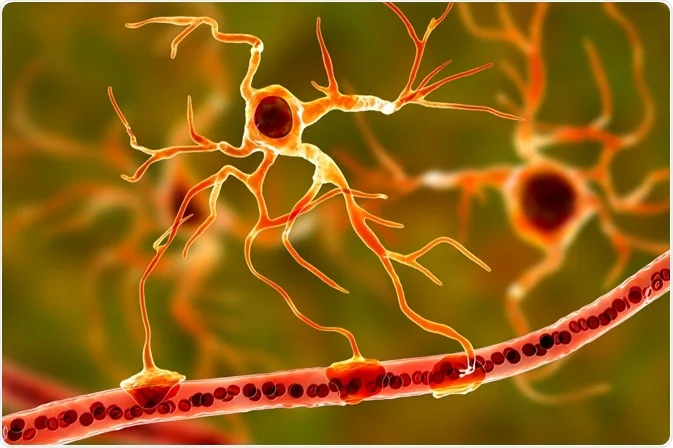
Astrocytes functions
Synapse formation, maintenance upkeep formation, removal of K+ (maintain concentration), Nutritive function, remove dead neurons after brain injury
Oligodendrocites
Contribute the myelin sheath to the axon in central nervous system. In the peripheral nervous system they are called Schwann cells (outside brain)
Microglia
A type of immune cell and glia that mobilize after injury, infection, or disease
What are some causes of an abnormal Astrocytes?
formation of malignant brain tumors and Multiple Sclerosis
What are some causes of oligodendrocyte loss
Multiple sclerosis:immune system attacks the myelin sheath, cause slow electrical signals or none at all.
What are some causes of Demyelinating Schwann cells? (Damage to myelin sheath in neurons in the peripheral nervous system)
Type 1 Charcot- Marie- Tooth disease: loss of muscle and poor Motor and sensations issues
Blood brain barrier function
Helps protect the brain from impacts
Endothelial Cells
Cells that from a thin layer throughout all blood vessels. Specifically in the brain it’s a selective barrier that filters needed materials for the brain while keeping out unwanted contents.
Phases of action potential
Resting potential, action potential, propagation
Resting potential is defined by…
The electrical charge difference (electrical gradient) between inside of the neuron’s membrane and the outside. With the inside being more negative (-70mV)
How are the different charges (between inside and outside of the neuron) maintained?
Sodium-potassium pump
What is the sodium-potassium pump?
Channels that allow 3 sodium ions out and 2 potassium ions in
How do we create energy to have action potential to fire in neurons?
By the attraction or tension between positive and negative charges from the electrical gradient
What’s resting potential?
The state that neuron is in before firing a signal. Defined by the inside of the membrane having a charge of -70millivolts. (Preparing to fire)
What disturbs the resting potential?
Stimulation
What is the threshold of excitement?
-55mV
In order for the action potential to happen what needs to occur?
Depolarization from -70mV to -55mV
After stimulation reaches the threshold what happens?
Massive depolarization occurs, which involves sodium channels open allowing for more sodium into the membrane
What occurs at the peak of action potential?
Polarization occurs, which involves sodium channels close, while potassium channels are open, allowing only potassium to exit the cell
Neurons experience polarization until what?
Until the membrane returns to its resting potential (-70mV)
Action potential is…
When stimulation reaches a threshold causing depolarization until it reaches peak and depolarizes
The refractory period is when…
The neuron cannot easily fire until it has reached -70mV in the membrane
Why can’t the neuron fire? What makes it difficult?
1st part of the refractory period forces all sodium channels to close (impossible to fire), 2nd part the sodium channel is open but it would take more energy to fire because of the deficiency of potential (works harder to overcome that and threshold). All this while potassium is leaving the cell
What is the all-or-none law?
All Action potential are equal in amplitude. They all fire at the same strength and speed or none at all.
What affects the intensity of the stimulus?
The frequency that the neurons fire. (Frequency of the action potential)
What is propagation of the Action potential?
Positive charges inside the membrane causes the neighboring membrane to depolarize and reach that threshold causing it to open up sodium channels. Thus regenerating the action potential.
is propagation of the action potential unidirectional? Why or why not?
It is unidirectional because the previous section is in the refractory period (can’t be active) so the only option is to move forward.

What is the Myelin sheath?
Insulation material made from fats and protein

What is the highlighted region called?
Myelin Sheaths
Myelin sheaths are present where?
All nerve cells, including Schwann cells and oligodendrocytes. It’s also the white matter in the brain
How does the myelin sheaths affect action potential?
Increases the speed
Saltatory conduction
Where sodium (+) jumps through the gaps between nodes through the myelin sheaths to regenerate AP. Because the myelin sheaths are there it helps the ions not lose energy.
In what direction does energy go through the neuron?
Dendrites to axon

What is the highlighted region?
Nodes of Ranvier

What is the highlighted region? Note this neuron is in the peripheral nervous system
Schwann Cells
Spindle cells/neurons where are they located?
In the layers of the cerebrum cortex specifically in the anterior cingulate cortex, and the frontal insular cortex
What are spindle neurons responsible for?
Social awareness, empathy, theory of mind, judgment, morality, emotional regulation, self-awareness
What happens if the spindle neurons malfunction or die?
Frontal temporal dementia (loss of socal-awareness, empathy, emotional regulation)
What is Optogenetics?
Biological technique to stimulate the brain using light. Basically Turning neurons off and on using a light.
How does optogenetics work?
Insert light sensitive protein (algae) into a type of neuron. 2. Based on the light the protien will activate or inhibit neurons. 3. Insert a optical fiber to shine light
Transcranial Magnetic stimulation (TMS)
Non invasive. Uses magnetics to stimulate a portion of the scalp. It will active or inactivate neurons in a narrow area below the scalp. Temporary brain activity.
Limitations of TMS
Bit painful. Only for the outer cortex, difficult to target areas that are deeper, temporary cognitive changes
TMS is helpful for what conditions?
Migraines, depression, OCD, and smoking addiction

Deep brain stimulation
Electrical stimulation of the brain using a pacemaker like device that produces a pulse from the collar bone to specific areas of the brain where the nuerostimulator is placed.
What is deep brain stimulation used for?
When medication is not working. For Parkinson’s disease, depression, OCD, epilepsy
Deep brain stimulation limitations
Have to know exactly where to send signals, the surgery is highly invasive, the pulse generator can become faulty but unlikely
what’s electroencephalography? (EEG)
Measures and records the electrical activity of your brain using small metal discs attached to your scalp.
EEG is used for?
Finding type and causes of seizures, and epilepsy, checking for brain problems after a stroke or head injury, finding issues with sleeping disorders, helping doctors confirm Brain death, can use to record consciousness and unconsciousness
EEG cons And pros ?
EEG picks up on the electrical interference from the skull, bone, and cerebrospinal fluid making it harder to see the brain (low spatial resolution) easy to use , and cheap!
What is Magnetoencephalography (MEG)
Non-invasive test that measure and records magnetic fields produced by electrical activity in the brain.
Limitations of EEG and MEG?
EEG has a lot of noise due to the interference of bone (mass). Both MEG and EEG have bad spatial resolution (more noise) compared to other methods.
Benefits, cons, and uses of MEG?
Pinpoints origin of epileptic seizures, tumor evaluation. Real time recording of the brain (milliseconds). Highly expensive and rare to use
Electrocorticography (ECOG) or intracranial EEG
Electrodes are placed (thin grid) directly on or under the brain. This helps record electrical activity right in the cerebral cortex.
ECoG limitations and benefits
Highly invasive surgical procedure, good spatial and temporal resolution.
What is the ECoG used for?
Patients who are going through brain surgery.
Magnetic Resonance Imaging (MRI)
Structural image of the brain (anatomy), uses strong magnetic fields.
Functional Magnetic Resonance Imaging (fMRI)
Overlaps functional and structural images, also uses magnetics, measures the oxygen levels in the blood flowing through the brain to spot active brain cells.
fMRI is used for?
Studying brain function, surgical planning, evaluation of conditions
MRI is used for?
Diagnose/ monitor conditions in the brain, heart etc,
Limitations of fMRI and MRI
Bad temporal resolution (2 seconds) but good spatial resolution