PKP Kap. 3
 Call Kai
 Learn
Learn Practice Test
 Spaced Repetition
 Match
Match Flashcards
 Knowt Play
1/8

There's no tags or description
Looks like no tags are added yet.
Name | Mastery | Learn | Test | Matching | Spaced | Call with Kai | Chat |
|---|
No analytics yet
Send a link to your students to track their progress
9 Terms
Who was Freud, and how did he view humans (and go about studying them)?
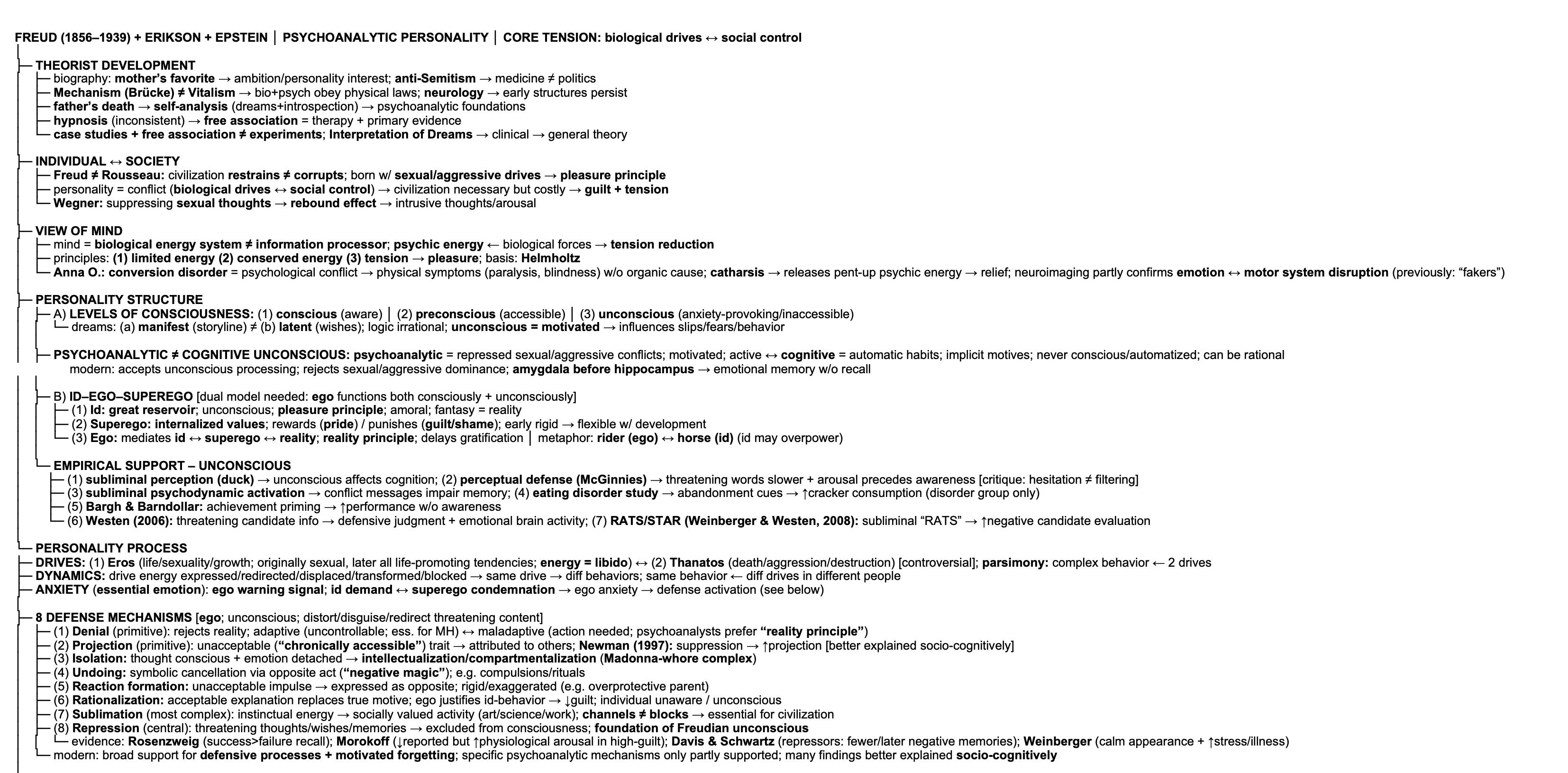
Freud (1856–1939): Development of the theorist; mother’s favorite child (among many) → interest in confidence, ambition, personality; anti-Semitism → medicine instead of politics/government; Mechanism (Brücke) ≠ Vitalism → biological and psychological phenomena obey physical laws; neurology research → early structures persist throughout life; father’s death → depression/anxiety → lifelong self-analysis (dreams + introspection) → foundations of psychoanalysis; hypnosis abandoned (inconsistent) → free association (!) (uncensored thoughts) = therapy + primary evidence; The Interpretation of Dreams (initially rejected)→ transition from clinical practice to general theory of mind; psychoanalysis emerged from medical science + clinical observation + self-analysis + historical context.
Individual ↔ society: Freud ≠ Rousseau; humans born with sexual/aggressive drives pursuing the pleasure principle; civilization restrains rather than corrupts instinctual expression; personality emerges from conflict between biological drives and social control → Civilization is necessary but psychologically costly because it requires continual suppression of instinctual wishes (pleasure principle!), producing guilt and tension; supporting this, Wegner found that suppressing sexual thoughts produces a rebound effect, increasing later intrusive thoughts and emotional arousal (e.g. phobias, obsessions..).
View of personality science: psychology should resemble physics; emphasis on lawful explanations and precise theory; relied primarily on case studies + free association rather than experiments or standardized tests because he believed intensive clinical analysis uniquely revealed unconscious processes; BUT modern psychology values his theoretical insights and rich clinical observations but generally rejects case studies alone as sufficient scientific evidence (!)
View of humans: Mind = biological energy system ≠ information processor; psychic energy originates from biological forces seeking expression/tension reduction (quiescence); principles: (1) limited energy (investment in one domain reduces availability elsewhere); (2) conserved energy (blocked impulses redirected via path of least resistance rather than disappearing); (3) tension reduction through behaviour → pleasure; based on Helmholtz’s conservation of energy
Anna O.: hysteria (conversion disorder) improved after catharsis (emotional reliving of traumatic memories) → release of pent-up psychic energy + evidence that forgotten experiences continue operating unconsciously; blocked sexual/aggressive energy redirected into alternative behaviors (incl. cultural productivity); modern neuroimaging partly supports emotion → emotional + motor-system interactions in conversion disorder (previously thought “fakers”).
Describe the psychoanalytic personality structure, as well as its contemporary acknowledgements.
Personality structure: two complementary models; (1) levels of consciousness (where mental contents reside) + (2) id–ego–superego (what mental systems do); Freud introduced the second because one coherent system (ego) could function both consciously and unconsciously, so consciousness levels alone could not explain personality. → Contemporary view of the unconscious: Psychoanalytic unconscious ≠ Cognitive unconscious (!)
Levels of consciousness: (a) Conscious (currently aware thoughts); (b) Preconscious (not currently conscious, but easily retrievable); (c) Unconscious (anxiety-provoking wishes, traumatic memories, unacceptable desires → inaccessible under normal conditions because awareness would produce psychological pain).
Dreams: Manifest content (storyline) ≠ Latent content (hidden wishes/conflicts); dream logic = irrational (contradictions coexist; time/space distorted; symbols replace direct meaning); dreams allow forbidden wishes to be fulfilled safely (symbolically rather than directly). Implication: unconscious contents remain active → influence slips of the tongue, emotions, attractions, fears, behavior; unconscious = motivated (!), not merely hidden/passive.
Clinical observations: Hypnosis → forgotten memories + intense emotional reactions (rage, sobbing, anxiety) became accessible → initial support for unconscious mental contents influencing behavior.
Loads of research + criticism thereof (!)
Id, Ego, Superego (functional systems):
Id: original “great reservoir” of psychic energy; source of sexual/aggressive drives; entirely unconscious; follows pleasure principle; seeks immediate gratification; ignores morality (“totally non-moral”) and reality; cannot tolerate frustration; fantasy = actual gratification = equally satisfying.
Superego: internalized parental/social values; operates as internal judge; rewards acceptable behavior (pride, self-approval) and punishes unacceptable behavior (guilt, shame, inferiority); early superego rigid/perfectionistic (judges thoughts as harshly as actions) but becomes more flexible with development.
Ego: mediator between id ↔ superego ↔ external reality; follows reality principle (!); delays gratification, distinguishes fantasy from reality, tolerates tension, redirects instinctual energy, plans strategically, negotiates compromises among drives, morality, and environmental constraints; develops throughout childhood. Metaphor: ego ≠ executive; ego = rider, id = horse (id supplies the energy and may ultimately overpower the rider).
What’s the contemporary evidence / acknowledgement of Freud’s psychoanalytic structural assumptions?
→ Contemporary view of the unconscious: Psychoanalytic unconscious ≠ Cognitive unconscious.
Psychoanalytic = repressed sexual/aggressive wishes, emotional conflicts, irrational motives, kept unconscious for motivated reasons and continuing to influence behavior.
Cognitive = automatic habits, learned associations, cultural assumptions, implicit motives, routine information-processing (outside awareness because never conscious, unprocessable, or automatized) → can be logical, rational, intelligent. Modern psychology accepts unconscious processing but generally rejects Freud’s claim that sexual/aggressive conflicts dominate mental life; nevertheless, neuroscience supports parts of Freud’s view (early emotional memories may influence later behavior without conscious recollection because amygdala develops before hippocampus, and neural systems appear capable of motivated forgetting).
Experimental support for unconscious processing: (tachistoscope frequently used)
Subliminal perception (Duck experiment) → hidden duck influenced later imagery despite no conscious perception → unconscious perception affects cognition.
Perceptual defense (McGinnies) → threatening words recognized more slowly; physiological arousal (sweat gland activity) preceded conscious recognition → possible unconscious filtering of threatening stimuli (critique: participants may simply have hesitated to verbalize taboo words).
Subliminal psychodynamic activation → conflict-provoking messages (“Loving Daddy Is Wrong”) impaired memory; conflict-reducing messages (“Loving Daddy Is OK”) did not → unconscious motivational conflicts can influence cognition.
Eating-disorder studies → subliminal abandonment cues (“Mama Is Leaving Me”) increased cracker consumption only in women with eating disorders → unconscious conflict influences behavior.
Goal activation (Bargh & Barndollar) → achievement-word priming improved later performance without awareness → unconscious goals guide behavior.
Political judgment (Westen et al., 2006) → threatening information about preferred candidates elicited defensive judgments + increased activity in emotional brain regions → motivated unconscious processing.
RATS / STAR (Weinberger & Westen, 2008) → subliminal “RATS” produced more negative evaluations of political candidates than neutral primes → unconscious cues bias judgments.
Modern acknowledgement: strong evidence for unconscious processing, implicit motives, automatic goal activation, and some motivated forgetting; neuroscience also supports unconscious emotional memory (e.g., amygdala before hippocampus), BUT Modern criticism: evidence largely rejects Freud’s claim that the unconscious is mainly driven by repressed sexual/aggressive conflicts; many findings are better explained by social-cognitive mechanisms and are limited by methodological and replication issues.
How does Freud describe the process of personality, and which essential emotion does he mention?
Personality process: driven by biological psychic energy originating from bodily drives (≠ fixed instincts; flexible motivational forces seeking expression + tension reduction); central questions → (1) Which drives exist? (2) What happens to their energy?
Life (Eros) ↔ Death (Thanatos) instincts:
Eros → survival, self-preservation, sexuality, reproduction, growth; psychic energy = libido; originally sexually motivated; later encompasses all life-promoting tendencies (!)
Thanatos → destruction, aggression, self-harm, return to inorganic state; explains aggression/suicide towards others (highly controversial!).
Central: Parsimony: complex behavior ← interaction of only two drives; sexual/aggressive drives originate in the id.
Dynamics of functioning: drive energy may be expressed directly, redirected, displaced, transformed (e.g., socially acceptable forms), or blocked → same drive can produce different behaviors; same behavior may arise from different underlying drives // all ACROSS individuals!
Essential emotion = Anxiety: ego function; arises when instinctual wishes conflict with reality or superego; functions as a warning signal that danger is approaching. Typical conflict: id demands gratification ↔ superego condemns impulse ↔ ego experiences anxiety and initiates defense mechanisms to restore psychological stability (often in response to remembered or forgotten traumatic experiences).
Includes: 8 Defense mechanisms: Denial, Projection, Isolation (+ Undoing), Reaction Formation, Rationalization, Sublimation, Repression; modern research broadly supports defensive processes, motivated forgetting, and repressive styles, but evidence for Freud’s specific psychoanalytic mechanisms remains mixed, with many findings better explained by social-cognitive mechanisms than by repressed id-based conflicts.
What are defense mechanisms according to Freud?
8 Defense mechanisms: ego functions; unconscious strategies activated by anxiety to distort, disguise, redirect, or exclude threatening thoughts, wishes, and impulses → protect psychological stability by mediating id ↔ superego ↔ reality.
Denial (primitive): rejects painful reality/internal impulse (“this can’t be happening”, “I’m not angry”); conscious avoidance → automatic/unconscious (!); temporarily adaptive (esp. uncontrollable situations / for overall mental health!) but maladaptive when reality-oriented action is needed (preferred by psychoanalysists).
Projection (primitive): unacceptable impulse/trait attributed to others (hostility, laziness, etc., usually “chronically accessible”) while denied in oneself; Newman et al. (1997): suppressing a disliked trait increased judging others as possessing that same trait → support for projection, though explained better by social-cognitive mechanisms than id conflicts (!).
Isolation: thought remains conscious but emotion detached → intellectualization; compartmentalization (e.g., Madonna–whore complex: love or sex, but not both in one woman!).
Undoing: symbolic cancellation of unacceptable thought/action through another act (“negative magic”); examples: compulsions, rituals, excessive checking.
Reaction formation: unacceptable impulse expressed as its opposite; exaggerated, rigid behavior (e.g., overprotective parent masking hostility, serial killer, who “couldn’t hurt a fly”).
Rationalization (complex): acceptable explanation replaces true unacceptable motive (crimes in name of “love”); ego justifies id-driven behavior → reduced guilt/anxiety ( = superego behaviour); individual usually unaware / unconscious (!) of the true motive.
Sublimation (very complex): instinctual energy redirected into socially valued activities (art, science, sports, work); unlike other defenses, channels rather than blocks energy (!) → viewed as essential for civilization.
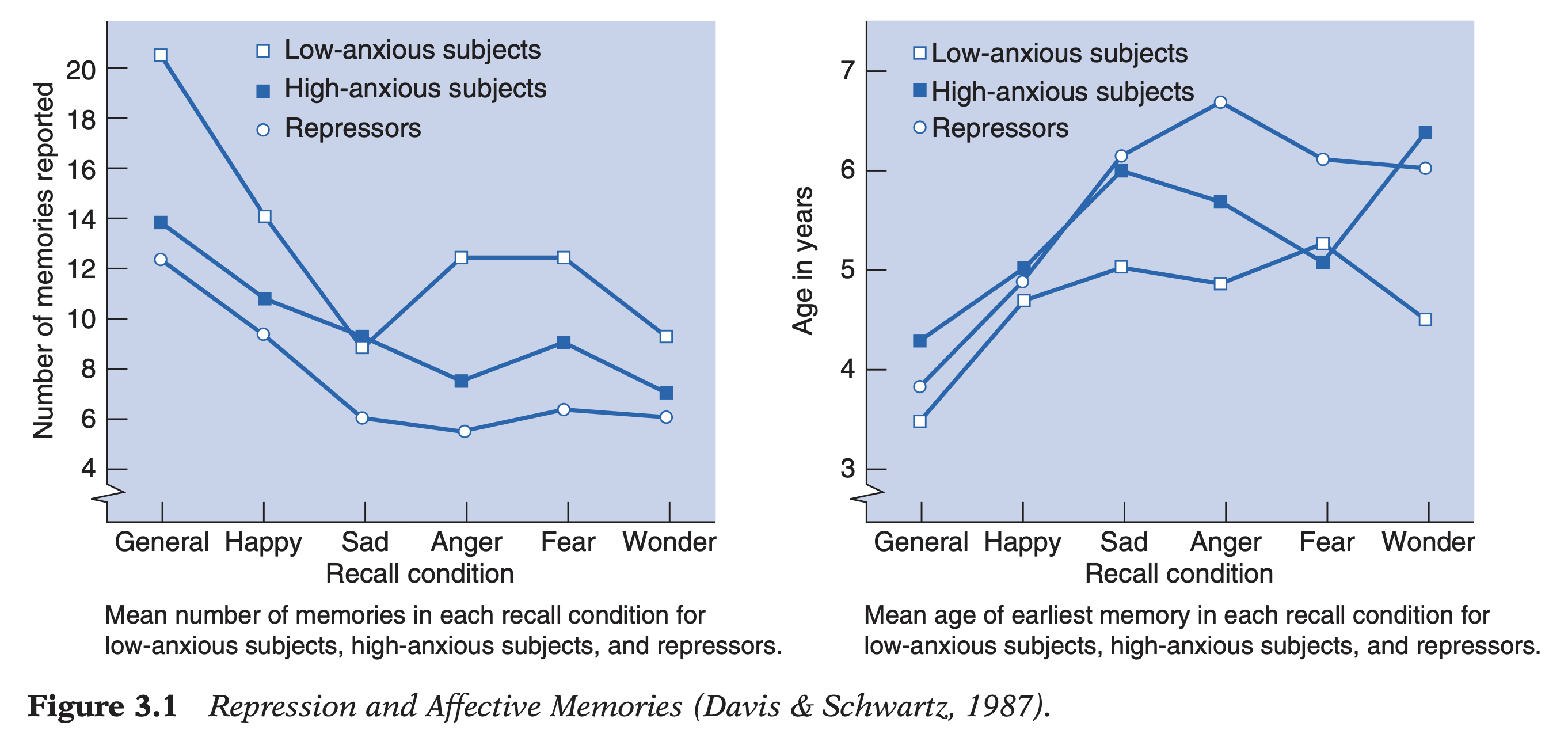
Repression (central defense): threatening thoughts, wishes, or memories excluded from consciousness → unconscious; foundation of Freud’s unconscious. Evidence: Rosenzweig (success > failure recall when invested), Morokoff (sex guilt: ↓reported but ↑physiological arousal with high-guilt group), Davis & Schwartz (repressors recalled fewer/later negative memories), Weinberger (repressive style: calm appearance but ↑stress responses/illness) → partial support, though evidence remains debated.
Modern research broadly supports defensive processes, motivated forgetting, and repressive styles, but Freud’s specific psychoanalytic explanations are only partly supported, with many findings better explained by social-cognitive mechanisms than by repressed id-based conflicts.
How does Freud describe the growth and development of the personality, and how was this further developed?
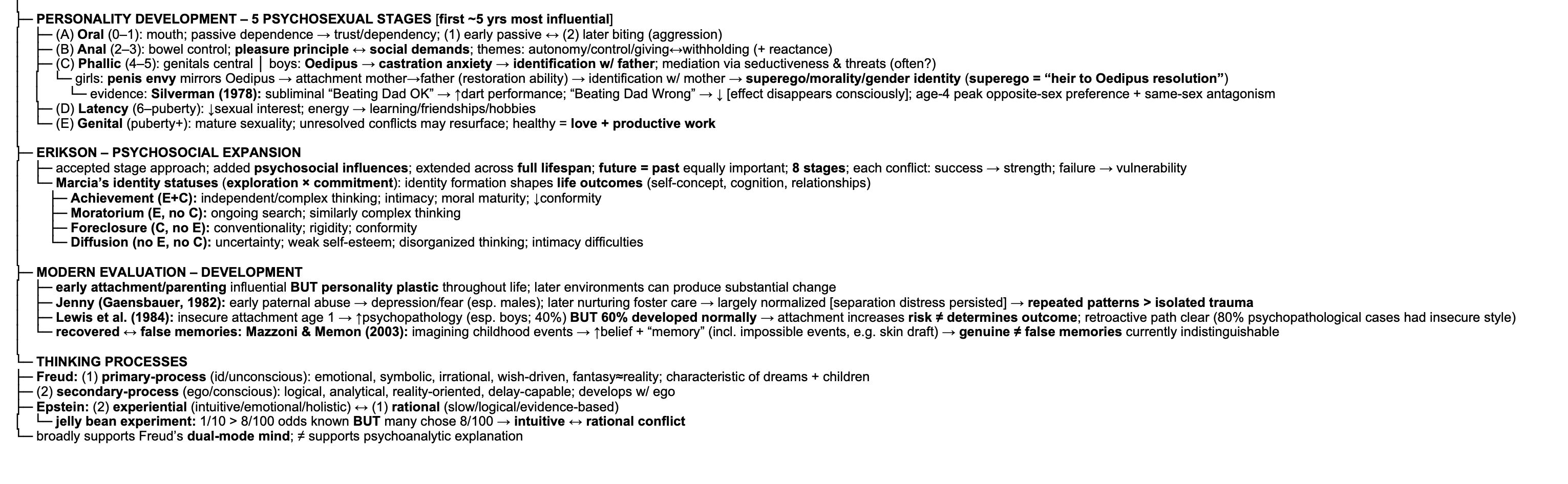
Freud: Personality development = universal sequence of psychosexual (“sensual”) stages; each stage defined by an erogenous zone providing gratification/tension reduction; conflicts at each stage permanently shape adult personality; first ~5 years most influential.
Oral stage (≈ 0–1 yr): mouth (feeding, sucking, biting); passive dependence on caregivers → trust/dependency; (1) early passive ↔ (2) later biting phase (aggression + pleasure merge); adult remnants: kissing, chewing gum, “food for thought.”
Anal stage (≈ 2–3 yrs): bowel control/toilet training; pleasure principle ↔ social demands; themes: autonomy, control, giving ↔ withholding, obedience ↔ defiance; may produce intentional soiling (reactance).
Phallic stage (≈ 4–5 yrs): genitals become central
boys: Oedipus complex (mother attraction + father rivalry) → castration anxiety (heightened by maternal seductiveness/father’s threats; happens often!!) → resolution via identification with father.
Girls: penis envy mirrors (!) Oedipus complex in boys → attachment shifts mother → father (“restore” penis symbolically) → resolution via identification with mother → superego, morality, gender identity (“superego = heir to Oedipus resolution”).
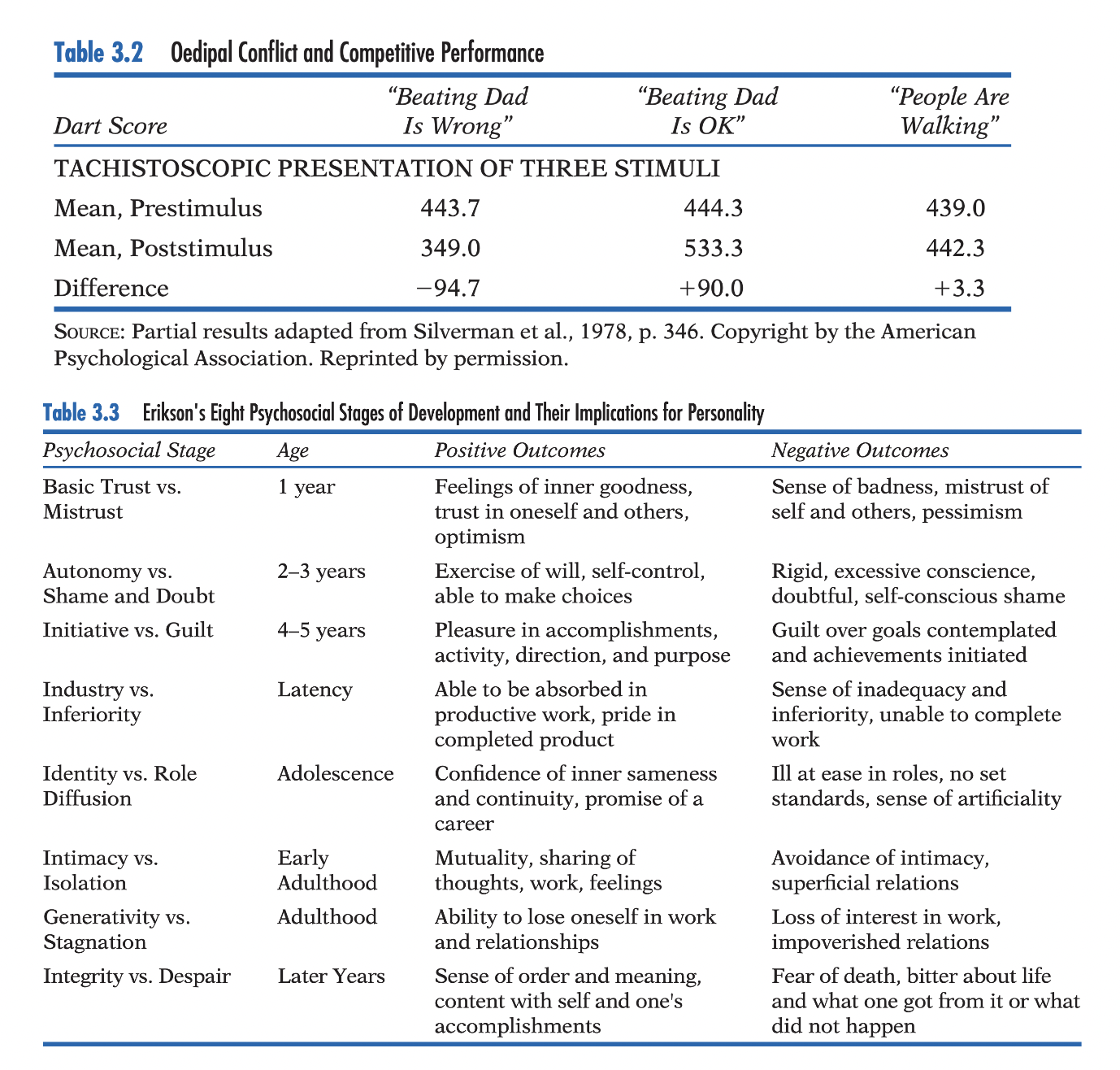
Evidence: Silverman et al. (1978): after Oedipal priming, subliminal “Beating Dad Is OK” improved dart performance whereas “Beating Dad Is Wrong” impaired it (effect disappeared when consciously presented); another study found greater opposite-sex parent preference and same-sex parent antagonism around age 4 (declining by ages 5–6).
Latency stage (≈ 6 yrs–puberty): reduced sexual interest; psychic energy redirected toward learning, friendships, hobbies, and social development.
Genital stage (puberty+): mature sexuality emerges; libido directed toward adult relationships; unresolved earlier conflicts may reappear; healthy outcome = capacity for love and productive work.
Erikson: Psychosocial expansion: Accepted Freud’s stage approach but emphasized psychosocial as well as instinctual influences; extended development across the entire lifespan (importance; past = future) through 8 psychosocial stages // Each conflict: successful resolution → psychological strengths; failure → vulnerabilities. Central aspect of theory: Identity (adolescence): central task = coherent sense of self, continuity with past, future direction, balancing self-view with others’ perceptions.
Later, Marcia’s identity statuses (exploration × commitment): argued identity formation strategies shape later self-concept, cognition, and interpersonal relationships.
Achievement: exploration + commitment → independent/complex thinking, intimacy, mature moral reasoning, resistance to conformity.
Moratorium: exploration without commitment → ongoing identity search; similarly complex thinking.
Foreclosure: commitment without exploration → conventionality, rigidity, routine, conformity.
Diffusion: neither exploration nor commitment → uncertainty, weak self-esteem, disorganized thinking, intimacy difficulties.
What are modern views on Freud’s growth claims about personality, and what other interesting research/discoveries have been made regarding Freud’s ideas on thinking?
Modern evaluation of Freud’s developmental claims: early attachment, parenting, and emotional relationships strongly influence personality, BUT personality remains plastic throughout life; later environments, relationships, therapy, and experiences can produce substantial change.
Jenny case (Gaensbauer, 1982): early abuse by father → depression, fear (esp. of males), distress; later nurturing foster care largely normalized functioning (even for males), although separation-related anger/distress persisted → early experiences leave emotional traces, but later supportive environments can modify development; repeated relationship patterns appear more influential than isolated traumatic events.
Attachment study (Lewis et al., 1984): insecure attachment at age 1 predicted (prospective) more later psychopathology (especially in boys; 40%), but many insecurely attached children developed normally (60%) → early attachment increases risk ≠ determines outcome, BUT retroactive path clear (80% of psychopathological cases had insecure style).
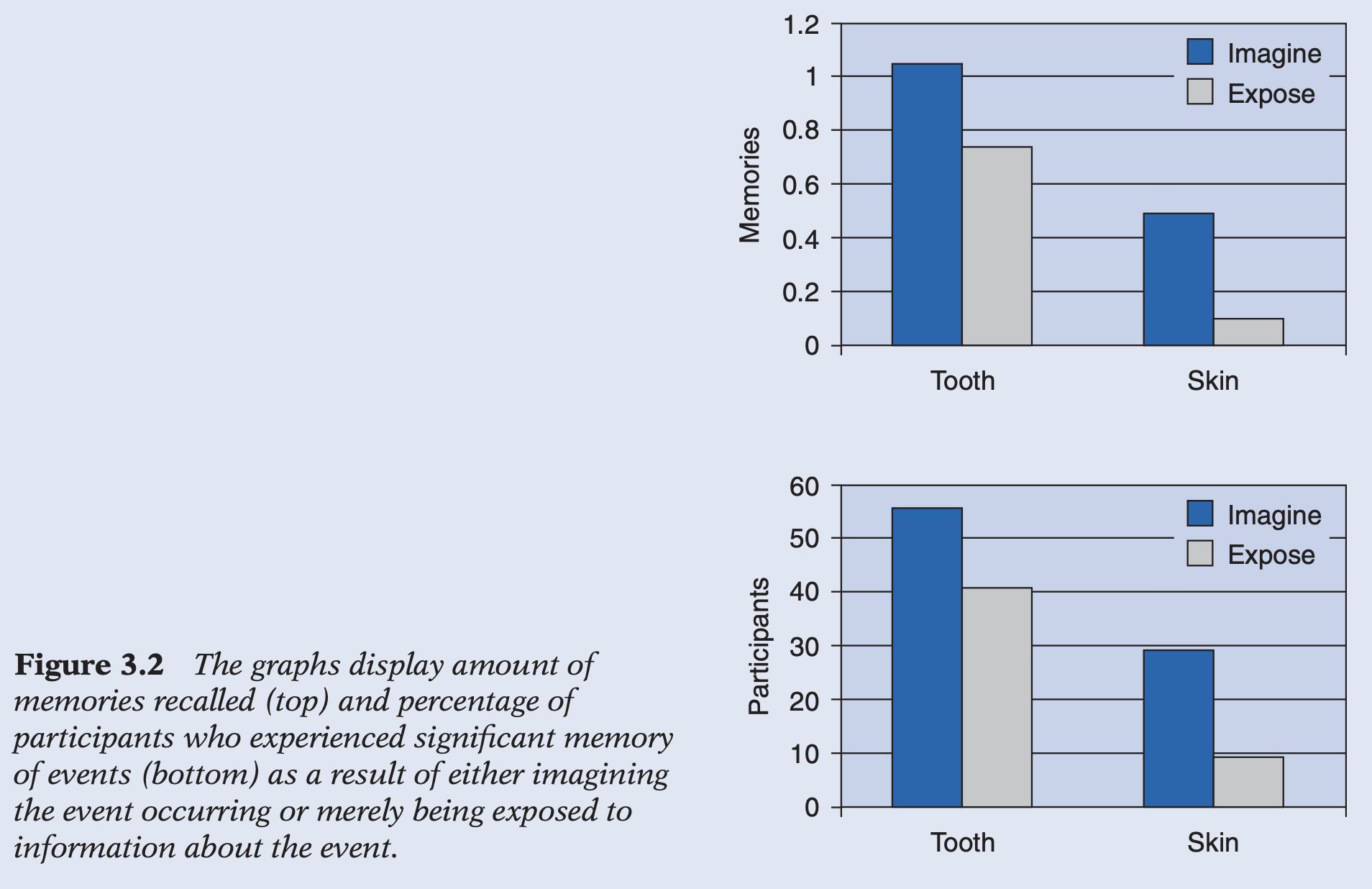
Recovered ↔ false memories: psychoanalysis → traumatic memories may be repressed then recovered during therapy; critics → some recovered memories may be false memories created by suggestion/imagination. Mazzoni & Memon (2003): merely imagining childhood events increased later belief and “memory” for those events (even an impossible skin-removal procedure) → genuine and false recovered memories currently cannot be reliably distinguished in individual cases.
Freud’s thinking processes: (1) Primary-process (id/unconscious) → emotional, symbolic, irrational, wish-driven, fantasy ≈ reality; characteristic of dreams and young children. (2) Secondary-process (ego/consciousness) → logical, analytical, reality-oriented, capable of delaying gratification; develops alongside the ego.
Modern development: Epstein: (1) Experiential thinking = intuitive, emotional, holistic; (2) Rational = slow, logical, evidence-based // Jelly bean experiment: despite knowing 1/10 > 8/100 odds, many participants chose 8/100 because it felt more likely → demonstrates conflict between intuitive and rational thinking, broadly supporting Freud’s idea that the mind operates through multiple interacting modes of thought, though not his psychoanalytic explanation.
Tree (PKP Ch. 3) 1/2
Tree (PKP Ch. 3) 2/2