PHLT 432 Exam 1
 Call Kai
 Learn
Learn Practice Test
 Spaced Repetition
 Match
Match Flashcards
 Knowt Play
1/176

There's no tags or description
Looks like no tags are added yet.
Name | Mastery | Learn | Test | Matching | Spaced | Call with Kai | Chat |
|---|
No analytics yet
Send a link to your students to track their progress
177 Terms
What is the definition of ergonomics?
The branch of science that is concerned with the achievement of optimal relationships between workers and their work environment
In a latin context, what does ergonomics mean?
The study of work.
Ergon = work
Nomikos = law
What is the golden rule of ergonomics?
Fit the job to the person, not the person to the job.
What does this mean? Instead of expecting workers to physically or mentally force themselves to adapt to poorly designed tasks or hazardous environments, this principle means modifying the work environment to match human capabilities and limitations
Ergonomics is an interdisciplinary science. True or false?
True. It is connected to psychology, physics, math, science, antomy, epi, chemistry, engineering, etc.
Lagging factors
Retrospective - waiting on data to happen. Can’t collect anything until something happens
Leading indicators
Evaluating a task before an issue happens. Preventative and prospective. Going out to evaluate a system to find potential areas for injuries before they occur.
What is the primary objective of ergonomics?
To achieve an optimal relationship between people and their work environment
What are the greatest conflicts to ergonomics?
Worker’s productivity
Cost of implementation
Corporate buy-in
Worker’s productivity
A business wants to stay in business; if an intervention cuts production, nobody wants it. We need to keep people safe without decreasing production.
Cost of implementation
There are usually 3 levels:
Cheap but fast, the problem still exists long-term
Middle ground: spend more money to get a medium-term fix, risks are still there
Completely get rid of the risk by spending as much money as possible
We need to find a balance between the money spent and the impact an intervention has. If there is no data to use as evidence that the intervention is important, the cost is harder to justify (this can be an issue with leading indicators)
Corporate buy-in
Organizations and workplaces will hire consultants. Anytime an ergonomist consultant goes to a workplace, they have to get them to buy into the intervention.
At the end of the day, all interventions really just come down to money justification (similar to cost of implementation above). The language is business is money.
Ergonomic Risk
The primary objective is to maximize the area (buffer zone) between employee capabilities (the human side - personal factors, non-occupational factors, behavioral factors, etc.) and job requirements (the work side - occupational factors, workload demand, etc.).
When job demands exceed human limits, ergonomic risk increases.
What is anthropometry?
The human component of ergonomics
The measurement of humans
What are the goals of anthropometric design?
We must design for those in the…
Range
Average
Extremes
Designing for the range
Designing for the most optimal person in a range of 5th percentile female and 95th percentile male. If they can do the task, most everybody can do it. This range allows us to optimize the amount of people that can do a task (covers about 90% of the population). Usually means using mechanical adjustments (standing desks, adjustable chairs)
Designing for the average
Designing a fixed dimension based on 50th percentile measurements. While cost-effective for short-use items (e.g., checkout counters or auditorium seating), ergonomists caution that “designing for the average designs for no one”—because an individual who is average in stature is rarely average in arm reach, leg length, or torso size
Designing for the extreme
Accounts ONLY for the 5th percentile female or ONLY for the 95th percentile male. Usually very expensive. Sets fixed upper or lower thresholds when adjustability is impractical.
Ex: Airlines for athletes; private jets are completely customized for their long limbs
What are the 4 industrial applications?
Tool/equipment evaluation
Manufacturing/assembly lines
Limitations of human capabilities
Environmental effects on human capacity
Tool/equipment evaluation
Design, modification, replacement, and maintenance of equipment for enhanced productivity, and the work-life & product quality
Manufacturing/assembly lines
Design and modification of work spaces and workplace layout for ease and speed of operation, service, and maintenance
Limitations of human capabilities
Design and modification of work methods, including automation and task allocation between human operators and machines
What tools are humans using, are they using them in the right way?
Environmental effects on human capacity
Controlling physical factors (heat, cold, noise, vibration, light) in the workplace for the best productivity and safety of employees
Occupational factors
Environmental conditions (temperature, light, noise)
Physical and mental requirements of a job
Worker’s exposure to hazardous materials
Interaction between worker and work equipment
Types of hazards
Physical
Extremes of temperature, noise, vibration, and radiation
Falling, slipping, tripping
Chemical
Liquids, solids, gases, dusts, fumes, mists
Can be inhaled, swallowed, or absorbed
Biological
Healthcare industry: Blood, cooling liquids, bacteria
Anatomy
Branch of science which deals with the body’s structures (bones, muscles, tendons, ligaments, other structures)
STRUCTURE
Physiology
Science of body’s functions, including metabolism, muscle mechanics, oxygen and nutrient distribution, temperature regulation, nerve transmission, other functional activities
FUNCTION
What is anatomical position?
Standing erect, eyes looking forward to the horizon, arms by sides, palms of hands and toes directed forward

What are the 3 reference planes?
Sagittal
Coronal
Transverse
Saggital plane
Vertical plane dividing the body into left and right parts
Also known as the “median” (but isn’t necessarily in the middle)
The mid sagittal plane divides into right and left halves
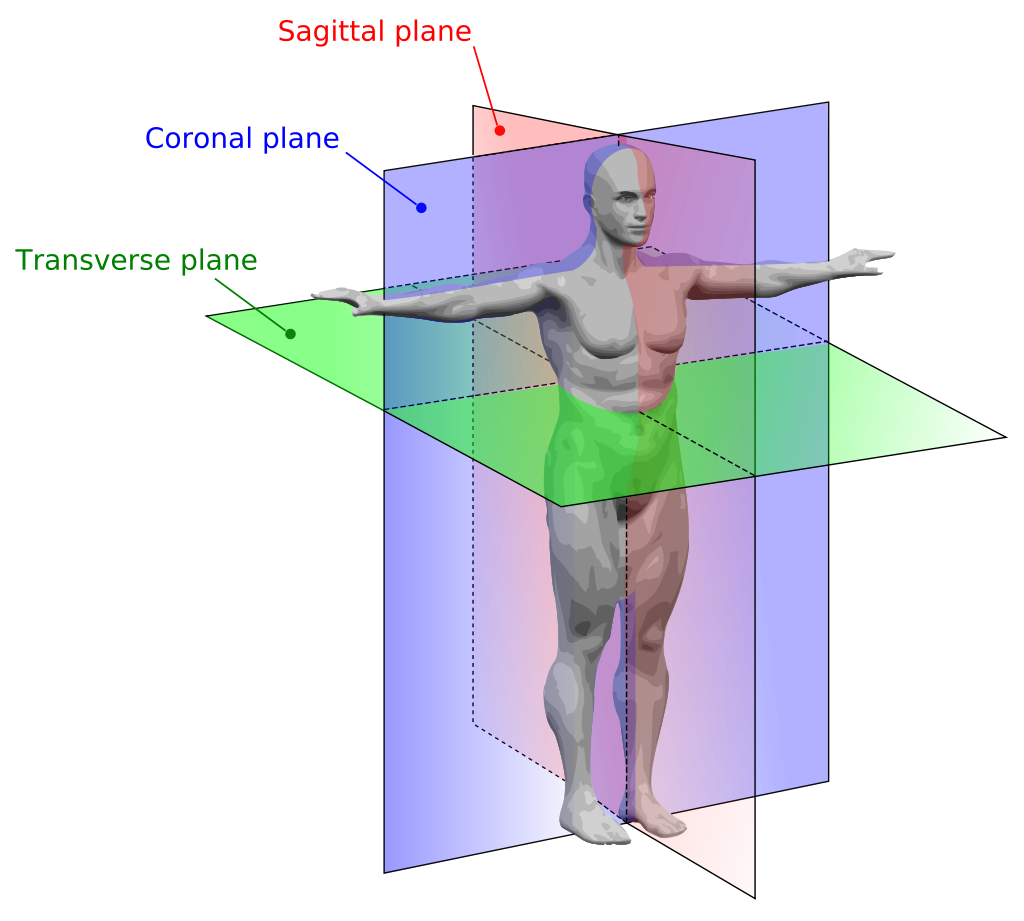
Coronal plane
Vertical plane perpendicular to the median
Divides body into FRONT and BACK
Imagine you are wearing a CROWN on the front or back of your head

Transverse plane
Horizontal plane that is perpendicular to the saggital and coronal planes
Divides body into upper and lower parts (top and bottom)

Anterior
Refers to the front, nearer the surface of the body

Posterior
Refers to the back, nearer the back surface of the body

Superior
Above, upper, higher part of the body (near crown of head)

Inferior
Below, lower part of the body (near soles of the feet)
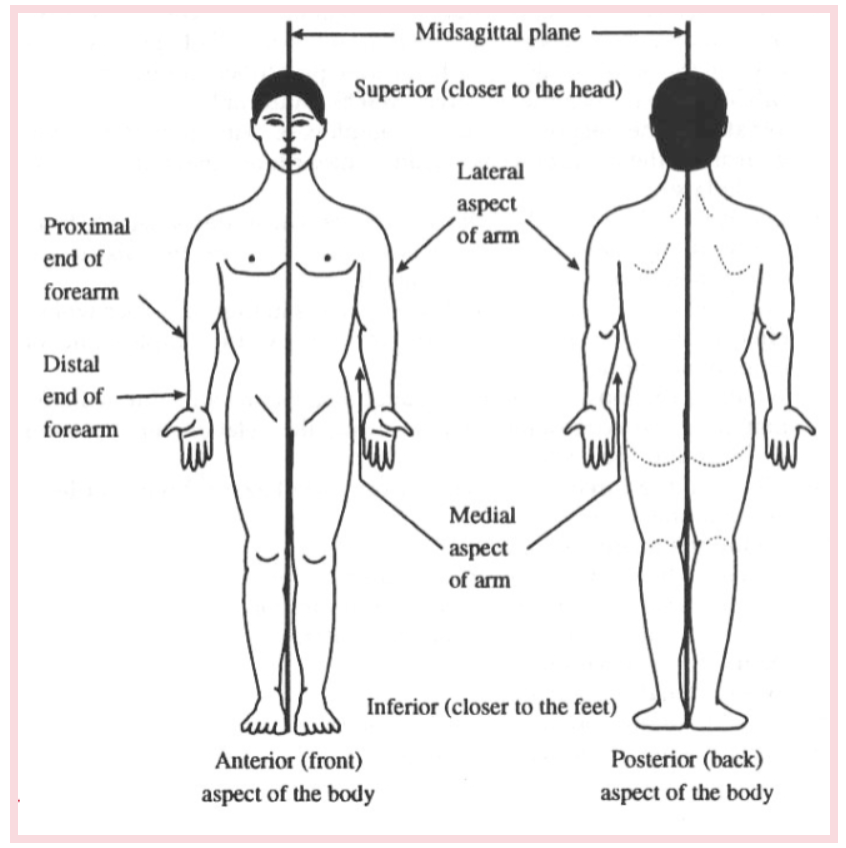
Medial
Nearer the median plane of the body (or body part)

Lateral
Farther from the median plane

Proximal
The end of a body member nearer the body; the point where a limb attaches

Distal
The end of a body segment farther from the body or point of attachment

Palmar or volar
Anterior surface of the hand or forearm

Dorsal
Pertaining to the back or nearer the back (of the foot, hand, and forearm)
Similar to “posterior”
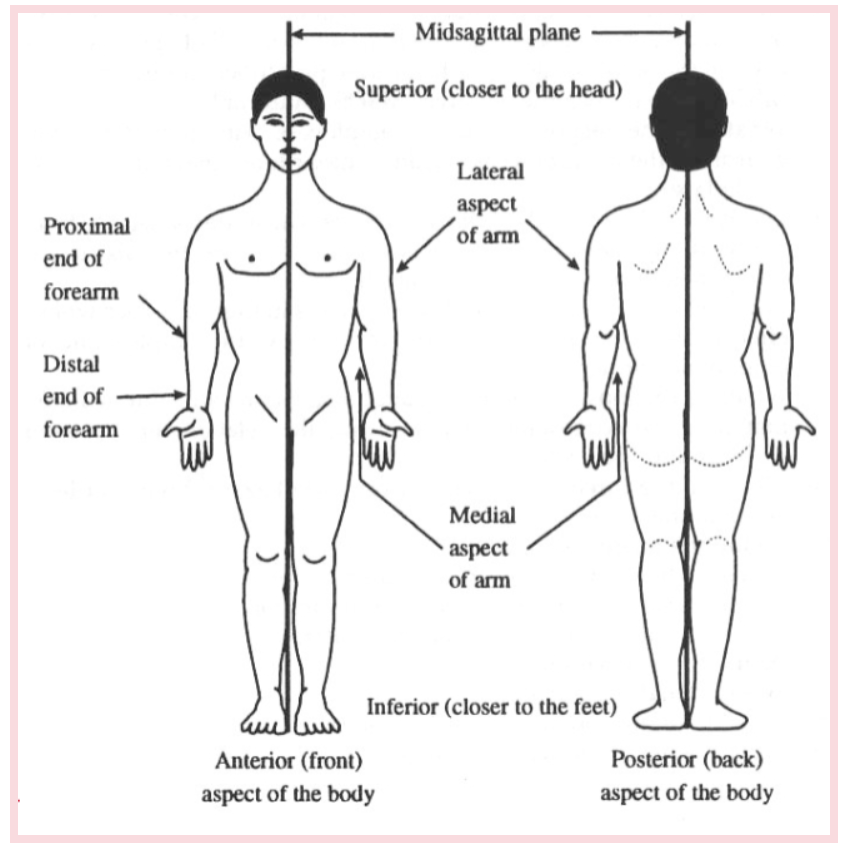
Plantar
Sole of the foot

Who said “People buy into the leader before they buy into the idea.”?
John Maxwell
What are the components of the skeletal system?
Bone
Cartilage
Hemopoietic Tissues
Tendons
Ligaments
What are hemopoietic tissues responsible for?
Forming blood cells
What components of the skeletal system are connective tissue?
Tendons and ligaments (and technically fascia but that’s later in the slide)
How many bones are there in the human body?
206
How are bones classified?
By shape
Long bones
Arms, legs, fingers, toes
What is a characteristic of long bones?
They are strong vertically (long axis) but very weak horizontally. For example, the femur provides strong weight support, but a horizontal force would easily break it.
Short bones
Wrists and ankles
Characteristics of short bones
Can make a combined movement based on the capable movements of each bone, which can move in many different planes. Has a significant amount of movement capacity
Flat bones
Ribs, skull, etc.
Characteristics of flat bones
To provide protection to internal organs like the lungs and brain
Irregular bones
Vertebrae, sacrum, etc
Characteristics of irregular bones
To allow mobility, support, nerve escape (which is why there are holes in the sacrum)
Their purpose is to provide function. Function controls the design.
Right now you need to go back in the lecture slides (PPT 2) and memorize all of the bones on the “bones to know” slide
I did it!
Connective tissue is made up of…
Ligaments, tendons, and fascia
Ligaments
Connects bone to bone and stabilizes joint structures
What does a ligament connect?
Bone to bone
Tendons
Transmits force from muscle to bone
What do tendons connect?
Muscle to bone
Fascia
General connective tissue
Where might fascia be found?
Cavity lining. It is internal connective tissue.
Axial skeleton
Skull, spone, ribs and sternum, and pelvis. Basically everything connected to the spine.

Appendicular skeleton
Arms, legs, collarbone
Upper extremeties
Clavicle and scapula, humerus, radius, ulna, wrist, hand bones
Lower extremeties
Femur, patella, fibula, tibia, foot bones

Functions of the skeletal system
Supporting body’s framework (preventing collapse into soft tissue)
Provides physical framework upon which to apply force
Protection of vital organs, like the ribcage and skull
Allow movement of body (provides mechanical levers for skeletal muscles)
Housing bone marrow which produces red blood cells
Storing calcium and phosphorous
Cartilage
Cushions the ends of bones and acts as a shock absorber
Found between joints of spinal column (disks), at joint surface of limbs, at end of ribs
Ex: Between the ribs and sternum, there is cartilage
Firm, elastic, flexible, and capable of rapid growth
Avascular (Nutrients and oxygen reach cells only by diffusion. It can’t replenish itself)
What are the 3 types of cartilage?
Hyaline
Fibrous
Elastic
Hyaline cartilage tissue
Covers articular surfaces
Cushions joints against impact effects
Hyaline = glassy
Can be found in fingers because it is a lubricant fluid = lots of movement
Fibrous cartilage tissue
Greatest rigidity and tensile strength
Ribcage, intervertebral disks
Resistant to wear + tear and compression
Elastic cartilage tissue
Elasticity and firmness
Ears and nose (maintains shape of anatomical structures)
Cartilage microstructure
Similiar to bone in that…
Has more intercellular substance than cells
Collagenic fibers reinforce the matrix of tisuse
This makes it resistant to stretching and gives it tensile strength
Different from bone in that…
Fibers are imbedded in a firm gel instead of calcified matrix (bones are calcified/ossified)
Flexibility rather than rigidity
Fiber orientation: Tendons
Pattern: The fibers are arranged completely in parallel, straight lines
Purpose: Tendons connect muscle to bone
Because muscles pull in one specific direction (toward the MUSCLE), this parallel alignment gives the tendon maximum tensile strength along a single axis to transmit force efficiently without stretching
Fiber orientation: Ligaments
Pattern: The fibers are mostly parallel with interwoven, crisscrossing fibers
Purpose: Ligaments connect bone to bone to stabilize joints
Since joints experience forces from varying angles during movement, the slight cross-weaving allows the ligament to withstand primary pulling forces while providing stability against multi-angle stress.
Fiber orientation: Skin
Pattern: The fibers are arranged in a random, crisscrossed, multidirectional web
Purpose: Skin must stretch, flex, and resist friction or forces coming from any direction without tearing, so a mesh pattern provides elasticity and flexibility in all directions
What are the 3 types of joints?
Fibrous/suture
Cartilaginous
Synovial
Fibrous/suture joints
Sutures in skull and pelvis
Strong, inflexible
Cartilaginous joints
Intervertebral disks, sternum
Shock absorption
Moderate degree of movement
Synovial joints
Finger, elbow, knee
Wide range of movement between articular surfaces
Limited movement based on number of axes
Enclosed by a joint capsule made up of bone, articular cartilage, supporting ligaments, the synovium, and lubricating synovial fluid
Moves smoothly for fine motor control (Hinge and ball-and-socket joints in the fingers, elbows, and knees)
Vertebrae
Cervical
Thoracic
Lumbar
Sacral
Cervical
7 vertebrae in the neck area
Thoracic
12 vertebrae behind the ribcage
Lumbar
5 vertebrae in the lower back
Sacral
5 fused vertebrae below the lower back
Coccyx (not as important lol)
4-5 fused vertebrae near the tailbone
What are the vertebrae numbers down the back?
7
12
5
5
Spinal structure
Vertebrae separated by intervertebral disks
The disks are tough, fibrous rings filled with gel-like substances that act as shock absorbers, provide flexibility, and are the most fragile part of the spine
Ex: That’s why a herniated disk hurts so much, because it puts constant pressure on the nerve.
Types of spinal curvature
Scoliosis, kyphosis, lordosis
Scoliosis
Abnormal lateral (away from the trunk) curvature
Kyphosis
Abnormal posterior (to the back) curvature of the thoracic spine
Lordosis
Abnormal anterior (to the front) curvature of the lumbar spine
Microscopic structure of bone
Bone consists of living cells and non-living intercellular substance
Intercellular matrix is non-living, calcified, and rigid
The living cells are osteoblasts, osteoclasts, and osteocytes (trapped osteoblasts)
Build, breakdown, monitor
Two types of long bone structures
Compact (dense): Shafts of long bones (diaphysis) and outer shell of bone structures
Cancellous (spongy): Enlarged ends of long ends (epiphysis), the surface for muscle connection
Where is bone marrow stored?
Medullary cavity
Diaphysis
Main shaft of long bone, provides support without excess weight (hollow cylinder)
Epiphysis
Extremities of long bones, provides for muscle attachments and stable joints
Articular cartilage
Thin layer of hyaline cartilage covering articular surface if epiphysis - cushions joint
Medullary cavity
Runs length of diaphysis, contains bone marrow
Wolff’s Law
Bone will deposit where needed (for structural support) and be reabsorbed where not needed based upon the mechanical stresses placed on it.
Implications of Wolff’s Law
Healing broken bones
Space travel
Bed-ridden patients (osteoporosis)
Lifting jobs