Communities and Ecosystems Lecture Flashcards
 View linked note
 Call Kai
 Learn
Learn Practice Test
 Spaced Repetition
 Match
Match Flashcards
 Knowt Play
1/57

Earn XP
Description and Tags
Vocabulary flashcards covering ecological communities, interspecific interactions, trophic structures, energy flow, and biogeochemical cycles based on Chapter 37 of Campbell Biology: Concepts & Connections.
Name | Mastery | Learn | Test | Matching | Spaced | Call with Kai | Chat |
|---|
No analytics yet
Send a link to your students to track their progress
58 Terms
Biological community
An assemblage of all the populations of organisms living close enough together for potential interaction, described by its species composition.
Community ecology
The study of factors that influence species composition and distribution of communities and affect community stability.
Interspecific interactions
Relationships with individuals of other species in the community that affect population structure and dynamics; they include competition, mutualism, predation, herbivory, and parasitism.
Interspecific competition
A −/− interaction that occurs when populations of two different species compete for the same limited resource.
Mutualism
A +/+ interaction in which both participating populations benefit, such as the relationship between reef-building corals and photosynthetic dinoflagellates.
Predation
A +/− interaction where one species (the predator) kills and eats another (the prey).
Herbivory
A +/− interaction where an animal consumes plant parts or algae.
Parasitism
A +/− interaction where host plants or animals are victimized by parasites or pathogens that obtain nourishment from them.
Prey-Adapted protective strategies
Camouflage, mechanical defense(shells, thorns), chemical defense(toxins/posion)
Parasite
Organism living on or in a host for nourishment
Internal Parasite
Nematodes and tapeworms
External Parasite
Mosquitos, ticks, aphids
Non-native pathogens
Cause rapid destruction due to ecosystem’s lack of natural defenses
Ecological niche
The sum of an organism’s use of the biotic and abiotic resources in its environment.
Coevolution
A series of reciprocal evolutionary adaptations in two species, in which change in one species acts as a new selective force on another.
Pathogens
Disease-causing microscopic parasites that include bacteria, viruses, fungi, or protists.
Trophic structure
A pattern of feeding relationships in a community consisting of several different levels.
Food chain
The sequence of food transfer up the trophic levels, moving chemical nutrients and energy from producers to consumers.
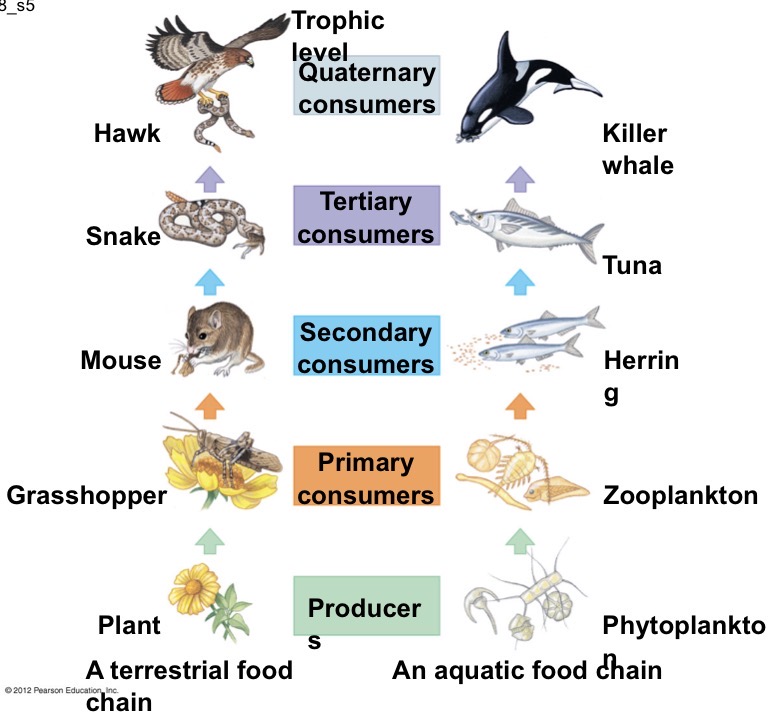
The Trophic Levels
Producers
Primary Consumers
Secondary Consumers
Tertiary Consumers
Quaternary Consumers
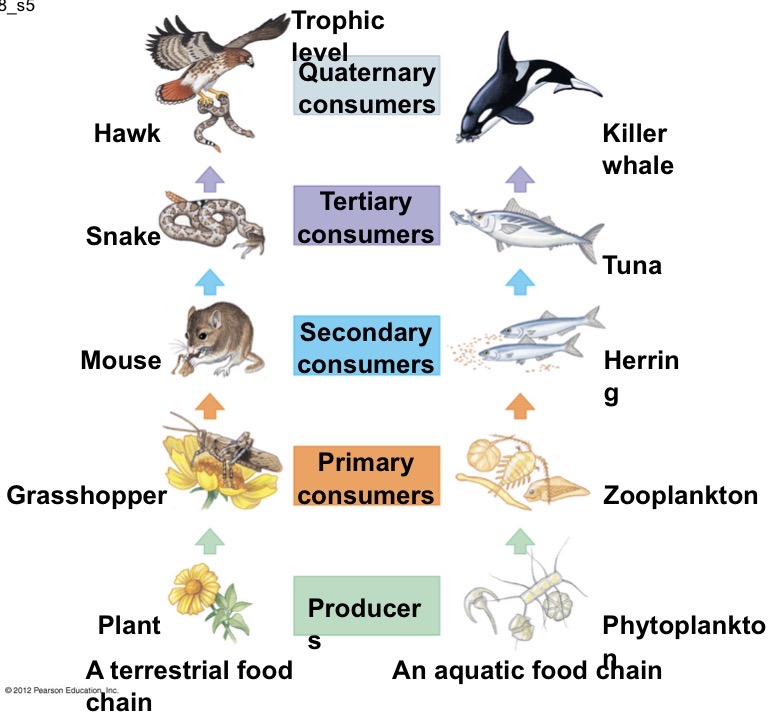
Autotrophs
Producers
Heterotroph
Quaternary Consumers
Producers
Autotrophs that support all other trophic levels by converting light or chemical energy into organic compounds.
Consumers
Heterotrophs categorized by their feeding level, including primary consumers (herbivores), secondary consumers, tertiary consumers, and quaternary consumers.
Detritivores
Organisms that derive their energy from detritus, the dead material produced at all trophic levels.
Decomposers
Mainly prokaryotes and fungi that secrete enzymes to digest organic materials and convert them into inorganic forms in a process called decomposition.
Food web
A network of interconnecting food chains where consumers may eat more than one type of producer.
Species diversity
The variety of species in a community, defined by two components: species richness and relative abundance.
Species richness
The total number of different species in a biological community.
Relative abundance
The proportional representation of each species in a community.
Keystone species
A species that occupies a niche that holds the rest of its community in place and has a disproportionate impact relative to its biomass or abundance.
Disturbance
Events such as storms, fires, floods, droughts, or human activity that damage biological communities and strip away vegetation.
Ecological succession
The process of community change resulting from colonization by a variety of species, which are then replaced by a succession of other species.
Primary succession
A type of succession that begins in a virtually lifeless area with no soil, such as after a volcanic eruption.
Secondary succession
A type of succession that occurs when a disturbance destroys an existing community but leaves the soil intact.
Succession Stages
Annual Plants → Perennial Plants & Grasses → Shrubs → Softwood Trees → Hardwood Trees
Climax community
The final, stable stage of succession, often characterized by old-growth hardwood trees.
Invasive species
Organisms introduced into non-native habitats by human actions that establish themselves at the expense of native communities, often due to the absence of natural enemies.
Ecosystem
Consists of all the organisms in a community and the abiotic environment with which those organisms interact.
Terrarium
Components of an ecosystem illustrating fundamentals of energy flow through chemical cycling
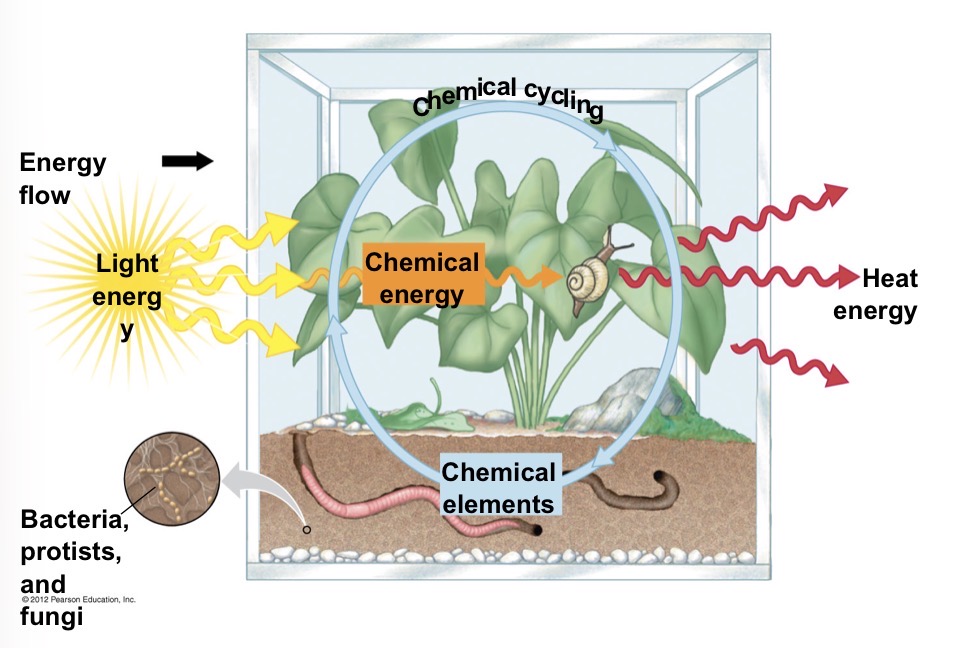
Energy flow
The movement of energy through the components of an ecosystem, starting with light energy and ending with heat loss.
Chemical cycling
The transfer of materials, such as chemical elements, within an ecosystem among producers, consumers, decomposers, and abiotic reservoirs.
Primary production
The amount of solar energy converted to chemical energy by an ecosystem’s producers for a given area during a given time period.
Biomass
The total amount of living organic material in an ecosystem.
High ecosystem productivity
Rain forests, coral reefs, algae, etc.
Pyramid of production
A representation of the flow of energy through trophic levels where only about 10% of the energy at one level is available to the next.
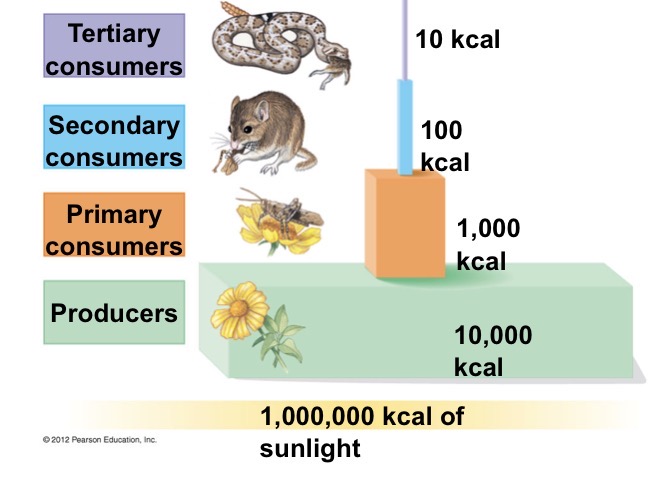
Low productivity Ecosystems
deserts & open oceans
Ecological Cost of Meat
Human population has 10x more energy when eating plans over meats - meat consumption is economically and environmentally expensive due to 90% energy loss at each tropical level
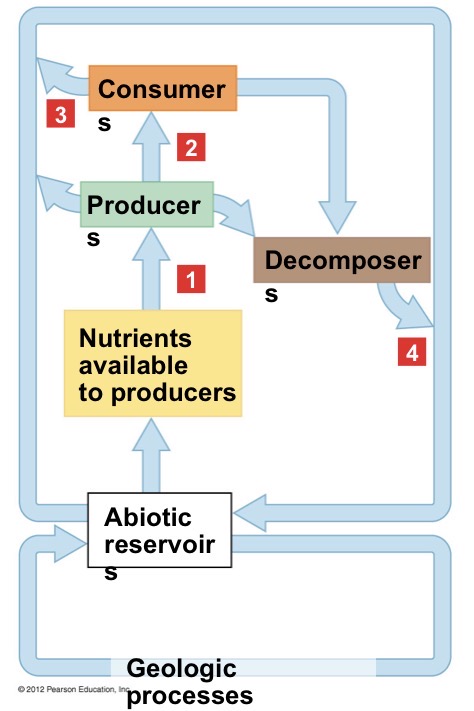
Biogeochemical cycles
Cycles that involve both biotic and abiotic components and include abiotic reservoirs where chemicals accumulate outside of living organisms.
Ecosystems Dependents
Continual influx of energy & recycling of chemical elements
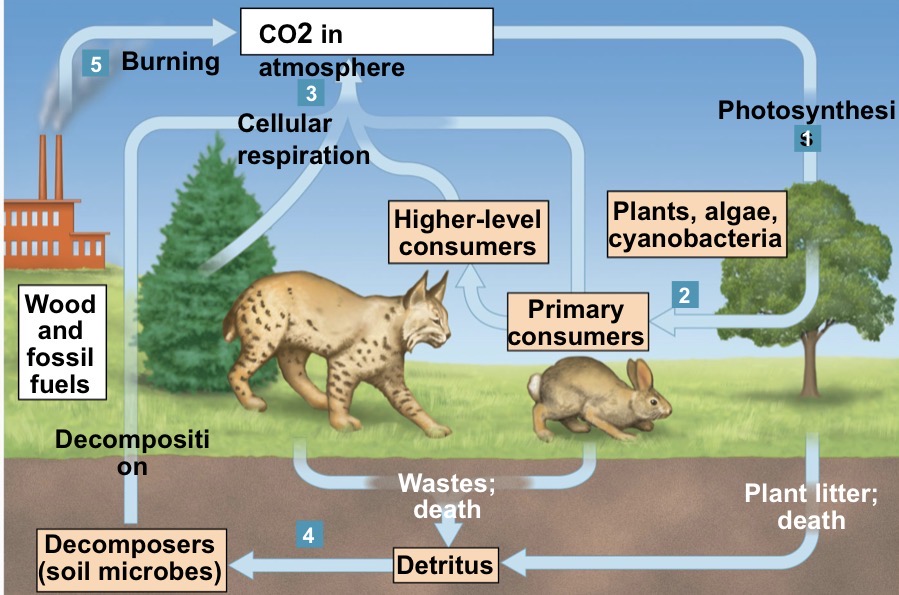
Carbon Cycle
Major Ingredient of organic molecules found in atmosphere, fossil fuels, and dissolve in ocean
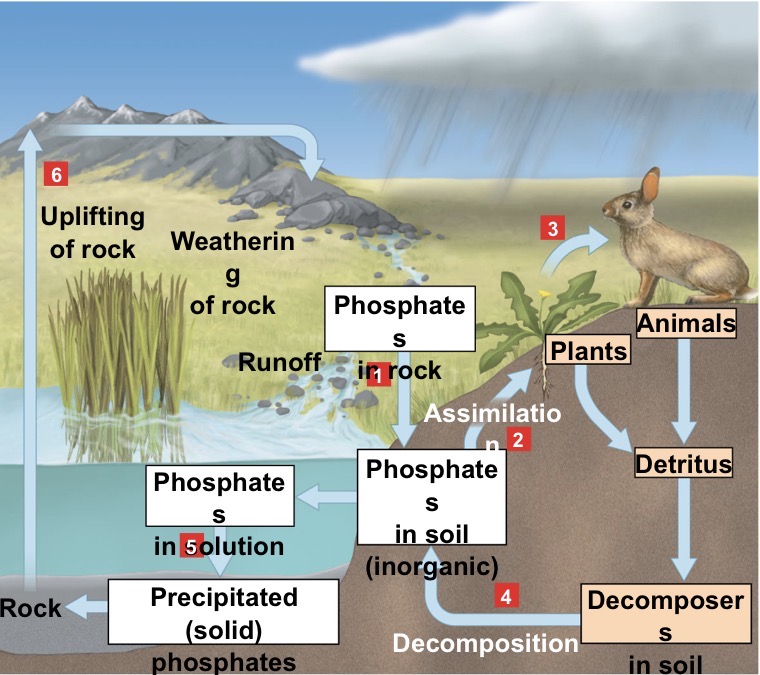
Phosphorus Cycle
Required for nucleic acids, phospholipids, and ATP with no atmospheric components - rocks being primary source. Phosphate levels often limiting factor in aquatic ecosystems
Nitrogen Cycle
Required for proteins and nucleic acids containing abiotic reservoirs and nitrogen fixation
Nitrogen fixation
A process carried out by specific bacteria that converts atmospheric N2 into compounds of nitrogen that can be used by plants.
Eutrophication
A process where nutrient levels of phosphorus and nitrogen increase in standing water, leading to oxygen depletion and decreased species diversity.
Rapid Eutrophication
Depletion of oxygen levels + Decrease in species diversity
Abiotic reservoirs
Where chemicals stockpile outside organisms
Sources of pollution in Eutrophication
Agricultural fertilizers, pesticides, sewage facilities, and animal feedlots runoff
Ecosystem services
Natural services including recycling nutrients, decomposing wastes, regulating climate, buffering against hurricane damage, and preventing erosion.