Movement Disorders Pharma
 Call Kai
 Learn
Learn Practice Test
 Spaced Repetition
 Match
Match Flashcards
 Knowt Play
1/22

There's no tags or description
Looks like no tags are added yet.
Name | Mastery | Learn | Test | Matching | Spaced | Call with Kai | Chat |
|---|
No analytics yet
Send a link to your students to track their progress
23 Terms
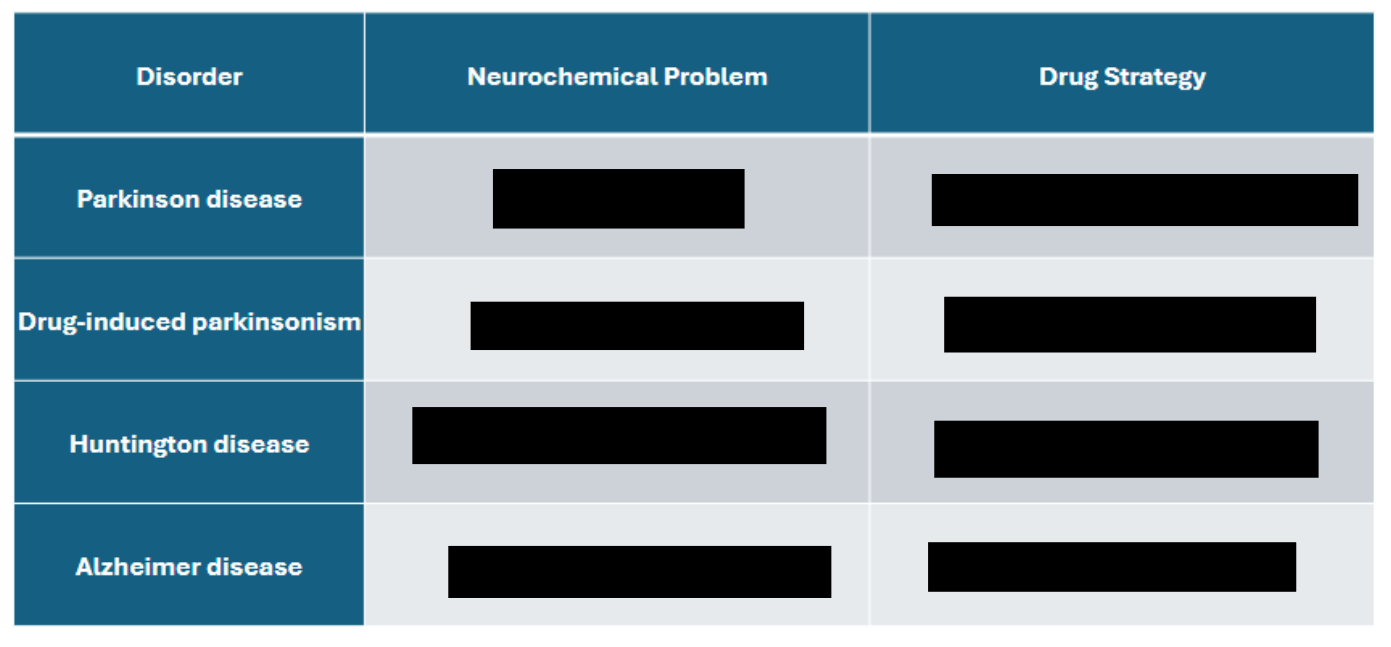
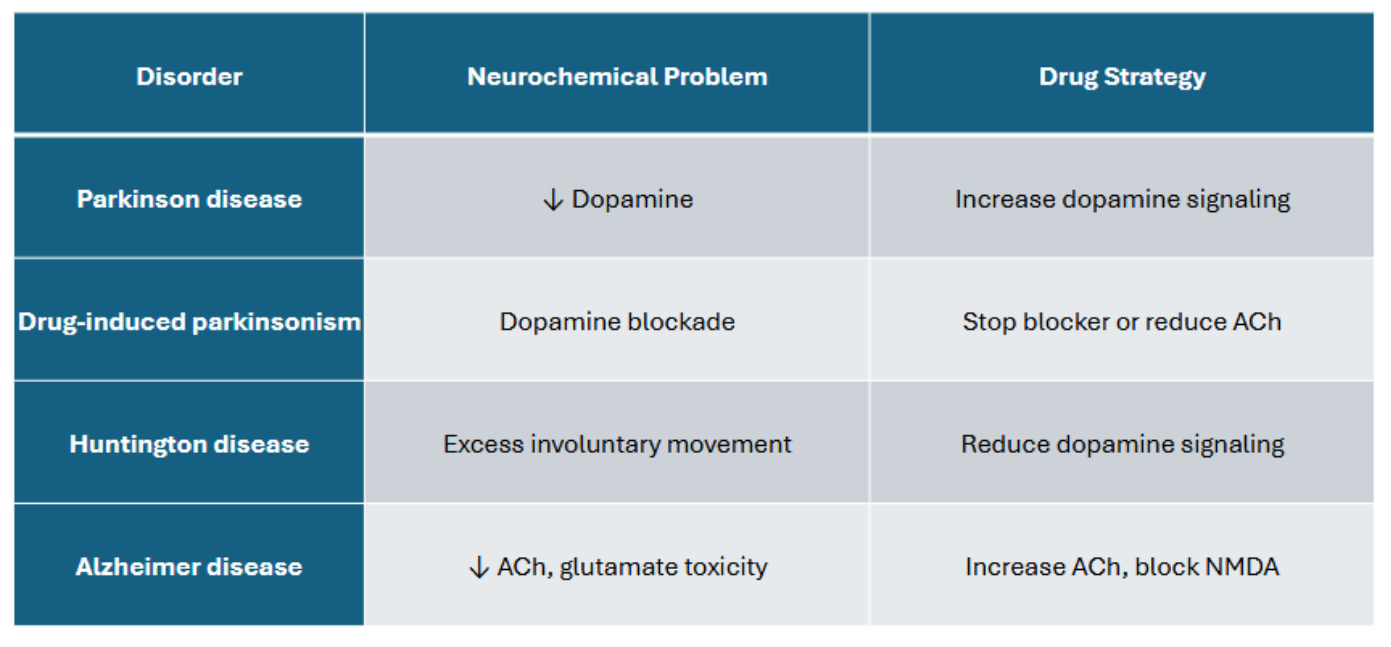
List the function of these DOPAMINERGIC PATHWAYS
DOPAMINERGIC PATHWAYS
Mesocortical pathway
Perception, cognition, social behavior
Mesolimbic pathway
Motivation & reward
Nigrostriatal pathway
Motor control (affected in Parkinson’s disease)
↓ activity → extrapyramidal symptoms
Tuberoinfundibular pathway
↓ activity → ↑ prolactin release
NOTE:
Antipsychotics work on all except for Mesocortical
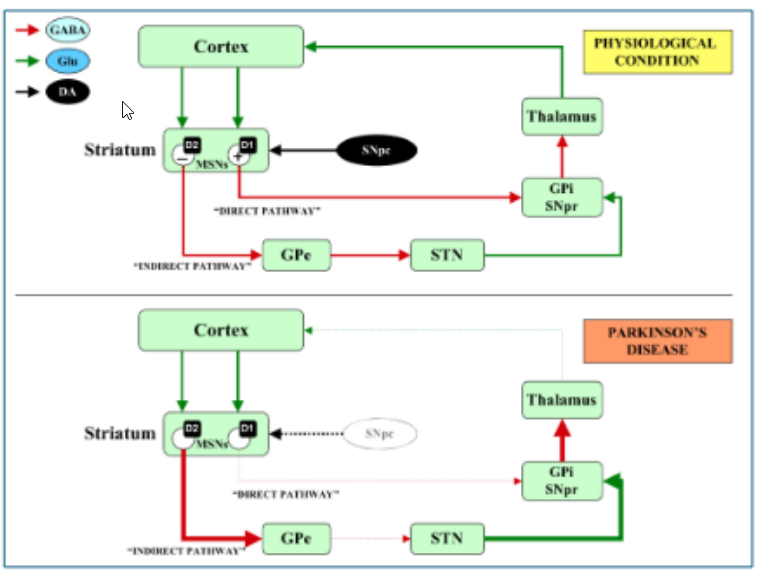
Describe PD Patho
Describe what happens in the normal physiological condition vs PD condition
PD Patho
Loss of inhibitory dopaminergic neurons in substantia nigra
Dopa neurons fire tonically, and not in response to specific sensory inputs
Less dopamine release in the neostriatum
Loss of inhibitory effect of dopamine in neostriatum
Less inhibition of
stimulatory Motor neurons
inhibitory GABA neurons -> substantia nigra
↓ inhibitory effects of dopamine → ↑ acetylcholine production → abnormal signaling → impaired mobility
Physiological condition
Dopamine -> promotes movement by
stimulating direct D1 pathways
inhibiting indirect D2 pathway
PD Condition:
Dopa Deficiency ->
Overact. Indirect D2 pathways
Reduces Direct D1 pathway
-> inhibition of the motor thalamus
[REVIEW] basal ganglia pathway
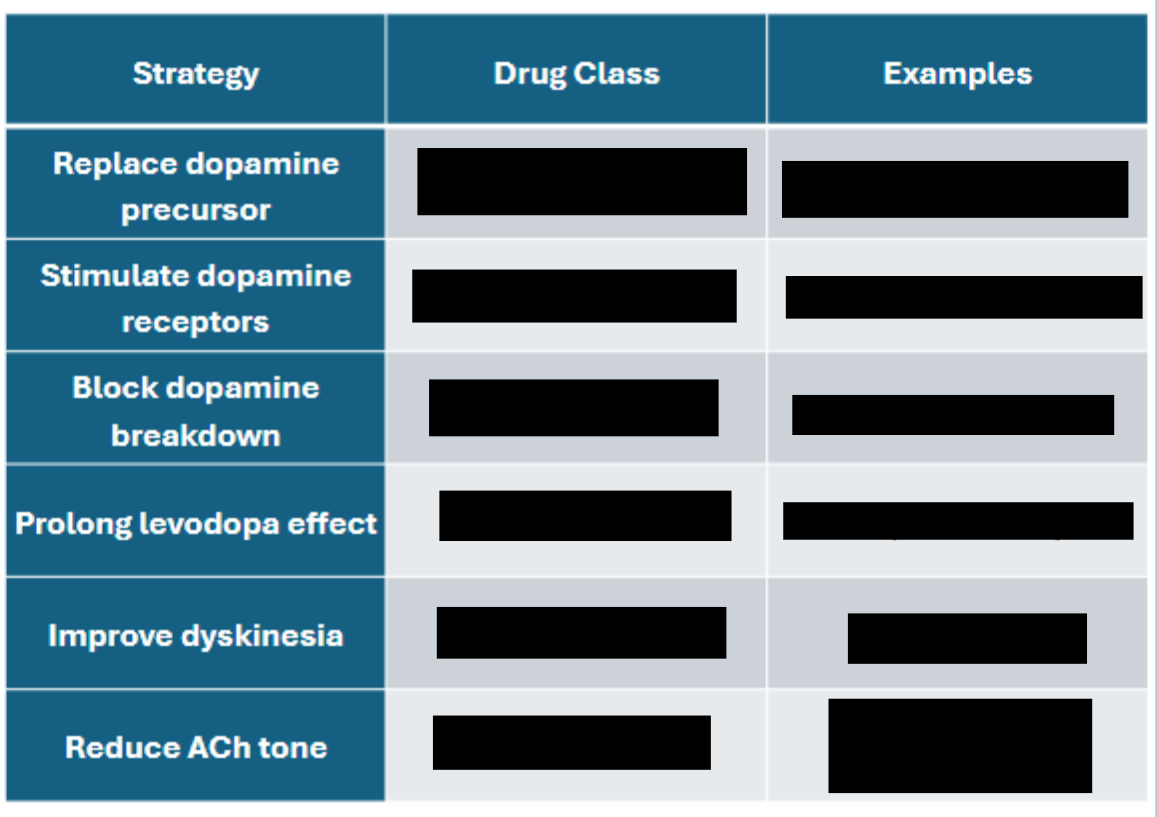

Describe LEVODOPA
What is it
MOA
Treats
Synergy
Describe Carbidopa
MOA
Synergy Effects
List the adverse effects of Both
Long term Levodopa complications
Drug Interactions
LEVODOPA
What is it?
dopamine replacement agent
MOA
Dopa can’t cross BBB; Levodopa can -> converts to dopa in C/PNS
Treats:
Parkinson motor symptoms (most effective)
bradykinesia & rigidity
Synergy:
Combines w/ carbidopa
Sinemet, Rytary
peripheral decarboxylase inhibitors → ↑ bioavailability
Carbidopa
MOA
Inhibits peripheral DOPA decarboxylase
Levo can’t -> Dopa
Does not Cross BBB
Synergy effects :
↓ levodopa in the periphery → ↑ levodopa to the CNS
↓ dose of levodopa needed by 4- to 5-fold
↓ adverse effects arising from peripheral dopamine
ADVERSE EFFECTS (Both)
GI:
N/V
Cardiovascular:
Orthostatic hypotension;
possible arrhythmias
CNS:
Hallucinations,
confusion,
Psychosis
especially in older patients
Motor
Dyskinesias + motor fluctuations w/ chronic therapy
LONG-TERM LEVODOPA COMPLICATIONS
Wearing-off
Dose effect does not last until next dose.
On-off phenomenon
Sudden unpredictable shifts between mobility and immobility.
Dyskinesia
Involuntary choreiform movements.
DRUG INTERACTIONS
Vitamin pyridoxine (B6)
Function: ↑ peripheral breakdown of levodopa
Can be co-administered with levodopa & carbidopa combination
Vitamin B6 increases the rate of aromatic amino acid decarboxylation
Carbidopa inhibits this action of Vitamin B6
Nonselective monoamine oxidase inhibitors (MAOIs)
Phenelzine + levodopa → hypertensive crisis
enhanced catecholamine production
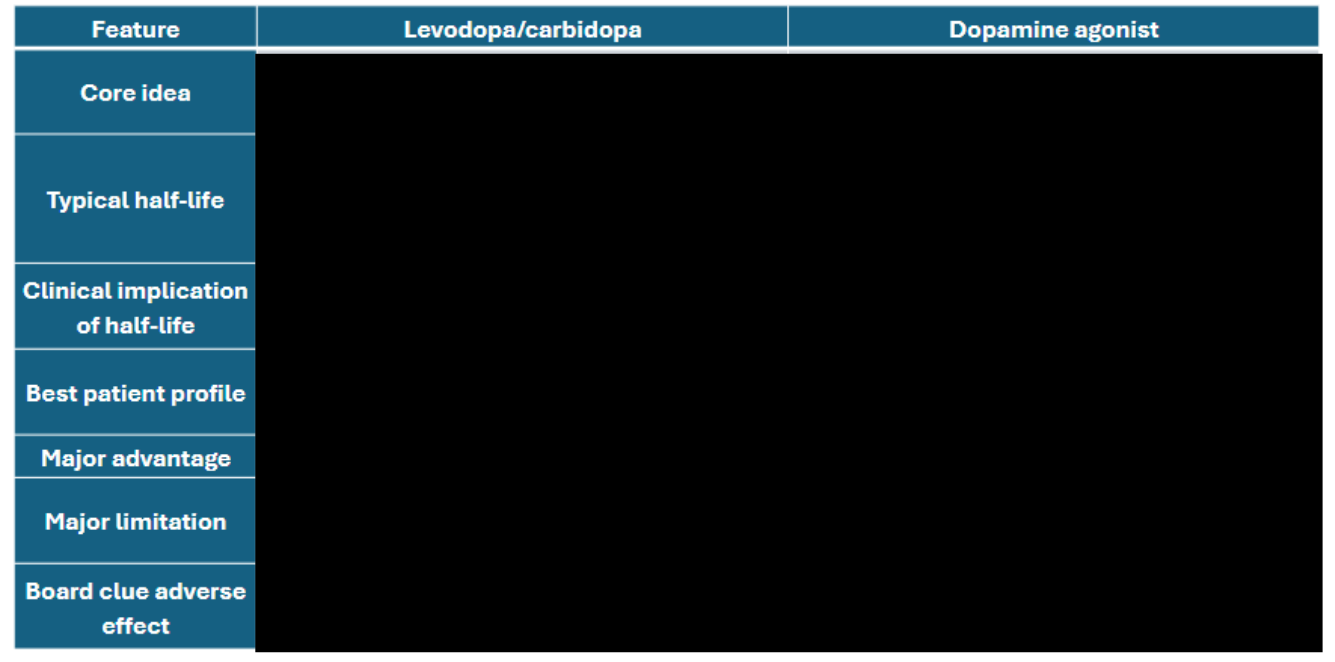
Describe DOPAMINE AGONISTS
Main Uses
Pt. Profile
Members/Diseases used for
Adverse Effects
DOPAMINE AGONISTS
Main uses
Parkinson disease
Restless legs syndrome
Hyperprolactinemia
PT. Profile:
used in younger patients or as adjuncts
Members/Diseases used for:
Parkinson/RLS
Pramipexole & ropinirole
Prolactin/pituitary
Bromocriptine & cabergoline
Transdermal dopamine agonist patch
Rotigotine
Adverse effects:
Hallucinations,
sleep attacks,
orthostatic hypotension,
nausea
Impulse-control disorders:
Gambling, shopping, hypersexuality
Ergot agonists:
Risk of fibrosis

Describe MAO-B INHIBITORS
Members
MOA
Uses
Adverse Effects
MAO-B INHIBITORS
Members:
Selegiline
Rasagiline
safinamide
MOA:
↓ dopamine breakdown → ↑ CNS dopamine
Uses:
Mild Parkinson disease
adjunct to levodopa
Adverse effects:
Insomnia;
serotonin syndrome risk
Describe COMT INHIBITORS
Members
MOA
Uses
Key Distinctino
AE
COMT INHIBITORS
Members:
Entacapone,
tolcapone,
opicapone
MOA:
Inhibit COMT → prolong levodopa effect
COMT methylates levodopa → 3-O-methyldopa
Carbidopa → ↑ levodopa → ↑ 3-O-methyldopa
3-O-methyldopa competes with levodopa → ↓ levodopa transport -> CNS
Uses
Adjunct to levodopa & carbidopa
Key distinction:
Tolcapone → hepatotoxicity risk
it is also a central COMT Inhibitor
ADVERSE EFFECTS
Dyskinesia, diarrhea, nausea
Orange urine:
Benign, especially entacapone
Hepatotoxicity
Tolcapone
Describe AMANTADINE
MOA
USES
AE
MOA:
↑ dopamine release;
Decreases Dopa Reuptake
NMDA antagonism
Use:
Parkinson symptoms;
levodopa-induced dyskinesia
Adverse effects:
Livedo reticularis,
edema,
confusion,
hallucinations
Describe ANTICHOLINERGICS
Members
MOA
Uses
Avoid/Caution
AE
ANTICHOLINERGICS
Members:
Benztropine
trihexyphenidyl
MOA:
Block muscarinic receptors → ↓ cholinergic activity
Uses:
Tremor
Drug-induced parkinsonism
Avoid/caution:
Older adults,
dementia,
BPH,
glaucoma
ADVERSE EFFECTS
Can’t see: Mydriasis, blurred vision
Can’t pee: Urinary retention
Can’t spit: Dry mouth
Can’t sweat: Hyperthermia
Can’t think: Confusion, delirium
NOTE:
In the Striatum, Dopa urges movement, AcH urges nonmovement; Thus in PD, no Dopa = no movement; also means AcH excess = nonmovement
Describe the PARKINSON TREATMENT STRATEGY
Older/Severe symptoms
Younger/mild symptoms
Wearing-off
Dyskinesia
Tremor
Drug-induced
PARKINSON TREATMENT STRATEGY
Older/severe symptoms
Levodopa/carbidopa
Younger/mild symptoms
Dopamine agonist or MAO-B inhibitor
Wearing-off
Add COMT or MAO-B inhibitor
Dyskinesia
Amantadine
Tremor
Anticholinergic
Drug-induced
Stop culprit ± benztropine/amantadine
Describe ESSENTIAL TREMOR
What is it?
Common Sites
Key Distinction w/ Pd
Pharmacology
First line
ALT
AE
Essential Tremor
What is it?
Action/postural tremor
Common sites:
Hands, head, voice
Key Distinction w/ PD
Essential = action;
Parkinson = resting tremor
NOTE:
Often familial; may improve with alcohol
PHARMACOLOGY
First-line:
Propranolol
primidone
Alt
Topiramate,
gabapentin,
benzodiazepines
AE
Propranolol:
Bradycardia, hypotension, bronchospasm
Primidone
Sedation, dizziness, ataxia
Describe HUNTINGTON DISEASE
Genetics
Patho
Symptoms
Pharma
Family
Drugs
MOA
ALT
AE
HUNTINGTON DISEASE
Genetics:
Autosomal dominant CAG repeat
Pathology:
Caudate atrophy
Symptoms:
Chorea,
Psychiatric symptoms,
cognitive decline
PHARMACOLOGY
Family:
VMAT2 Inhibitors
Drugs:
Tetrabenazine,
deutetrabenazine
MOA:
VMAT2 inhibition → ↓ dopamine release
Reduces Huntington chorea
Alt:
Antipsychotics for chorea/behavioral symptoms
ADVERSE EFFECTS
Depression and suicidality
Major Risk
Parkinsonism,
akathisia,
sedation
Describe DYSTONIA
What is it?
Types
Treatments
Describe Botulinum Toxin
MOA
Uses
AE
DYSTONIA
What is it?
Sustained contractions → abnormal postures
Types:
Focal, segmental, generalized
Treatment:
Focal dystonia: Botulinum toxin
Other Options:
Anticholinergics,
benzodiazepines,
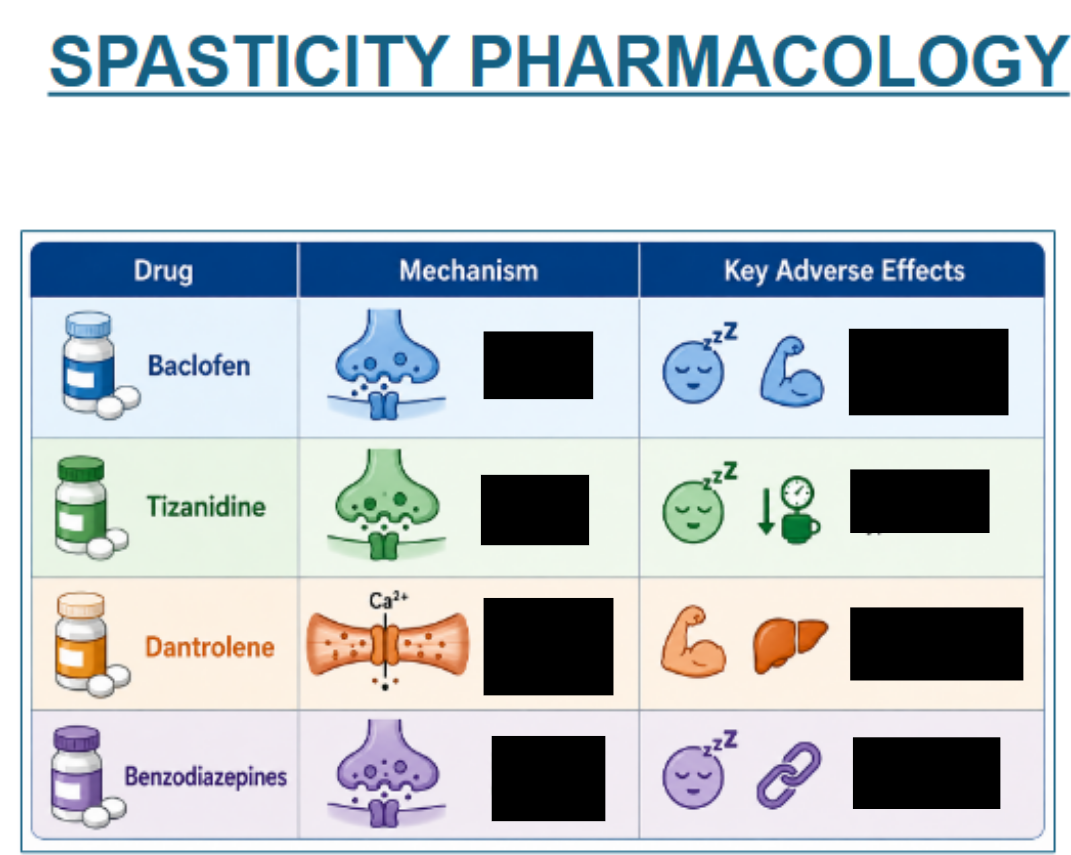
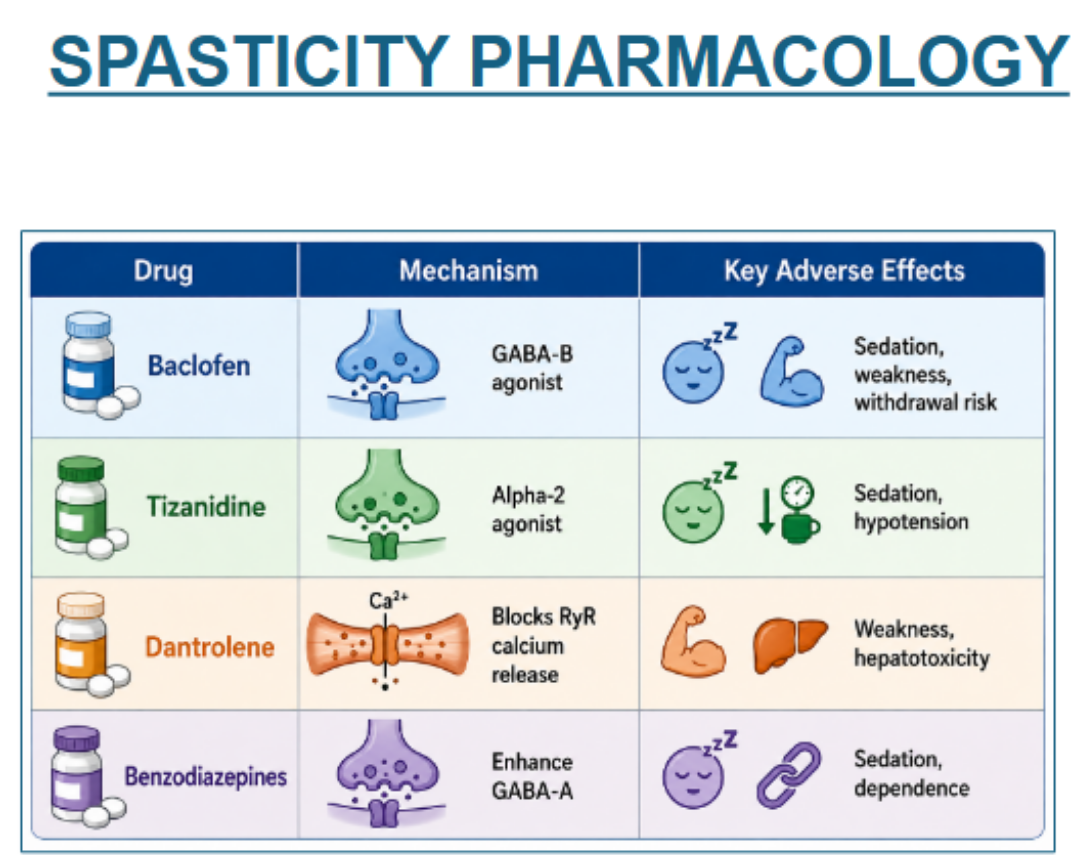
baclofen
BOTULINUM TOXIN
MOA:
Blocks ACh release via SNARE cleavage -> Local chemodenervation → ↓ muscle contraction
Uses:
Dystonia,
spasticity,
migraine,
hyperhidrosis
AE
Local weakness;
Dysphagia;
rare systemic effects
Describe the treatment for TICS & TOURETTE SYNDROME
Treatment:
Alpha-2 agonists:
Clonidine, guanfacine
For Mild tics w/ ADHD
Antipsychotics
Risperidone, aripiprazole, haloperidol
More severe tics
Selected cases: VMAT2 inhibitors
Describe RESTLESS LEGS SYNDROME
What is it?
Treatment
RESTLESS LEGS SYNDROME
What is it?
Urge to move the legs
Worse at rest and at night
Movement provides relief
Treatment:
Treat iron deficiency first
Gabapentin/pregabalin = common options
Dopamine agonists may cause augmentation
Describe ALZHEIMER DISEASE
Pathology
Symptoms
Treatment/MOA
ALZHEIMER DISEASE
Pathology:
Amyloid-β plaques + tau tangles
Neurotransmitter loss: ↓ Acetylcholine
Symptoms:
Progressive memory + cognitive decline
Treatment/MOA:
AChE inhibitors:
Donepezil, rivastigmine, galantamine → ↑ ACh
Memantine
NMDA antagonist → ↓ excitotoxicity
Anti-amyloid antibodies
Lecanemab, donanemab → ↓ amyloid pathology
Describe ACETYLCHOLINESTERASE INHIBITORS
Members
Uses
Adverse Effects
Caution in
ACETYLCHOLINESTERASE INHIBITORS
Members:
Donepezil,
rivastigmine,
galantamine
Use:
Symptomatic treatment of Alzheimer disease
Also Parkinson disease Dementia
rivastigmine
ADVERSE EFFECTS
cholinergic excess
GI:
N/V diarrhea
Cardiac:
Bradycardia, syncope
Other
Bronchoconstriction, urinary frequency, vivid dreams
Caution:
Asthma/COPD,
bradyarrhythmias,
peptic ulcer disease
Describe MEMANTINE
MOA
Uses
Synergy
AE
MEMANTINE
MOA:
NMDA antagonist → ↓ glutamate excitotoxicity
Uses:
Moderate–severe Alzheimer disease
Synergy:
combined with: Donepezil
AE:
Dizziness,
confusion,
headache,
constipation
Describe ANTI-AMYLOID MAb
Members
MOA
Uses
Req. for prescription?
ANTI-AMYLOID MAb
Members:
Lecanemab,
donanemab
MOA:
Target amyloid-β → plaque clearance
Use:
Selected patients w/ early symptomatic AD
Require for Prescription:
Confirmed amyloid pathology + MRI monitoring