Chapter 18.1 -18.3
 Call Kai
 Learn
Learn Practice Test
 Spaced Repetition
 Match
Match Flashcards
 Knowt Play
1/42

There's no tags or description
Looks like no tags are added yet.
Name | Mastery | Learn | Test | Matching | Spaced | Call with Kai | Chat |
|---|
No analytics yet
Send a link to your students to track their progress
43 Terms
The word electric derives from where?
the Greek word for amber
electron
How are the effects of static electricity explained?
it is explained by a physical quantity
The physical quantity is Electric Charge
How many times are charges are there?
two (2)
What charges are there?
Positive and Negative
Do like charges repel or attract?
They repel
Do unlike charges repel or attract?
they attract
Does the force between charges decrease or increase as distance increases?
The force between charges decrease with distance
What charges are associated with protons, neutrons, and electrons?
Protons are +
Electrons are -
Neutrons are neutral
Is a charge created or destroyed when charges are separated?
No, instead existing charges are moved about and are always constant
This is the law of conservation
Is the total charge constant in any process?
Yes, always constant
When a charges particle is created, is it true that another particle having an opposite charge is always created? If so, why?
It is true so that the total charge created is zero (0)
Can mass be created from energy? If so, how?
Yes, mass can be created from energy in the amount Δ𝑚=𝐸*𝑐²
What is the Su unit for charge?
It is coulomb (C)
Most objects are considered neutral why?
Because they have an equal number of protons (+) as there are electrons (-) resulting in the charge balancing out to neutrality
When a glass rod is rubbed with a silk cloth, the rod develops a positive charge and the cloth develops a negative charge. Since both objects attract dust, the dust must carry a third type of charge that is attracted to both positive and negative charges. True or false?
False
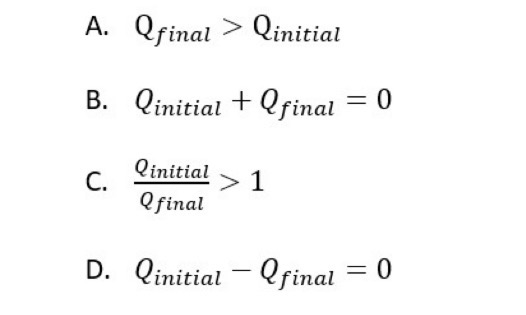
Which of the following describes conservation of charge?
D. The law of conservation of charge states that Qinitial - Qfinal = 0
When dissolved in water, a neutral molecule of calcium chloride dissociates into three ions: one calcium ion and two chloride ions. Each chloride ion has one negative elementary charge unit. What is the charge on the calcium ion, in elementary units?
+2
Because the CaCl was neutral initially so if there are two negativly charged Cl atoms then the Ca atom must be positively charged by 2
What are free electrons?
electrons in metal and similar conductors that re not bound to individual atoms or sites in the material
True or false?
Any substance that has free electrons and allows charge to move relatively freely through it is known has a conductor?
True
What happens when free electrons (moving electrons) collide with fixed atoms and molecules in a conductor?
the free electron loses some energy
What does a superconductor in relation to energy?
Allow the movement of charge WITHOUT any loss of energy
Salty water and other similar conducting materials contain what? What can these things do?
They contain free ions which move through them
An atom or molecule having a positive or negative (nonzero) total charge is known as what?
Another way to word it: total number of electrons is not equal to the total number of protons
an atom
Does glass allow charges to move through?
No
An object that does not all charged to move through them are known as what?
insulators
Can electrons and ions in insulators move easily?
NO, they are bound and cannot move easily
move 10²3 times more slowly than in conductors
Is pure water a conductor or an insulator?
Pure water is an insulator
Is dry table salt a conductor or ann insulator?
dry table salt is an insulator
Is molten salt a conductor or ann insulator?
Molten salt is a conductor
What is electrostatic repulsion?
SEARH
What is polarization?
polarization is the separation of charges in an object that remains neutral
Can neutral objects be attracted to any charged object? If so, why?
Yes, they can because the polarization of atoms and molecules in neutral objects results in their attraction to a charged object
Polar vs Non-Polar
SEARCH
what do polar molecules have that is considered natural or inherent?
Polar molecules have a separation of charges although they are neutral overall
Polar molecules are particularly affected by other charged objects and show greater polarization effects than molecules with naturally uniform charge distributions.
SEARCH
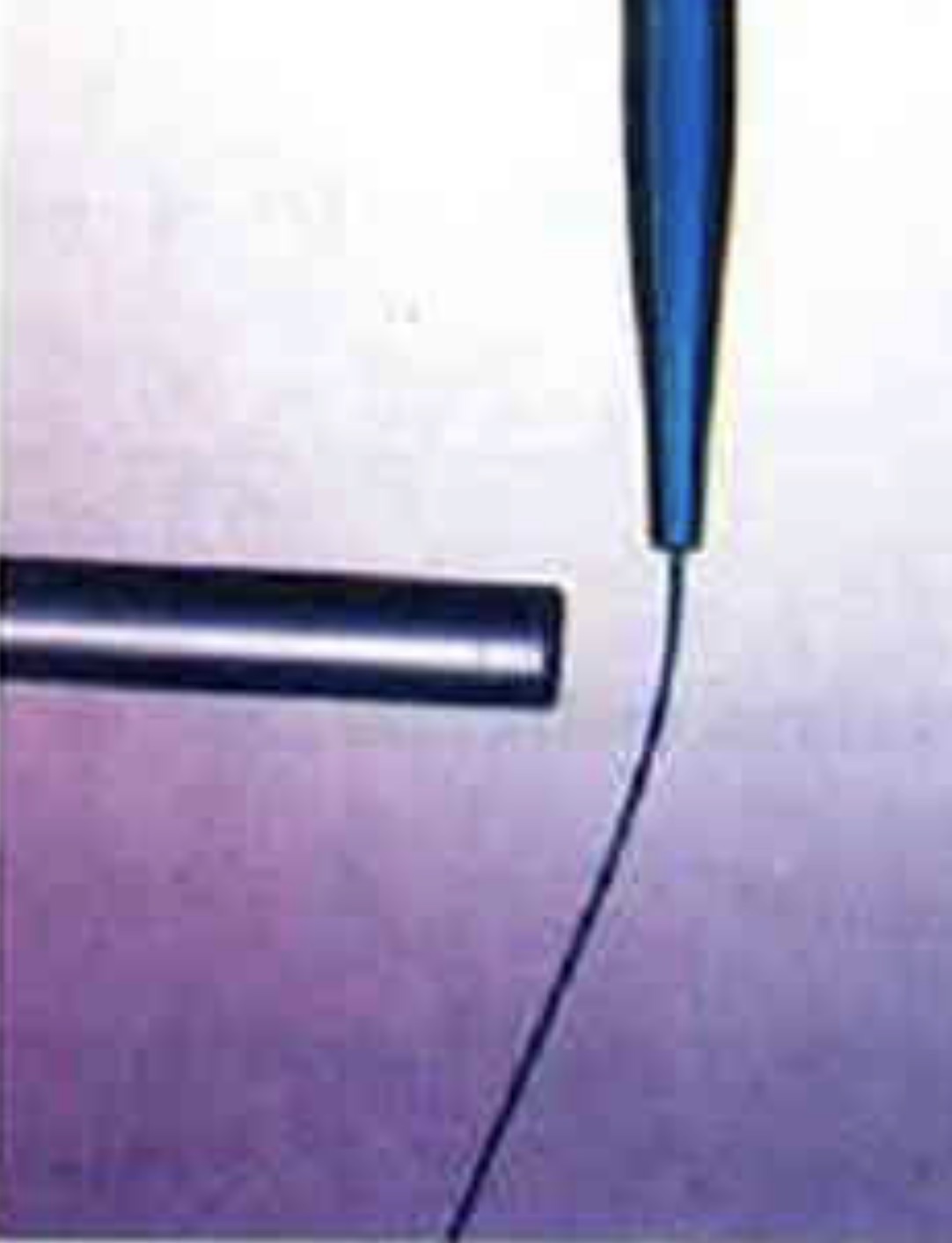
Can you explain the attraction of water to the charged rod in the figure below?
Water molecules are polarized, giving them slightly positive and slightly negative sides. This makes water even more susceptible to a charged rod’s attraction. As the water flows downward, due to the force of gravity, the charged conductor exerts a net attraction to the opposite charges in the stream of water, pulling it closer.
An eccentric inventor attempts to levitate by first placing a large negative charge on himself and then putting a large positive charge on the ceiling of his workshop. Instead, while attempting to place a large negative charge on himself, his clothes fly off. Explain why.
If you have charged an electroscope by contact with a positively charged object, describe how you could use it to determine the charge of other objects. Specifically, what would the leaves of the electroscope do if other charged objects were brought near its knob?
Describe how a positively charged object can be used to give another object a negative charge. What is the name of this process?
Why might a car attract dust right after being polished, even though car wax and car tires are insulators?
Polishing generates excess charge on the car and thus attracts neutral dust particles by polarizing them.
Pure water is an insulator. If you add a lot of salt to it, the salt dissolves into positively and negatively charged particles. The solution of water and salt is still an insulator.
True or false?
False
Charging an object by polarization requires touching it with an object carrying excess charge.
True or false?
False, Charging by polarization does not require touching the objects.