Quiz 1
 Call Kai
 Learn
Learn Practice Test
 Spaced Repetition
 Match
Match Flashcards
 Knowt Play
1/58

Earn XP
Description and Tags
Name | Mastery | Learn | Test | Matching | Spaced | Call with Kai | Chat |
|---|
No analytics yet
Send a link to your students to track their progress
59 Terms
What is the basic conservation-law idea?
Accumulation= In - Out + Source - Sink
What are the first questions I should ask when reading a quiz 1 problem?
What am I conserving
What enters
What leaves
Is anything generated?
Is anything removed/decayed
Is it steady or transient
Is it perfectly mixed?
Is density constant?
Is velocity uniform or variable?
What geometry/surface does the material cross?
What is the system mass balance for a conservative constituent?

What does QC represent?
A mass flow rate
Never use C alone as the IN or OUT mass rate
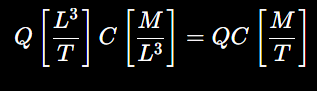
What does VC represent?
The mass of constituent stored in the system
d(VC)/dt is the rate of accumulation

What does steady state mean mathematically?
Accumulation=0
so d/dt=0
It does not mean IN and OUT individually each equal zero
What words suggest a transient problem?
initially
changes with time
C(t)
V(t)
after __ hours
begins at t=0concentration suddenly changes
how long until….
accumulation
water level rises/falls
Keep the derivative
Do constant flow rates automatically mean steady state?
No
Constant Qin and Qout can still produce changing storage.
Example:
Qin>Qout
means dV/dt>0
even though both flows are constant
What does perfectly mixed mean?
The concentration leaving equals the concentration inside
Cout=Csystem=C
The system is treated as having one uniform concentration
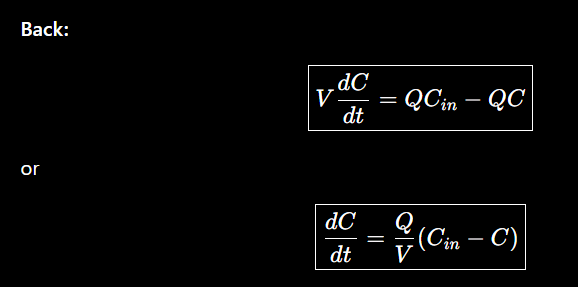
Perfectly mixed + constant volume + conservative contaminant gives what equation?
V*dC/dt= QCin-QC
or
dC/dt= Q/V(Cin-C)
What is mean residence/ detention time?
T=V/Q
It represents a characteristic time for fluid to pass through a system

What useful relationship follows from T=V/Q?
T=V/Q —> Q/V=1/T
therefore:
dC/dt= 1/T(Cin-C)

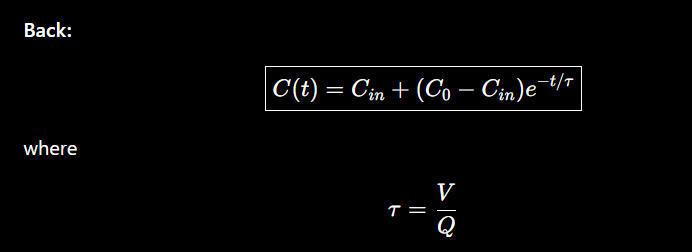
What is the general solution for a perfectly mixed tank with constant Cin, no reaction, and constant V,Q?
C(t)= Cin + (C0-Cin)e^-t/T
where
T=V/Q
If initially C0=0 and contaminated water begins entering, what does the solution become?
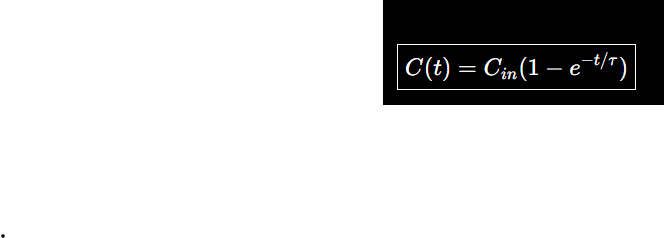
C(t)=Cin(1-e^-t/T)
The concentration rises exponentially toward Cin
If contaminated input stops and clean water enters, what happens?
Exponential decay:
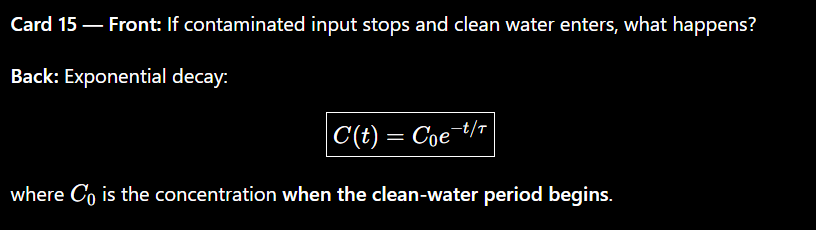
C(t)= C0e^-t/T
where C0 is the concentration when the clean water period begins
What do I do when conditions change at a specific time?
Solve the problem piecewise.
The ending concentration from period 1 becomes the initial concentration for period 2
If the change happens at t=ts:
C=Cse^(-(t-ts)/T)

What does “emits”, produces”, “genrates” or “added at __mass/time” mean?
SOURCE
If the source is given directly as mass/time:
+W
What words indicate a sink?
decays
consumed
metabolized
removed
uptake
degradation
These produce a negative term
What is the sink term for first order decay?
-VkC
because the first order reaction rate is proportional to concentration
k has units of:
1/time
What is the complete mixed-system balance with a source W and first order sink?
d(VC)/dt= QCin-QC +W - VkC
if steady:
0=QCin-QC +W -VkC
Stead mixed system with a source but no decay?
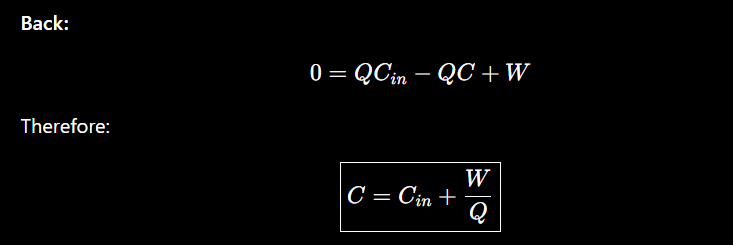
0= QCin -QC +W
therefore:
C=Cin +W/Q
What if k is the unknown?
Write:
0=QCin-QC+W-VkC
Then algebraically isolate k
k=QCin+W-QC/VC
What is the constant-density water-volume balance
dV/dt= Qin-Qout
Include evaporation or other losses as outflow/loss terms
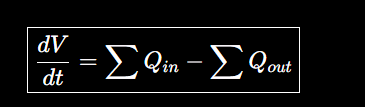
What does a positive dV/dt mean?
dV/dt>0 = storage increase
Negative means storage decreases
0 means constant storage
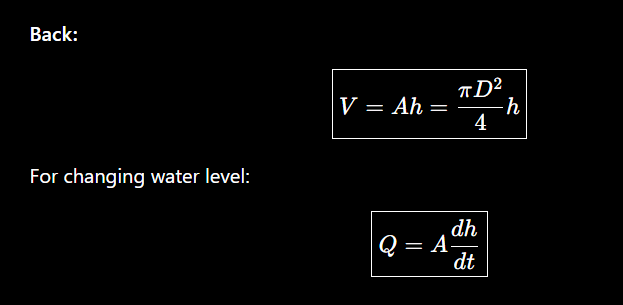
How do i relate changing volume to changing water depth in a tank/lagoon with constant horizontal area?
V=A*h
so:
dV/dt= Adh/dt
dh/dt= net volumetric inflow/A
What clues suggest i should use the control volume approach?
piper
inlet/outlet surface
velocity
diamter/radius
flow through a surface
well screen
veolcity profile
u( r )
derive velocity from Q
cylindrica;/circular geometry
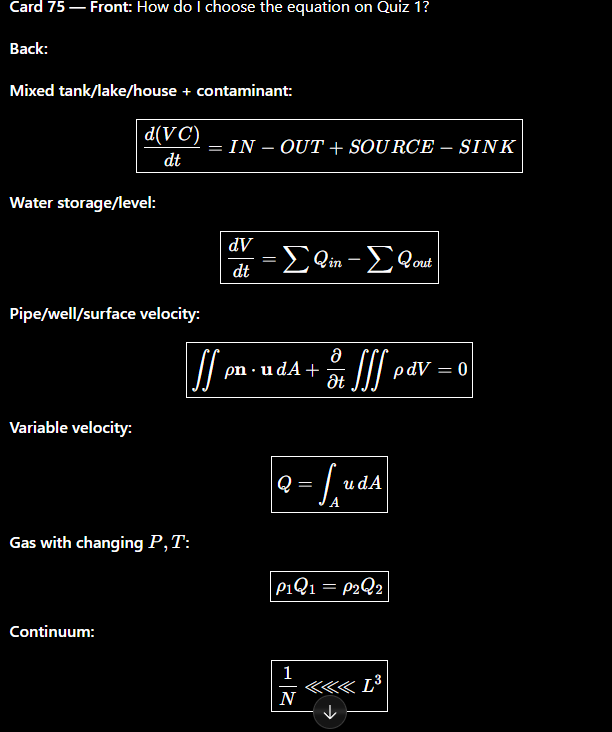
What is the general control-volume mass conservation equation?
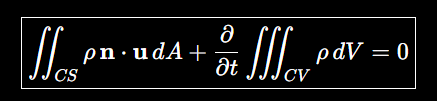
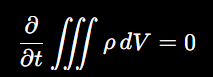
What does steady do in the control volume equation?
Eliminates the accumulation volume integral
It does NOT eliminate the surface integral
What does incompressible mean?
density=constant
Density can often be canceled
What determines the sign of a control-surface flow term
The outward normal n
An inlet: n*u< 0= IN negative
n * u> )= OUT positive
When can i use Q=uA
When u is uniform over the area or the problem gives an average velocity
Q=uA
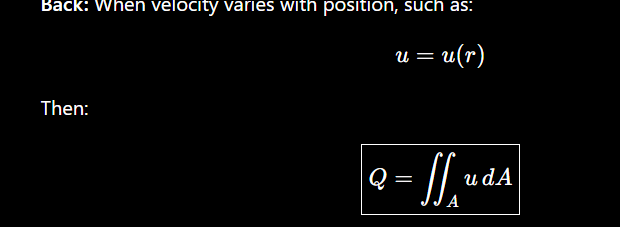
When must i integrate the velocity
When velocity varies with position, such as:
u=u ( r)
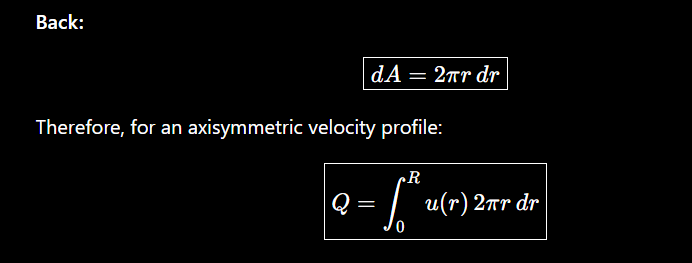
what is dA for a thin circular ring?
dA= 2 pi r dr
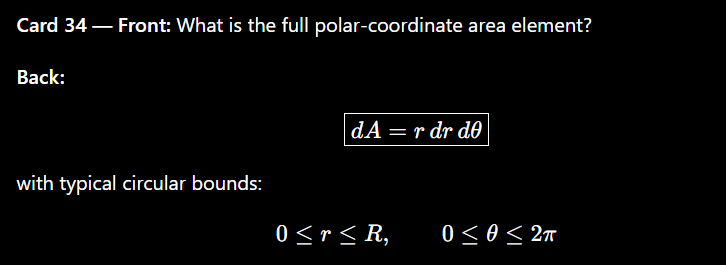
What is the full polar coordinate element
dA= rdr dtheta
If the problem gives u(r ), what should immediately go through my mind?
Variable velocity profile —> Integrate
Do not automatically plug the max velocity into uA
Area of a circular opening?
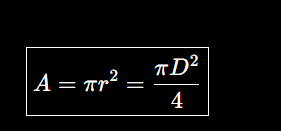
Area of the side of a cylinder?
Volume of a cylindrical tank?
Can I assume Qin=Qout for a gas if pressure or temperature changes?
No
Gas density can change
p1Q1=p2Q2
Idea gas equation
From PV=nRT
p=PM/RT`
What useful gas-flow relationship follows from mass conservation + ideal gas law?
P1Q1/T1=P2Q2/T2
Recognition clue:
gas + changing P,T —> density may change
What does the continuum assumption mean?
We treat matter as continuously distributed rather than tracking individual molecules/particles.
Whether this is reasonable depends on the scale of the system compared with the particles.
What continuum criterion does Chapter 1 use?
1/n ««« L³
How do I solve a continuum problem using 1/N≪≪≪L
Calculate:
1/N
and
L^3
Then compare them
What does 1/N represent dimensionally?
Approximate volume per particle
If N[particles/m³]
then:
1/N [m³/particles]
What unit check should I perform on every constituent mass balance
Every term should reduce to:
mass/time
Relationship between mg/L and g/m³?

What should I do before combining flow rates with time?
Make the time units agree.
Examples:
1hr=60min=3600s
Don't combine m3/s with hours without converting.
What if a tablet/object loses mass over time and that lost material becomes a contaminant source?
Determin its mass-loss rate first:
dissolution rate=
Then multiply by the active-ingredient fraction if needed.
That becomes the source W in the constituent balance.
This is the central setup in the Fall 2020 chlorinator problem

If a tablet is 30%30\% active ingredient, how do I find active-ingredient source rate?
What if solids/sludge accumulate inside part of a control volume?
Do not set accumulation to zero.
Use:
Accumulation= rate entering region- rate leaving region
Then relate accumulated mass to concentration *accumulated volume
M=CV
What if the accumulating material has constant concentration C
M=CV
so:
dM/dt= CdV/dt
if C is constant
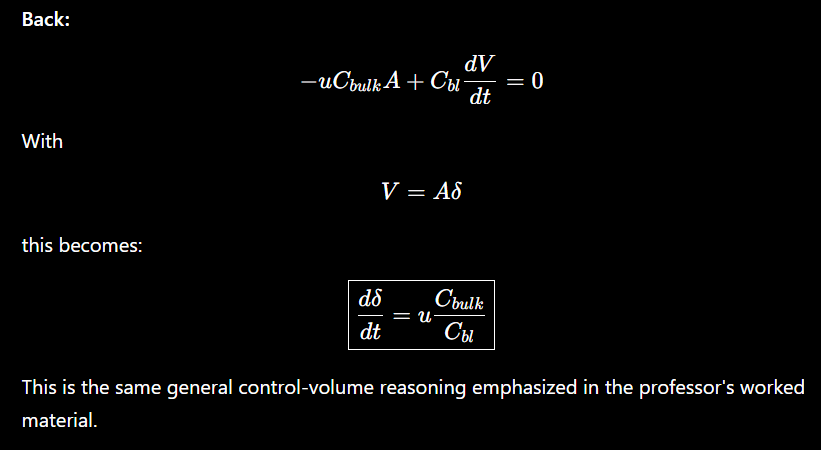
What is the key idea when a boundary layer gets thicker with time
The control volume containing material is growing, so accumulation remains
V= A* Delta
then dV/dt= A* ddelta/dt
What did the membrane-type derivation reduce to in our Chapter 1 work?
If dV/dt is positive and constant, what does V(t) look like?
A straight increasing line.
Constant derivative = constant slope.
If dC/dt becomes smaller as C approaches equilibrium, what shape should C(t) have?
Exponential approach to a limiting concentration.
It rises quickly at first, then flattens.
What does exponential decay look like?
Rapid decrease initially, followed by slower decrease approaching zero:
C=C0e−t/τ
Steady state means Qin=Qout. True or false?
Not universally.
Steady constituent concentration means constituent accumulation is zero.
For constant-volume incompressible water:
∑Qin=∑Qout
But always determine what quantity is being balanced.
“Which equation do I use?” master card