Business Azut (copy) (copy)
 Call Kai
 Learn
Learn Practice Test
 Spaced Repetition
 Match
Match Flashcards
 Knowt Play
1/532

There's no tags or description
Looks like no tags are added yet.
Name | Mastery | Learn | Test | Matching | Spaced | Call with Kai | Chat |
|---|
No analytics yet
Send a link to your students to track their progress
533 Terms
Business
combines factors of production to satisfy people’s wants by producing goods or services.
Need
is a good or service essential for living.
Want
is a good or service which people would like to have, but which is not essential for living. People's wants are unlimited.
Economic problem
There exist unlimited wants but limited resources to produce the goods and services to satisfy those wants, this creates scarcity.
Scarcity
is the lack of sufficient products to fulfill the total wants of the population.
Factors of production
resources needed to produce goods or services. There are four factors of production and they are in limited supply.
(factor of production) Land
is the term used to cover all of the natural resources provided by nature and includes fields, forests, oil, gas, metals and other resources.
(factor of production) Labour
is the term used to describe the number of people available to make products.
(factor of production) Capital
is the finance, machinery and equipment needed for the manufacture of goods.
(factor of production) Enterprise
is the skill, and risk-taking ability of the person who brings the factors of production together to produce a good or a service. For example, the owner of a business. These people are called entrepreneurs.
Opportunity cost
is the next best alternative given up by choosing another item.
Specialisation
occurs when people and businesses concentrate on what they are best at.
Division of labour
is when the production process is split up into different tasks and each worker performs one of these tasks. It is a form of specialisation.
Advantages(2) and disadvantages(2) of division of labour
Advantages
Workers are trained in one task and specialise in that. This Increases the efficiency and output
Less time is wasted moving from one workbench to another
Quick to train workers as fewer skills need to be taught.
Disadvantages
Fall in efficiency if workers become bored
If one worker is absent and no one else to do the job then the production might be stopped
Added value
is the difference between the selling price of a product and the cost of bought in materials and components.
How to increase added value
Improve packaging (To give an idea of high quality product)
Sell in pleasant surroundings
Employ experienced workers
Improve quality
(To establish a brand image of high quality product)
Decrease the cost of making( by buying cheaper raw materials)
Increase the selling price
(This widens the gap between cost and price)
Primary sector
Business whose main activity involves extraction of raw materials
Secondary sector
industry manufactures goods using raw materials provided by the primary sector.
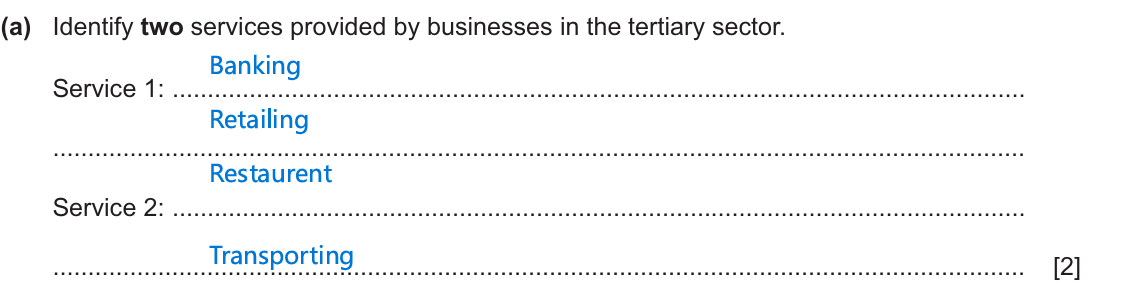
Tertiary sector
industry provides services to consumers and the other sectors of industry.
Click
De-industrialisation
occurs when there is a decline in the importance of the secondary, manufacturing sector of industry in a country.
Mixed economy
has both a private sector and a public sector.
Private sector( no need to know def)
Businesses not owned by the government. Services are charged and paid for by the customer
Public sector( no need to know def)
Government owned and controlled businesses and organisations. Services provided are free and are paid for by taxes.
Capital
the total amount if money invested into a business by the owners
Privatisation
When governments sell public sector businesses to private sector businesses
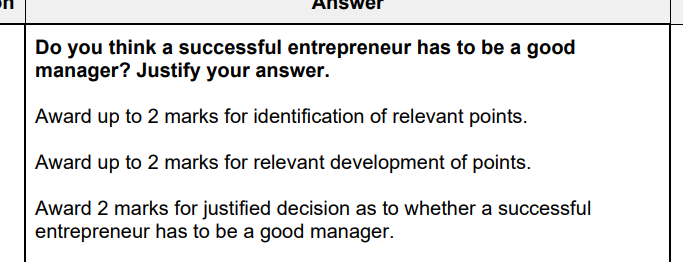
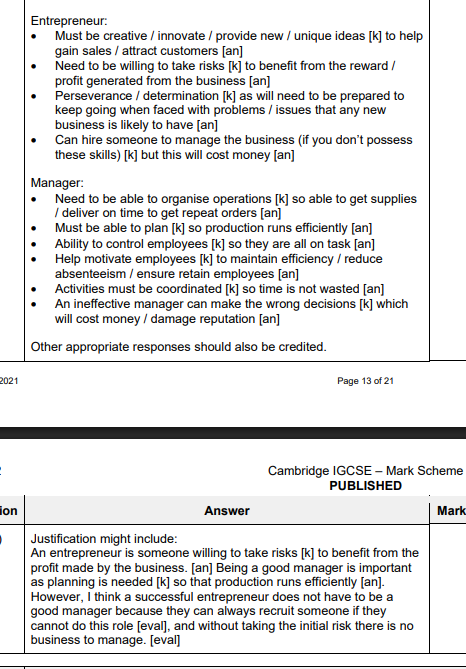
Entrepreneur
person who organises, operates and takes the risk for a new business venture.
Benefits of being an entrepreneur(2)
-Independence- able to choose how to use time and money
-Able to put ideas into practice
-May become famous and successful if business grows
-May be profitable and the income might be higher than working as an employee for another business
-Able to make use of personal interests and skills
Disadvantages of being an entrepreneur(2)
-Risk-the business might fail
-Capital- have to put own money into business and might have to find other sources of money
-Lack of knowledge and experience in starting and operating a business
-Opportunity cost- lost income from not being employed in another business
Qualities of an entrepreneur(8) (CHRISIOE)
-Hard working- Have to work long hours and have few vacation days
-Risk taker- Making decisions to produce goods or services that people might buy is potentially risky
-Creative- A new business needs new ideas about products , services and ways to attract customers, in order to make it different from other companies
-Optimistic- Looking forward to the future is essential, if you think you will fail you will fail
-Self-confident- Necessary to convince to convince banks, other lenders and customers that your business will be successful
-Innovative- Being able to put new ideas into practice in interesting and different ways is important
- Independent- Will often have to work on their own before they can hire other people, have to be able to be motivated and be able to work by their self
-Effective communicator- Talking clearly and confidently to banks, other lenders, customers and government agencies about the new business will raise the profile of the new business
Why do governments support business startups(4)
-Reduce unemployment- New businesses will often create jobs
-Increase competition- New businesses give customers more choice and compete with already established businesses
-Increase output- The economy benefits from being increased output of goods and products
-Increase tax revenue-When the company grows large they would need to pay filthy amount of tax
-Can grow further- May help some small firms grow to become very large and important in the future
How do governments help business(2)
-Business idea and help- Governments organize advice and support sessions offered by experienced people
-Finance- Loan money to businesses at small interest rates or grants. Additionally, lower tax rates could be implied on the startups
-Location- Rent free spaces
-Training courses for entrepreneurs and/or workers
Business plan
a document containing the business objectives and important details about the operations, finance and owners of the new business.
Contents of a business plan
Description of the business
Products or services
The target market
Location
Organizational structure
Financial Information
Future business objectives
Business stratergies
How does a business plan help an entrepreneur(4)
To predict cash flow problems
To support loan application
Give business a sense of purpose
To help identify the skills required
To help identify what promotional method they should use
TO calculate costs of setting up the business
How to measure Business Size(4)
Number of employees
Value of output
Value of sales
Value of capital employed
Capital employed
is the total value of capital used in the business.
Why do owners want their business to grow(2)
-Possibility of higher profit for owner
-Larger market share- this gives the business more influence when dealing with suppliers and distributors
Internal growth
occurs when a business expands its existing operations, e.g creating a new product or expanding to another market(location)
External growth
is when a business takes over or merges with another business.
Integration
is when one firm is integrated into another one.( Another word for external growth)
Merger
is when the owners of two businesses agree to join their firms together to make one businesses.
Takeover
is when one business buys out the owners of another business, which then becomes part of the predator business.
Horizontal integration
is when one firm merges with or takes over another one in the same industry at the same stage of production.
Vertical integration
is when one firm merges with or takes over another one in the same industry but at a different stage of production, it can be forward (higher stage of production) or backward (lower stage of production).
Conglomerate integration
is when one business merges with or takes over a business in a completely different industry. Also known as diversification
Problems of business growth and how to overcome that problem?(2)
-Larger business is harder to control. Hire specialists managers
-Expansion is expensive. May need to borrow a loan.
Why do some businesses stay small(2)
-Market size- if the market size is small than a business which operates in that market is likely to remain small
-The owner's preference- Owner might want to avoid the stress and worry of running a large company
-Lack of capital-Not enough money to expand the business
-Lack of demand-
-Lack of knowledge-
Why some businesses fail
-Poor management
-Too much competition
-Too much debt
-Lack of money to pay wages or rents
Why new businesses have a higher chance of failing(2/3)?
Poor planning (due to lack of experience)
Strong competition from large firms( cannot benefit from economies of scale like large firms)
Lack of demand ( cannot pay for cost from sales revenue)
Difficulties entering the market ( as does not have brand loyalty)
Sole trader
is a business owned by one person.
Advantages and disadvantages of being sole trader(2 each)
Advantages
Can make his own decisions (Decision can be made quickly)
Keeps all the profit( So has an incentive to work harder)
Business details are private
Disadvantages
Unlimited Liability ( may lose personal assets to pay business debts)
Limited sources of finance (difficult to fund expansion)
No one to share workload with( may feel burnt out, and make mistakes )
Limited liability
means that the liability of shareholders in a company is only limited to the amount they invested.
Unlimited liability
Owners of a business can be held responsible for the debts of the business they own. Their liability is not limited to the investment they made in the business.
Partnership
is a form of business in which two or more people agree to jointly own a business.
Advantages and disadvantages of being in a partnership (2 each)
ADVANTAGES
Easy to set up
More capital
New skills and ideas
Can cover up for the other business partner if one is absent
DISADVANTAGES
Unlimited liability
Conflict (Lower productivity)
Profit needs to be shared
Partnership agreement
is the written and legal agreement between business partners. Not essential to have it but always recommended.
Unincorporated business
is one that does not have a separate legal identity. Sole traders and partnerships are unincorporated businesses.
Incorporated business(Limited company)
are companies that have separate legal status from their owners.
Private limited company
Businesses owned by shareholders but they cannot sell share to public
Advantages and disadvantages of private limited companies (2 each)
ADVANTAGES
Limited liability
Shares can be sold to raise funds
Easier to keep control that public limited company
Incorporated
DISADVANTAGES
Needs to host AGM which requires lots of money
Expensive to set up
Many legal formalities (increases costs)
Only can sell shares to family and friends
Dividends needs to be paid to shareholders (decreased retained profit)
Public limited companies
Businesses owned by shareholders but they can sell shares to public and their shares are tradeable on stock exchange
Advantages and disadvantages of public limited companies (2 each)
ADVANTAGES
Limited liability
Large amount of money can be raised as shares are tradeable on stock exchange (to fund growth)
No restriction on buying or selling of shares
Incorporated
DISADVANTAGES
Owners might lose control over the company
Very expensive to set up
Needs to give dividends(decreases retained profit)
Many legal formalities (increased costs)
Why would a small business not prefer to become a PLC(2/1)?
As the business would require a huge capital to sell its share to public.
The owner of the business likes to stay in control.
Why would a business decide to convert into LTD(1)?
As the business can raise money by selling the shares to family, friends etc.
Shareholders
are the owners of a limited company. They buy shares which represent part ownership of a company.
Annual general meeting (agm)
is a legal requirement for all companies. Shareholders may attend and vote on who they want to be on the Board of Directors for the coming year.
Dividends
are payments made to shareholders from the profits (after tax) of a company. They are the return to shareholders for investing in the company.
Franchise
is a business based upon the use of the brand names, promotional logos and trading methods of an existing successful business. The franchisee buys the license to operate this business from the franchisor.
Advantages and disadvantages of being a franchisee (2 each)
ADVANTAGES
Banks would lend money as the chances of failing is low
Support from franchisor - advice, training, marketing
More chance of success as selling a well known product
DISADVANTAGES
Needs to share profit with franchisor
Needs to follow franchisor rules
Advantages and disadvantages of being a franchisor (2 each)
ADVANTAGES
Expansion of business with less money
Gets a part of the profit owned by the franchise
DISADVANTAGES
Bad franchisee can ruin reputation of whole company
Money and time spent on supporting franchisees
Joint venture
is when two or more businesses agree to start a new project together, sharing the capital, the risks and the profits.
Advantages and disadvantages of joint ventures (2 each)
ADVANTAGES
Sharing of costs and risks
Local market and product knowledge is known by one of the business
DISADVANTAGES
Have to share profits
Conflicts may occur
Public corporations
These are businesses that are fully owned by the government. But they are managed by a board of directors who are made clear what the purpose of the business is.
Business objectives
are the aims or targets that a business works towards.
Benefits of business objectives
-They give workers and managers a clear target to work towards
-Making decisions will be easier since they will focus on "will it help us achieve our objectives"
-Helps unite entire business under one goal
-Can compare how business has performed compared to its objectives
Different types of objectives
-Survival
-Profit
-Growth
-Returns to shareholders
-Market share
-Service to the community
What is the primary objective of business?
To make Profit
Social Enterprise
has social objectives as well as an aim to make profit to reinvest it back into the business.
Objectives of social enterprises
to provide jobs and support for the disadvantaged groups in society
Environmental: to protect the environment
Financial: to make a profit to reinvest back into the business.
Market share
is the percentage of total market sales held by one brand or business
Stakeholder
is any person or group with a direct interest in the performance and activities of a business.
Stakeholder groups
-Owners
-Consumers
-Workers
-Government
-Managers
-Banks
-The Local community
Why might a business’s objectives might change?(2)
Increase competition
Weak performance
Market changes
Features of owner(2)
They put up capital into set up and expand the business.
They are risk takers.
Objectives for owner(2)
-Growth of the business so their investment is worth more
-Want a share of the profit made by company to reinvest it back into the business
Features of workers(2)
They are employed by the business.
They have to follow the instructions of managers and may need training to do their work efficiently.
Objectives for workers(2)
-Regular payment
-Contract of employment
-Job security
-Job that gives satisfaction and provides motivation
Features of managers(2)
They are employees of the business and control the work of other workers.
They take important decisions.
Objective for managers(2)
- High salaries for their important work
- Job security
-Growth of business so they can have more status and power
Features of consumers(2)
They are important for all businesses. They buy goods or services a company provides.
Without them a company might fail.
Objective for consumers(2)
-Safe and reliable products
-Value for money
-Well-designed product of good quality
-Reliability of service and maintenance
Features of government(2)
It is responsible for the economy of the country.
It passes laws to protect workers and consumers
Objective for Government(2)
-Business to be successful, will pay taxes, employ workers and increase country output
-Business to follow laws
Objective of the whole community(2)
-Jobs for working population
-Product that does not damage the environment
-Safe products that are socially responsible
1 Feature of Banks
They provide finance to other businesses.
Objective for banks(1)
-Business to pay back money lent with interest
Motivation
reason why employees want to work hard and work for the business effectively