SLHS 457 Exam 2
 Call Kai
 Learn
Learn Practice Test
 Spaced Repetition
 Match
Match Flashcards
 Knowt Play
1/54

There's no tags or description
Looks like no tags are added yet.
Name | Mastery | Learn | Test | Matching | Spaced | Call with Kai | Chat |
|---|
No analytics yet
Send a link to your students to track their progress
55 Terms
Internal Evidence
Evidence obtained from the case/client, including assessment and, case history, and environmental/contextual factors
External Evidence
Evidence from research articles/studies. Must be evaluated by type of research, quality of research (peer-reviewed?), level of evidence, research design
6 Steps of EBP
1) Develop a PICO question
2) Find the internal evidence
3) Find the external evidence
4) Critically evaluate the external evidence
5) Integrate internal and external evidence
6) Apply and evaluate the outcome of the decision
Step 1 of EBP
Develop a PICO Question (Population, Intervention, Comparison, Outcome)
Step 2 of EBP
Find the Internal Evidence (clinical knowledge and experience, client preference, contextual factors)
Step 3 of EBP
Find the External Evidence (finding research articles, refining by PICO question)
Step 4 of EBP
Critically Evaluate External Evidence (evaluate relevance, quality, type, design)
Step 5 of EBP
Integrate Internal and External Evidence
Step 6 of EBP
Apply and Evaluate Outcome of the Decision
PICO Question
Population/Problem
Intervention
Comparison
Outcome
Research Design
Vary in controlling randomization, causality vs. correlation, etc
Experimental vs. Non-Experimental Research Study
Experimental research manipulates one or more control variables, while non-experimental research focuses more on observation
Peer-Review
A process by which scholarly articles are evaluated by other experts in the field to ensure scientific quality
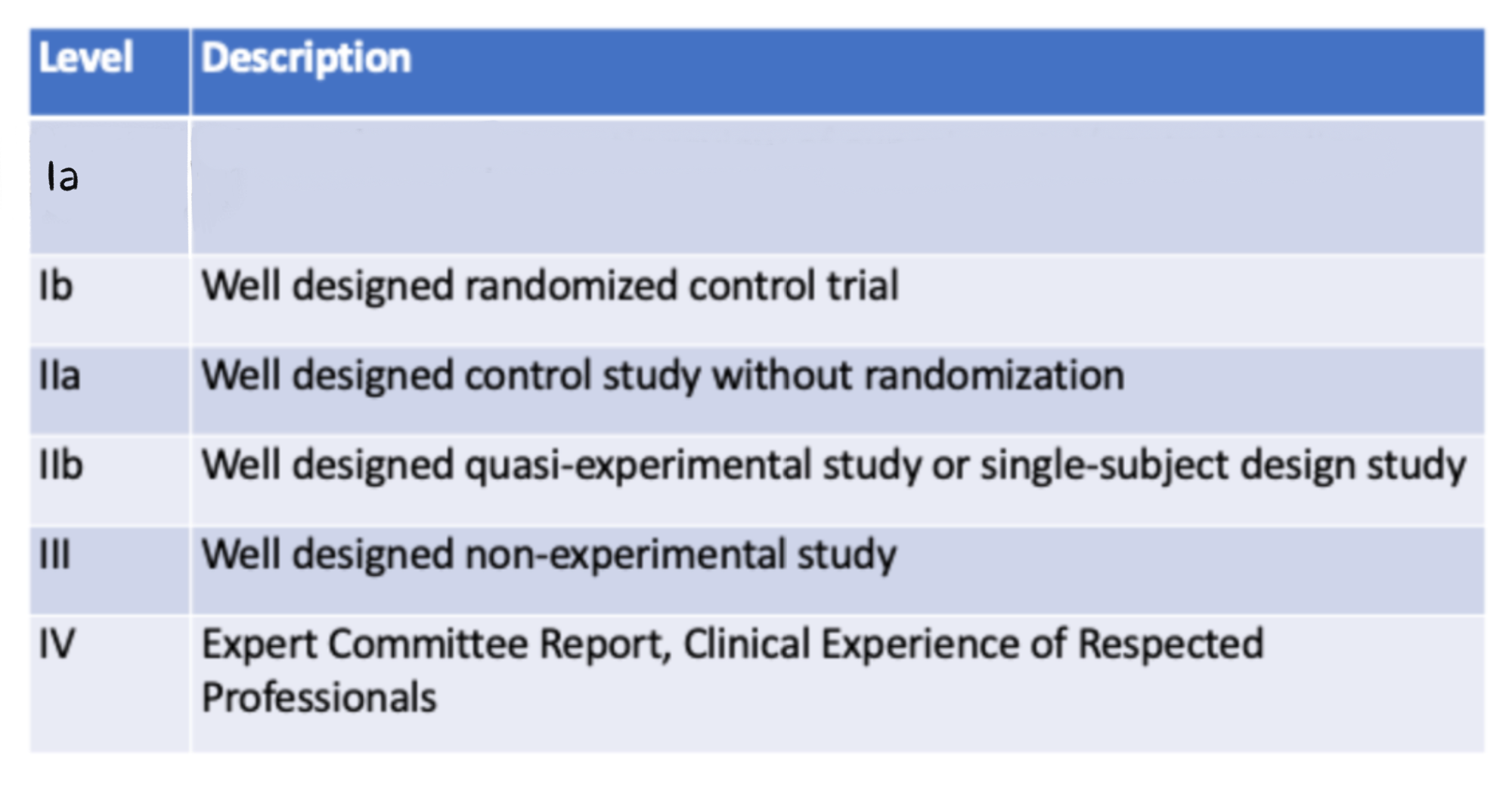
Levels of Evidence: Ia
Well-designed systematic review of experimental/control study
Controlled, groups, experimental
It is shown that…
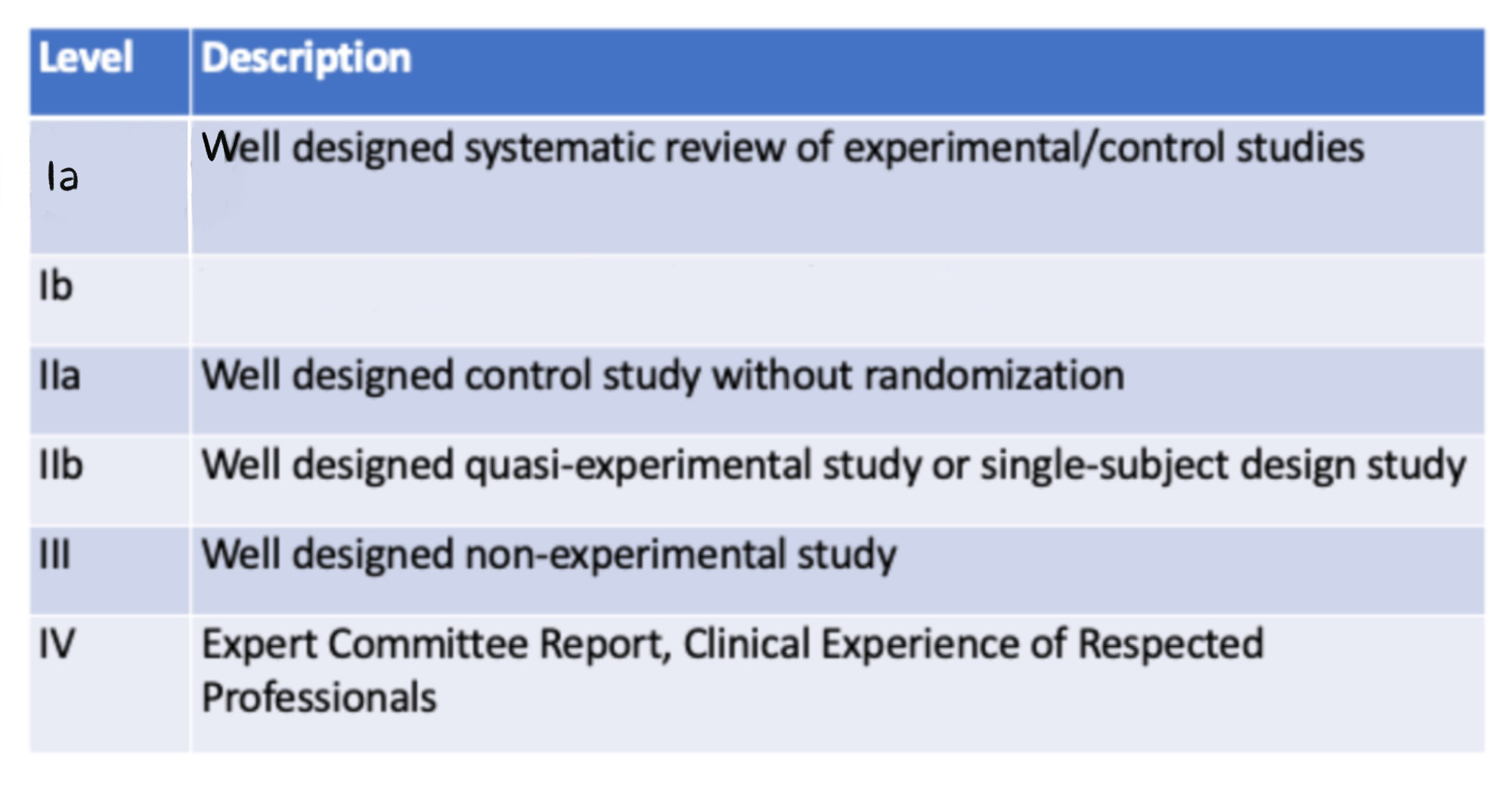
Levels of Evidence: Ib
Well-designed RCT
Controlled, groups, experimental
It is likely that…
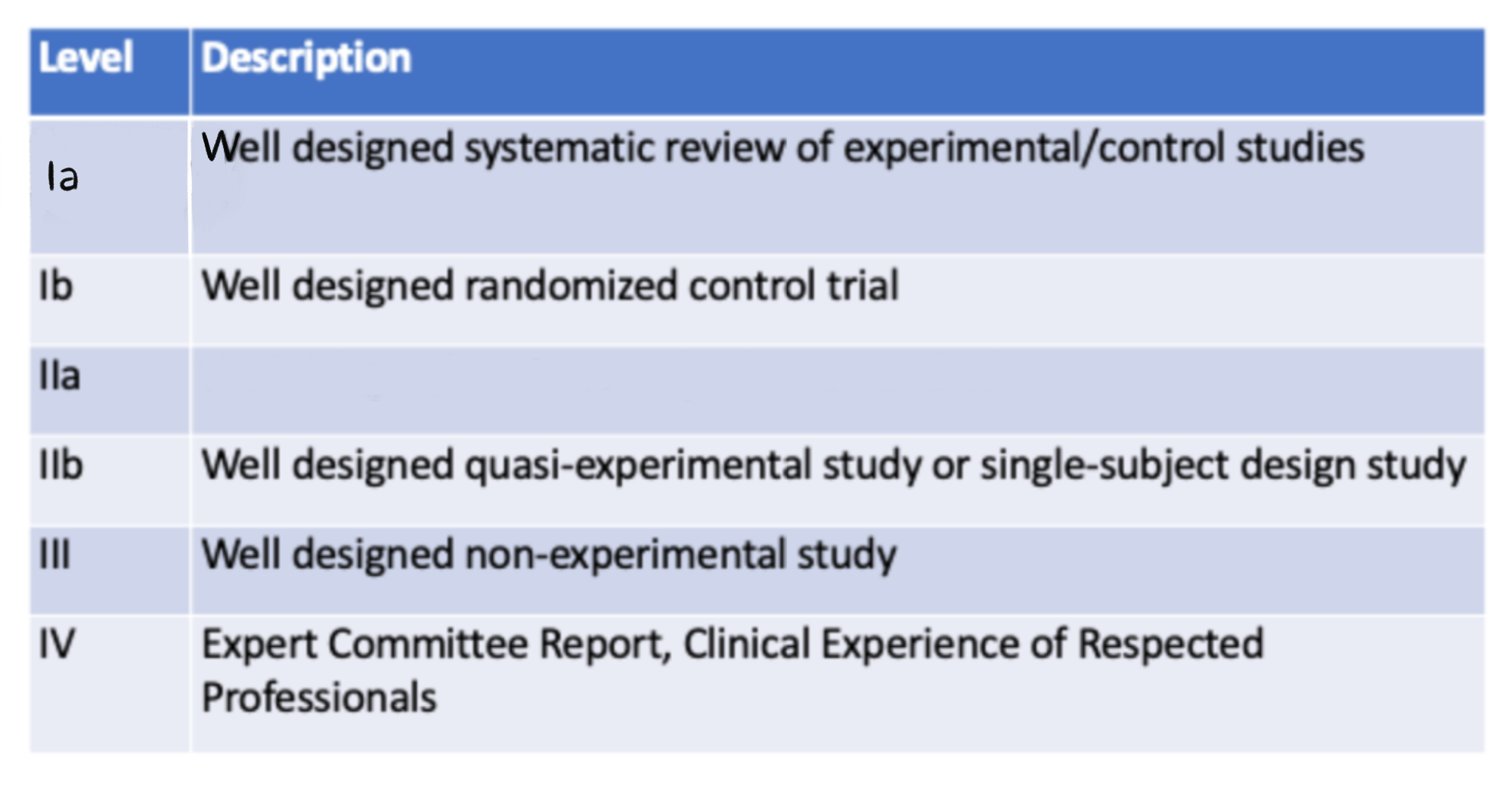
Levels of Evidence: IIa
Well-designed control study without randomization
Controlled, group study, experimental
It is likely that…
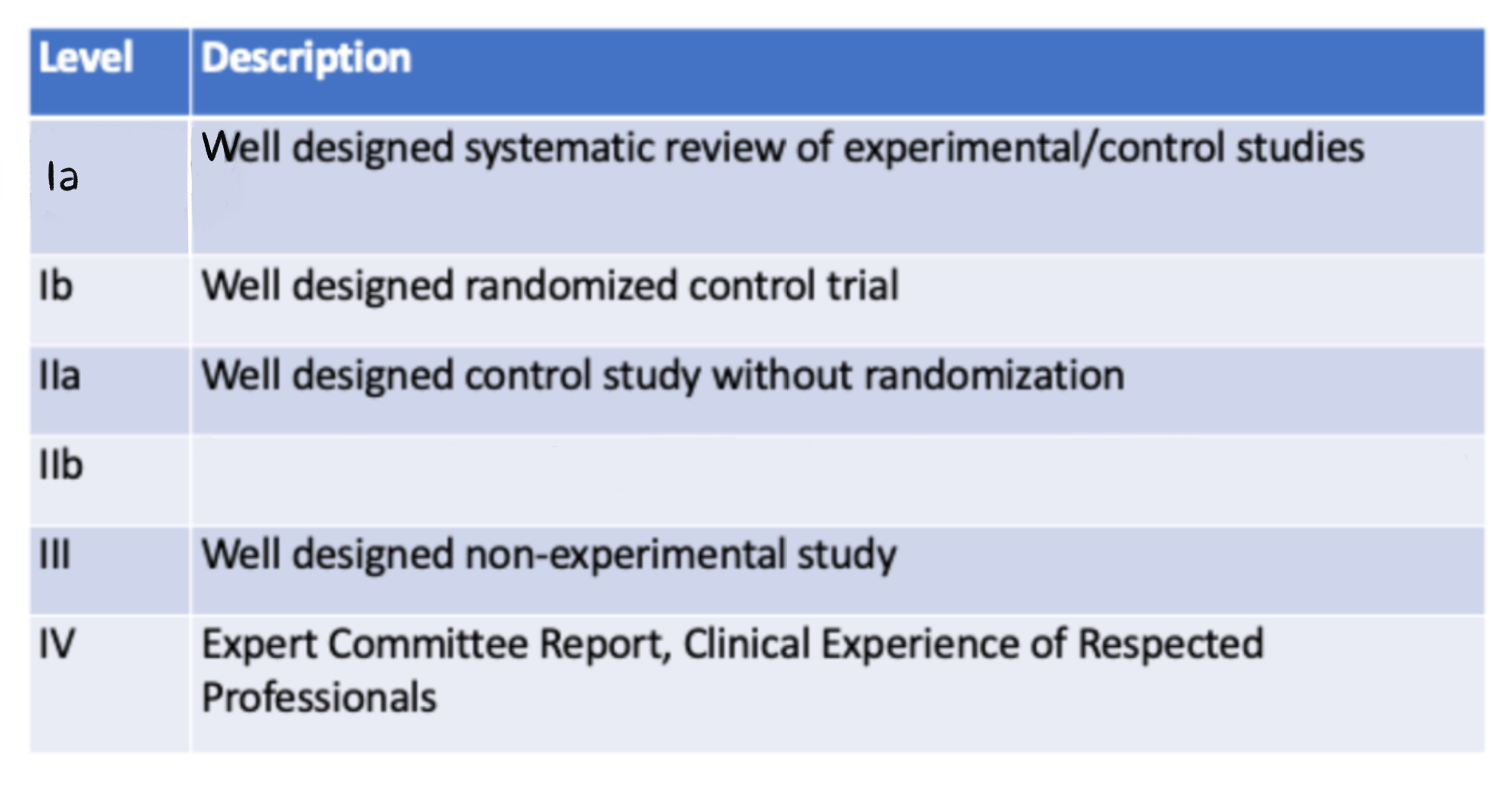
Levels of Evidence: IIb
Well-designed quasi-experimental study, single subject study design (SCED)
No control (or control within subject), no groups, experimental
There are signs that…
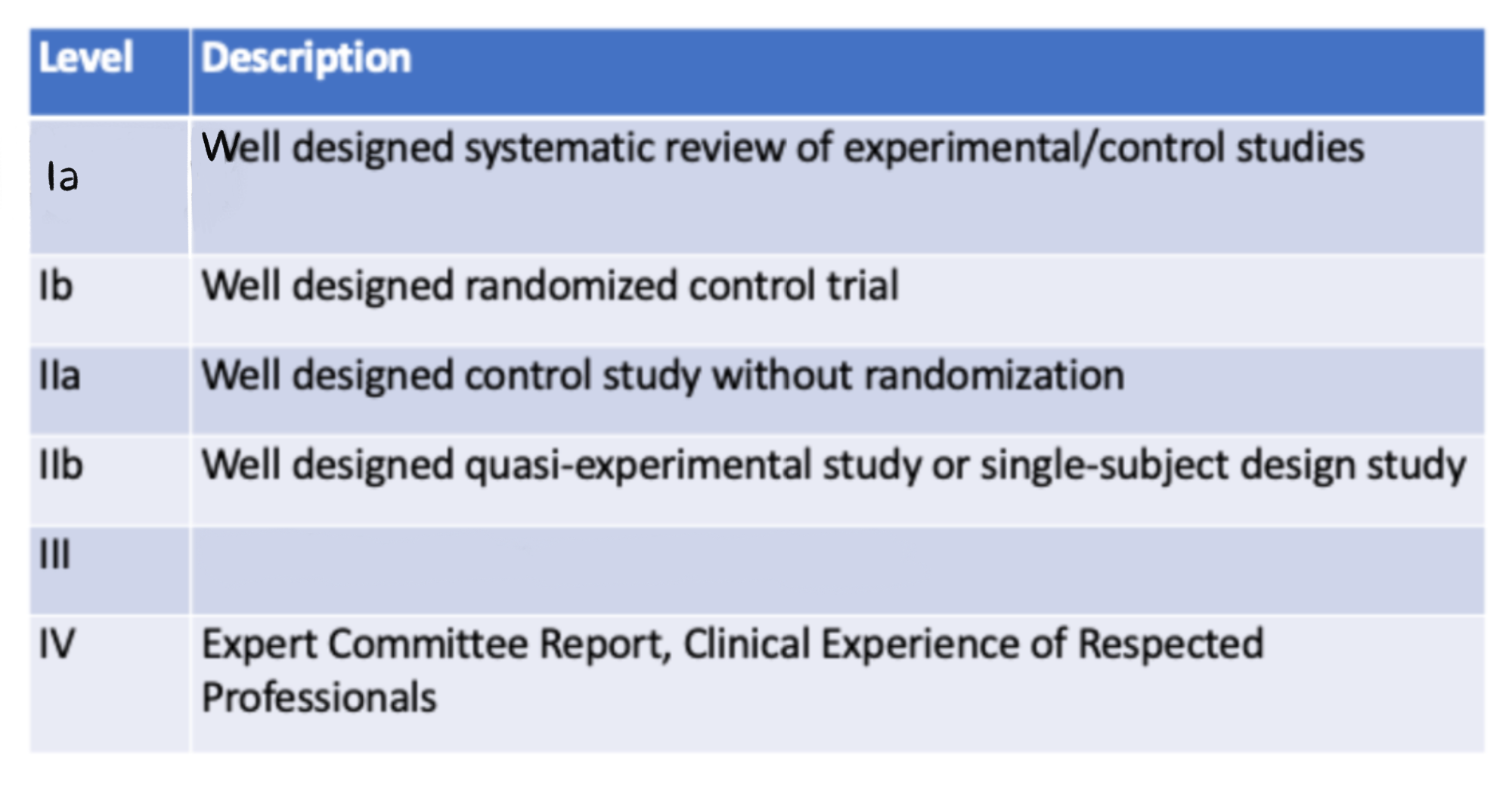
Levels of Evidence: III
Well-designed non-experimental study (case studies, group studies, cross-sectional design)
No control, sometimes groups, non-experimental
There are signs that…
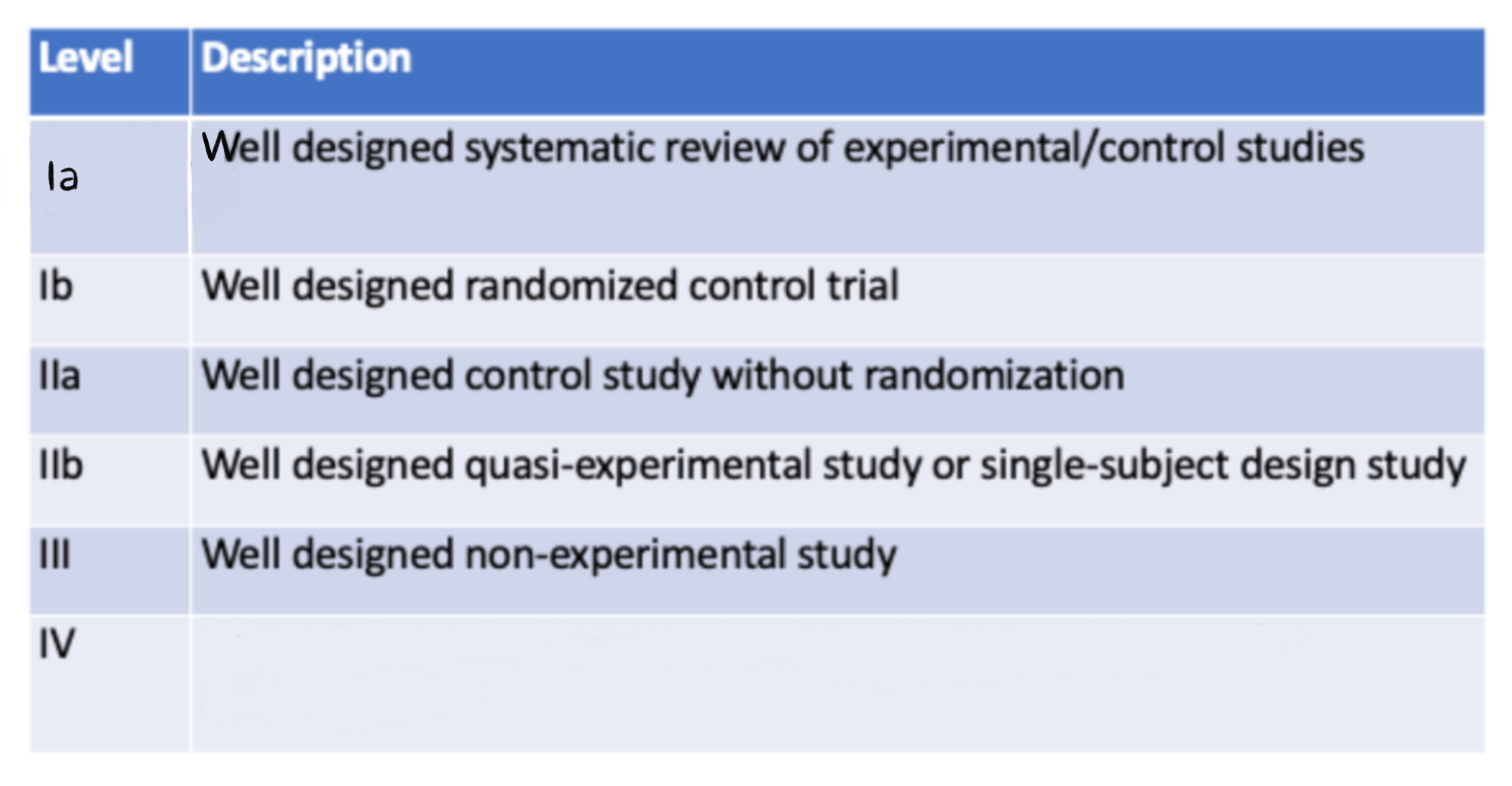
Levels of Evidence: IV
Expert committee reports, clinical experience of respected professionals
No control, no groups, non-experimental
Experts of the opinion that….
Expert Report
Answers, “what do experts think?”, may use data from other studies
Case Study
What occurred in an individual case, no control/experiment
Cross-Sectional Study
A non-experimental study observing groups (what is occurring)
Single Case Experimental Design (SCED)
Quasi-experimental (controlled within subject), established baseline, observe change (A/B)
Quasi Experimental Study
An experimental study without control/randomization (pre/post intervention design)
Randomized Control Trial (RCT)
A randomized, controlled experiment that can show outcome is a result of treatment
Systematic Reviews
Big statistical analysis of multiple studies, “study of studies”, requires a lot of previous research
Barriers to EBP
Lack of time to find, read, and critique research articles
Disconnect between intervention procedures in controlled research environment vs clinical settings
Importance of Research Design
Study design alone is not enough to assess the credibility of a study. Even study designs that are associated with a high level of evidence like RCTs can produce lower quality research based on issues internal to the study.
ICF-CY Framework
ICF-CY is a holistic framework for intervention, which integrates social, personal, and environmental factors WITH body structure/function to provide a view of the client as a whole, rather than in terms of their impairment.
This is important because SLP’s goals for intervention can often be limited to the specific context of therapy, rather than creating goals with the client’s life and environment in mind.
Factors Influencing Difficulty Generating a Clinical Decision
There is an abundance of evidence supporting multiple intervention approaches.
When one intervention has more high-level research evidence, but it is not realistically applicable to your real-life clinical scenario
Long-Term Goal
What you expect your client to be able to do by the end of intervention
Short-Term Objective
Steps that lead up to achieving LTG.
Session Objective
What you expect your client to do by the end of the session
Cumulative Treatment Intensity
Dosage, calculated by length of intervention, frequency of sessions, and number of learning opportunities
Continuous Dosage
Maintaining the same dosage over intervention (slow, long)
Sprint/Variable Dosage
Varying the frequency and intensity of dosage (may be to see more kids)
Treatment Strategy
How you set up teachable moments
Antecedent
What we do BEFORE to encourage a targeted behavior
Consequence
What we do to let them know if they hit the targeted behavior, and why.
Importance of Treatment Goals
Progress monitoring
Accountability
Zone of Proximal Development
The area between what a child can do independently and what they need support with. Goals should be in this zone.
Additive Objectives
Working on multiple skills at once
Sequential Objectives
Stepping stones, one goal must be achieved before moving on to the next
Vertical Attack Strategies
Working on one goal at a time in isolation
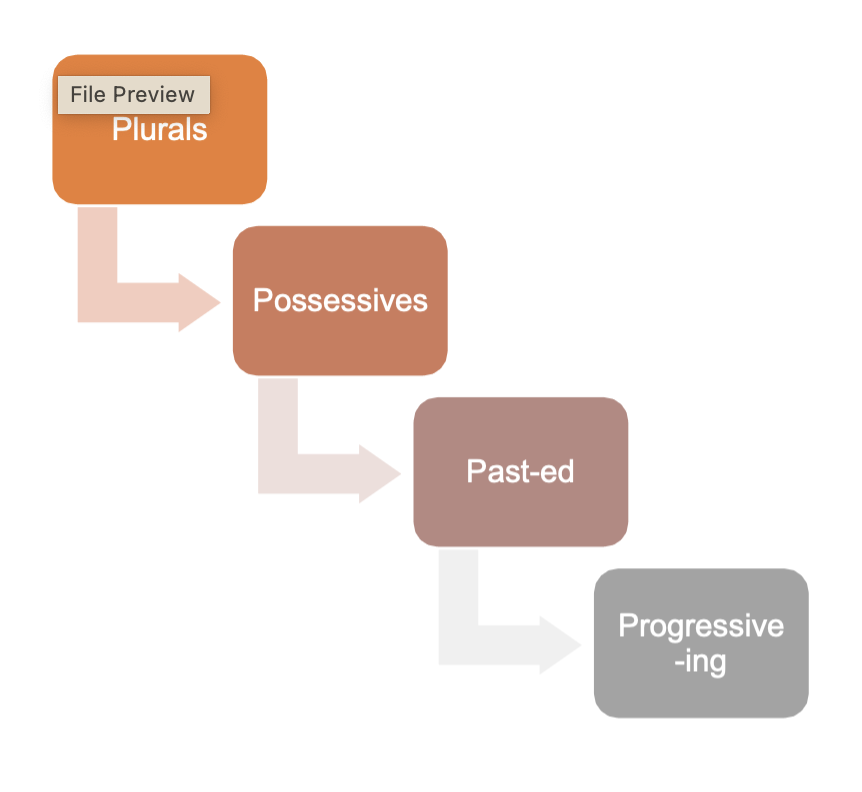
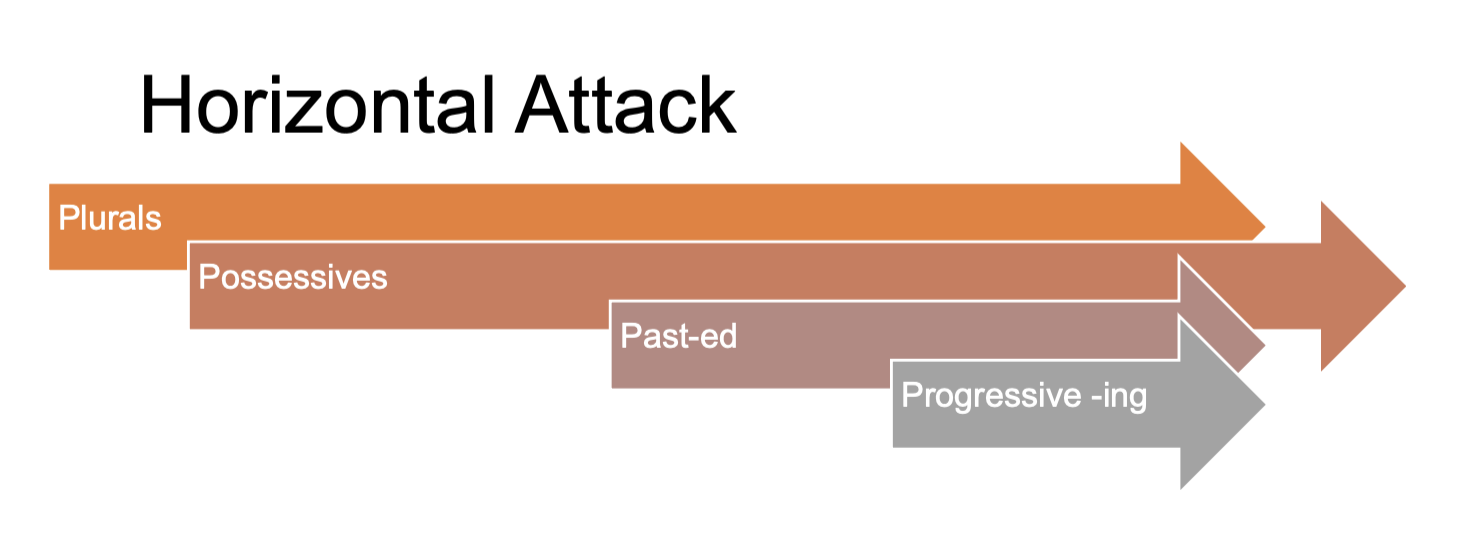
Horizontal Attack Strategies
Gradually adding new skills to work on at the same time, layering
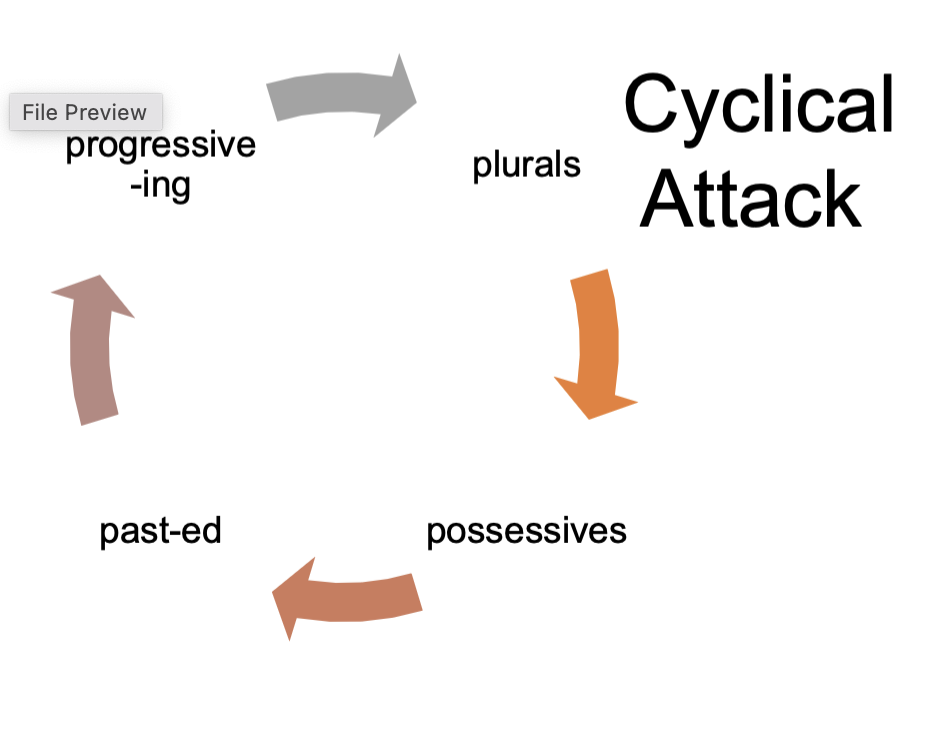
Cyclical Attack Strategies
Working on skills a little bit at a time, cycling through each target
Consulting
Gathering and sharing information
Collaborating
Working together to achieve some goal
Coaching
Helping someone to achieve some goal (teaching, giving feedback)
Moving towards Independence
High dosage, high support, feedback from others
Less support, self-reflection, intermittent dosage and feedback
Little to no support and feedback, self-reflection
Qualitative Data
Observations, interview, or reported information
Frequency Data
Percentage or fraction, information about performance out of ‘x’ trials
Duration Data
How long did it take (ex: holding a sound out)?
Interval Data
Assessing if a behavior occurred within a given time frame
SOAP Notes
Subjective - what was observed/reported
Objective - data collected in session
Analysis - interpretation of data
Plan - recommendations for next session