renal function
 Call Kai
 Learn
Learn Practice Test
 Spaced Repetition
 Match
Match Flashcards
 Knowt Play
1/92

There's no tags or description
Looks like no tags are added yet.
Name | Mastery | Learn | Test | Matching | Spaced | Call with Kai | Chat |
|---|
No analytics yet
Send a link to your students to track their progress
93 Terms
role of the kidneys
filter out small ater soluble aste products
manages levels of ater and sodium in plasma
produces adrenaline from adrenal gland
erythropoietin made by the kidney
hy is sodium important?
blood volume and pressure, stored in extracellular space so modulates ho much ater e keep in the extracellular space
aste products in urine
urea, hydrogen ions, creatinine
hydrogen ions
produced through metabolism
need to remove to avoid lo pH
creatinine
aste product produced by muscle breakdon and repair
urea
protein breakdon gives off urea
hat is urine made from mostly?
plasma
it takes 200 litres of plasma to make the 2 litres of urine that e make per day
kidney gets 1L of cardiac output per minute, multiply that by no. of minutes per day, around 1400L gets delivered to the kidney. hoever, only 200L of this gets filtered, only 2L turns into urine
99% of ater entering kidney is reabsorbed
urine versus blood conc of aste products
aste products are more concentrated in the urine than in the blood
indicates that ater is reabsorbed
secretion to add more aste product than as initially filtered

hat substances are present in plasma but not urine?
HCO3, glucose, albumin
either doesn’t get filtered or all of it is reabsorbed
nephron
a million nephrons in the kidney
in the medulla of the kidney, loop goes into the deeper section of the medulla
1200L of blood passes through the nephrons every day

parts of the kidney
cortex (outer) and medulla (inner)
parts of the nephron
glomerulus
proximal convoluted tubule
loop of Henley (descending limb and thick ascending limb)
distal convoluted tubule
connecting tubule
collecting duct

thick ascending limb
does a flyby of the glomerulus
collecting duct
collecting ducts from other nephrons merge in and it becomes the ureter
blood flo through the nephron
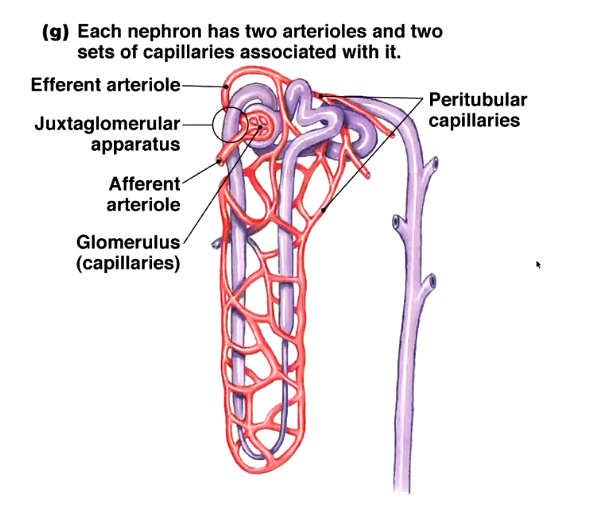
blood moves in through afferent arteriole hich leads to the glomeruler capillaries
a portion of the blood gets filtered (20%), but most gets pushed out into the efferent arteriole, then into the peritubular capillaries
some blood gest reabsorbed into capillaries, some stuff gest secreted from capillaries into nephron
amount of solute exccreted = amount filtered - amount rebsorbed + amount secreted
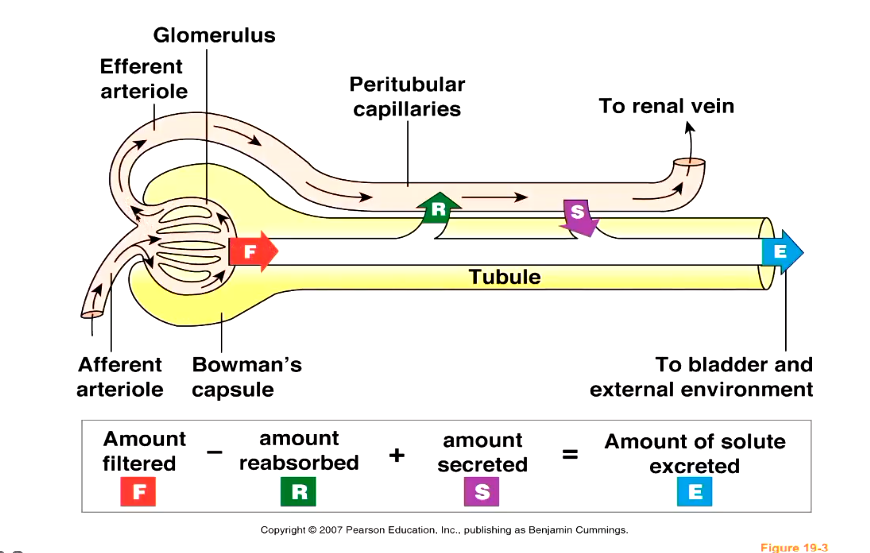
peritubular capillaries
capillaries that rap around the rest of the nephron, colecting hat is reabsorbed out of the nephron
here does the majority of reabsorption occur?
in the proximal tubule and loop of Henle

substances that are filtered into the nephron
the lower the percentage of excretion, the more of the substance needs to be reabsorbed

parts of the glomerulus
ascending limb of loop of Henle can be seen on the left
whatever enters the proximal tubule we call “filtered”, needs to get through glomerular capillaries - size barriers
Bowman’s capsule: fluid filled space surrounding the capillaries
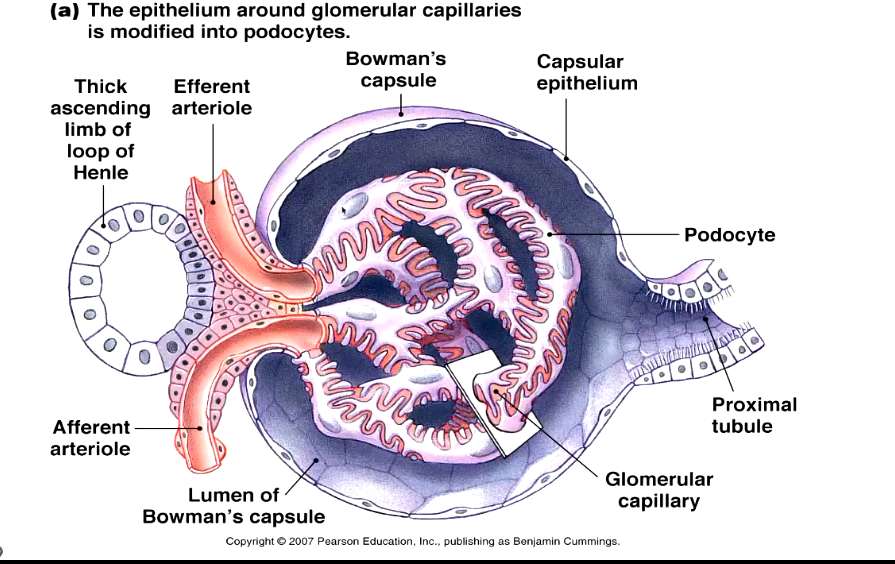
size barriers
large molecules are blocked by:
fenestrated capillaries
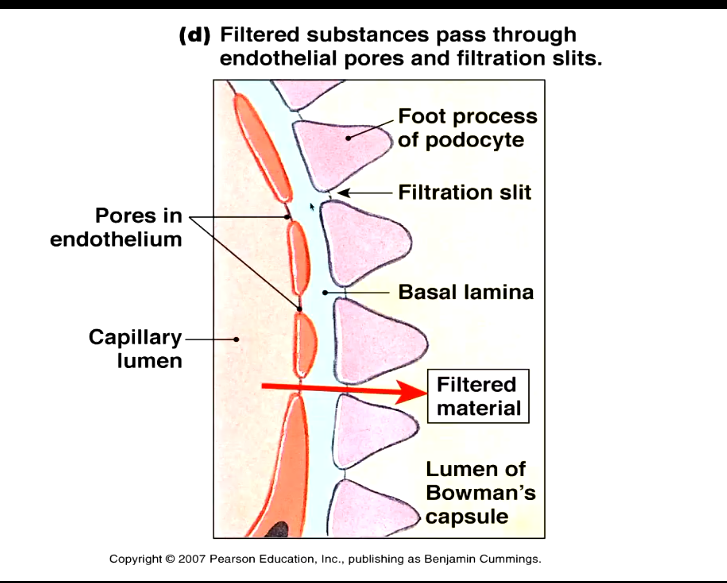
podocytes create thin filtration slits
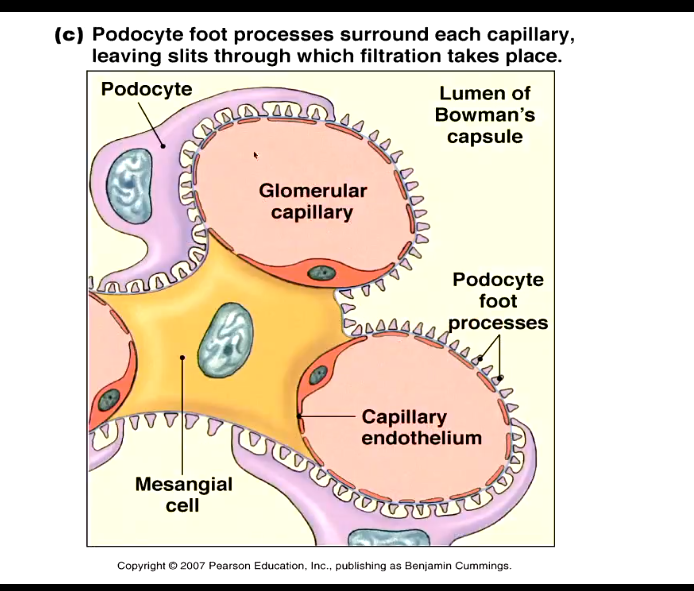
mesangial cell
keeps the capillaries in position
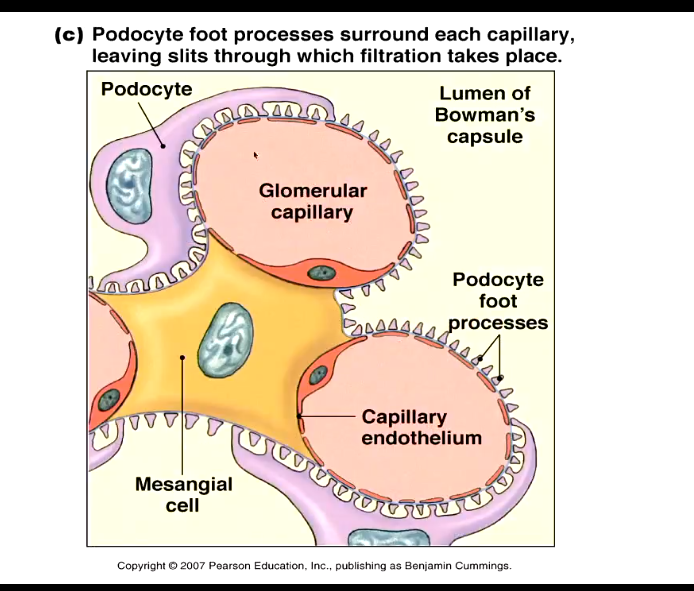
endothelial pores and filtration slits
substances to be filtered need to pass through the pores and through the negatively charged lamina and then through the filtration slit in the podocyte
does albumin get filtered?
it’s small enough to get through but the negative charge barrier stops it from getting through
glomerular filtration rate
clinical indicator of renal function
volume of plasma filtered by the glomerulus per unit time
how much plasma comes out of glomerulus and enters nephrons
about 100 mL/min

low glomerular filtration rate
declines with age and with conditions like diabetes
what is the main force that affects GFR?
hydrostatic pressure in the glomerular capillary
hydrostatic pressure in the glomerular capillary
55 mm Hg (higher than in systemic capillaries)
there is some oncotic pressure in the glomerular capillaries (30 mm Hg) but net filtration pressure of 10 mm Hg
no oncotic pressure in Boman’s space drawing fluid out as there is no albumin in this space

oncotic pressure in Boman’s capsule
0
why is the pressure in the glomerular capillaries greater than in systemic capillaries?
e don’t ant to reabsorb anything back into glomerular capillaries, so pressure needs to stay high to ensure that filtration is occurring all along their length
hypertension and kidneys
as pressure is high in the glomerular capillaries, hypertension is very dangerous for kidneys
how is GFR modulated?
GFR increased by dilating afferent arteriole or constricting efferent arteriole as it causes an increased hydrostatic pressure in the glomerular capillaries
what happens to renal blood flow when the afferent arteriole constricts?
it decreases, (SNS mechanism through a1 receptors)
to maintain GFR, we can constrict the efferent arteriole

how to measure GFR?
inulin
measure how much is in the blood and the rate at which its appearing in the urine
ideal compound because:
it is not reabsorbed
it is not secreted
it is exogenous
it is not metabolised

process of using inulin to measure GFR
e.g. we might put a conc of 4 units of inulin per 100 mL of plasma
can measure rate of inulin appearing in the urine (e.g if it’s 4 units per minute, since there’s 4 units in 100 mL of plasma we would know that the rate of filtration is 100mL/minute)

renal clearance
the rate of urinary excretion of a substance relative to its plasma concentration
how quickly a substance in our plasma will be cleared
ho many mLs orth of plasma are e clearing of the substance every minute (mLs/min)
importance of renal clearance
important for pharmacology: need to know how frequently to dose someone with a drug

clearance calculation example
we are actively clearing 50 mL/min
doesn’t matter about the conc of the substance, it’s about the volume entering the nephron and the percentage of the substance cleared (percentage x volume)

clearance calculation including secretion
penicillin - 4 units/100mL, however, 2 units are secreted per 100mL
therefore 150mL/minute
if clearance of X is less than GFR, then
X is being reabsorbed by the nephron
hat happens to GFR hen MAP increases?
it doesn’t change (within a relatively typical range)
achieved through: myogenic response and tubuloglomerular feedback

myogenic response
reflex constriction as a result of pressure increase in afferent arteriole
macula densa
here the afferent arteriole connects to thick ascending loop of the loop of Henle
tubuloglomerular feedback
if GFR increases, flow through tubule increases, therefore flow through macula densa increases
macula densa can detect levels of NaCl, if GFR is increased too high, the flow through the early parts of the nephron is too fast to absorb enough NaCl, macula densa detects high levels of NaCl
macula densa tells afferent arteriole to constrict (by releasing adenosine)

adenosine
paracrine, travels to smooth muscle cells of afferent arteriole and tells them to constrict
juxtaglomerular apparatus
the macula densa and the afferent arteriole
ho can renal excretion be altered?
regulating Na+ excretion:
renin-angiotensin system
sympathetic NS
atrial natriuretic peptide
regulating water excretion:
vasopressin (anti diuretic hormone)
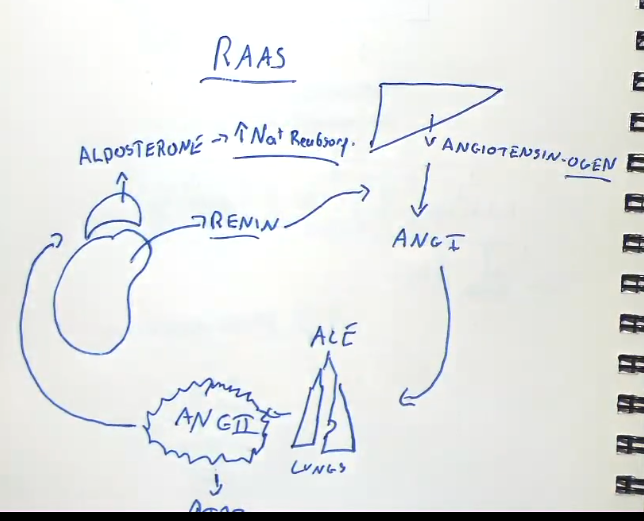
renin-angiotensin-aldosterone system
recruited when blood pressure drops, in tandem with the SNS
raises blood pressure
causes us to reabsorb sodium
begins with granular cells
granular cells
cells lining the afferent arteriole
releases renin in response to lo BP
renin
travels in the blood to the liver,
liver is normally producing angiotensinogen
renin cleaves angiotensinogen into angiotensin I
angiotensin I
travels to lungs
lungs produce angiotensin converting enzyme (ACE) hich converts angiotensin I to angiotensin II
angiotensin II
increases TPR through vasoconstriction of arterioles, increases GFR by constricting efferent arteriole
travels to the adrenal glands above the kidney and causes it to release aldosterone
increases some Na+ reabsorption in the proximal tubule (small effect as 80-85% of Na+ is absorbed here, so small changes can have a big effect)
how does angiotensin II rescue drop in GFR due to low BP?
constricts efferent arteriole
aldosterone
steroid hormone
mineralocorticoid: hormone that regulates minerals (in this case, Na+)
increases Na+ reabsorption from the collecting duct back into our circulation
sympathetic NS effect on renal excretion
NA slightly stimulates an increase in Na+ reabsorption from proximal convoluted tubule
main effect on afferent arteriole: effect on a1 receptors to cause constriction to ensure that blood is sent to skeletal muscles
therefore decreases GFR
however, the sympathetic NS also activates the renin angiotensin aldosterone system, which constricts the efferent arteriole to bring GFR back up
acute tubular necrosis
if an artery is haemorrhaged, the SNS ill cause heavy vasoconstriction of the afferent arteriole
this combined ith a decrease in blood volume can result in kidney ischemia - tubules die off so sodium and ater cannot be reabsorbed
profound diuresis
is reabsorption or secretion bigger in the tubules?
reabsorption
1200 L moves through the kidney per day, only 200 L enters the nephron to get filtered, most of this needs to be reabsorbed as we only produce 2L of urine per day
here is reabsorption greatest along the nephron?
proximal tubule, descending limb, loop of Henle and ascending limb (bulk reabsorption - 85% of water and Na+ are reabsorbed)
fine tubing occurs at distal tubule and collecting duct
hat does the inside of the proximal tubule look like?
lots of villi to create high surface area
what is the most important solute to be reabsorbed?
sodium, as reabsorption of everything else follos reabsorption of sodium
reabsorption in proximal tubule
Na+ reabsorption
electrochemical gradient drives anion reabsorption
ater reabsorption
permeable solute reabsorbed
Na+ reabsorption in proximal tubule
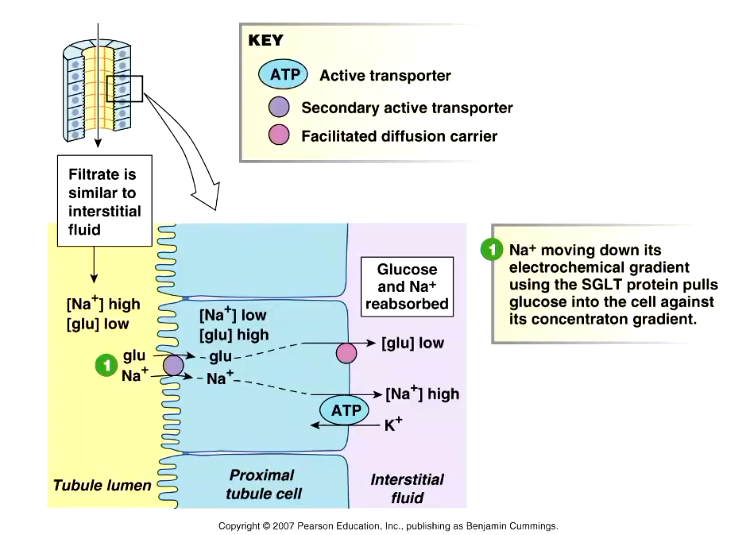
through active transport
Na+/K+ pumps on basolateral membrane creates conc gradient (creates lo level of Na+ in proximal tubule cells)
therefore, only a channel is needed on luminal membrane so that Na+ can pass from tubule lumen to proximal tubule cell
peritubular capillaries are on the right, reabsorbing all the Na+

electrochemical gradient drives anion reabsorption
anions follo the positively charged Na+ don their electrochemical gradient

ater reabsorption
water moves by osmosis, folloing solute reabsorption
therefore, ater reabsorption is linked to Na+ reabsorption in theproximal tubule, cannot change one independently of the other (this is different in the distal tubule)

permeable solutes reabsorbed
K+, Ca2+, urea, etc have channels
they no have a concentration gradient as the ater has left, making them more concentrated in the lumen
so they ill flo into the extracellular fluid

reabsorption into peritubular capillaries
peritubular capillaries closely surround the proximal tubule, so everything is reabsorbed into them
they are an extension of the afferent arteriole
active reabsorption in the proximal tubule?
although only sodium is directly actively reabsorbed, reabsorption of all the other substances also counts as active as it required the ork of ATP in the first place to move sodium to allo these solutes to follo
reabsorption ith cotransporters
Na+ gradient can be used ith cotransporters
every Na+ that comes through can bring other molecules ith it too, such as glucose or amino acid transporters
e ant to reabsorb all glucose so e have a lot of these transporters
SGLT-2 inhibitors
SGLT-2 is a sodium glucose transporter
inhibitors reduce reabsorption of sodium and glucose
ork in diabetics to reduce plasma glucose levels, it leaves in the urine
glomerular hyperfiltration
in diabetic nephropathy and hypertension
too much pressure on glomerular capillaries
so much glucose in the plasma that SGLT-2s are orking really hard, but ith every glucose molecule reabsorbed, Na+ is also reabsorbed
macula densa detects lo Na+, thinks that GFR must be lo, dilates afferent arteriole, increases pressure in glomerular capillaries too high
therefore SGLT-2 inhibitors can be used in diabetes to protect glomeruli
hy does glucose appear in the urine of a diabetic?
abnormally high levels of glucose in the plasma
SGLT-2s are saturated, can’t absorb any more glucose - tubular/transport maximum

reabsorbing HCO3-
in the proximal tubule, there is a Na+/H+ exchanger - Na+ enters the proximal tubule cell, and the H+ enters the lumen
H+ combines ith HCO3- to form H2CO3
CA converts H2CO3 to H2O and CO2
CO2 is reabsorbed a it has a conc gradient
then CO2 combines ith H2O to form H2CO3, hich then splits into HCO3- and H+
HCO3- is filtered into blood
H+ is used again in the exchanger
e can reabsorb almost 100% of HCO3-

oxygen consumed by kidney
80% of oxygen consumed by the kidney tied to reabsorption of ater, chloride, glucose, amino acids, urea
tied to secretion of potassium, hydrogen ions
effect of aldosterone in the collecting duct
increases activity of sodium/potassium pump on basolateral membrane
increased expression of EnACs on luminal membrane
increased potassium secretion
increased activity of hydrogen ATPase on luminal membrane

increased potassium secretion
increased activity of sodium/potassium pump results in increased K+ conc in the cells
therefore K+ channel on luminal membrane allos secretion of K+ into the lumen
hydrogen ATPase
on the luminal membrane
kicks hydrogen out into the lumen
ho is electrical neutrality maintained in the presence of aldosterone?
for every to Na+ ions reabsorbed as a result of aldosterone, e secrete one K+ and one H+ to maintain electrical neutrality
hyperaldosteronism
Na+ reabsorbed increases, BP goes up
hyperkalemic (lo K+)
alkalotic (getting rid of too much H+)
sodium input
diet (food 7 drink) = 150 mmol on average consumed
intravenous (normal/isotonic saline) = 0 mmol
sodium output
urine = 140 mmol
faeces = 8 mmol
skin = 2 mmol
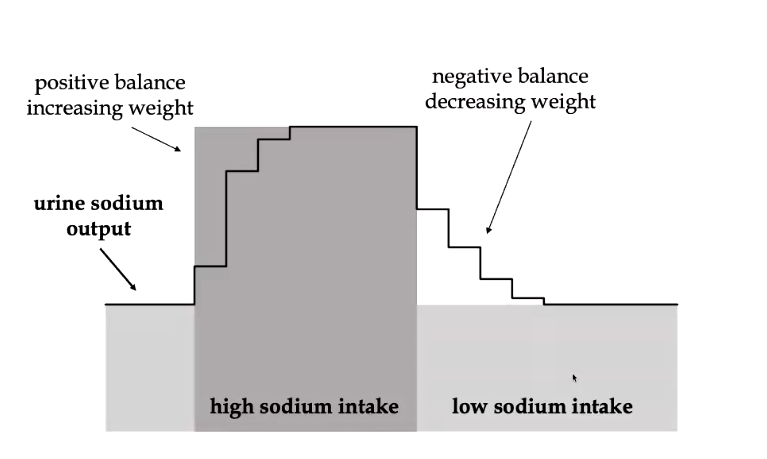
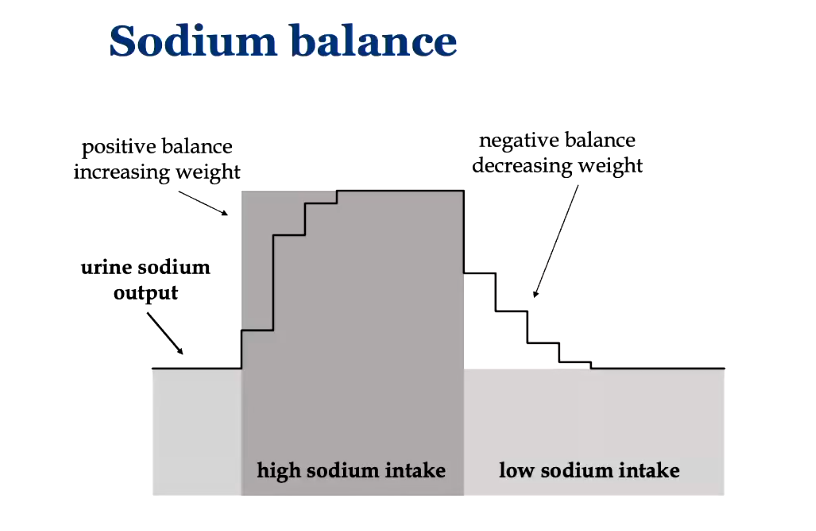
high sodium intake
takes a few days for the body to adjust to Na+ balance
each step is about a day and represents urine sodium output
if e suddenly increase our sodium intake, our sodium input incrases dramatically (dark grey square)
takes a hile for our urine output to match this, takes a hile for aldosterone levels to drop enough so that e can excrete the sodium
results in a temporary positive sodium balance
hy does it take a hile for the body to adjust to Na+ balance changes?
as aldosterone is a steroid hormone, sloer acting, longer lasting hormone
e don’t ant dramatic immediate changes as Na+ balance affects cardiovascular system
positive sodium balance
results in you retaining ater
results in an increase in eight
9 extra grams of sodium results in one L of water retained
low sodium intake
takes a while for your sodium output to catch up, so initially you’re urinating out more sodium than you’re taking in
negative sodium balance, drop weight
how does infusion of normal saline change blood volume?
sodium is in the extracellular fluid (plasma and interstitial fluid)
the saline will move into these fluids
25% of extracellular fluid is plasma
therefore an infusion of 1L of normal saline will cause a change in blood volume of 0.25L
ideal treatment for low BV?
could add albumin to IV drip as albumin stays in the plasma and will osmotically keep water in the plasma
in practice artificial electrolyte solutions or blood is often used as adding albumin can result in reactions
how does the body detect sodium balance?
judged through BP receptors:
carotid baroreceptors
renal arterial pressure receptors
cardiac atrial baroreceptors
angiotensin II vs aldosterone effects on sodium reabsorption
angiotensin II causes a mild increase in Na+ reabsorption in the PCT, therefore causes an increase in reabsorption of everything else, including water
however, aldosterone works in the collecting duct, so it can exclusively affect Na+ reabsorption without affecting water reabsorption
what triggers renin release? (RAAS system)
stimulated by volume depletion:
fall in pressure at preglomerular (afferent) arteriole
reduction in sodium chloride delivery (signals reduced GFR) to macula densa
sympathetic nerve activation (recognised via baroreceptors)
atrial natriuretic peptide
if stretch increases in the atrium, there must be an increase in plasma volume
atrial natriuretic peptide released (short acting hormone)
in collecting duct, ANP decreases reabsorption (opposite effect of aldosterone)
removes ENaCs from the luminal membrane of the collecting duct to reduce Na+ reabsorption
here does secretion occur?
proximal tubule, distal tubule and collecting duct
hat affects diameter of afferent arteriole?
tubuloglomerular feedback (either ay)
myogenic response (either ay)
sympathetic NS (const.)
ANP (dilate)
hat affects efferent arteriole
ANG II (constriction)
damage to kidneys caused by medication
ACE inhibitor (decreased Ang II, dilation of efferent arteriole)
loop diuretic: drop in blood volume
NSAID: block production of prostaglandins, which cause relaxation of the afferent arteriole. if they’re blocked, constriction of the afferent arteriole occurs
major decrease in GFR