Mendelian Inheritance And Probabilities
 Call Kai
 Learn
Learn Practice Test
 Spaced Repetition
 Match
Match Flashcards
 Knowt Play
1/8

There's no tags or description
Looks like no tags are added yet.
Name | Mastery | Learn | Test | Matching | Spaced | Call with Kai | Chat |
|---|
No analytics yet
Send a link to your students to track their progress
9 Terms

Is this trait dominant or recessive?
recessive

Is the gene autosomal, X-linked, or mitochondrial?
autosomal

This pedigree shows the inheritance pattern of hemophilia in European royal families from the
1800’s. What type of mutation causes hemophilia?
A) Dominant autosomal
B) Recessive X-linked
C) Recessive autosomal
D) Dominant X-linked
E) Y-linked
B) Recessive X-linked
How many different gametes can each parent create? (How large is our Punnett square going to be?) Aa Dd Ss X Aa Dd Ss
a. 2
b. 4
c. 8
d. 16
e. 32
c. 8 (2³=8)
Assuming that each gene is on a different chromosome, how many unique types of gametes can this Drosophila produce? Aa Bb Cc Dd
a. 6
b. 8
c. 16
d. 32
c. 16 (2^4 = 16)
What is the probability that a kitten from this cross would be: striped, dilute, with no white?
Aa Dd Ss X Aa Dd Ss
a. 3/64 = 0.047
b. 9/64 = 0.14
c. 3/12 = 0.25
d. 27/64 = 0.42
a. 3/64 = 0.047 (3/4 × ¼ x 1/4)

Consider a couple with 3 children. Both parents are heterozygous for the sickling allele.
A = HbA = normal RBC
a = HbS allele = sickled RBC
What is the probability that their first child will have sickle cell anemia while their 2nd and 3rd
children will have normal RBC?
a. P = ¼ x ¾ x ¾
b. P = ¼ + ¾ + ¾
c. Neither a nor b
a. P = ¼ x ¾ x ¾

What type of inheritance pattern is being tracked here?
A) Dominant autosomal
B) Recessive X-linked
C)Recessive autosomal
D)Dominant X-linked
E) Y-linked
A) Dominant autosomal
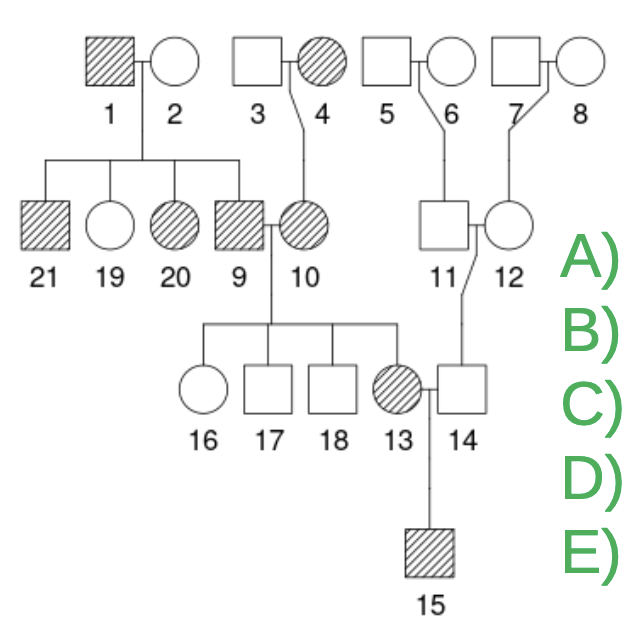
Which affected individual could be homozygous for this trait?
A) 21
B) 13
C)15
D)10
E) Noone is homozygous
B) 13