Direct Retainers Part 2(quiz part)
 Call Kai
 Learn
Learn Practice Test
 Spaced Repetition
 Match
Match Flashcards
 Knowt Play
1/114

There's no tags or description
Looks like no tags are added yet.
Name | Mastery | Learn | Test | Matching | Spaced | Call with Kai | Chat |
|---|
No analytics yet
Send a link to your students to track their progress
115 Terms
Types of direct retainers
DIRECT RETAINERS FOR TOOTH BORNE (FOR CLASS III & IV)
DIRECT RETAINERS FOR TOOTH BORNE (FOR CLASS I & II)
DIRECT RETAINERS FOR TOOTH BORNE (FOR CLASS III & IV)
(Simple Circlet or Akers) clasp
Reverse circlet
Multiple circlet
Embrasure (Double Akers) Clasp
Ring clasp
"C" clasp (Hair-pin or Reverse action)
Half and half
Onlay clasp
Combination clasp
RPI clasp (canine abutment)
DIRECT RETAINERS FOR TOOTH BORNE (FOR CLASS I & II)
Bar clasp
RPI clasp
RPA clasp
Combination Clasp
Advantages
● Excellent bracing qualities
● Easy to design and construct
● Less potential for food accumulation below the clasp compared to Bar Clasp
Advantages of Circumferential Clasp or Suprabuldge Clasp
Bar clasp also called as
Infrabuldge Clasp
Disadvantages
More tooth coverage than bar clasps that can cause enamel decalcification
Enamel decalcification - ngipin na may puti puti, abutment area kung san nakalagay yung clasp
More metal is displayed than with bar or combination clasps
Adjustments are difficult or impossible due to the half round nature of the clasp
Disadvantages of Circumferential Clasp or Suprabuldge Clasp
Introduced by Dr. N. B. Nesbitt in 1916
Modified by Dr. Polk E. Aker
Versatile and widely used
McCracken — calls it the Akers clasp.
Stewart — calls it the simple circlet clasp.
Simple Circlet Clasp or Akers Clasp
Who called it the simple circlet clasp.
Stewart
Who called it Akers Clasp
McCracken

What type of clasp is Shown
Simple Circlet Clasp or Akers Clasp
Indications
Tooth supported (posterior)
Pag nag tooth next to a edentolous area is a posterior: clasp mo dapat akers, next mong gagawin is yung survey line. Kung kaya pa ilagay yung correct placement ng retentive and reciprocal arm.
Kapag nakatayo
Indications Simple Circlet Clasp or Akers Clasp
Advantages
● Fulfills the design requirements of support, stability, reciprocation
● Encirclement, and passivity.
● Easy to construct and relatively simple to repair.
Advantages of Simple Circlet Clasp or Akers Clasp
Disadvantages
● May promote decalcification and compromise dental esthetics (because of the metal).
● Tends to increase the circumference of the clinical crown (food accumulation and enamel decalcification)
Disadvantages of Simple Circlet Clasp or Akers Clasp
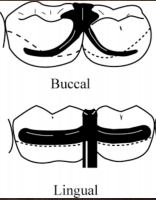
What type of Circumferential Clasp/Suprabuldge is shown
Embrasure Clasp or Double Akers Clasp
Two simple circlets joined at their bodies
Embrasure Clasp(Double Akers)
Indications
● Used on the side of the arch where there is no edentulous space
Embrasure Clasp(Double Akers)
Embrasure clasp is also known as
Double Akers
when you design you should follow the
polygon of support/configuration
Used when the other side has limited space on the edentulous area and placement of pontic is not possible
Embrasure Clasp or Double Akers
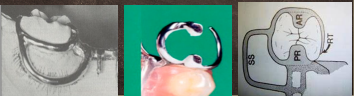
What type of Circumferential clasp/suprabulge is shown
Ring Clasp
Indicated when the proximal undercut cannot be approached
○ e.g tipped mandibular molar.
Ring Clasp
On a ring clasp when Large angle of cervical convergence (Tilted mandibular molar) you should use
Occlusal Rest
Contraindications
● Excessive tissue undercuts prevent the use of a supporting strut.
● Limited vestibular depth.
○ Should left 1mm on the free gingival margin
Contraindications of Ring Clasp
Ring Clasp can’t be made with tissue that has limited _________
Vestibular Depth
Advantages
● Excellent bracing (with supporting strut)
● Allows use of an available undercut adjacent to edentulous area (angle of cervical convergence, depending on the size)
Advantages of Ring Clasp
Disadvantages
● Covers a large area of tooth surface, therefore requiring meticulous hygiene
● Very difficult to adjust due to the extreme rigidity of the reciprocal arms.
● The lower bracing arm should be at least 1 mm from the free gingival margin and relieved to prevent impingement of the gingival tissues.
Disadvantages of Ring Clasp
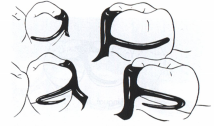
This type of Circumferential Clasp/ Suprabuldge clasp is called
C Clasp
C Clasp is also referred to as a :
“fishhook” or “hairpin” clasp
Design considerations
Clinical crown must have sufficient vertical height.
There must be adequate space between the occlusal and apical portions of the retentive arm.
The occlusal arm must not interfere with opposing teeth during maximum intercuspation (MI).
Design considerations for a C clasp (hairpin/reverse-action clasp)?
C clasp is contraindicated on a
Small vertical crown height
Indications
When soft tissue contour prevents the use of a bar-type (infrabulge) clasp.
When a reverse circlet clasp cannot be used because there is insufficient occlusal clearance.
Meaning: The upper and lower posterior teeth come very close together, leaving little/no space for the clasp.
Indications For C Clasp

What type of Circumferential/ Suprabulge is used
Half and Half Clasp
Consist of a circumferential retentive arm arising from one direction and a reciprocal arm arising from another direction
○ Consist of two minor connector
Half and Hald Clasp
Half and Hald Clasp i indicated for
Unilateral partial denture design

What type of Circumferential Clasp/ Suprabuldge is shown
Multiple Clasp
2 circumferential clasp joined at the terminal end of the 2 reciprocal arms
Multiple Clasp
Indications
● Additional retention and stabilization is needed (tooth-supported RPD)
● RPD replace half of the arch (Dental prosthesis will not cross the midline)
Indications of a Multiple Clasp:
Indicated on a Unilateral RPD
Multiple Clasp

What type of Circumferential Clasp/ suprabulge is shown
Onlay Clasp
● Consists of a rest that covers the entire occlusal surface and serves as the origin for buccal and lingual clasp arms
Onlay Clasp
Indicated when the occlusal surface of the abutment lies noticeably apical to the occlusal plane.(Mababa ang occlusal plane )
Onlay Clasp
Serves as a vertical stop and also aids in the establishment of an acceptable occlusal plane.
Onlay Clasp
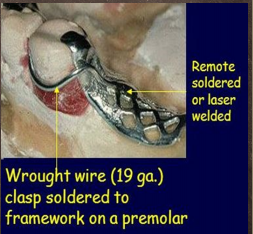
What type of circumferential clasp/suprabuldge is shown
Wrought Wire Combination Clasp
Wrought Wire Combination Clasp also referred to as ________ By Dr. O.C. Applegate
Combination Clasp
A wrought wire combination clasp is consisted of an
occlusal rest, a cast metal reciprocal arm, and a wrought-wire retentive arm.
It is used for tooth-tissue supported RPD
wrought wire combination clasp
Indications
● On an abutment adjacent to a Kennedy Class I
● Class II posterior edentulous area when the usable undercut is located at the mesiofacial line angle of the most posterior abutment.
Indications of Wrought wire combination clasp
Basically a two process fabrication, Fabricate then solder the retentive arm
Cast metal reciprocal arm → made as part of the cast framework
Wrought-wire retentive arm → made separately from wrought wire and then soldered/attached to the framework
Combination Clasp
Infrabuldge Clasp- Dr F. Ewing Roach presented his “bar-type” or “Roach”
clasp exhibits a “____” type of retention
Infrabuldge Clasp- Dr F. Ewing Roach presented his “bar-type” or “Roach”
clasp exhibits a “push” type of retention
other terms for infabuldge clasp
Roach clasp, Bar-type clasp
exhibits a “push” type of retention
Infrabuldge Clasp
exhibits a “pull” type of retention- it prevents dislodgement of the direct retainer away from the tooth.
Suprabuldge Clasp
Flexibility of the infrabulge clasp is controlled by the taper and length of the _________ - usually more ________than a suprabulge clasp The longer the arm, the more ______it will be.
Flexibility of the infrabulge clasp is controlled by the taper and length of the approach arm - usually more esthetic than a suprabulge clasp The longer the arm, the more flexible it will be.
Types of infrabuldge clasp
T-clasp
Modified T-clasp
Y-clasp
I-clasp
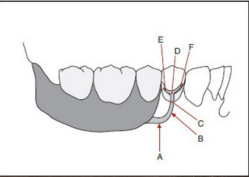
Type of infrabuldge clasp shown
T-Clasp
T-Clasp
Approach arm: cross the free gingival margin at________ and contact the abutment at the ______________
T-Clasp
Approach arm: cross the free gingival margin at 90 degrees and contact the abutment at the height of contour
Approach arm: cross the free gingival margin at 90 degrees and contact the abutment at the height of contour
T-Clasp
Indications
● Kennedy Class I or Class II partially edentulous situations when an undercut is located adjacent to the edentulous area.
● Used when the abutment is slightly rotated towards the edentulous area.
Indications of T-Clasp:
Contraindications of what type of Infrabulge clasp:
● Severe soft tissue undercut
● Height of contour is located near the occlusal surface.
T-Clasps
One projection is located below the survey line and the other projection is located above the survey line.
T- Clasp
Indicated when there is soft tissue undercut present
Suprabuldge instead of Infrabuldge
Indications
Kennedy Class I and Class II applications when retentive undercuts are located adjacent to the edentulous area(s)
Improve esthetics
Indications of a Modified T Clasp:
Difference bet T clasp and modified T clasp is that the _____________ is missing in this area. The retentive component is next to the edentulous area which is located below the survey line.
Difference bet T clasp and modified T clasp is that the non- retentive component is missing in this area. The retentive component is next to the edentulous area which is located below the survey line.
In order for the T-Clasp to be more esthetic this component is removed which will the T Clasp will not be called Modified T Clasp
Non-retentive component
On a T Clasp where is the retentive component located
Under the Survey Line

What Type of Infrabulge Clasp is shown
Modified T Clasp
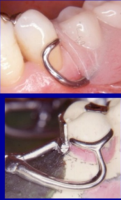
identify the image on the top and image on the bottom
Up: Modified T Clasp
Down: T Clasp
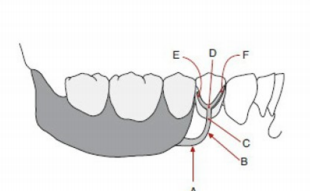
Type of infrabulge Shown
Y Clasp
formed when the approach arm terminates in the cervical third of the abutment, while the mesial and distal projections are positioned near the occlusal/incisal surface.
Y Clasp

What type if Infrabulge is shown
I Clasp
Indications for I Clasp
Kennedy Class I and Class II partially edentulous arches the contact area between the clasp and the abutment is _________ in height and ________ in width should be placed at or mesial to the midfacial prominence of the abutment (or mesial to the buccal ridge).
2.0-3.0mm in height
1.5-2.0mm in width
Indications
Kennedy Class I and Class II partially edentulous arches the contact area between the clasp and the abutment is 2.0-3.0 in height and 1.5-2mm in width should be placed at or mesial to the midfacial prominence of the abutment (or mesial to the buccal ridge).
Indications for I Clasp
Placed at the mesial of the Midfacial prominence of the abutment
I Clasp
REST, PROXIMAL PLATE, I BAR (RPI)
Kratochvil in 1963
The components of this clasp assembly are:
"R" -____ (always mesial)
"P" - ____(proximal plate)
"I" -____ (retentive arm)
REST, PROXIMAL PLATE, I BAR (RPI)
Kratochvil in 1963
The components of this clasp assembly are:
"R" - Rest (always mesial)
"P" - Distal (proximal plate)
"I" - I-Bar (retentive arm)

Type of Clasp Assembly shown
Rest, Proximal Plate, I bar(RPI)
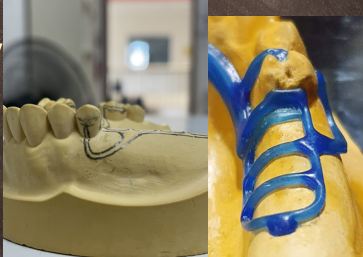
Type of Clasp Assembly shown
Rest, Proximal Plate, I bar(RPI
Contraindications
● Insufficient depth of the vestibule. (The inferior border of the I-bar must be located at least 3-4 mm. from the gingival margin.)
● No labial or buccal undercut on the abutment(Flat tooth)
● Severe soft tissue undercut
● Disto-buccal undercut (less than 180° encirclement
Contraindications of REST, PROXIMAL PLATE, I BAR (RPI)
The rest of the RPI is always located at the ______ of the abutment. Because it serves as a ______ when lifting the denture base of the distal extension cases (Classes I and II KC) when eating
The rest of the RPI is always located at the mesial of the abutment. Because it serves as a lever when lifting the denture base of the distal extension cases (Classes I and II KC) when eating
Rests are Located on the _____________ of a premolar or __________ surface of a canine-rests serve as rotational centers
Rests are located on the mesio-occlusal surface of a premolar or mesio-lingual surface of a canine-rests serve as rotational centers
Mesial rests direct tipping forces toward the mesial surfaces. This places the abutments in firm contact with adjacent teeth, providing a “_______” effect
Mesial rests direct tipping forces toward the mesial surfaces. This places the abutments in firm contact with adjacent teeth, providing a “buttressing” effect
Located on a _________ on the distal surface of the tooth. The superior edge of the proximal plate is located at the bottom of the guide plane
Located on a guide plane on the distal surface of the tooth. The superior edge of the proximal plate is located at the bottom of the guide plane
The proximal plate extends _______ so that the distance between the minor connector and the proximal plate is less than the mesio distal width of the tooth. The plate is approximately ______ and joins the framework at a right angle.
The proximal plate extends lingually so that the distance between the minor connector and the proximal plate is less than the mesio distal width of the tooth. The plate is approximately 1 mm thick and joins the framework at a right angle.
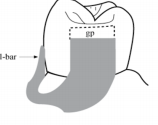
What is the component shown
Proximal Plate
I tooth tissue supported, You have to extent the proximal plate up to ________line angle. Should be wider when used on a tooth-tissue supported rpd
Proximolingual line angle
Proximal plate should be less than the _______ width of the tooth si it can provide bracing function on the tooth.
Mesiodistal Width

What is the component shown
I bar
I bar is located on the_________ of the premolar and on the ________ surface of the canine
I bar is located on the buccal surface of the premolar and on the mesio buccal surface of the canine
I bar originates at the _____ (denture base retaining element) and approaches the tooth from the gingival direction
Gridwork
Bend of the I bar should be located _____ from the gingival margin.
3 mm
I bar isn’t used in this type of tooth
Molars
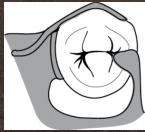
Type of Direct retainer shown
Rest, proximal plate, akers (RPA)
● Developed and described by Eliason in 1983
● Clasp arises from the proximal plate and terminates in the mesio buccal undercut
Rest, proximal plate, Akers (RPA)
Indications
● Insufficient vestibule depth
● Severe tissue undercut
● High frenum attachments-tooth with minimal underc
Indications for Rest, proximal plate, Akers (RPA)
Alternative for RPI
RPA
Difference from RPI: RPA is the ?
Rest
In an Akers clasp, what is associated with the proximal plate?
Akers clasp has a proximal plate.
In the RPI system, what are the three components
Rest + Proximal plate + I-bar.
In the RPI system, where does the retentive arm come from?
The retentive arm comes from the proximal plate.
is similar to the cast circumferential clasp with the exception that the retentive arm is fabricated from a round wrought wire (platinum-gold-palladium alloy or chrome-cobalt alloy)
Combination Clasp
Combination clasp retentive arm is fabricated from a ___________
Round wrought wire