IB Exam (Unit 2)

0.0(0)
Studied by 0 people
call kaiCall Kai
learnLearn
examPractice Test
spaced repetitionSpaced Repetition
heart puzzleMatch
flashcardsFlashcards
GameKnowt Play
Card Sorting

1/31

flashcard set

Earn XP

Description and Tags

Last updated 10:50 PM on 5/7/24
Name
Mastery
Learn
Test
Matching
Spaced
Call with Kai

No analytics yet

Send a link to your students to track their progress

32 Terms

1
New cards

U1: What does Molecular Biology teach us?

explains living processes in terms of the chemical substances involved

2
New cards

U2: What about Carbon makes it so useful?

  • can form four covalent bonds

    • allows a diversity of stable compounds to exist

3
New cards

U3: State what life is based on. List examples of it.

  • Life is based on carbon

Examples:

  • carbohydrates

  • lipids

  • proteins

  • nucleic acids

4
New cards

U4: Outline Metabolism in relation to Molecular Biology.

the web of all the enzyme-catalyzed reactions in a cell or organism

5
New cards

U5+6: Define Catabolism and Anabolism

Catabolism: the breakdown of complex molecules → simpler molecules

  • the hydrolysis of macromolecules into monomers

Anabolism: the synthesis of simpler molecules → complex molecules

  • formation of macromolecules from monomers by condensation reactions

6
New cards

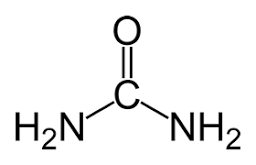
A1: Outline how urea is an example of a compound that is produced by living organisms but can also be artificially synthesized

  • Theory of Vitalism believed vital forces gave living things life

  • urea is found in urine

    • believed to only be created through vital forces

  • Wöhler creates it artificially using silver isocyanate and ammonium chloride

  • begins disproving vitalism

<ul><li><p>Theory of Vitalism believed <em>vital forces </em>gave living things life</p></li><li><p>urea is found in urine</p><ul><li><p>believed to only be created through vital forces</p></li></ul></li><li><p>Wöhler creates it <strong><span style="color: red">artificially</span></strong> using silver isocyanate and ammonium chloride</p></li><li><p>begins <strong><span style="color: green">disproving</span></strong> vitalism</p></li></ul>
7
New cards

A1:

8
New cards

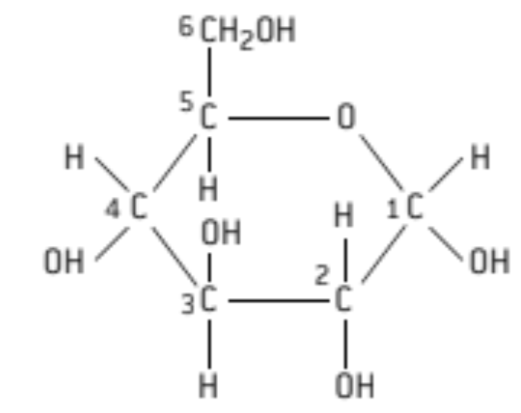
S: Draw a molecular diagram of glucose

  • hexagon

    • 5Cs and 1O

  • C #5 has a CH2OH

  • C #3 has a OH on top

<ul><li><p>hexagon</p><ul><li><p>5Cs and 1O</p></li></ul></li><li><p>C #5 has a CH2OH</p></li><li><p>C #3 has a OH on top</p></li></ul>
9
New cards

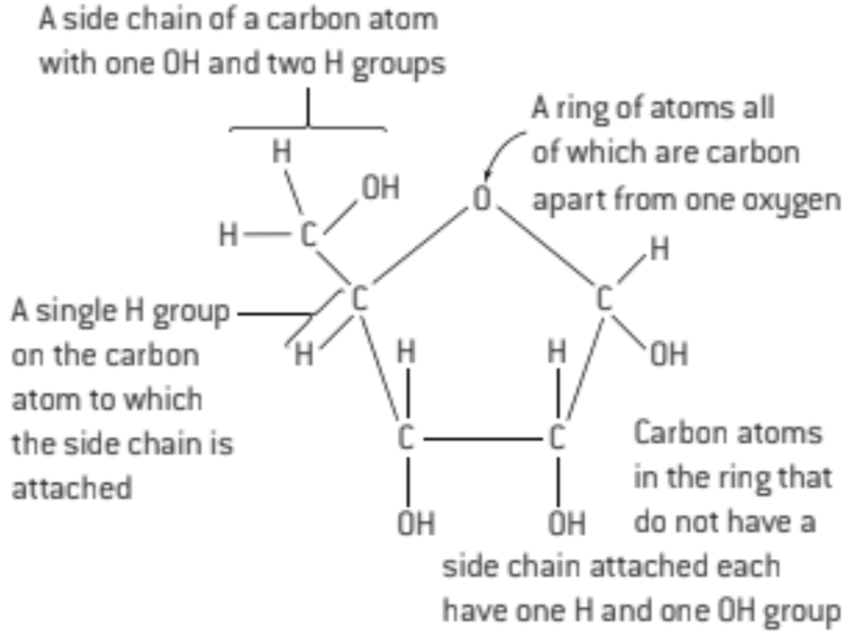
S: Draw a molecular diagram of ribose

  • pentagon (4C and 1O)

  • side chain with one -OH and 2 -H

  • side chan with lone H

<ul><li><p>pentagon (4C and 1O)</p></li><li><p>side chain with one -OH and 2 -H</p></li><li><p>side chan with lone H</p></li></ul>
10
New cards

S: Draw a molecular diagram of a Saturated Fat

can also be written as:

H-(CH₂)n-COOH

<p>can also be written as:</p><p>H-(CH₂)<sub>n</sub>-COOH</p>
11
New cards

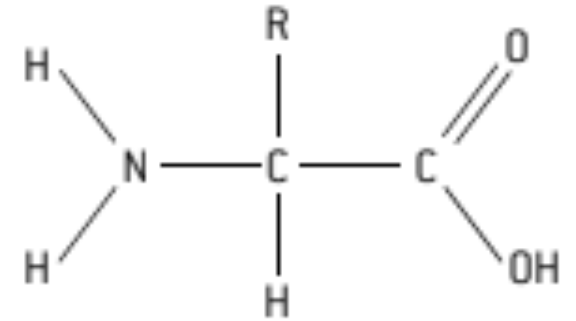
S: Draw a molecular diagram of an Amino Acid

  • H = hydrogen atom

  • NH or NH₂ amine group

  • (-COOH) = carboxyl group

  • R = r group or radical

<ul><li><p><strong>H</strong> = hydrogen atom</p></li><li><p><strong>NH</strong> or <strong>NH₂</strong> amine group</p></li><li><p><strong><span style="color: red">(-COOH)</span></strong> = carboxyl group</p></li><li><p><strong>R</strong> = r group or radical</p></li></ul>
12
New cards

U: Identify the qualities of a Sugar

13
New cards

U: Identify the qualities of a lipid

  • have two or three hydrocarbon chains

  • the quadruple ring structure of steroids

  • Hydrocarbon chains often shown as a zigzag line

  • rings of carbon atoms shown as hexagons or pentagon

14
New cards

U: Identify the qualities of a protein

  • H = hydrogen atom

  • NH or NH₂ = amine group

  • (-COOH) = carboxyl group

  • R = r group or radical

  • Look for bond between N-H (peptide bond)
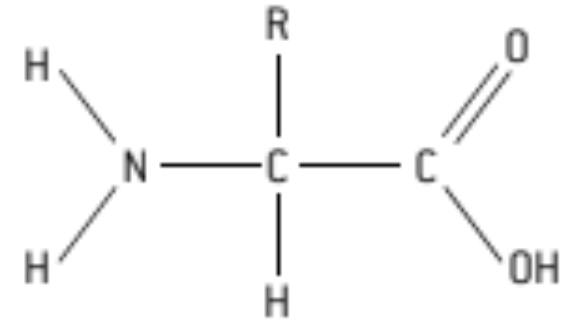
<ul><li><p><strong><span style="color: red">H</span></strong> = hydrogen atom</p></li><li><p><strong><span style="color: purple">NH</span></strong> or <strong>NH₂ </strong>= amine group</p></li><li><p><strong><span>(-COOH)</span></strong> = carboxyl group</p></li><li><p><strong>R</strong> = r group or radical</p></li><li><p>Look for bond between N-H (peptide bond)</p></li></ul>
15
New cards
16
New cards
17
New cards
18
New cards
19
New cards
20
New cards
21
New cards
22
New cards
23
New cards
24
New cards
25
New cards
26
New cards
27
New cards
28
New cards
29
New cards
30
New cards
31
New cards
32
New cards

Explore top notes

note
NOUNS
Updated 1100d ago
0.0(0)
note
AP Physics 1: Ultimate Guide
Updated 693d ago
0.0(0)
note
CELLULAR RESPIRATION
Updated 1728d ago
0.0(0)
note
Chemistry
Updated 279d ago
0.0(0)
note
Chapter 23- Alkenes
Updated 1278d ago
0.0(0)
note
Chapter 5: Foundations: History
Updated 1082d ago
0.0(0)
note
NOUNS
Updated 1100d ago
0.0(0)
note
AP Physics 1: Ultimate Guide
Updated 693d ago
0.0(0)
note
CELLULAR RESPIRATION
Updated 1728d ago
0.0(0)
note
Chemistry
Updated 279d ago
0.0(0)
note
Chapter 23- Alkenes
Updated 1278d ago
0.0(0)
note
Chapter 5: Foundations: History
Updated 1082d ago
0.0(0)

Explore top flashcards