Unit 3.2 Analytic Techniques: Electrophoresis, Chromatography
 Call Kai
 Learn
Learn Practice Test
 Spaced Repetition
 Match
Match Flashcards
 Knowt Play
1/112

There's no tags or description
Looks like no tags are added yet.
Name | Mastery | Learn | Test | Matching | Spaced | Call with Kai | Chat |
|---|
No analytics yet
Send a link to your students to track their progress
113 Terms
Analytic techniques
Scientific, laboratory methods used to measure the concentration of analytes in blood and other body fluids
electrical charge
Electrophoresis separates charged compounds based on their ___
cathode (-)
anode (+)
cations (+) move toward __
anions (-) move toward __
paper
cellulose
acetate
agarose gel
polyacrylamide gel
starch gel
[CAPPAGS]
Enumerate Support media for electrophoresis
PROTEINS in serum, urine, CSF, and other body fluids
Electrophoresis lab applications
Electroendosmosis/Endosmosis
movement of buffer ions and solvent relative to the fixed support
Iontophoresis
migration of charged small charged ions
zone electrophoresis
migration of charged macromolecules
Electrophoretogram
the result of zone electrophoresis
consists of sharply separated zones of macromolecules
Power supply – provides electric current
Support medium
Buffer – to maintain pH
Sample
Detecting system – quantitates the separated fraction of particles
Enumerate Components of Electrophoresis
Densitometer
quantitate the separation of protein fractions in electrophoresis
Electrophoretogram
visual representation of separated protein fractions
Amido black
Ponceau S
Oil red O
Sudan Black B
Fat Red 7B
Coomassie Blue
Gold/Silver stain
[APOSFCG]
Enumerate Stains for visualization of fractions in electrophoresis
Gold/Silver stain
very sensitive electrophoresis stain;
even in nanogram quantities of proteins
Densitometric scan
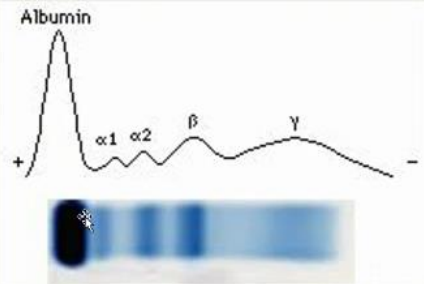
___ gives a graph showing the concentration of different proteins (globulins) in an electrophoretogram.
ALP isoenzyme analysis
CK isoenzyme analysis
Electrophoresis Lab applications
ALP (alkaline phosphatase) isoenzyme analysis
Electrophoresis is considered the most useful single technique for ___
(cathode) Intestinal → Placental → Bone → Liver (anode)
Migration direction of ALP in isoenzyme analysis using electrophoresis
CK BB (CK1)
In CK isoenzyme analysis, what is the fastest migrating substance?
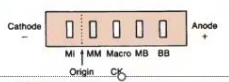
CK MB (CK2)
In CK isoenzyme analysis, what is the second fastest migrating substance?
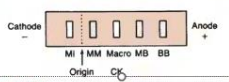
CK MM (CK3)
In CK isoenzyme analysis, what is the slowest migrating substance?
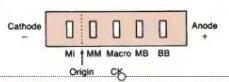
CK Macro
In CK isoenzyme analysis, what is the atypical enzyme?
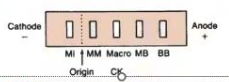
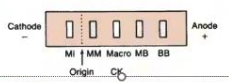
cathodal
In CK isoenzyme analysis, CK Mi is band ____ only (did not migrate at all)
Osmometry
the measurement of osmolality of an aq. solution such as serum, plasma, or urine
Glucose
urea nitrogen
sodium
[GUNS]
Ex. of osmotically active particles
Osmometer
device that measure the freezing point depression or vapor pressure depression of samples
milliosmolal per kilogram (mOsm/kg)
Unit used in osmometry
Sodium
Main omsmolality contributor
Osmolality
the concentration of dissolved (osmotically active) particles per kilogram of solvent.
↑ Plasma/Serum Osmolality
↑ Sodium concentration in blood
↑ thirst sensation
↑ ADH secretion (activated)
Explain the effect of INCREASED plasma/serum osmolality on sodium concentration, thirst sensation, and ADH secretion
↓ Plasma/Serum Osmolality
↓ Sodium concentration in blood
↓ thirst sensation
↓ ADH secretion (suppressed)
Explain the effect of DECREASED plasma/serum osmolality on sodium concentration, thirst sensation, and ADH secretion
Thirst sensation
body’s mechanism to dilute the concentrated sodium ions in the blood
directly proportional; directly proportional
↑ Freezing point depression
↑ no. of solute particles
↑ osmolality
Freezing point depression is _____ to the No. of solute particles and ____ to osmolality
Chamber
Sample container
Steering wire
Thermistor
Read out device
Refrigerant inlet & outlet ports
Enumerate Components of a Freezing point osmometer
Stirring wire
Components of a Freezing point osmometer:
Stirs the sample to ensure an even temperature and initiates (starts) freezing by creating tiny ice crystals.
Thermistor
Components of a Freezing point osmometer:
A sensitive temperature sensor that detects the sample's freezing point.
Readout device
Components of a Freezing point osmometer:
Calculates and displays the osmolality in mOsm/kg based on the freezing point.
Refrigerant inlet and outlet ports
Components of a Freezing point osmometer:
Circulate the cooling fluid that rapidly cools the sample; regulates cooling of the spx
Rapid cooling → Supercooling → Stirring starts freezing → Thermistor measures freezing point → Readout converts freezing point depression to osmolality (mOsm/kg).
Explain how a Freezing Point Osmometer works (process)
Chromatography
a separation method based on different interactions of the specimen compounds with the mobile phase and with the stationary phase as the compounds travel through a support medium
![<ul><li><p>Mobile phase (gas or liquid)</p></li><li><p>Stationary phase (solid or liquid)</p></li><li><p>Column</p></li><li><p>Eluate</p></li></ul><p></p><p><em>[MECS]</em></p>](https://assets.knowt.com/user-attachments/f7d342ff-21ee-4295-8997-e146547ce9c5.png)
Mobile phase (gas or liquid)
Stationary phase (solid or liquid)
Column
Eluate
[MECS]
Enumerate components of Chromatography
mobile phase
Components of Chromatography
carries the sample
can be GAS or LIQUID
Stationary phase
Components of Chromatography
which mobile phase flows
can be SOLID or LIQUID
Column
Components of Chromatography
holds the stationary phase
eluate
Components of Chromatography
separated components
Adsorption
Partition
Steric exclusion
Ion exchange chromatography
[SIPA]
Enumerate Modes of Separation for Chromatography
Adsorption
Modes of Separation for Chromatography:
separation based on polar functional groups
Liquid-Solid Chromatography
Adsorption a.k.a. __
Mobile Phase = liquid
Stationary phase = solid (usually polar)
Adsorption is called Liquid-Solid Chromatography because?
furthest
slowest
In adsorption:
Most soluble in the mobile phase (polar) = move ___
Least soluble in the mobile phase = move ___
Partition
Modes of Separation for Chromatography:
based on relative solubility in an organic (nonpolar) solvent and aquaeous (polar) solvent
Liquid-Liquid Chromatography
Partition a.k.a. ___
Polar molecules = Aqueous solvent
Nonpolar molecules = Organic solvent
[PANOt]
In partition:
Polar molecules = ___
Nonpolar molecules = ___
Steric Exclusion
Modes of Separation for Chromatography:
a variation of liquid-solid chromatogrpahy
separate solute based on size and shape
funnel-like
Column (packed with porous material)
In Steric exclusion, what component traps the small molecules while excluding large and intermediate-sized molecules
Ion-Exchange chromatography
Modes of Separation for Chromatography:
separation based on the magnitude and charge of ionic species
Resin with charged functional groups
(cation-exchange & anion-exchange resins)
What is the stationary phase in Ion-Exchange Chromatography
TLC (thin layer chromatography)
HPLC (high-performance liquid chromatography
GC (gas chromatography)
Paper chromatography
Enumerate Chromatographic Procedures
alumina
silica gel
cellulose
cross-linked dextran
[CCAS]
sorbents used in TLC
glass/plastic plate
In TLC, a thin layer of sorbent is uniformly coated on a _______
spot ;
plate
In TLC, each sample to be analyzed is applied as a ___ near one edge of the ___
Retention factor (Rf)
the distance leading edge of components moves / total distance solvent front move
semi-quantitative drug screening test
TLC application
HPLC (high-performance liquid chromatography)
uses pressure for fast separations
Sample Injector (loop injector, syringe)
Chromatogram
Ex of HPLC
loop injector
best and most used HPLC
Reservoir
Pump
Column
Detector
[Role Play Cum Dick]
Enumerate components of HPLC
Reservoir
Components of HPLC:
holds the mobile phase;
where the sample is being placed
Pump
Components of HPLC:
forces the mobile phase from the reservoir to the column
Column
Components of HPLC:
stationary phase;
where separation happens
Detector
Components of HPLC:
records the differences in separation
Chromatogram
Components of HPLC:
final result;
a graph showing the differences in separation
GC (gas chromatography)
best for compounds that are naturally volatile or can be easily converted into a volatile form
can be gas-solid or gas-liquid chromatography
gas-solid ;
gas-liquid
GC can be a ___ (stationary phase is solid) or ___ (stationary phase is liquid) chromatography
carrier gas
It is called gas chromatography because we need a ___ to volatilize the sample
cylinder
gas regulator
needle valve
syringe
septum (injector port) & heater
column oven
detector oven
concentration detector
recorder
[CGe Na SiS Calm Down Ca Right meow]
Enumerate Components of GC
Cylinder
Components of GC:
mobile phase that supplies inert gas (helium, argon, nitrogen)
volatilize the sample
Gas regulator & Needle valve
Components of GC:
controls the pressure and flow rate of the carrier gas passing through
Syringe
Components of GC:
introduces the sample to the septum
Septum (injector port) and heater
Components of GC:
makes sure the sample is volatilized/vaporized
Column oven
Components of GC:
where mobile phase flows
Detector oven
Components of GC:
stabilizes the temperature that will go to the concentration detector
Concentration detector
Components of GC:
Measures concentration of the analyte of interests
Recorder
Components of GC:
creates the chromatogram
Paper chromatography
technique for separating dissolved chemical substances by taking advantage of their different rates of migration across sheets of paper
fractionation sugar and amino acids
Paper chromatography applications
Paper chromatography
Place filter paper onto a container > immerse one edge of the paper on the solvent > wait for the movement of solvent upwards the paper
T
T or F
Just like TLC, we can use the same materials for Paper Chromatography (i.e., silica gel, cellulose, cross linked dextran)
Mass Spectrophotometer (MS)
Definitive identification of samples eluting from GC or HPLC columns is possible when a ____ is used as a detector
Gas chromatography = GC/MS
Liquid chromatography = LC/MS
MS must be coupled with other analytic techniques such as what?
mass-to-charge (m/z) ratio
In MS, compounds are measured based on their ___
Sample inlet
Ionization source
Mass analyzer
Ionization detection
[oh SIMION!]
Enumerate Components of MS
sample inlet
Components of MS
where spx is introduced
Ionization source
Components of MS
spx is initially volatilized by a carrier gas and heat
then ionized to form charged molecules and fragments
Mass analyzer
Components of MS
where separation of fragments based on mass-to-charge ratio happens
Ionization detection
Components of MS
measures the analyte of interest by looking at its m/z ratio
GC-MS: Electron ionization (EI)
LC-MS: Atmospheric pressure ionization (API)
Electrospray ionization (ESI)
Atmospheric Pressure Chemical Ionization (APCI)
Matrix-Assisted Laser Desorption/Ionization–Time of Flight (MALDI-TOF)
Enumerate ionization sources for MS
EI (electron ionization)
most common form of ionization in GC-MS
requires a source of electrons in the form of a filament to which an electrical potential is applied
70 eV (electron volts)
electrical potential generated by electronic ionization
Atmospheric pressure ionization (API)
ionization source for LC-MS