Class 20: Social Networks - Power & Influence
 Call Kai
 Learn
Learn Practice Test
 Spaced Repetition
 Match
Match Flashcards
 Knowt Play
1/22

There's no tags or description
Looks like no tags are added yet.
Name | Mastery | Learn | Test | Matching | Spaced | Call with Kai |
|---|
No analytics yet
Send a link to your students to track their progress
23 Terms
Positional Power
Legitimate power
Coercive power
Reward power
Personal power
expert power
Referent power
Power
Is the capacity to influence others who depend on you in some way
Power exist at all levels of an organization
It can flow in any direction
Downward: from senior leaders to junior staff (most common)
Upward: from employees to managers (e.g, through expertise or critical information)
Lateral: between peers or across departments (e.g, collaboration, persuasion)
Power can be held by both individuals and groups
Downward direction of power
From senior leaders to junior staff (most common)
Upward direction of power
From employee to managers (e.g, through expertise or critical information)
Lateral direction of power
Between peers or across departments (e.g, collaboration, persuasion)
Human capital
Is the competencies and resources you have yourself - your intelligence, education, experience
Social capital
Is the resources you can mobilize through others, and the ways that your connections to others help you achieve you goals
social capital f often discussed in terms of social networks
What is a network?
A network is a group of connected people or things
ex: social media connections, coworkers, teams, or even ideas
Why do networks matter?
This helps us find out things like:
Who has the most influence?
Who connects different groups?
Who might be isolated?
Key insights of networks
There are different ways to be important in a network:
some people have lots of connections
Others are bridges between groups
Some are central to the flow of information
What is a social network?
It’s a visual map of relationships between people
It’s based on sociology and graph theory (a branch of math)
A network is made up of:
nodes = people (or organizations)
Edges = connections or relationships between them
Why it matters
social networks helps us see and study how people are connected
We can use the to understand:
How information spreads
Who trusts whom
How ideas or gossip move
Even how diseases or innovation spread
Networks tell us…
Who s important and why
Degree centrality
How many direct connections do I have? Often means a cohesive network around the person
ex: I talk to 10 people on my team
Ex: all your friends know each other well
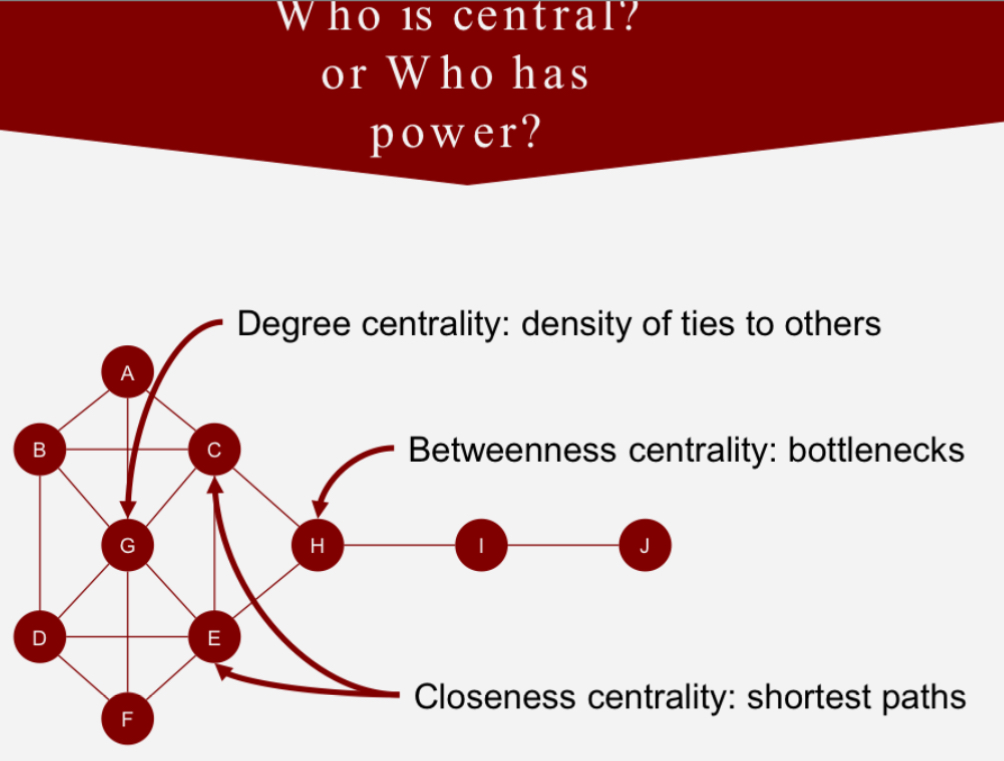
Betweenness centrality
How often am I the bridge between others? Means you have a bridging network
ex: two departments only talk through me — connect them
Ex: you have friends in different groups who don’t know each other welll
Closeness centrality
How quickly can i reach everyone else in the network?
ex: I can get a message to anyone in just a few steps
Centrality
In a network confers positional power. But when and why such power is important?
Organizational change
Is one of the most important applications of positional power
hard to implement, because organizations are inherently neat (why?)
Can be implemented as a sequence of individual - and group-level changes
Networks help managers to see where to start
Divergent change
Best implemented by change agents who bridge network clusters
requires a radical shift in cultural norms and accepted practices
Examples:
Transferring responsibility for patient discharge from hospitals to NHS
Replacing billable hours metric in law firms
Change agents with bridging networks
Are less likely to encounter unified resistance
Can tailor their message to needs/customs of each group
Nondivergent change
Best implemented by change agents in cohesive networks
incremental change, lower stakes
Examples:
Adding to physician responsibilities related elated to new technology used in the NHS
Change agents with cohesive networks
Are more likely to be trusted (e.g. that the change is beneficial for all, not just management)
Peer pressure may help convert holdouts
Entrepreneurial (bridging) network
An individual bridges across structural holes, thereby connecting individuals or groups that would otherwise not be connected
relative advantages:
Access to novel and diverse information
Increases innovation and creativity
Brokerage and control opportunities
Integration across groups
Career advancement
Clique (cohesive) network
Most members are directly linked to each other: few or no structural holes; high cohesion
relative advantages
Promotes trust
Provides clear normative expectations
Promotes cooperation and reciprocity
Facilitates implementation and execution
Leveraging your network
Your personal network can be an important source of power, but bigger isn’t always better!
try to bridge disconnected clusters of people
Try to bridge hierarchical levels and functional groups
Invest in relationships that extend your expertise
Beware of homophily (random group assignment helps here)
Connect to powerful others
Balance strong/weak ties, cohesiveness and brokerage