pitttttt to peeeel 333333
 Call Kai
 Learn
Learn Practice Test
 Spaced Repetition
 Match
Match Flashcards
 Knowt Play
1/55

There's no tags or description
Looks like no tags are added yet.
Name | Mastery | Learn | Test | Matching | Spaced | Call with Kai | Chat |
|---|
No analytics yet
Send a link to your students to track their progress
56 Terms
why was Britain in such a bad position at this time?
1. Isolated in Europe - France had supported US during the war;
2. Other countries formed a league against Britain’s policy of interfering with their trade
(e.g. Russia, Austria, Prussia, Netherlands, Ottoman Empire)
3. France had close relationship with other countries.
eg.
Spain - via related Royal families (Bourbons)
Austria
Russia
Pitt’s foreign policy aims?
End isolation
Prevent Russia, Austria, France, Spain forming a “Quadruple Alliance”
Promote trade
Ensuring France did not control the Netherlands
Avoid war
what was Britain’s relation to the UP?
Pitt backed the House of Orange in the conflict in the Netherlands (United Provinces) against the Patriot Party.
CONTEXT: British foreign policy, 1783-89: The end of isolation
Patriot Party in the Netherlands wanted the Netherlands to have a MORE INDEPENDENT POLICY (being anti-British)
Britain had FAMILY links to the Netherlands (King William III of England)
Britain had imposed trade restrictions on the Netherlands during the War of Independence
Patriot Party was pro-French - a DEFEAT for the House of Orange in the CIVIL WAR would give France control over the Netherlands
This would affect Britain’s trade links into Europe AND threaten British security
BUT: Pitt wanted to AVOID WAR - due to debt; wanted to improve trade
what did Pitt sign in 1785?
1785: Signed a Trade Treaty with the United Provinces
when was the Eden Treaty signed?
1786
explain the Triple Alliance situation?
formed with Prussia and UP in 1788
Willem V, stadtholder (ruler) of the UP was related to the King of Prussia- wife was Wilhemina
Wanted Prussian troops to help crush the Patriot Party who had taken control of Amsterdam
Patriot Party asked France to help
Pitt: Risk of Civil War with France and Prussia backing each side
what did Pitt do in terms of his preparation?
Give money and ammunition to the supporters of the House of Orange
Aug 1788: signed an alliance with the UP and Prussia - Triple Alliance
Prepared the British Navy for a possible French invasion of the Netherlands
BUT: he let the Prussians do the fighting - 20,000 Prussian troops intervened and the House of Orange was victorious.
what were Pitt’s successes in foreign policyyy?
France had not been allowed to become dominant in the Netherlands/UP
Trade treaties benefitted Britain because they provided markets for Britain's industrial goods
Britain was no longer isolated - Britain had allies e.g. UP, Prussia
Improved relations with France(Eden Treaty)
Britain had avoided war
Navy was expanded - key to protect Britain’s overseas empire (India, Caribbean)
what were Pitt’s limitations in terms of foreign policy?
Russian expansion in Asia was a potential threat to British control of India
Pitt’s support for Prussia was limited - unwilling to back Prussia’s desire for land in Eastern Europe - therefore there limits to how close this relationship could get))
Patriot Party in the Netherlands did not disappear ———-potential for problems in the future
France still had ambitions to take land in the Netherlands (note the events of 1792-95)
French Revolution would change the situation again - presenting Pitt with new problems
HOWEVER, it could be argued that Pitt had achieved the aims he had set out to achieve
what’s the “Blue water strategy”?
using naval power to maintain Britain’s
power
What was British foreign policy to France in the early stages of the Revolution?
Initial reaction: events in France not threatening. Pitt’s priority was to maintain peace.
why was the Policy of Neutrality maintained?
1. Louis XVI was a poor ruler (no need for Britain to intervene)
2. Had supported the Americans in the War of Independence
3. Britain transformed into a constitutional monarchy in the English Civil War + Glorious Revolution - France prob too
4. A new regime in France = good for peace and trade
5. Revolution could weaken France
7. War would be costly
8. War might create unrest at home, revolutionary ideas spreading to Britain
9. France had not broken any treaties or agreements
10. When France did go to war in April 1792, Prussia and Austria seemed big enough to defend themselves.
why was Russia seen as a greater threat compared to France?
in 1789 Russia was expanding into Eastern Europe
taking territory from the Ottoman Empire - Britain and Prussia combined to warn Russia off
(but note: Pitt backed down due to lack of support in Parliament and within his own Cabinet)
When and why did policy to France change?
because of the growing radicalism of the French Revolution:
-April 1792 - France went to war to defend the revolution - against Austria and Prussia
-September 1792 - France was declared a republic
November 1792: France declared support for all revolutionary movements abroad
Rise of the radical group - the Jacobins
British fear of revolution spreading to Britain (Paine, English Jacobins, etc) was now very real
What triggered the policy change with France?
21 Jan 1793, Louis XVI executed
23 Jan 1793 - Pitt expelled French Ambassador
Embargo **stopping of trade on British and Dutch shipping announced by France
France invaded the Netherlands and would take control of the main river into Europe for Britain’s trade: the River Scheldt
when did Britain declare war on France?
11 Feb 1793
what were some key developments under Pitt?
Formation of the First Coalition (1793) and its eventual collapse.
Naval dominance and key battles (e.g., Glorious First of June, 1794).
The financial strategies Pitt employed to sustain the war effort, including his income tax of 1798.
Pitt’s diplomacy: attempts to create coalitions and alliances.
Challenges faced, such as limited land victories and domestic unrest.
key events of 1797-1807:
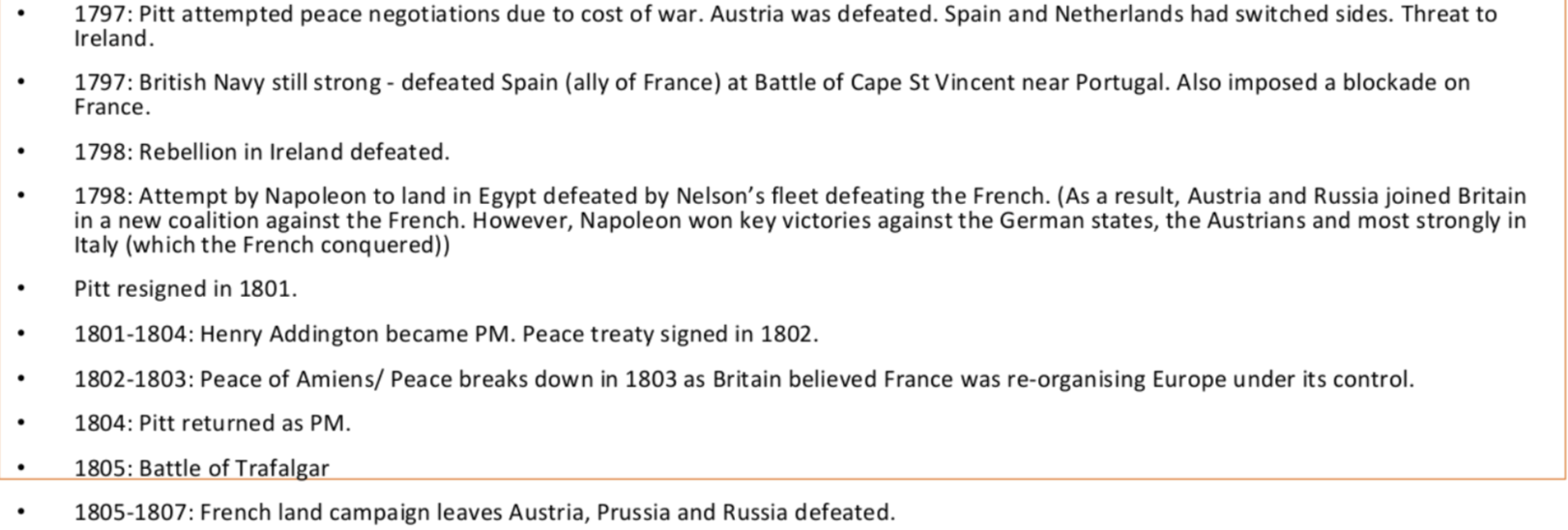
Strengths of Britain’s conduct of the war 1793-1806
naval success
leadership
avoid military engagement
wealth + finance
determination
what were the naval successes during war with France?
Preparations were made pre-1793
Britain had over 600 better ships; France less than 300
Navy maintained embargo
Prevented invasion
Quota Acts, 1795 – provided recruits
Investment in dockyards
Dealt with naval mutinies of 1790s
what were the Leadership strengths?
Lord Howe: 1794: Battle of the Glorious First of June - destroyed 22 French ships - key early defeat of France
Lord Nelson won key victories:
Egypt, 1798 - Britain maintained control of eastern Med and thus traderoutes to Asia, especially India
Battle of Copenhagen, 1801 (Danes wanted to trade freely with France - Britain keen prevent this as Scandinavia = key source of wood)
Battle of Trafalgar, 1805 - defeat for France and Spain off the south-west coast
what were Pitt’s military successes?
Pitt added to Britain’s overseas Empire - Caribbean and Asia Tobago, St. Lucia, Trinidad
Support for allies in Europe came in other ways -
1793-1802 - known as “Pitt’s Gold”: £9mn given to Austria and Prussia;
1795 £4.6mn lent to Austria; much large amounts were given - post-1806
what were the finance strengths?
Pitt had improved Britain’s finances significantly, 1783-1792 putting Britain in a strong position
Britain had the benefit of an established banking system going back to the 1600s - the Bank of England was created in the 1690s
By the 1780s the Industrial Revolution had begun and this benefited Britain
The Empire also benefitted Britain financially as did its naval power - control of trade routes
War was initially funded through loans, 1793-98
From 1797, moved towards greater use of paper money
Trebled indirect taxes
— 1799: introduced the first Income Tax - remained in place until 1816 - 10% on all incomes over £200; lower rate of tax for £60-200
It never raised the 10mn expected but it did substantially increase the government’s income
what were Pitt’s determination strengths?
Solid arguments e.g. in Parliament
Perhaps uninspiring (e.g. compared to Churchill) but without mass media they were not aimed at a mass audience -
aimed at MPs, peers, etc.
Need for sacrifice
Made the war about principles:
“justice, humanity and religion”
Limitations of Britain’s conduct of the war 1793-1806
Pitt unsuited to war. Was a reformer - especially of finance.
Pitt entered the war with little idea of its size, scope or length - financial decisions early in the war were made on this basis. It took him time to readjust the financial strategy and move to Income Tax.
Pitt’s government lack a clear overall strategy: Grenville (Foreign Sec) wanted to focus purely on
France; Henry Dundas (Home Sec) wanted to focus on trade and colonies
Forced to negotiate, 1796-99
Naval mutinies of 1790s
Supported ending the war in 1802 even if land was lost 1804-1806: maintained support for the war - despite his own poor health - however, this was insufficient to win the war
Naval power insufficient to win the war
Military campaign on land in Europe required
Britain’s allies unable to win the war - divided, poorly led - Pitt failed to understand that Austria and
Prussia were more concerned by their own self interests in eastern Europe e.g. carving up Poland
By 1806, was it clear that Pitt’s original foreign policy aims had been met?
not really
France dominated Europe
France controlled the Low Countries (Austrian Netherlands and UP)
Britain’s alliances - the Coalitions - kept breaking down Russia made peace with France in 1807 - it was now free to threaten
Britain’s empire in Asia
Trade was interrupted by war
what was the Continental System?
In 1806, ban on British goods.
European ports shut to British ships.
what was the Treaty of Amiens 1802 and how was it limited?
it was a peace treaty signed with France
but war began again in 1803
when did Pitt leave and return to office?
left in 1801
returned in 1804
what was the Battle of Trafalgar 1804?
britain’s most famous naval victory
made French invasion impossible
it confirmed their naval supremacy
but what did Napoleon do before the Battle of Trafalgar?
lol he decided on a land campaign that defeated all 3 of Britain’s allies
(in the war of the Third Coalition)
what had happened by 1807?
Russia, Austria and Prussia had all signed Peace Treaties
so Britain was isolated again
how did Britain oppose Napoleon from 1803-1814?
negotiated and financed coalitions of other European powers
maintained a naval blockade against France, preventing other nations from trading w it + seizing france’s ships
fought a naval war against the navies of france
maintained a long war in spain, that france had taken over
explain Napoleon’s first abdication?
after defeat in russia and spain, france was invaded
so he abdicated in 1814 and was exiled to a Mediterranean Island (elba)
escaped in 1815 and took control of france again → “Hundred Days” of power
this was ended by a defeat from british+ prussian forces at Waterloo
what was the British strategy after Pitt’s death?
continued to encourage coalitions - the Third Coalition of Austria, Prussia, and Britain
war ended with an alliance between russia and france
but power of royal navy prevented a french invasion
negotiated alliances + subsidised a fresh anti-napoleon coalition
these concerted actions lead by third coalition forces was too much and defeat for france in 1814
policy of naval blockade continued (had the right to stop and search ships in enemy ports
how did britain win the Peninsular War?
bulk of britian’s warfare was in portugal + spain
PNSRW started in portugal as they refused to accept napoleon’s enforcement of the Continental System
1808: britain sent forces to Portugal to drive out french
france relied on long lines of communication (but they were defeated)
so napoleon brought fresh armies to spain, reinstating his brother on the throne
under sir john moore the british forces managed to retreat to corunna and the navy evacuated them
french failed to conquer portugal
who was castelreagh?
an Irish peer
became foreign secretary in 1812-1822 (suicide)
negotiated alliances against Napoleon; therefore played a large part in his defeat
leader of the HoC
what did castereagh generally do ?
stability
opposed radicalism , based his policy firmly on national interests
x sentiment
what did casltereagh actually do?
made the complete defeat of Napoleon his priority
signed peace w/ the USA asap
maintaining policies of coalitions against France
aimed to maintain cooperation with/ other european countries to have a sense of lasting peace
what did casltereagh believe was the only way forward?
taking vigorous action rather than negotiations
to guarantee British security
+ its ability to trade freely
and USA?
ended a war w/ the USA in 1814
why was the Treaty of Chaumont significant + when was it
1814
showed his commitment by negotiating
also financing the allies w a greater amount Britain had last contributed (£26mill)
looked beyond the defeat of Napoleon and onto longterm cooperation
what was change in the war caused by
Napoleon seemed vulnerable because
losses in invading russia
Britain on the other hand : military successes in Spain
contribution of supremacy at sea
how did casltreagh prevent the breaking up of the coalition
encouraging his allies
striking British forces in Spain under Wellington 1813
so invading france in 1814
-MORE CREDIBILITY TO BRITAINS LEADERSHIP)
how were Britains interests met by the end of the war
British trading opportunities had increased
threat from france much reduced
balance of power in Europe maintained
new kingdom of holland = good security
naval supremacy confirmed
why did the congress of Vienna
needed a way to ensure cooperation actually lasted
and 1 dominant power wouldn’t control Europe
what did Britain gain from the congress of Vienna?
valuable colonial possessions AS RETURN OF the investments made on allies during the war
e.g. naval bases
france contained, no risk of trade/invasion
+it went back to a monarchy js like Britain again
which of castlereaghs aims were not achieved?
was clear that the unity of great powers x last after france
concerned about tara Alexander I in russia
+ his ‘Holy Alliance’ w/ Prussia and Austria
(no more common interests, they wanted it to align with christianity )
who was canning + key difference
George canning 1822
become foreign secretary after casltreagh
-main difference was that c1 was more interested in keeping good foreign relations + wanted ‘congress system’ to continue
what was going on with Spain?
russia, Prussia + france were going to intervene to restore monarchy in 1820
castlereagh +austria said no cs he didn't want to extend French influence
canning said no too but had no warm relations w/ austria
so lost Austrian support , x stop French intervening
what was going on with South America?
key concern of a frnaco-spanish American empire + france dominating one again (c2)
10% of British exports latin america
c2 refused plans
for Spain/portugal to regain control
mainly wanted to extend profitable trade , came across as supporting new liberal nations
c1 didn’t make drastic public statements about importance of liberty
what was going on with Portugal?
established a constitutional monarchy , feared foreign intervention
canning supported an appeal for aid , sent a naval force of 5,000 marines
this policy promised support for an established + commercial ally
while resisting French expansion
what happened with the USA?
c1 made efforts to maintain good relations for trading
e.g. treaty of Ghent
c2 disliked Monroe doctrine 1823 (can’t intervene or else war)
thought it bad for trade
trade talks in 125, expressed his dislike for US statesmen
what was going on with Greece?
revolt against Turkish control since 1821
turkey also got help from a soldier from Ottoman Empire, who treated any rebels w/ brutality
Britain loved greek culture + believed they should help Greece
russia wanted to help fellow christians in Greece too
Britisj (c1 and 2) sceptical russia would dominate turkey and Mediterranean
-ended up signing a treaty together to secure greek independence (liberal)
lead to their independence in march 1832
what canning more successful?
c1 failed to capture unity of great powers after France’s defat in 1815
c2 lost Austrian support , x preventing frnehc invasion of Spain (humiliation after they’d done it during the peninsular war)
c2 asserted British influence in supporting Portugal
treaty w russia showed he hadn’t abandoned the European powers (long-term unsuccessful as they fought against turkey + took lands)
-castlereagh had to keep powers together due to war, unlike canning who privatised trade and keeping people in. Britain happy