wk 8: Long term decisions
 Call Kai
 Learn
Learn Practice Test
 Spaced Repetition
 Match
Match Flashcards
 Knowt Play
1/18

There's no tags or description
Looks like no tags are added yet.
Name | Mastery | Learn | Test | Matching | Spaced | Call with Kai | Chat |
|---|
No analytics yet
Send a link to your students to track their progress
19 Terms
What are long term decisions
decisions made with no constraints. All costs and inputs are able to varied in the long run
more likely to have long term effects on profitability.
eg. long term pricing, activity based management, outsourcing
What are relevant costs and revenue
costs/revenue that are expected to change between alternatives and are expected in future.
Absorption vs Variable costing: what is capacity
the infrastructure, resources and assets needed so we have the ability to produce a given volume of output(factory rent, supervisor salary, HR, delivery vehicle maintenance)
How do we find fixed costs/unit
We get the capacity cost which is the cost required to produce a desired volume of output (not what was actually produced)
Fixed cost/unit=Fixed manufacturing cost/Output volume
Absorption vs Variable costing
Absorption costing
all manufacturing costs are absorbed into inventory and hence sit there until inventory is sold and go into cogs. Non-manufacturing costs are period costs, but fixed manufacturing costs and DM,DL go into inventory (product costs)
Variable costs
only variable manufacturing costs go into inventory (variable direct manufacturing costs and variable moh)
CM separates variable from fixed costs
then fixed moh and fixed and variable non-moh are treated as period costs
How does absorption and variable costing affect operating profit
When production>what we sell
ABSORPTION COSTING
it leads to a higher profit
because the manufacturing costs are split across more output and if not sold it remains in inventory not cogs
less expenses→more profit
VARIABLE COSTING
leads to a lower profit
even tho the variable manufacturing costs go to inventory, the fixed moh go into period costs.
When production=what we sell
both absorption and variable costing lead to the same profit
When production<what we sell
ABSORPTION COSTING
operating profit is lower, cuz more cogs are expensed
VARIABLE COSTING
operating profit is higher
What should the difference in profit be under ac and vc
Fixed MOH per unit x change in inventory units=0.45×200k
Direction of inventory impact on profit
when inventory increases: AC is higher (hence there is adverse incentive to produce a lot to make profit look better)
when inventory decreasing: VC is higher
How to get rid of adverse incentives from absorption costing
use variable income statements to evaluate managerial performance
extend time used to evaluate managerial performance
adopt jit inventory system
include non-financial info in criteria.
AC benefits and limitations
PROS
complies with regulations
provides full product costing which can be useful for long term pricing decisions
CONS
may encourage adverse behaviour
leads to higher inventory holding which has risks ie. damage, theft etc, obsolescence
VC benefits and limitations
PROS
good for short term decision making by splitting fixed and variable costs
less dysfunctional behaviour
CONS
not always clear if smth is fixed or variable costs
cost breakdown can be commercially sensitive
external reporting may not be appropriate
Determining Long term price-3 main infleunces for pricing non commodity products
base on customers: perceived value of product
competitors: what other companies charge
costs: what it costs the business to make and deliver the product
Alternative long term pricing approaches
TARGET PRICING: using customers + competitors
develop product that satisfies customer needs
choose target price
decide on target profit/unit (markup)
derive target cost per unit=target price-target profit/unit
perform value engineering so that actual cost<target cost
COST PLUS PRICING: finding costs + markup
price= cost base + markup
markup designed based on ROI (the return investors want on the capital they invested)
Finding cost base
depends on company or will tell you in question
it could be fixed + variable costs
or direct + indirect costs
use correct allocation base (reflects underlying cost driver) to allocate costs to each product

Value engineering
there are value added activities(costs customers are willing to pay for) and non-value added activities (customer does want to pay for. Cost of rework due to errors. Rush orders of materials caused by poor planning )
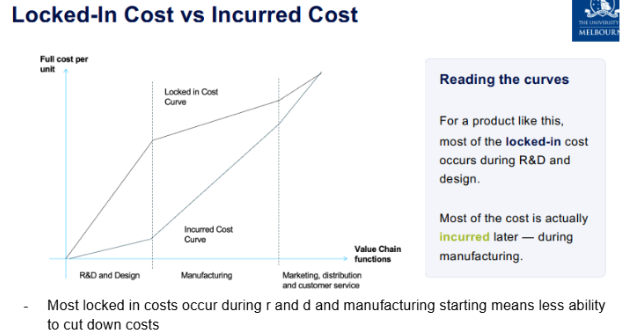
locked in vs incurred costs
Locked in costs: not yet incurred but will certainly be in future
incurred cost: actually happens when resource is used up which can happen long after cost is locked in.

Fixed costs in future
in the future fixed costs become relevant

Activity based management
ABM is using ABC infor to improve performance and profitability
when is customer profitability important and why do we assign costs to customers
When individual customers demands differ a lot
Ie. they buy materially diff product mix
require diff levels of organisational support
WHY
priortise profitable ones
offer discounts when needed to get more business from low cost customers
negioate changes in customer behaviour that lower costs to serve them
last resort stop serving unprofitable ones
Order processing costs
custom costs assigned to customers including processing costs and sales visit costs (mainly fixed), if customer is dropped it doesn’t change in short run (so cost per order rises) but does in long run
