Medicinal Ingredients + Proteins
 Call Kai
 Learn
Learn Practice Test
 Spaced Repetition
 Match
Match Flashcards
 Knowt Play
1/16

There's no tags or description
Looks like no tags are added yet.
Name | Mastery | Learn | Test | Matching | Spaced | Call with Kai | Chat |
|---|
No analytics yet
Send a link to your students to track their progress
17 Terms
Solvent extraction
- separation process that involves a liquid and a solid
- solid object (such as a plant) is placed in contact with a liquid (solvent), and the plant components of interest are transferred into the solvent
Variants to improve solvent extraction
- Grinding or blending the leaves to break up the plant structure
- Adjusting solvent to match polarity of the extract (solvent blends for low polarity molecules)
- Adjusting temperature. If the desired extracts are thermally stable, prolonged heating will help extraction.
Thermally Stable
can withstand heating without decomposing or undergoing an unwanted chemical reaction.
Steam distillation
- boiler used to produce a flow of steam which is then passed through the leaves
- hot steam breaks down the plant cells and carries plant oils with it
- steam and the oils are then condensed
- non-polar oils separate from the water by forming a layer on top
When is steam distillation used?
- When the desired compounds are volatile and thermally stable.
- Commonly used to extract essential oils, such as tea-tree oil and eucalyptus oil. The extracted plant oils are mixtures, not pure substances.
Secondary structure of proteins
- From coiling and pleating of sections of protein molecule
- Forms hydrogen bonds between amide linkages
- Hydrogen bond between H of -NH group in one peptide link and O of C=O group in another peptide link
- called an a-helix or b-pleated sheet
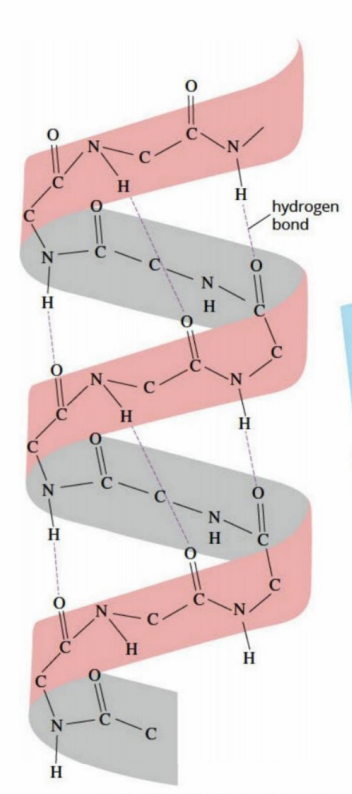
a-helix
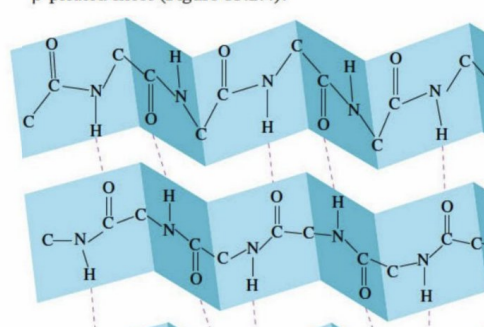
B-pleated sheet
zwitterion
- dipolar ion
- NH2 group acts as a base, accepting a proton to become a -NH3+ group
- COOH group act as an acid, donating a proton to become a -COO- group
Tertiary proteins
- produced by the three-dimensional folding of its secondary structures (a-helices and B-pleated sheets) between side chains
5 types of bonding in the Tertiary Protein Structure of the R groups
- Hydrogen Bonds
- Dipole Dipole Interactions
- Ionic Interactions
- Covalent Cross Links
- Dispersion Forces
Hydrogen Bonds Tertiary Proteins
- contains O-H, N-H or C=O
Dipole Dipole Interactions Tertiary Proteins
- any polar group such as those containing -S-H, -O-H or -N-H
Ionic interactions Tertiary Proteins
- contains -NH3+ and another group that contains -COO- (NH3+ bonds with COO-
Covalent cross-links Tertiary Proteins
- cysteine side groups react to form a disulfide bridge (-S-S-)
Dispersion forces
- any non-polar group
Quaternary Structure of Proteins
- composed of two or more polypeptide chains
- may even interact with non-protein molecules to produce a larger, more complex functional unit