2.2 Demand
 Call Kai
 Learn
Learn Practice Test
 Spaced Repetition
 Match
Match Flashcards
 Knowt Play
1/20

There's no tags or description
Looks like no tags are added yet.
Name | Mastery | Learn | Test | Matching | Spaced | Call with Kai | Chat |
|---|
No analytics yet
Send a link to your students to track their progress
21 Terms
Demand
The quantity of goods/services that consumers are willing and able to buy at a given price, at a given time
Law of demand
States that there is an inverse relationship between the quantity demanded and the price of a good/service (as P ↑, QD ↓)
Individual demand
The demand for a product by a consumer
Market demand
The demand for a product by all consumers in a market
Joint demand
Goods which are interdependent/demanded together e.g playstation and playstation games
Competitive demand
Demand for goods that are in competition with each other
Composite demand
Demand for a good that has multiple uses
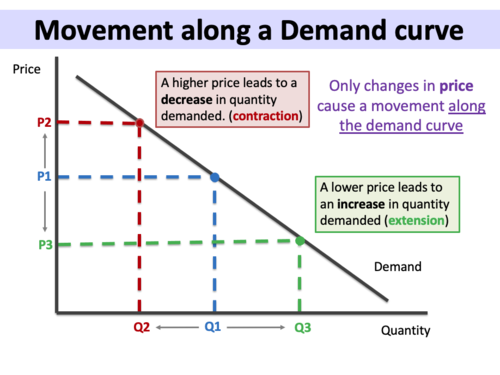
Movements along the demand curve (extension/contraction)
Caused by changes in price
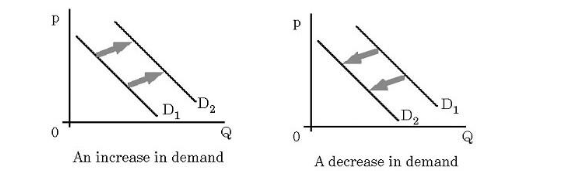
Shifts of the demand curve (increase/decrease)
Caused by changes in income, tastes, fashions, the price of competiton, price of compliments, population, advertising, legislation, social factors, the distribution of income, interest rates, unforeseen circumstances
Ceterus Paribus
All other things remain equal
Extension/contraction
Movement along the demand curve only caused by changes in the price of a good
Shift to the left/right
Demand curve shifts to a new curve caused by various factors
Income effect
A fall in prices increases the real purchasing power of consumers
This allows people to buy more with a given budget
For normal goods, demand rises with an increase in real income
Substitution effect
A fall in the price of good X makes it relatively cheaper compared to substitutes
Some consumers will switch to good X, leading to higher demand
This mostly depends on whether the products are close substitutes e.g. Coke and Pepsi
Seasonal demand
This refers to fluctuations in output and sales related to the seasonal time of the year e.g. Easter chocolate in spring
Derived demand
Demand for a factor of production used to produce another good or service e.g. steel for cars
Exceptions to the law of demand
Goods of ostentatious consumption (snob goods), goods affected by consumer expectations, inferior/giffen goods, addictive/demerit goods
Goods of ostentatious consumption/snob goods
These goods are demanded simply because they are expensive, therefore as price rises, demand rises too e.g. Gucci bag
Goods affected by consumer expectations
If goods rise in price and are expected to keep doing so, the demand for them will rise e.g. property, wine, stocks
Inferior/giffen goods
As income rises, the demand for the good will fall e.g. Tesco own brand beans
Demerit/addictive goods
As price rises, quantity demanded does not fall as consumers continue to buy e.g. alcohol, cigarettes