31.3 - Fascism Rises in Europe
 Call Kai
 Learn
Learn Practice Test
 Spaced Repetition
 Match
Match Flashcards
 Knowt Play
1/4

There's no tags or description
Looks like no tags are added yet.
Name | Mastery | Learn | Test | Matching | Spaced | Call with Kai |
|---|
No analytics yet
Send a link to your students to track their progress
5 Terms
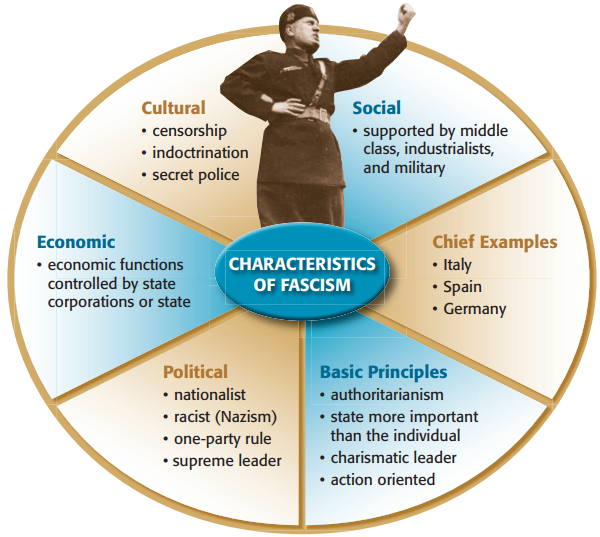
Fascism
A new, militant political movement that emphasized loyalty to the state and obedience to its authoritarian leader
Promotes an extreme form of nationalism and militarism
Denial of individual rights
Dictatorial one-party rule
Similarities to Communism: both ruled by dictators who allowed only their own political party, denied individual rights, had a supreme state, and didn’t practice any form of democracy
Differences to Communism: didn’t seek a classless society, but instead believed that each class had its place and function
Benito Mussolini
Widespread unrest in Italy because of discontent over the failure to win large territorial gains at the 1919 Paris Peace Conference, along with rising inflation and unemployment
Mussolini promised to revive Italy’s economy, rebuild its armed forces, and give the country strong leadership
Founded the Fascist Party in 1919 and gained support
In 1922, 30,000 Fascists marched on Rome and demanded that King Victor Emmanuel III put Mussolini in charge of the government — the king agreed and Mussolini took power “legally”
Abolished democracy, outlawed all political parties except the Fascists, used a secret police force to arrest his opponents, censored the media, and promoted Fascist doctrines
Adolf Hitler
Joined a political group called the National Socialist German Workers’ Party, or Nazi for short, which believed that Germany had to overturn the Treaty of Versailles and combat communism
Nazism: German brand of Fascism
Hitler was chosen to be the leader of the Nazi Party and, inspired by Mussolini’s march on Rome, attempted to seize power in Munich but failed and was sent to prison
Mein Kampf (“My Struggle”): included Hitler’s beliefs and future plans for Germany — asserted that the Germans, “Aryans,” were superior to other races; called the Versailles Treaty an outrage and wanted to regain German land; and wanted to get more lebensraum (“living space”) for Germany by conquering eastern Europe and Russia
Revived the Nazi Party after leaving prison and, following the Great Depression and collapse of the German economy, many Germans turned to Hitler for stability and strong leadership
The Nazis were the largest political party by 1932
President Paul von Hindenburg, head of the Weimar Republic, appointed Hitler chancellor
Hitler called for new elections, hoping to win a parliamentary majority, which they achieved — blamed the fire at the Reichstag building on the Communists, stirring up fear
Hitler’s Totalitarian State
Banned all other political parties
Created the Schutzstaffel (SS), which arrested and killed many of Hitler’s enemies
The Gestapo, the Nazi secret police, forced most Germans into total obedience
Took control of the economy
Used propaganda and censorship to shape public opinion and win praise for his leadership
Anti-Semitism
Hatred of Jews
Key part of Nazi ideology
Nazis used Jews as scapegoats for all of Germany’s problems since the war
Laws deprived Jews of most of their rights
Violence against Jews