A. TITRIMETRY / VOLUMETRIC ANALYSIS (copy)
 Call Kai
 Learn
Learn Practice Test
 Spaced Repetition
 Match
Match Flashcards
 Knowt Play
1/67

There's no tags or description
Looks like no tags are added yet.
Name | Mastery | Learn | Test | Matching | Spaced | Call with Kai | Chat |
|---|
No analytics yet
Send a link to your students to track their progress
68 Terms
a. Volumetric Analysis
c. Titrimetry
Titrimetry is aka Volumetric Analysis
[TITRIMETRY / VOLUMETRIC ANALYSIS]
The analytical method that involves a solution of reagent of known concentration added to a solution of analyte until a reaction is judged complete
a. Volumetric Analysis
b. Spectroscopy
c. Titrimetry
d. Chromatography
a. Titrant
[TITRIMETRY / VOLUMETRIC ANALYSIS]
The solution of known concentration added to the analyte in Titrimetry
a. Titrant
b. Solvent
c. Indicator
d. Analyte
b. Endpoint
[TITRIMETRY / VOLUMETRIC ANALYSIS]
The point in Titrimetry when the reaction is judged to be complete
a. Equivalence point
b. Endpoint
c. Neutralization point
d. Saturation point
d. Buret
[APPARATUS]
The apparatus used for accurate transferring of the titrant in Titrimetry
a. Volumetric Flask
b. Erlenmeyer Flask
c. Wash Bottle
d. Buret
c. Amber colored buret or buret wrapped in aluminum foil
[APPARATUS]
The type of buret used for light-sensitive titrants such as potassium permanganate
a. Glass stopcock buret
b. Plastic buret
c. Amber colored buret
d. Colorless buret
a. Glass stopcock buret
[APPARATUS]
BEQ: The type of buret used for acids in Titrimetry
a. Glass stopcock buret
b. Amber colored buret
c. Plastic stopcock buret
d. Rubber stopcock buret
d. Erlenmeyer Flask
[APPARATUS]
The apparatus used for swirling the contents during titration
a. Volumetric Flask
b. Wash Bottle
c. Buret
d. Erlenmeyer Flask
c. Iodine Flask
used in iodometric titrations
[APPARATUS]
The alternative to the Erlenmeyer Flask
a. Beaker
b. Volumetric Flask
c. Iodine Flask
d. Wash Bottle
d. Wash Bottle
Contains the same solvent used to dissolve the sample
[APPARATUS]
The apparatus used for washing drops of titrant clinging to the tip of the buret
a. Erlenmeyer Flask
b. Volumetric Flask
c. Iodine Flask
d. Wash Bottle
a. Volumetric Flask
[APPARATUS]
The apparatus used for quantitative preparation of the titrant in Titrimetry
a. Volumetric Flask
b. Wash Bottle
c. Buret
d. Erlenmeyer Flask
b. Lower meniscus
[APPARATUS]
The meniscus read when using a colorless solution in a volumetric apparatus
a. Upper meniscus
b. Lower meniscus
a. Upper meniscus
[APPARATUS]
The meniscus read when using a colored solution in a volumetric apparatus
a. Upper meniscus
b. Lower meniscus
b. To prevent parallax error
[APPARATUS]
The reason the eye must be at level with the meniscus when reading a volumetric apparatus
a. To ensure complete reaction
b. To prevent parallax error
c. To ensure proper swirling
d. To prevent color interference
d. Titrant
Titrand= unknown
Titrant= known
[TERMS]
The reagent of known concentration added to the analyte from a buret during titration
a. Titrand
b. Indicator
c. Analyte
d. Titrant
b. Titrant
[TERMS]
Added to analyte from a buret during titration
a. Titrand
b. Titrant
c. Analyte
d. Indicator
c. Standardized Solution and VS
[TERMS]
The other terms for Titrant
a. Analyte and Sample
b. Titrand and VS
c. Standardized Solution and VS
d. Indicator and Standard Solution
c. Titrand
Titrand= unknown
Titrant= known
[TERMS]
The active constituent being analyzed in Titrimetry with unknown concentration
a. Titrant
b. Indicator
c. Titrand
d. Standard Solution
c. Analyte and Sample
[TERMS]
The other terms for Titrand
a. Titrant and VS
b. Standard Solution and VS
c. Analyte and Sample
d. Indicator and Analyte
d. Indicators
[TERMS]
Compounds capable of changing colors which aid in the visualization of the endpoint
a. Titrants
b. Solvents
c. Titrands
d. Indicators
c. Endpoint
[TERMS]
The point at which the reaction is observed to be complete through a color change
a. Equivalence Point
b. Stoichiometric Point
c. Endpoint
d. Theoretical Point
d. Equivalence Point
The equivalence point of a chemical reaction is the point at which equal quantities of reactants are mixed chemically.
basta equivalence → endpoint
[TERMS]
The Endpoint is only an estimation of which point in Titrimetry
a. Neutralization Point
b. Saturation Point
c. Theoretical Point
d. Equivalence Point
d. Equivalence Point
[TERMS]
The point at which a chemically equivalent amount of titrant has reacted with the analyte
a. Endpoint
b. Color Change Point
c. Neutralization Point
d. Equivalence Point
a. Stoichiometric Point
b. Theoretical Point
[TERMS]
The other terms for the Equivalence Point
(multiple answers)
a. Stoichiometric Point
b. Theoretical Point
c. Saturation Point
d. Neutralization Point
c. Potentiometry
other method used to determine the Equivalence Point is Electrometry
[TERMS]
The tedious method used to determine the Equivalence Point by measuring pH for every mL of titrant added and plotting a graph
a. Gravimetry
b. Spectroscopy
c. Potentiometry
d. Chromatography
c. Titration Error
[TERMS]
The slight difference between the endpoint and the equivalence point in Titrimetry
a. Systematic Error
b. Blank Error
c. Titration Error
d. Personal Error
a. ET = Vep − Veq
difference between the actual volume of the reagent required to reach the end point (Vep) and the theoretical volume necessary to reach the equivalence point (Veq).
[TERMS]
The formula used to calculate Titration Error
a. ET = Vep − Veq
b. ET = Vep + Veq
c. ET = Vep × Veq
d. ET = Veq − Vep
c. Blank Titration
[TERMS]
The titration procedure where the entire procedure is repeated except that the analyte is omitted
a. Back Titration
b. Standardization
c. Blank Titration
d. Residual Titration
c. For correction and to enhance the reliability of results
[TERMS]
The purpose of Blank Titration
a. To determine the equivalence point
b. To standardize the titrant
c. For correction and to enhance the reliability of results
d. To determine the endpoint and the equivalence point
c. Titer
remember 1mL
[TERMS]
The weight of substance usually in mg which is chemically equivalent to 1 mL of standard solution
a. Equivalent Weight
b. Molarity
c. Titer
d. Normality
a. 5 mg H2O
[TERMS]
1 mL of Karl Fischer Reagent is equivalent to how many mg of water
a. 5 mg H2O
b. 10 mg H2O
c. 2 mg H2O
d. 15 mg H2O
c. Standardization
[STANDARDIZATION]
The process of determining the exact concentration of the titrant
a. Calibration
b. Validation
c. Standardization
d. Verification
d. Primary Standard
ultrapure; 100%
[STANDARDIZATION]
A substance of high degree of purity used as a reference material in titrations
a. Secondary Standard
b. Working Standard
c. Internal Standard
d. Primary Standard
d. Primary Standard
[STANDARDIZATION]
Reference material in titrations
a. Secondary Standard
b. Working Standard
c. Internal Standard
d. Primary Standard
a. Direct Standardization
[STANDARDIZATION]
The type of standardization that uses a Primary Standard
a. Direct Standardization
b. Back Standardization
c. Residual Standardization
d. Indirect Standardization
d. KHP (Potassium-H-phthalate)
[STANDARDIZATION]
The Primary Standard used to standardize NaOH VS and KOH VS
a. K2Cr2O7
b. Na2S2O3
c. Na2EDTA
d. KHP
c. K2Cr2O7 (Potassium dichromate)
[STANDARDIZATION]
The Primary Standard used to standardize Na2S2O3 VS
a. KHP
b. Na2EDTA
c. K2Cr2O7
d. ZnSO4
d. Secondary Standard
[STANDARDIZATION]
A standard solution whose purity has been determined by chemical analysis
a. Primary Standard
b. Internal Standard
c. Working Standard
d. Secondary Standard
c. Indirect Standardization
[STANDARDIZATION]
The type of standardization that uses a Secondary Standard
a. Direct Standardization
b. Residual Standardization
c. Indirect Standardization
d. Back Standardization
d. Na2S2O3 VS
Sodium thiosulfate
[STANDARDIZATION]
The Secondary Standard used to standardize I2 VS
a. Na2EDTA
b. ZnSO4
c. KHP
d. Na2S2O3 VS
a. Na2EDTA TS
[STANDARDIZATION]
The Secondary Standard used to standardize ZnSO4 VS
a. Na2EDTA TS
b. Na2S2O3
c. K2Cr2O7
d. KHP
c. Normality
[STANDARDIZATION]
The number of gram equivalent weights of a solute in 1 liter of solution
a. Molarity
b. Molality
c. Normality
d. Formality
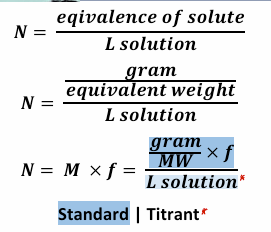
[STANDARDIZATION]
Normality Formulas
c. f = 1
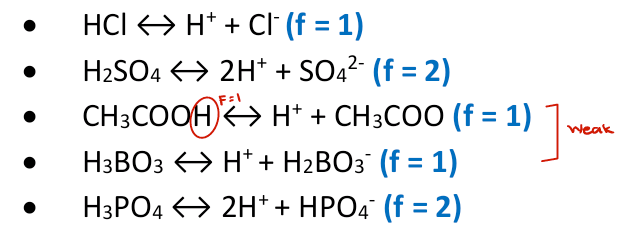
[STANDARDIZATION]
The Normality Factor (f) for HCl in a neutralization reaction
a. f = 2
b. f = 3
c. f = 1
d. f = 4
a. f = 2
[STANDARDIZATION]
The Normality Factor (f) for H2SO4 in a neutralization reaction
a. f = 2
b. f = 3
c. f = 4
d. f = 1
c. f = 1
[STANDARDIZATION]
The Normality Factor (f) for H3BO3 in a neutralization reaction
a. f = 3
b. f = 2
c. f = 1
d. f = 4
d. f = 2
[STANDARDIZATION]
The Normality Factor (f) for H3PO4 in a neutralization reaction
a. f = 3
b. f = 1
c. f = 4
d. f = 2
b. f = 1
[STANDARDIZATION]
The Normality Factor (f) for CH3COOH in a neutralization reaction
a. f = 3
b. f = 1
c. f = 4
d. f = 2
c. Number of replaceable H⁺
[STANDARDIZATION]
The basis for determining the Normality Factor (f) for acids in neutralization reactions
a. Number of replaceable OH⁻
b. Number of electrons gained
c. Number of replaceable H⁺
d. Number of positive charges
d. f = 2
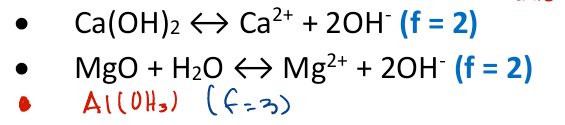
[STANDARDIZATION]
The Normality Factor (f) for Ca(OH)2 in a neutralization reaction
a. f = 1
b. f = 3
c. f = 4
d. f = 2
d. Number of replaceable OH⁻
if has OH → strong base, so lahat mag dissociates
kung ilan OH, yun din Normality factor (f)
[STANDARDIZATION]
The basis for determining the Normality Factor (f) for bases in neutralization reactions
a. Number of replaceable H⁺
b. Number of electrons lost
c. Number of positive charges
d. Number of replaceable OH⁻
c. f = 2
[STANDARDIZATION]
The Normality Factor (f) for Na2CO3 in a neutralization reaction
a. f = 1
b. f = 3
c. f = 2
d. f = 4
b. f = 3
[STANDARDIZATION]
The Normality Factor (f) for Al(OH)3 in a neutralization reaction
a. f = 1
b. f = 3
c. f = 2
d. f = 4
c. Number of + or - charges
[STANDARDIZATION]
The basis for determining the Normality Factor (f) for salts in neutralization reactions
a. Number of replaceable H⁺
b. Number of electrons lost
c. Number of + or - charges
d. Number of replaceable OH⁻
c. f = 2
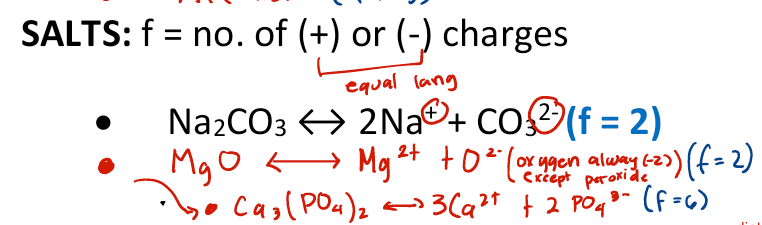
[STANDARDIZATION]
The Normality Factor (f) for Na2CO3 in a neutralization reaction
a. f = 1
b. f = 6
c. f = 2
d. f = 4
c. f = 2
[STANDARDIZATION]
The Normality Factor (f) for MgO in a neutralization reaction
a. f = 1
b. f = 6
c. f = 2
d. f = 4
b. f = 6
[STANDARDIZATION]
The Normality Factor (f) for Ca3 (PO4)2 in a neutralization reaction
a. f = 1
b. f = 6
c. f = 2
d. f = 4
b. Number of electrons gained
VDGEROA
VD- valence decrease
[STANDARDIZATION]
The basis for determining the Normality Factor (f) for Oxidizing Agents in redox reactions
a. Number of electrons lost
b. Number of electrons gained
c. Number of positive charges
d. Number of replaceable H⁺
a. Number of electrons lost
VDGEROA
VD- valence decrease
[STANDARDIZATION]
The basis for determining the Normality Factor (f) for Reducing Agents in redox reactions
a. Number of electrons lost
b. Number of electrons gained
c. Number of positive charges
d. Number of replaceable H⁺
d. f = 2
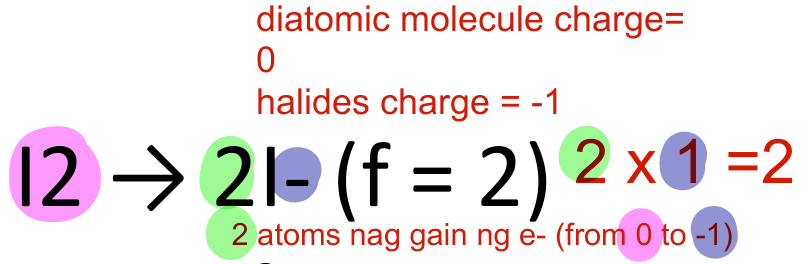
[STANDARDIZATION]
The Normality Factor (f) for I2 in a redox reaction as an Oxidizing Agent
a. f = 5
b. f = 1
c. f = 4
d. f = 2
a. f = 5
permanganate = MnO4 → Mn2+ = 5x1 (f=5)
[STANDARDIZATION]
The Normality Factor (f) for Permanganate in a redox reaction as an Oxidizing Agent
a. f = 5
b. f = 1
c. f = 4
d. f = 2
b. f = 1
ceric 4+ (Ce4+) → Ce3+ (f=1)
[STANDARDIZATION]
The Normality Factor (f) for Ce4+ in a redox reaction as an Oxidizing Agent
a. f = 5
b. f = 1
c. f = 4
d. f = 2
c. f = 1
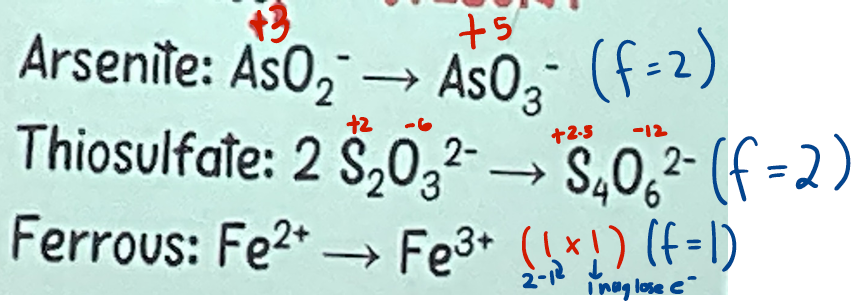
[STANDARDIZATION]
The Normality Factor (f) for Fe2⁺ as a Reducing Agent in a redox reaction
a. f = 2
b. f = 3
c. f = 1
d. f = 4
a. f = 2
[STANDARDIZATION]
The Normality Factor (f) for Arsenite as a Reducing Agent in a redox reaction
a. f = 2
b. f = 3
c. f = 1
d. f = 4
a. f = 2
[STANDARDIZATION]
The Normality Factor (f) for Thiosulfate as a Reducing Agent in a redox reaction
a. f = 2
b. f = 3
c. f = 1
d. f = 4
d. f = 2
BaCl2 ↔ Ba2+ + 2Cl- (f = 2)
[STANDARDIZATION]
The Normality Factor (f) for BaCl2 in a precipitation reaction involving halide salts
a. f = 1
b. f = 3
c. f = 4
d. f = 2
c. Number of (+) or (-)
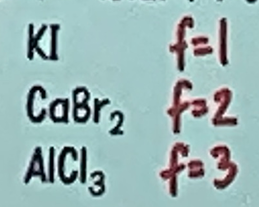
[STANDARDIZATION]
The basis for determining the Normality Factor (f) for Precipitation formed by halide salts
a. Number of electrons lost
b. Number of replaceable H⁺
c. Number of (+) or (-)
d. Number of electrons gained
b. f = 1 always
[STANDARDIZATION]
The Normality Factor (f) always used in complexation reactions
a. f = 2
b. f = 1
c. f = 3
d. f = 4
d. N = M × f
[STANDARDIZATION]
The relationship between Normality (N) and Molarity (M)
a. N = M − f
b. N = M + f
c. N = M / f
d. N = M × f