Carbohydrate Storage and Synthesis: Glycogenesis and Glycogenolysis Flashcards
 Call Kai
 Learn
Learn Practice Test
 Spaced Repetition
 Match
Match Flashcards
 Knowt Play
1/62

Earn XP
Description and Tags
Vocabulary flashcards covering the storage and synthesis of carbohydrates in liver and muscle, based on lecture notes and Baynes 3rd edition.
Name | Mastery | Learn | Test | Matching | Spaced | Call with Kai | Chat |
|---|
No analytics yet
Send a link to your students to track their progress
63 Terms
Glycogenesis
The metabolic pathway used to create glycogen from glucose.
Glycogenolysis
The biochemical pathway that breaks down glycogen into glucose-1-phosphate and glucose.
Glut-2 transporter
A transporter located in the liver that is freely permeable to glucose, allowing it to enter and leave the cell.
Glucokinase
An inducible enzyme in the liver that converts Glucose to Glucose-6-P, trapping glucose in the cell, showing increased activity after a high carbohydrate meal.
Hexokinase
The enzyme in muscle tissue responsible for converting Glucose to Glucose-6-P, trapping glucose in the cell.
Phosphoglucomutase
The enzyme that catalyzes the interconversion of Glucose-6-P and Glucose-1-P.
UDP-glucose pyrophosphorylase
The enzyme that reacts Uridine triphosphate (UTP) with Glucose-1-P to form Uridine-diphosphate glucose (UDP-glucose) and PPi.
UDP-glucose
An activated glucose compound used as a substrate for glycogen synthesis.
Glycogenin
A primer protein with glucosyl transferase activity that attaches two to seven glucose residues to itself from UDP-glucose to start a glycogen chain.
Glycogen Synthase
The regulatory enzyme of glycogenesis that adds glucose molecules to the alpha 1-4 chain; its dephosphorylated form is more active.
Branching enzyme
The enzyme that removes a seven-glucose terminal segment and transfers it to a C6-OH group to create an alpha 1-6 branch.
Insulin and Glucagon
Regulators of glycogenesis
Insulin
Activates glycogen synthase and deactivates glycogen phosphorylase
Insulin
Stimulates uptake of glucose by muscle and adipose tissue
Insulin
Increases transcription of Glut-4 transporters and insertion into muscle and adipose tissue membranes
Glucagon
Activates glycogen phosphorylase and deactivates glycogen synthase
Glycogen Phosphorylase
The enzyme specific for alpha 1-4 linkages that converts glycogen to Glucose-1-P sequentially from the terminal ends. Breaks alpha 1-4 bonds
Debranching enzyme
A bifunctional enzyme consisting of glucan transferase and 1,6-glucosidase activities used to handle alpha 1-6 branches during glycogenolysis
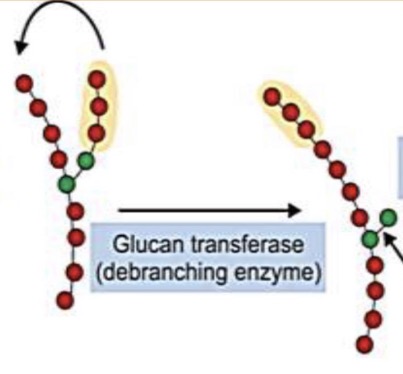
Glucan transferase
A component of the debranching enzyme that moves a segment of a branch from a 1-6 linkage to a 1-4 linkage for glycogen phosphorylase can continue working.
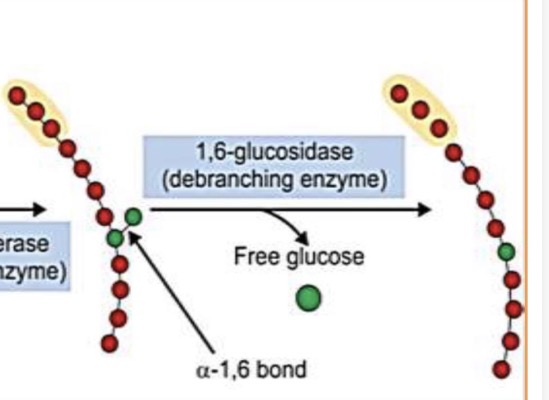
1,6-glucosidase
The component of the debranching enzyme that releases free glucose from the branch point.
Glucose-6-phosphatase
An enzyme that exists only in the liver which converts Glucose-6-P to free Glucose for release into the blood.
Liver Glycogen amount
Approximately 75 g in a 70 kg adult, accounting for 3-5% of tissue mass.
Muscle Glycogen amount
Approximately 250 g in a 70 kg adult accounting for 0.5-1.0% of tissue mass.
Liver Glycogen supply duration
Provides approximately a 3 hour supply of blood glucose between meals.
Glucagon
A hormone from pancreatic alpha-cells that causes rapid activation of glycogenolysis in the liver in response to hypoglycemia.
Epinephrine
A hormone from the adrenal medulla that causes rapid activation of glycogenolysis in response to stress or hypoglycemia.
Cortisol
A hormone from the adrenal cortex that causes chronic activation of glycogenolysis in response to stress.
Insulin
A hormone from pancreatic beta-cells that inactivates glycogenolysis and facilitates the dephosphorylation of glycogen synthase.
Adenylate cyclase
The enzyme activated by G-protein in the liver cascade that converts ATP to cAMP.
cAMP
A second messenger that activates Protein Kinase A (PKA) to initiate the phosphorylation cascade.
Active PKA
The form of Protein Kinase A that phosphorylates phosphorylase kinase and inactivates glycogen synthase.
Phosphorylase kinase
The enzyme that phosphorylates glycogen phosphorylase-b to convert it into its active 'a' form.
Glycogen phosphorylase a
The active, phosphorylated form of the enzyme that catalyzes glycogen breakdown.
Glycogen phosphorylase b
The inactive, dephosphorylated form of the enzyme involved in glycogen breakdown.
Phospholipase C (PLC)
An enzyme activated by epinephrine in the liver that cleaves PIP2 into IP3 and DAG.
Inositol trisphosphate (IP3)
A signaling molecule that triggers the release of Ca²+ from the endoplasmic reticulum in the liver.
Calmodulin
A protein that binds Ca²+ to form a complex which activates phosphorylase kinase independently of cAMP.
Glut-4 transporter
Glucose transporters whose transcription and membrane insertion in muscle and adipose tissue are increased by insulin.
Tyrosine kinase activity
The type of receptor activity through which insulin signaling functions to regulate glycogenesis enzymes.
Blood and Extracellular Glucose amount
Approximately 10 g of glucose, providing 40 calories in an 70 kg adult.
Calories from Liver Glycogen
Approximately 300 calories.
Calories from Muscle Glycogen
Approximately 1000 calories.
Nonreducing end
The end of a glycogen segment where glucose residues are sequentially removed or added.
Cascade amplification system
A series of enzymatic reactions (e.g., Glucagon to cAMP to PKA) where each step increases the signal magnitude.
Beta adrenergic receptor
The receptor type in muscle mediated by cAMP that is activated by epinephrine to trigger glycogenolysis.
Nerve impulse (in muscle)
Causes an influx of calcium ions to form the calcium-calmodulin complex, activating phosphorylase kinase hormone-independently.
AMP (in muscle)
Increased levels activate phosphorylase kinase and relieve inhibition of PFK-1 during exercise.
PFK-1
An enzyme in glycolysis that is activated by high levels of AMP in muscle during exercise.
Myokinase
An enzyme in muscle that produces AMP from two molecules of ADP during muscle work.
Glucose-1-phosphate (G-1-P)
The direct product of the phosphorolysis of glycogen by glycogen phosphorylase.
Glucose-6-phosphate (G-6-P)
Common intermediate used for glycolysis, glycogen synthesis, or blood glucose release (liver only).
Gluconeogenesis
The synthesis of glucose from non-carbohydrate precursors; liver glycogen is formed principally from these precursors.
Primary target of insulin stimulatory effect
The dephosphorylation and activation of glycogen synthase.
Inhibitor 1
A protein in the liver cascade that, when phosphorylated, inhibits phosphoprotein phosphatase.
PPi (Pyrophosphate)
A byproduct released when UTP reacts with Glucose-1-P to form UDP-glucose.
Absolute glucose requirement
Tissues like the brain and Red Blood Cells (RBC) have this specific need for blood glucose.
Anti-glucagon effects of insulin
Increased GTPase, phosphodiesterase, and phosphoprotein phosphatase activities.
Induction of biosynthetic enzymes
A mechanism of insulin action involving gene expression to promote anabolic processes.
Diacylglycerol (DAG)
A product of PIP2 cleavage that, along with Ca²+, activates protein kinase C in the liver.
Protein kinase C
An enzyme activated by DAG and Ca2+ in the hepatic epinephrine signaling pathway.
Phosphodiesterase
An enzyme increased by insulin action that breaks down cAMP, opposing glucagon.
G-protein
A membrane-associated protein that couples hormone receptors (like glucagon or adrenergic) to effector enzymes.
Fight/flight response
A physiological state that triggers epinephrine production and subsequent muscle glyocgenolysis.