Biology GCSE AQA Year 9: Ecology
 Call Kai
 Learn
Learn Practice Test
 Spaced Repetition
 Match
Match Flashcards
 Knowt Play
1/57

There's no tags or description
Looks like no tags are added yet.
Name | Mastery | Learn | Test | Matching | Spaced | Call with Kai | Chat |
|---|
No analytics yet
Send a link to your students to track their progress
58 Terms
What is an adaptation?
. Features that help organisms to survive in their environment and reproduce
. Adaptations may be structural, behavioural, or functional
What are structural adaptations?
. External physical features
. e.g body coverings, camouflage
What are behavioural adaptations?
. Actions by the organism which help them to survive or reproduce
. e.g migration, attracting a mate, survival behaviours
What are functional adaptations?
. Internal workings within the organisms (related to processes such as metabolism or reproduction)
. e.g poison production, anti-freeze in cells, antibiotic production
What are extremophiles?
. organisms adapted to live in extreme conditions
. e.g high temp, pressure, or salt concentration
Why are deep sea volcanic vents extreme environments?
. high temp
. high pressure
. completely dark
Why is the ecosystem of deep sea volcanic vents unique?
. the producers are bacteria that feed on chemicals not photosynthesising plants or algae like in most ecosystems
. the extreme environment makes it very hard to move between vents so many hydrothermal vents have separately evolved species that are only found in that one location. Their adaptations allow them to survive in these conditions
What is an ecosystem?
A community of living organisms (biotic component) interacting with each other and the non-living (abiotic) environment
What is a habitat?
The place where an organism lives
What is population?
All the organisms of one species who live in the same place at the same time and can breed together
What is community?
All of the populations of different species who live in the same place at the same time and can interact with each other.
What is interdependence?
Within a community each species depends on other species for food, pollination, seed dispersal, and shelter. Removing one species can affect the whole community.
What is an abiotic factor?
non-living factor
What are some abiotic factors?
. Light intensity
. Temperature
. Moisture levels
. Soil pH
. Soil mineral content
. Wind intensity / direction
. Oxygen levels for aquatic animals
. Carbon dioxide levels for plants
What is a biotic factor?
living factor
What are some biotic factors?
. Availability of food
. New predators arriving
. New pathogens
. one species outcompeting another so the numbers are no longer sufficient to breed (competition)
What does greater light intensity lead to?
greater light intensity = greater rate of photosynthesis = higher population = more animals can be supported
What can a change in temp lead to?
. Affects enzyme controlled reactions so can affect the rate of growth and reproduction in living organisms
. Is a limiting factor on photosynthesis
. Changes lead to: migration or hibernation in animals and leaf fall
What can a change in moisture levels / water lead to?
. All organisms require water (needed for chemical reactions, and to transport substances)
. Where water is scarce only species that are adapted to dry conditions will increase / maintain their population
. Where water is plentiful, vegetation is dense so more animals can be supported depending on the type and variety of vegetation
What can a change in soil pH lead to?
. can affect which plants grow
. affects the rate of decay (acidic soil restricts decay)
What can a change in soil mineral levels lead to?
Plants need mineral ions for growth e.g magnesium ions are used to make chlorophyll, nitrate ions are used to make amino acids (to make proteins).
What can a change in wind intensity / direction lead to?
. Can shape trees and landscape
. More wind = plants transpire faster (so can lose more water)
What can a change in availability of oxygen lead to?
. Oxygen is essential for aerobic respiration. On land, oxygen levels don't change much
. Oxygen levels in water can become limited (fish need a high concentration of dissolved oxygen in water)
What can a change in availability of carbon dioxide lead to?
. CO2 is a limiting factor for photosynthesis and plant growth
. Can also affect distribution of animals (mosquitoes are attracted to their food animals by high CO2 levels)
What do animals compete for?
. food
. territory
. mates
What do plants compete for?
. Light for photosynthesis
. Water for photosynthesis and support
. Minerals from the soil
. Space to grow
How does competition affect a community?
. When there is plenty of food, organisms breed successfully
. Organisms may not be resistant to new diseases. Organisms may not have defences
. A new species may outcompete another to the point where numbers become too low for successful breeding
How are predators and prey adapted?
. Predators are adapted to hunt, catch, and eat prey
. Prey are adapted to avoid capture from predators
. Methods of adaptation for predators and prey could be mimicry, vision, or camouflage
What does it mean if your results are reproducible?
the same results are repeated by someone else doing your experiment or by using a different method
What does it mean if your results are repeatable?
you repeat the experiment with the same equipment and get the same results
What does it mean if your results are valid?
they must answer the question you're asking
What is abundance?
how many living organisms there are
What is distribution?
how spread out the organisms are
How can abundance and distribution be measured?
Quantitative data can be obtained by:
1) Random sampling with quadrats: in areas where distribution is quite uniform, the abundance is measured
2) sampling along a transect: used to observe changes in distribution across areas of the habitat
What is a quadrat and how is it used?
. square frame used to define the size of a sampling area
. use the same size quadrat every time
. Sample as many areas as you can to make the results as valid as possible
What is random sampling used for?
. to estimate the population size (abundance) of an organism
. ensures results aren't biased
. the larger the sample size, the more representative the results
Describe how you could carry out random sampling to compare the abundance of daisies in 2 different fields
. Mark out an area in the first field using 2 tape measures
. Use a random number generator to generate coordinates
. Place the quadrat at each coordinate and count the number of daisies in the quadrat
. Repeat several times in that field
. Calculate a mean number of daisies per quadrat
. Repeat all the steps above in the other field taking the same number of samples
What is sampling along a transect used for?
. Shows how the distribution of organisms changes along a line, perhaps as an abiotic factor is changing, so you can investigate the relationship between the 2
. not random but still unbiased
Describe how you could use a quadrat to investigate how the species of plants change with distance from a river
. Use a tape measure to create a line transect
. Place quadrats at regular intervals
. Count the number of species in each quadrat
Why is it important to have a large sample size?
. More reproducible / repeatable / valid results
. Allows you to identify anomalies
How do you find the mean?
sum of all numbers / number of numbers
How do you find the mode?
the most common value
How do you find the median?
. put numbers in ascending order
. find number in the middle or mean of 2 middle numbers
How do you find the range?
highest number - lowest number
What is a food chain and what do the arrows represent?
. A simple model that illustrates the feeding relationships in a community
. Arrows = what things are eaten by and the flow of energy
What do all food chains start with?
. producers - photosynthetic organisms
. they synthesise molecules
. e.g a green plant or algae, which makes glucose by photosynthesis
What is a trophic level?
The feeding level in an ecosystem
Give an example of a food chain with trophic levels and names of each animal's place in the food chain
. Grass - TL1, Producer
. Grasshopper - TL2, Primary Consumer
. Frog - TL3, Secondary Consumer
. Python - TL4, Tertiary Consumer
. Eagle - TL5, Quaternary Consumer / Apex Predator
Why is it advantageous for an organism to have more than one food source?
. Provides organisms with greater flexibility, nutritional benefits, and a reduced risk of food scarcity
. Allows them to exploit a wider range of resources, adapt to changing conditions, and maintain ecosystem stability
What is a food web?
Shows how food chains are connected
Why might some animals not occupy the same trophic level in a food web?
. They might eat different things in different food chains and, when merged, occupy different trophic levels
. e.g krill eats phytoplankton making it a primary consumer but it also eats herbivorous zooplankton making it a secondary consumer
What happens when prey population increases?
more food for predators = more survive and reproduce = increase in predator population
What happens when the predator population increases?
eat more prey = decrease in prey population
What happens when the prey population decreases?
not enough food for predators = competition for food increases = predator population decreases
What happens when the predator population decreases?
less prey being killed = more prey survive and reproduce = prey population increases again (and pattern continues)
What is a stable community?
Where all the species and environmental factors are in balance and population sizes remain fairly constant. The number of predators and prey rise and fall in cycles
Look at the graph on the other side of this flashcard. The orange line is predators and the blue line is prey. The x axis is time and the y axis is population size. What does the graph show?
Answer on the next flashcard
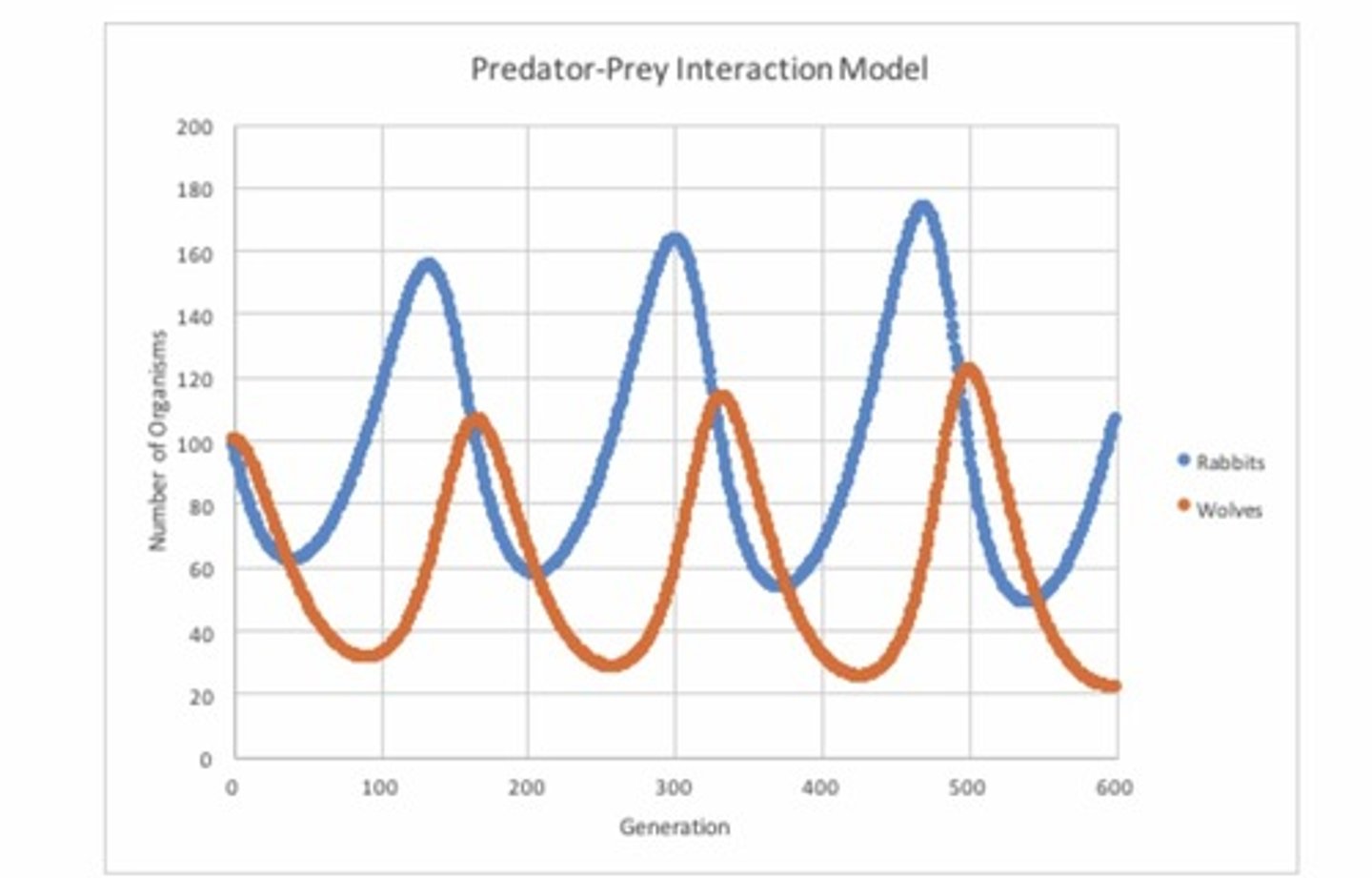
What does the graph show?
. there is almost always more prey than predators
. the number of predators increases because there's more prey
. the number of prey reduces because there are more predators
. the number of predators reduces because there is less prey