Presentation 8: Openness tradeoffs
 Call Kai
 Learn
Learn Practice Test
 Spaced Repetition
 Match
Match Flashcards
 Knowt Play
1/12

Earn XP
Description and Tags
Platform openness & governance
Name | Mastery | Learn | Test | Matching | Spaced | Call with Kai | Chat |
|---|
No analytics yet
Send a link to your students to track their progress
13 Terms
What is the core challange of digital Platforms?
Open vs. closed / fragmented vs. integrated platforms
Openess (toward external contributor):
more innovation
more participation
faster growth (more open systems has more apps)
lower quality signals
higher uncertainty (Ungewissheit)
potential ecosystem unstable
Control:
quality
security
trust
stronger value capture (more controlled systemms has higher price)
less attractive for developers
limits innovation
→ We can control the openness, the duration of IP rights, and thus the spillovers
→ The Core Tradeoff: Closed systems maximize integration and pricing power, while open systems accelerate innovation at the risk of platform fragmentation
→ Increasing platform openness creates a trade-off: while it drives growth and participation, it can also weaken platform control, reduce trust, and shift quality assessment from the platform to external networks
→ Openness and control should balanced by the platform owners by deciding how open the platform should be, how long IP rights are protected, and how much knowledge spills over to others
Explain downstream enhancements through openness.
Apple creates iPhone; Value:100
Apple opens SDK → Developer create apps; Value = 150
Apple notices Flashlight app is popular → Apple copies it and adds it directly into iOS; Value: 170
Developer build something new; Value:220
Apple absorb that innovation again
→ cycle

Which forms of platform openness exist?
User Openness: Freedom for end-users
Giving end users freedom in how they install, customize and use the platform and its complements (e.g. sideloading, installing third-party software, customization)
Access Openness: Freedom for complementors
Granting (gewähren) third-party participants access to the platform via interfaces (APIs, SDKs, boundary ressources) to develop complements
Resource Openness: Freedom regarding the platform core
Forfeiting intellectual property rights (IPR) to core platform resources, typically through open-source license e.g. GPL, Apache) and open-source code
Platform owner gives up exclusive IP rights
IP Policy as Control: Absorbing third-party innovations acts as an intellectual property policy that reduces fragmentation and hold-up, but it risks stifling future external contributions
Access Openness + Resource Openness: Shared Resources
Shared complements: Apps and hardware provided by third parties where IPR remains with the developer
e.g. Spotify app on Android
Shared Platform core: codebase (e.g. Android Open Source Project) where the host has legally given up exclusive control
e.g. Android Open Source Project → Google publishes the source code
→ both (Acess abd Resource openness) stimulate external innovation but also increase the risk of platform forking
Explain Exploitation (Ausnutzung) of Openness.
Exploitation: How opennes is abused (missbraucht)
Malicious (bösartig) content: driven by high access openness
Open interfaces and distribution channels enable anyone to develop and distribute content
This can lead to spam, maleware, fraud, privacy violations and other harmful content
Platform Forking (Verzweigung): driven by high Resource Openness
Forking: Reuse and modify opensource platform core to jumpstart development
e.g. Amazon Fire OS → Fork of Andoid (Google published Android source code, Amazon make his own version)
Cloning: Replicate the host`s APIs and interfaces to enable apps to run on the fork with minimal changes (= to run the same apps)
Hacking: Bypass or modify boundary resources to gain access to restricted ecosystem assets e.g. unofficial app stores, modified APIs)
Explain Defense of Exploitation.
Defense: How platform owners protect and retail control
Restrict Openness: Move critical features from open-source to a closed source regime (e.g., Google Mobile Services)
Digital Wrapping: Wrap APIs in proprietary client libraries to prevent cloning (e.g., Google Play Services)
e.g instead of giving developers direct acess Google wraps APIs inside propretary libraries so developers depend on Google libraries
Contractual Enforcement: Use alliance agreements (e.g., Mobile Application Distribution Agreement) to prevent incompatible forks from accessing key apps
e.g. Manufacturers must sign agreements to receive Google Apps
Rebranding and Ownership: Claiming (fordern) exclusive ownership of boundary resources signal control (e.g., “Google Play“)
e.g. Claim ownership over play store, google play, google maps not just android → even if android is open, google still owns the brand
Explain the Boundary resource Model.
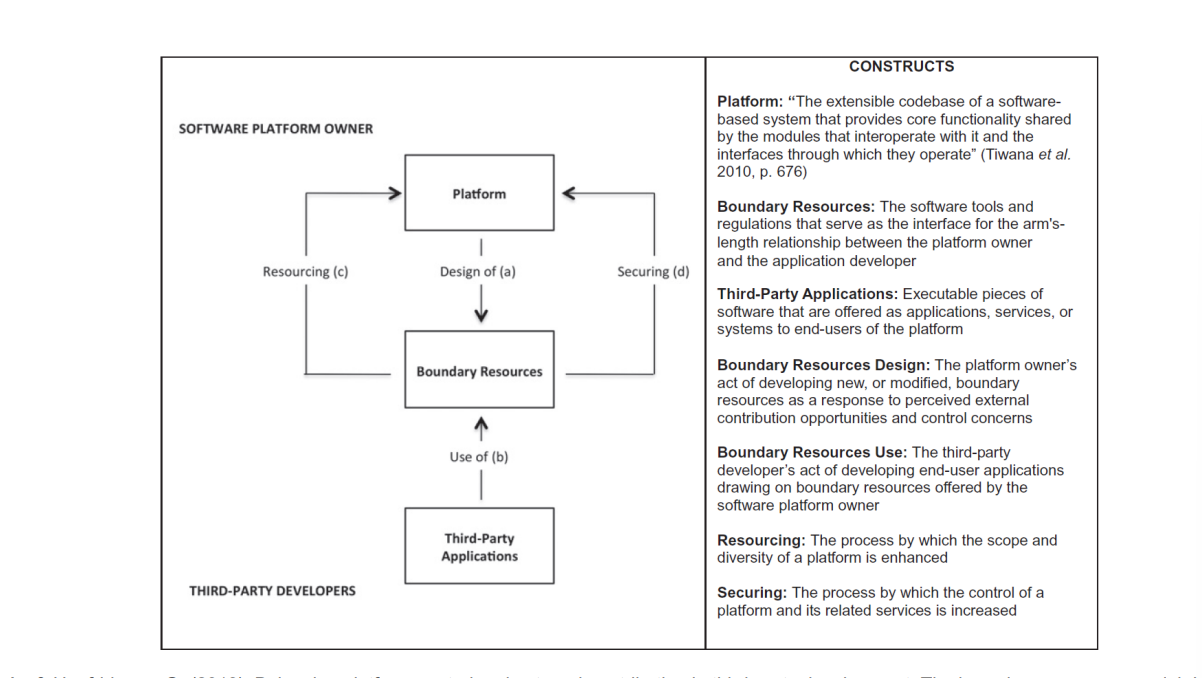
Boundary resources to realize Resourcing (Open acces for innovation) + Securing (embedded control for platforms safety)
Resourcing: Self-Resourcing vs. Diversity Resourcing
Self Resourcing (APIs, SDKs, developer tools) provided by the platform
Diversitiy Resourcing (many developers and applications, ecosystem growth) because of the existing APIs and SDKs
Self Resourcing creates Diversity resourcing
Securing:
Regulation based securing (rules and guidelines, app review)
Sovereignty based securing (platform owner decides final approval (Genehmigung), control over access, governance power)
→ Resourcing and Securing effects platform ecosystem and external developers + users
→ Boundary resources enable platforms to scale innovation by opening access to developers, while embedding control mechanism that protect the platform's stability
Compare openness by Role and operating system.
Demand-Side User (End-User):
Linux: Open
Windows: Open
Macintosh: Open
iPhone/iOS: Open
Supply-Side User (App-Developer):
Linux: Open
Windows: Open
Macintosh: Open (since Xcode, 2003)
iPhone/iOS: Open (since App Store, 2008)
Platform Provider (Hardware/OS Bundle):
Linux: Open
Windows: Open
Macintosh: Closed
iPhone/iOS: Closed
Platform Sponsor (Design & IP Rights):
Linux: Open
Windows: Closed
Macintosh: Closed
iPhone/iOS: Closed
→ Successful platforms exist at every point on the openness spectrum – there is no single "best" mode
Which models exist for organizing Platforms? (Platform Governance)
Models depending on two dimensions: Sponsor role (Who controls platform technology?) and Provider Role (Who provides the platform?)
Proprietary: One firm controls + One firm provides
e.g. Macintosh, PlayStation, Monster.com, FedEx
Joint Venture: Many Firms control + One firm provides
e.g. CareerBuilder, Orbitz
Licensing: One firm controls + Many firms provide
e.g. Palm OS, Windows, Microsoft MBNA cards
Shared: Many firms control + Many firms provide
e.g. Linux, Visa, DVD
→ Platform governance varies: a single firm can control everything (proprietary) or share responsibilities (shared/licensing/JV)
What is the difference between horizontal and vertical strategies for openning platforms?
Horizontal: Open to competitors:
Same layer (Platform ← → Platform)
Interoperability, Licensing, Broadening Sponsorship
e.g. Two platforms cooperate
Vertical: Open between layers (platform, developer, user)
Backward compatibility
Platform exclusivity
Absorbing complements
Platform owners can strategically adjust openness through horizontal and vertical mechanisms (e.g., interoperability, licensing, sponsorship, compatibility, and exclusivity) to influence growth, competition, and innovation
→ Platform owners can strategically adjust openness through horizontal and vertical mechanisms (e.g., interoperability, licensing, sponsorship, compatibility, and exclusivity) to influence growth, competition, and innovation
Which horizontal strategies for Opening Platform exist?
Interoperability: Allow rival platforms' users to interact with the focal platform's users. Achieved through converters/adapters
e.g. Apple: RealNetworks Harmony tried to connect iPod users to Real’s music store; Apple later broke compatibility
e.g. Linux: shared compatibility lets users switch providers such as Red Hat and Ubuntu while keeping access to Linux apps
Licensing new providers: License additional firms to provide platform goods while preserving sponsor control over technology
e.g. Apple: Mac clone licensing was terminated because it created competitors rather than differentiated growth
e.g. Linus: any party can bundle Linux with hardware or offer distributions, increasing provider variety
Broadening Sponsorship: Invite other parties to jointly develop the platform's core technology. Shares R&D costs but risks slower innovation
e.g. Apple/iPhone: sponsor role remains closed; Apple controls design, IP rights and platform rules
e.g. Linux: sponsor role is open; parties may contribute OS improvements under open-source community rules
Which vertical strategies exist for opening platforms?
Backward Compatibility:
When upgrading, sponsors must decide if next-gen products work with old complements
Failing to provide backward compatibility limits existing complementors' access
Retains user base, reduces switching risk
May constrain innovation with legacy baggage
e.g. Linux: users can switch between providers such as Ubuntu and Red Hat without losing access to Linux-compatible applications
Platform & Category Exclusivity:
Sponsors can restrict complements to their platform only (platform exclusivity) or grant sole access to one complementor per category (category exclusivity)
Accelerates growth, allows premium pricing
May provoke antitrust issues, alienate (entfremden) developers
e.g. Apple/iPhone: applications are available only through Apple’s store; Apple can reject third-party apps for quality or strategic reasons
Absorbing complements:
Platform providers incorporate functions previously supplied by third parties (e.g., Windows absorbing web browsing, media players)
IP Policy as Control: Absorbing third-party innovations acts as an intellectual property policy that reduces fragmentation and hold-up, but it risks stifling future external contributions
Efficiency gains, improved convenience
Displaces third-party suppliers, potential absure of dominance
e.g. the the iPod/iTunes bundle shows integration gains through simpler interfaces and user convenience
Does maximizing control maximize value?
No:
Too Open: many developers, lots of innovation but spam, forks, malware, low quality
Too Closed: high quality, secure, but few developers, little innovation
→ Maximum value is somewhere in the middle (goal: optimal openness)
What is the connection between governance and openness?
Governance = who makes the rules and who has decision power
Openness = how much access and freedom the platform allows
Governance determines openness