Human Breathing - Chp 30
 Call Kai
 Learn
Learn Practice Test
 Spaced Repetition
 Match
Match Flashcards
 Knowt Play
1/24

There's no tags or description
Looks like no tags are added yet.
Name | Mastery | Learn | Test | Matching | Spaced | Call with Kai | Chat |
|---|
No analytics yet
Send a link to your students to track their progress
25 Terms
Respiratory system diagram
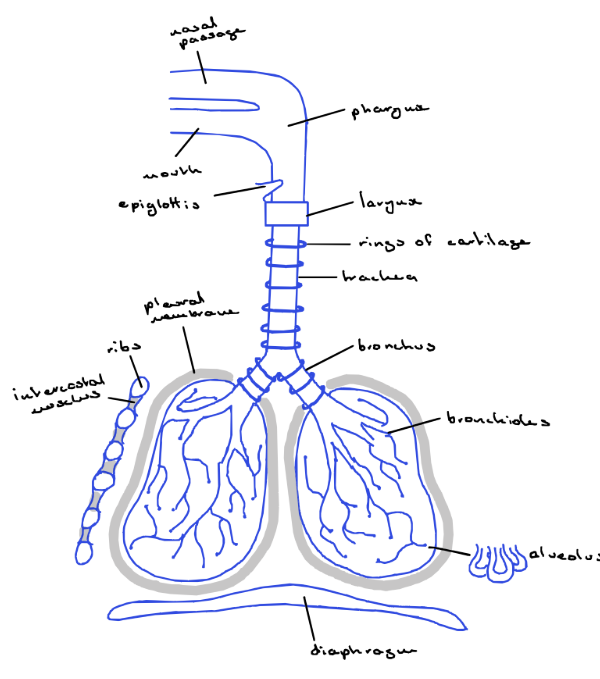
Thorax - structure
consist of the lungs, thoracic cavity and a series of tubes
Diaphragm - structure
a sheet of muscle that forms the floor of the thorax
Intercostal muscles - structure
located between each of the ribs + makes up the walls of the thorax together
Nasal passages - structure + function
has 2 openings called nostrils separated by a nasal septum
walls lined with fine hairs and mucous which trap and filter the air
moistens and warms the air to help it diffuse more easily in the alveoli
Pharynx - structure
passage at the back of the mouth that connects the mouth and larynx
Epiglottis - structure + function
a flap of tissue that closes off the trachea when we swallow
this prevents food entering the windpipe
Larynx - structure + function
found just below the epiglottis, also known as the voice box or Adam’s apple
contains 2 vocal cords that vibrate to produce sound when air passes over
Glottis- structure + function
area at the top of the trachea that contains the larynx and vocal cords
Trachea, Bronchi + Bronchioles - structure + function
Trachea, bronchi and higher bronchioles are all made up of muscle and elastic fibres with incomplete C shaped rings of cartilage - these prevent the tubes from collapsing as air is taken in
trachea allows air to pass to the lungs
trachea divides into 2 bronchi transporting the air into each lung
each bronchus divides into bronchioles which transport air into the alveoli
Cilia - structure + function
hair like projections that line the trachea, bronchi and bronchioles - mucous producing cells also line these structures
the mucous traps particles and the cilia beat to create an upward current to move these particles up to the oesophagus where they are swallowed
Alveoli - structure + function
hollow, balloon like sacs at the end of each bronchiole
about 700 million in 2 lungs
What adaptations are there to imrpove gas exchange in the lungs?
alveoli are numerous
alveoli have thin walls
alveoli are moist and warm
covered in capillaries that have thin walls
capillaries are numerous
all increase surface area
Lungs - structure + function
large spongy organs where gas exchange occurs
Pleural membrane - structure + function
aka Pleura
outer membrane lines the chest wall and diaphragm
inner membrane lines the lung
the gap between the membranes is the pleural cavity + is full of liquid, which lubricates the membranes preventing friction
Diffusion
movement of molecules from an area of high concentration to an area of low concentration
Describe the process of gas exchange:
O2
blood returning to the lungs is rich in CO2 and low in O2
O2 will diffuse into through the alveoli wall and capillary to the blood as the concentration is lower and the concentration in the alveolus is higher
CO2
CO2 and water diffuse through the capillary and alveoli wall out of the blood as the concentration in the alveolus is lower and the concentration in the blood is higher
they are then exhaled
How are gases transported around the body?
O2
97% of O2 combines with haemoglobin and 3% is dissolved in the plasma
travels to the pulmonary vein, into the heart, and then is pumped around the body
CO2
CO2 and water are transported in the plasma
What factor controls breathing?
CO2 levels
How do CO2 levels control breathing?
CO2 is a slightly acidic gas, and dissolved in water to form weak carbonic acid
this causes the pH of blood to fall slightly
cells in the medulla oblongata in the brain detect the slightly drop in pH
nerve cells in the medulla oblongata are connected to the diaphragm and intercostal muscles
when CO2 levels are high, pH drops and nerve impulses are sent to the diaphragm and intercostal muscles
Describe the process of inhalation:
an impulse is sent from the medulla oblongata to the intercostal muscles and diaphragm - muscles contract making this an active process
the intercostal muscles contract moving the ribs up and out
the diaphram contracts pulling down
this increases the size of the thorax
increase lung volume
deacreases thoracic pressure
external pressure is now higher than the thorax and air is forced into the lungs
Describe the process of exhalation:
no message is sent to the intercostal muscles and diaphragm and they relax - passive process no ATP required
intercostal muscles move down and in
diaphrahm moves up
this reduces the size of the thorax
decreases lung volume
increases thoracic pressure
external air pressure is lower than thoracic pressure and air is forced out of the lungs
How does exercise effect rate of breathing?
increases rate of respiration as muscle cells need more O2 and also increases CO2 levels
this triggers deeper and faster breathing to gain more oxygen and remove carbon dioxide
exhalation become an active process
Name a breathing disorder + what problems it causes
Asthma - the narrowing of the lower bronchioles, which prevents air from reaching the alveoli
Symptomms, causes, prevention and treatment of the named breathing disorder:
Symptoms: Noisy, wheezy breathing and a feeling of breathlessness
Causes: Triggered by external allergens that are inhaled e.g. pollen or dust
Prevention: Avoid allergens and preventative inhalers (bronchodilator)
Treatment: Use a bronchodilator which widens/dilates the bronchioles