Equilibrium
 Call Kai
 Learn
Learn Practice Test
 Spaced Repetition
 Match
Match Flashcards
 Knowt Play
1/51

There's no tags or description
Looks like no tags are added yet.
Name | Mastery | Learn | Test | Matching | Spaced | Call with Kai | Chat |
|---|
No analytics yet
Send a link to your students to track their progress
52 Terms
Definition: Reversible reactions
Reactions that proceed in both forward and backward reactions
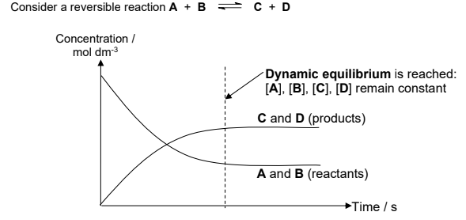
(concentration-time graph) Dynamic Equilibrium
(rate-time graph) Dynamic Equilibrium
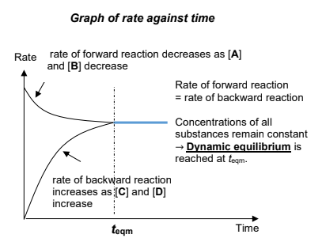
Definition: Dynamic Equilibrium
When a reversible reaction in a closed system reaches dynamic chemical equilibrium, reaction continues to occur. Rates of the forward and backward reactions are equal and there is no net change in the concentrations of the reactants and products.
Definition: Equilibrium Constant, Kc
Ratio of the product of the concentrations of products raised to the appropriate powers in the product of the concentrations of reactants raised to the appropriate powers at equilibrium at a given temperature.
Formula: Kc

Formula: Kc units

In an aqueous solution where water is used as a solvent, Kc expression does not include …
the concentration of water
Kc does NOT include ____.
solids
Definition: Partial Pressure of a gas
Pressure which the gas would exert if it alone occupies the same volume as mixture in the container
Kp can only be applied if the equilibrium has at least one ____
gas
Formula: Kp

Formula: Partial Pressure

Formula: Relationship between Kc and Kp

When does Kc = Kp?
Only when the number of moles of gaseous reactants is equal to the number of moles of gaseous products in the equation i.e. Δn = 0
Formula: Δn
aA + bB → cC + dD
Δn = (c + d) - (a + b)
Kc is proportional to Kp at ____
constant temperature
Memorise: What does Kc measure?
Extent to which a reversible reaction takes place
Memorise: Kc > 1
Reaction proceeds from left to right
Formation of products are favoured → equilibrium lies to the right
When Kc > 1000, reaction is effectively complete
Memorise: Kc < 1
Reaction proceeds from right to left
Formation of reactants are favoured → equilibrium lies to the left
When Kc < 0.001, reaction is negligible
Kc and Kp are dependent on _____ only
temperature
Are Kc and Kp affected by changes in concentration or pressure?
No
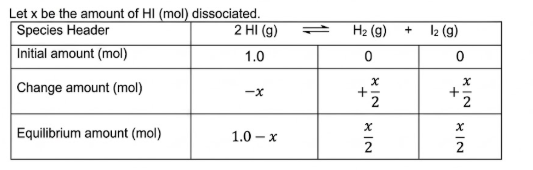
Formula: Drawing ICE Table
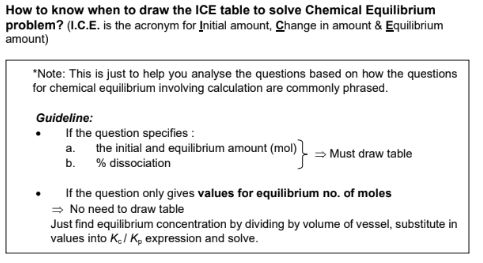
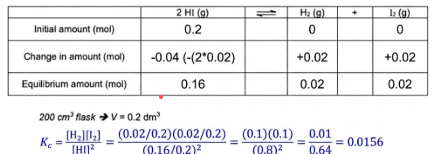
Q) (i) HI dissociates into H2 and I2 in a reversible reaction. 0.2 mole of gaseous HI was placed in a 200 cm3 flask. At equilibrium, it was found that 20% of HI had dissociated. What is Kc?
(ii) In another experiment at the same temperature, 1.0 mol of HI in a 1 dm3 vessel was allowed to dissociate. Calculate the percentage dissociation of HI.
(i)
(ii)

Formula: Percentage Dissociation

Formula: Degree of Dissociation

Definition: Le Chatelier’s Principle
When a system at dynamic equilibrium is subjected to a change which disturbs the equilibrium, the system will react in a way so as to counteract the effect of the change to re-establish equilibrium.
Memorise: What happens to equilibrium when concentration of reactants [A] is increased?
By LCP, the equilibrium position will shift right to decrease concentration of reactant until new equilibrium is attained.
New equilibrium mixture will contain more products, more reactant [A] and less reactant [B].
No change in Kc, kf and kb.
Memorise: What happens to equilibrium when concentration of reactants [A] is decreased?
By LCP, the equilibrium position will shift left to increase concentration of reactant until new equilibrium is attained.
New equilibrium mixture will contain less products, less reactant [A] and more reactant [B].
No change in Kc, kf and kb.
Memorise: What happens to equilibrium when concentration of products [C] is increased?
By LCP, the equilibrium position will shift left to decrease the concentration of products until a new equilibrium is attained.
New equilibrium mixture will contain less products, less reactant [B] and more reactant [A].
No change in Kc, kf and kb.
Memorise: What happens to equilibrium when concentration of products [C] is decreased?
By LCP, the equilibrium position will shift right to increase the concentration of products until a new equilibrium is attained.
New equilibrium mixture will contain more products, less reactants [A] and [B].
No change in Kc, kf and kb.
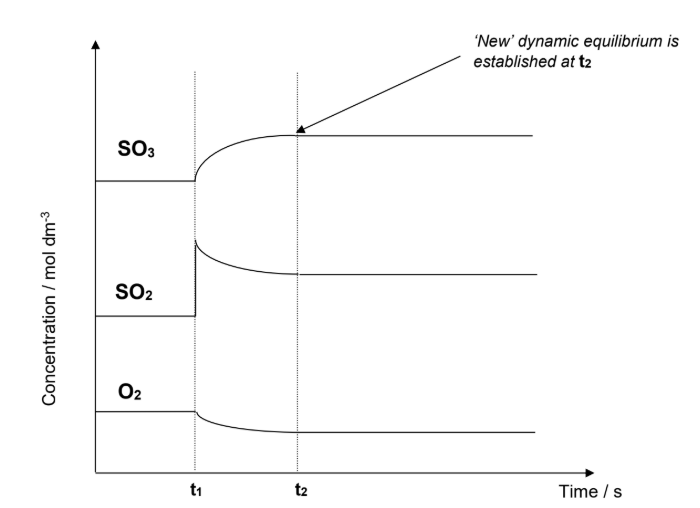
Graph for 2SO2 + O2 → 2SO3 where SO2 is added.
SO2 added.
By LCP, the equilibrium position will shift right to decrease concentration of reactant until new equilibrium is attained.
New equilibrium mixture will contain more products, more reactant [A] and less reactant [B].
No change in Kc, kf and kb.
Pressure changes only affect ____ reactions.
gaseous
Definition: Pressure
Force exerted by the gas particles on the wall of its container
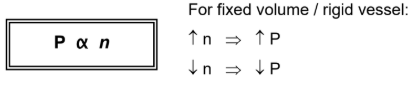
Memorise: What happens to equilibrium when pressure increases?
By LCP, the equilibrium shifts [side with less moles] to decrease the number of moles of gas, hence, decreasing pressure.
Kc, kf and kb not affected.
Memorise: What happens to equilibrium when pressure decreases?
By LCP, the equilibrium shifts [side with more moles] to increase the number of moles of gas, hence, increasing pressure.
Kc, kf and kb not affected.
Pressure has no effect on equilibrium position and composition of equilibrium mixture when…
Total no. of moles of gaseous reactants = Total no. of moles of gaseous products


Memorise: What happens to equilibrium when temperature increases?
#EQUILIBRIUM SHIFTS TOWARDS ENDOTHERMIC REACTION TO ABSORB HEAT.
~ Endothermic
By LCP, the equilibrium position shifts right towards endothermic reaction to absorb heat.
Kc increases.
~ Exothermic
By LCP, the equilibrium position shifts left towards endothermic reaction to absorb heat.
Kc decreases.
Memorise: What happens to equilibrium when temperature decreases?
#EQUILIBRIUM SHIFTS TOWARDS EXOTHERMIC REACTION TO RELEASE HEAT.
~ Endothermic
By LCP, the equilibrium position shifts left towards exothermic reaction to release heat.
Kc decreases.
~ Exothermic
By LCP, the equilibrium position shifts right towards exothermic reaction to release heat.
Kc increases.
Catalysts have no effect on …
Kc or Kp
Yield of Product
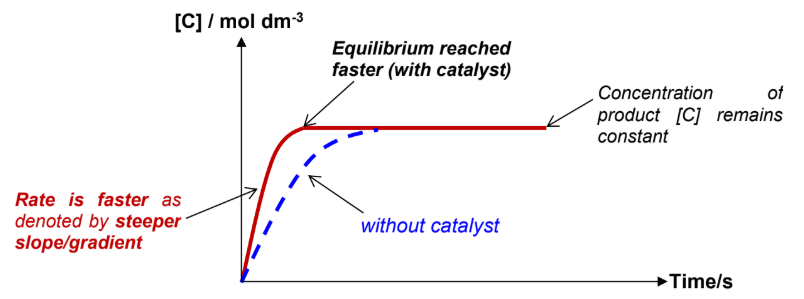
Memorise: What happens to equilibrium when catalyst is added?
Catalysts increase the rate of forward and backward reaction to the same extent, hence, position of equilibrium remains unchanged.
Catalysts increase the rate of reaction so that dynamic equilibrium is established faster.
Haber Process Equation for ammonia manufacturing
N2(g) + 3H2(g) — 2NH3(g)
ΔH = -92 kJ mol-1
Common operating conditions for Haber Process
High pressure of 250 atm
Moderate temperature of 450
Iron catalyst
Molar ratio of N2:H2 is 1:3
Definition: ΔG, Gibbs Free Energy
ΔG is a measure of the spontaneity of a reaction
Memorise: ΔG < 0
Spontaneous
Memorise: ΔG > 0
Non-spontaneous
Memorise: ΔG = 0
System is at equilibrium
Definition: Q, Reaction Quotient
Ratio of product of the concentrations of products raised to the appropriate powers to the product of the concentrations of reactants raised to the appropriate powers at a given temperature
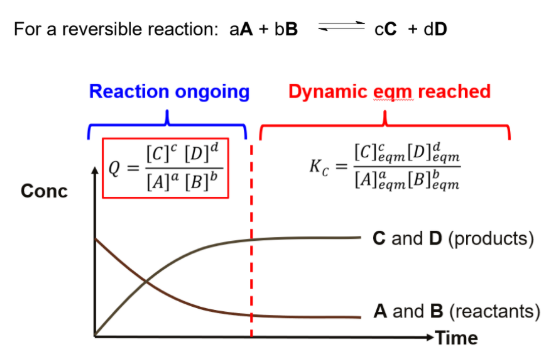
Q = Kc when…
system is at equilibrium
Formula: Q (reaction quotient)

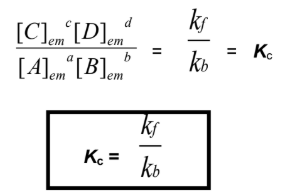
Formula: Relationship between Kc and kf/kb
Limitations of LCP
When more than 1 factor is changing