B3 : Infection and Response
 Call Kai
 Learn
Learn Practice Test
 Spaced Repetition
 Match
Match Flashcards
 Knowt Play
1/92

Earn XP
Description and Tags
Name | Mastery | Learn | Test | Matching | Spaced | Call with Kai |
|---|
No analytics yet
Send a link to your students to track their progress
93 Terms
What is the scientific definition of health?
The state of physical or mental well-being
What are communicable diseases?
Diseases that can spread from one person to the other (spread by a pathogen)
What are non-communicable diseases?
Diseases that can’t spread from one person to the other
What is a pathogen?
A microorganism that causes disease
What are the 4 type of pathogens?
Bacteria
Virus
Protist
Fungi
How do bacteria make people ill? (2)
They reproduce rapidly
They make you ill by producing toxins that damage cells and tissue
Name the 2 bacterial diseases
Salmonella
Gonorrhoea
What does salmonella cause?
Food poisoning
How can you get salmonella? (2)
By eating uncontaminated food that is contaminated with the salmonella bacteria
By eating food that was prepared in unhygienic conditions
What are the symptoms of salmonella? (4)
Fever
Stomach cramps
Vomiting
Diarrhoea
How can the spread of salmonella prevented?
In the UK chickens (and other meat sources) are given a vaccination again salmonella
What is gonorrhoea?
A sexually transmitted disease (STD)
How can you get gonorrhoea?
Via sexual contact (having unprotected sex)
What are the symptoms of gonorrhoea? (2)
Pain when urinating
Yellow or green discharge
What can prevent the spread of gonorrhoea? (2)
Treated with antibiotics
Usage of barrier methods such as condoms
Why has gonorrhoea become trickier to treat with antibiotics? + Which antibiotic?
The antibiotic used is penicillin but this has become harder because some bacteria has become resistant
How do viruses make people ill? (3)
They reproduce rapidly
Live inside your cells, replicate themselves and cause cells to burst leading to the virus spreading to other cells and infecting them
The cell damage makes us ill
What are the 3 types of viral diseases?
Measles
HIV
Tobacco mosaic virus (TMR)
How can viruses not be killed?
By antibiotics
How is measles spread?
From droplets from an infected persons sneeze or cough
What are the symptoms of measles? (2)
Red skin rash
Fever
What can measles sometimes cause?
Damage to the breathing systems and the brain
How do you prevent the spread of measles?
By getting vaccinated when you’re young
How is HIV spread? (2)
By sexual contact
Exchanging bodily fluids
What are the symptoms of HIV?
Flu like symptoms
What does HIV attack?
The immune system
How can HIV be prevented in the early stages?
Antiretroviral drugs (stop virus replicating + must be taken for the rest of their lives)
What can HIV cause in its later stages?
Aids
How is TMV spread?
By entering the wounds of plants
What are the symptoms of TMV?
A mosaic pattern is caused by discolouration which means plants can’t photosynthesise and therefore affects plant growth
How do protists spread disease?
Through a vector (an insect which doesn’t get the disease itself only carries and spreads it)
What disease is caused by protists?
Malaria
How is Malaria spread?
Via infected mosquitos biting humans
What are the symptoms of Malaria? (3)
Repeating episodes of a fever
Headaches
Vomiting
How can malaria be prevented? (3)
Stopping mosquitos from breeding (mosquitos breed in still water so we need to find areas of still water and drain them)
Using insecticides
Using mosquito nets when sleeping
What are fungal diseases?
Diseases caused by fungi
What disease is causes by fungi?
Rose black spot
How is Rose black spot spread?
Through the wind or in water
What organism does rose black spot infect?
Plants (roses)
What are the symptoms of rose black spot? (3)
Purple or black spots on leaves
Less photosynthesis occurs and leaves struggle to grow
Leaves eventually turn yellow and drop off
How can the spread of rose black spot be prevented? (2)
Gardeners use fungicides
Gardeners strip the plant of its infected leaves and burn them so the fungi can’t spread
How can the spread of diseases be reduced or prevented? (4)
Being hygienic → washing hands
Destroying vectors
Isolating infected individuals
Vaccination
What 4 body parts have specific functions to keep pathogens out of the body?
Skin
Nose (nostrils)
Trachea + Bronchi
Stomach
How does the skin prevent pathogens from entering the body? (3)
Acts as a barrier (protective layer)
Secretes antimicrobial substances (substances used to prevent or treat infections)
If skin is damaged, scabs are formed to stop pathogens from entering
How does the nose prevent pathogens from entering the body?
Contain hairs and mucus which trap pathogens before they enter the breathing system (but can’t always prevent this)
How do the trachea and bronchi prevent pathogens from entering the body? (2)
Both are covered in cilia
Cilia are covered in mucus to trap pathogens + then waft the mucus to the throat where it is swallowed into the stomach
How does the stomach prevent pathogens from harming the body?
Contains hydrochloric acid (pH of 2) which kills pathogens before they enter the digestive system
What defence system would kill pathogens if the stomach does not kill them?
The immune system
What are the 2 main function of the immune system?
They destroy pathogens and toxins
They protect us in the future if the pathogens ever re enter
What cell does the immune system have?
White blood cells
What are the 3 functions white blood cells have?
Phagocytosis
Producing antibodies
Producing antitoxins
Explain what happens when white blood cells carry out phagocytosis
White blood cells detect the pathogens and engulf (ingest) them and then kill them
What are antigens?
A molecule on the surface of a pathogen
Explain what happen when white blood cells produce antibodies (3)
When white blood cells come across a foreign pathogen they rapidly produce proteins called antibodies
The antibodies lock onto the antigens of a pathogen so they can be found and destroyed by other white blood cells
The antibodies are specific to the antigen
What happens if if a person is infected with the same pathogen?
The white blood cells will recognise the pathogen and kill it immediately eventually leading to immunity
Explain what happens when white blood cells produce antitoxins
White blood cells produce antitoxins to counteract toxins produced by pathogens to prevent you from getting ill
How does vaccination work? (4)
When getting a vaccine, dead or inactive forms of the pathogen are injected into your body (so they don’t actually cause harm)
The white blood cells then produce antibodies specific to the pathogen which bind to the antigens and are later engulfed by white blood cells
If the pathogen ever re enters the white blood cell will immediately make the correct antibodies for the pathogen
This will eventually give you immunity
What is herd immunity?
When a large group of people are vaccinated against a disease , it protects unvaccinated people because the unvaccinated person can’t catch the disease because no one is there to pass the pathogen on
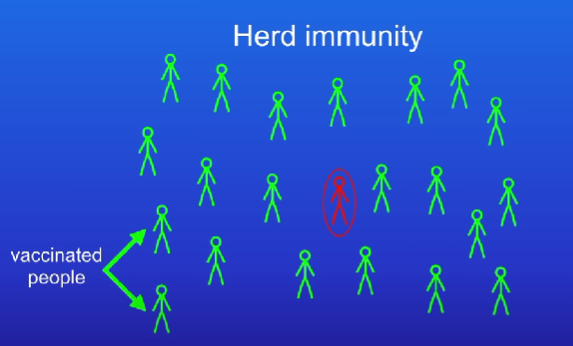
What are the pros of vaccinations? (2)
Control outbreaks of diseases such as epidemics
Leads to herd immunity
What are the cons of vaccinations? (2)
Don’t always lead to immunity
Can have bad reaction (rare)
What are painkillers (give example)? + What is their job?
Painkillers, such as aspirin, are drugs that relieve the pain and reduce symptoms (don’t actually kill the pathogen)
What are antibiotics (give example)? + What is their job?
Antibiotics, such as penicillin, kill or prevent the growth of the bacteria without causing harm to your cells
What do antibiotics not work on + why?
Viruses because viruses reproduce inside of cells and it would be hard to kill them without also damaging your cells
What happens when bacteria mutate?
They become resistant to antibiotics and can no longer be treated by antibiotics meaning they can cause serious infection
How would doctors slow the rate of development of resistive bacteria?
They avoid overprescribing antibiotics
Why is it important to finish the whole course of antibiotics?
Because antibiotics will kill the non resistant strain of bacteria but the resistant strain of bacteria will still be left + if you stop taking the antibiotics the left over bacteria will then reproduce and you will feel ill again
What is aspirin + how was it developed?
Aspirin is a painkiller + was developed from a chemical found in willows
What is Digitalis + how was it developed?
Digitalis is used to treat heart conditions + was developed from a chemical found in foxgloves
What is penicillin + how was it developed?
Penicillin is a drug that kills bacteria + was found by Alexander Fleming on a petri dish on which grew bacteria resistant mould now known as penicillin
What are the 5 stages of developing drugs? (5)
Preclinical testing (begins)
Preclinical testing (continue)
Clinical Trials
Double-blind trials
Peer review
What happens in the first stage of developing drugs (preclinical trials begin)?
Tests of the drug are done in a laboratory using cells and tissues
What happens in the second stage of developing drugs (preclinical trials continue)?
Tests of the drug are done on live animals to determine for toxicity (is it safe) + efficacy (does it work)
What happens in the third stage of developing drugs (Clinical trials)? (3)
Tests of the drug are done healthy volunteers and patients
Initially a small dose is given to see if there are any harmful side effects (when given to healthy people)
If the drug is found to be safe further trial are carried to find the optimum dose (the most effective with the least amount of side effects)
What happens in the fourth stage of developing drugs (Double-blind trials)? (3)
To see how well the drug works patients are put in 2 different groups
Half of them are given the real drug + the other half are given a placebo (fake drug)
This is to see if the drug actually works and isn’t in everyone’s head
Why are double-blind trials called that + why are they done? (2)
Because the doctor and the patients don’t know who was given a placebo or the real drug
This eliminates bias
What happens in the fifth stage of developing drugs (Peer review)?
Other scientists review the medicine + check for any mistakes
When new medicine is in use why is it monitored?
To see if there are any long term side effects
What type of white blood cell produces antibodies?
B-lymphocytes
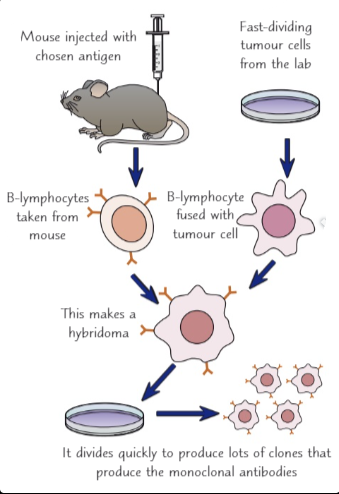
How are monoclonal antibodies produced? (6)
A mouse is injected with the chosen antigen
This triggers the B-lymphocytes (a type of white blood cell that produces antibodies) to be produced which will produce antibodies specific to the antigen
Then the B-lymphocytes are collected from the mouse
The B-lymphocytes produced won’t divide on their own so they are fused with a tumour cell to make a hybridoma + will divide rapidly
The hybridoma then divides rapidly
The antibodies will be collected and purified
What do pregnancy tests detect + where is this hormone found?
They detect the hormone HCG which is found in the urine of pregnant women
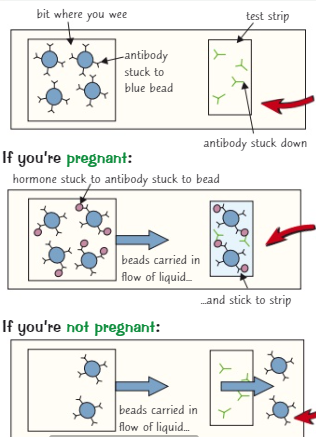
How are monoclonal antibodies used in pregnancy tests? (8)
On a pregnancy test, there is a bit of the stick where you wee on that has antibodies stuck into it with a blue head
The test strip (the bit which indicates you’re pregnant) has antibodies stuck onto it so they can’t move
If you’re pregnant, when you wee on the stick
the hormones bind to the blue antibodies
the urine moves up the stick + carrying the hormones + blue antibodies up
The blue antibodies bind with the antibodies stuck onto the stip
So it turns blue (or any other colour) indicating you’re pregnant
If you aren’t pregnant non of this happens because the blue antibodies didn’t have any hormones to bind with leading to no indication of pregnancy
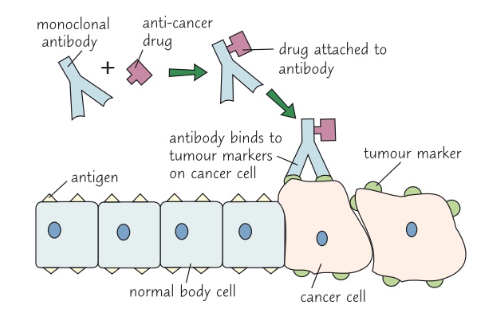
How are monoclonal antibodies used to treat cancer? (5)
Cancer cells have specific antigens called tumour makers
Monoclonal antibodies can be produced to bind specifically to tumour markers
An anti-cancer drug will be attached to these antibodies which may be a radioactive substance, a toxic drug or a chemical that stops cancer from growing + dividing
The antibodies are given to a patient via a drip
The drug attached to the antibodies will then attach to the tumour marker + this will kill the cancer cells but not normal body cells
How are monoclonal antibodies used to locate specific molecules in a cell or tissue? (3)
Monoclonal antibodies specific to the molecule will be made
Then they will be bound with fluorescent dye
If the molecule is present the monoclonal antibodies will attach to it and will be detected using dye
What are 2 other ways monoclonal antibodies can be used?
To bind to hormones + other chemicals to measure their levels
Test blood samples for specific pathogens
What side effects do monoclonal antibodies cause? (3)
Vomiting
Fever
Low blood pressure
What are the 2 main mineral ions plants need?
Nitrate ions
Magnesium ions
Why do plants need nitrate + what happens if they don’t get it?
Nitrate is needed to make proteins for growth + lack of nitrate causes stunted growth
Why do plants need magnesium ions + what happens if they don’t get it?
Magnesium ions are needed to make chlorophyll which absorbs sunlight for photosynthesis + a lack of magnesium ions causes chlorosis (causes plants to stop making photosynthesis) + yellow leaves
What are the 7 common signs of disease in a plant?
Stunted growth
Spots on leaves
Patches of decay
Abnormal growth (lumps)
Malformed stems or leaves
Discolouration
Pests
What 3 ways can plant diseases be identified by?
Looking it up in a garden manual or a gardening website
Taken to a lab where scientists identify the pathogen
Using test kits that identify the pathogens using monoclonal antibodies
What are the physical defences of a plant? (3)
Waxy cuticle → Barrier to stop pathogens from entering
Plant cells are surrounded by a cell wall made of cellulose
A layer of dead cells around their stems/barks → acts as a barrier to stop pathogens from entering
What are the mechanical defences of a plant? (3)
Have thorns + hairs → stops animals from touching + eating them
Leaves droop + curl when touched → prevent them from being eaten
Mimicry of other organisms → fools insects into not eating them
What are the chemical defences of a plant? (2)
Produce antibacterial chemicals → kill bacteria
Produce poison → deter herbivores