PROCEDURES SPECTS
 Call Kai
 Learn
Learn Practice Test
 Spaced Repetition
 Match
Match Flashcards
 Knowt Play
1/220

There's no tags or description
Looks like no tags are added yet.
Name | Mastery | Learn | Test | Matching | Spaced | Call with Kai | Chat |
|---|
No analytics yet
Send a link to your students to track their progress
221 Terms
How many lobes does the right lung have?
3
Which lung has 3 lobes?
Right
Aspiration is more likely to occur in which lung and why?
Right because it is wider, more vertical, and shorter
The level of trachea bifurcation is called the
carina
Which structure is located in front of the vertebrae and behind the nose and mouth?
Thyroid Cartilage
Carina
Larynx
Pharynx
Pharynx
T/F: 2 separate images may be taken for a chest x-ray. one on inspiration and one on expiration
True
What are the reasons for taking 2 chest images, one on inspiration and one on expiration?
demonstrates pneumothorax
see diaphragm movement
see foreign bodies
atelectasis
Define atelectasis
collapsed lung
Define pneumothorax
free air in the lungs
Where do you center for a PA chest?
Inferior angle of the scapula (T7)
Why do we want a patient standing for a chest x-ray? (2 reasons)
shows air-fluid levels
allows the diaphragm to reach its lowest position
What are the angles at the bottom of the lungs called?
costophrenic angles
T/F: you can do a PA axial lordotic
False (AP axial only)
How far out is the patient from the bucky in an AP axial lordotic position
about 1 foot
How many inches of light are required above the shoulders when doing an AP axial lordotic?
3 inches
Where do you center for an AP axial lordotic?
3-4 inches below the jugular notch at T7 (inferior angle of the scapula)
What is the goal of an AP axial lordotic?
to create a 15-20 degree angle to project the clavicles above the apecies of the lungs
How many degrees should the patient be arched for an AP axial lordotic?
15-20 degrees
How will the ribs appear on a lordotic?
flat and horizontal
What are the 4 body habitus?
Hypersthenic
Sthenic
Hposthenic
Asthenic
Which body habitus is higher and more horizontal?
hypersthenic
Which body habitus tends to look more narrow and lower
asthenic
To demonstrate fluid, what side should the patient be laying on
the affected side
What side should be marked on a lateral decub?
the side that is up
To demonstrate free air, what side should teh patient lay on?
the unaffected side
How do you find T7 from the front of the patient
3-4 inches below the jugular notch
If a patient has a pleural effusion in the left lung, which decubitus position should you put them in?
left lateral decub
How long does the patient have to be in the lateral decub position before the exposure is made?
5 min
T/F: the body needs to be elevated for a lateral decub
True
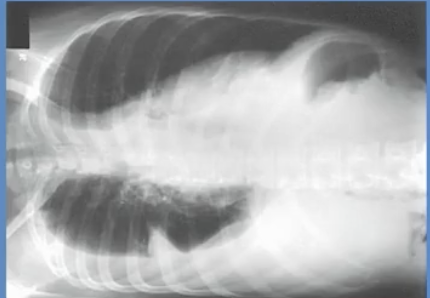
What is the position?
Right lateral decub
What side of the body is the stomach on?
left
Which two of the following are retroperitoneum?
rectum
kidneys
urinary bladder
pancreas
ovaries
spleen
kidneys and pancreas
Hypersthenic makes up what percentage of the population?
5%
Asthenic makes up what percentage of the population?
10%
Hyposthenic makes up what percentage of the population?
35%
The thoracic cavity is bounded together by bony walls comprised of what bones?
sternum and ribs
What separates the thoracic cavity from the abdominal cavity?
the diaphragm
What is known as the muscle of respiration
Diaphragm
As you inhale, what happens to the diaphragm?
it goes down
What separates the pleural cavities?
mediastinum
Which of the following are not found in the mediastinum?
heart
trachea
thyroid
esophagus
thyroid
What is the area called where structures pass through the diaphram?
esophageal hiatus
What are the 3 chambers of the thoracic cavity?
pericardial
left pleural
right pleural
What is the area called where the diaphragm and ribs meet?
costophrenic angle
What is know as the common passageway for food and air?
pharynx
A 16-20 C-shaped cartilaginous ring refers to what part of the respiratory system?
trachea
T/F: the trachea is always open
True
What is the hook like process on the last tracheal cartilage known as?
carina
What vertebral level does bifurcation occur?
T4 or T5
T/F: the trachea is anterior to the esophagus
True
If a patient is aspirating, what should you do?
roll the patient onto their left side
What is the smallest division of the bronchi?
bronchioles
List the subdivisions of the bronchial tree
primary bronchi
secondary bronchi
tertiary
bronchioles
terminal bronchioles
What is known as the functional unit of the lungs (parenchyma)?
Aveoli
What occurs at the alveoli?
deoxygenated blood turn to oxygenated blood through diffusion
The double membrane sack containing the lungs is known as the
pleural space
The outer lining that adheres to the respiratory cavity is called the
parietal
the inner lining adhered to the lungs is called the
visceral
Which lung has a cardiac notch on it?
left lung
The tongue-like process that sits below the cardiac notch is known as
lingula
How many fissures does the left lung have and what is it called?
1 - oblique fissue
How many fissures does the right lung have and what is it called?
2 - horizontal and oblique
what is known as the organ of respiration?
lungs
What is the most superior portion of the lungs called?
apex
What is the most inferior portion of the lungs called?
base
What is the opening on the medial border of the lungs where bronchi and great vessels enter or exit called?
hilum
T/F: lungs are a part of the mediastein?
False
T/F: the heart is anterior to the esophagus
True
Why is the right lung shorter than the left?
due to the liver
What is the method name for a lateral C-spine?
Grandy
What is the SID for a lateral c-spine?
72
T/F: the 1st apop joint can’t be seen on a lateral c-spine
Truen(must do the open mouth odontoid)
If the open mouth odontoid is done correctly, what should you see?
the denz in the shadow of the foramen magnum
What is the SID for an AP axial c-spine?
72 in
Where do you center for an AP axial c-spine?
thyroid cartilage (C4-C5)
How and where is the CR directed for an AP axial oblique c-spine?
15-20 degrees cephalic to the thyroid cartilage
How much is the patient obliqued for an AP axial c-spine
45-degrees
What side does and LPO oblique c-spine show?
right side
A fracture of C6-C7 is called what?
clay shovlers
How much is the patient obliqued for an AP oblique t-spine?
70 degrees
T/F: time indicators should always be used when images are taken at specifically timed intervals
True
T/F: a minimum of two projections 90-degrees from one another must always be taken
True
For proper visualization of joints, a minimum of how many views are required?
3 (AP, PA, lateral, and oblique)
Label the landmarks:
C1
C2-C3
C3-C4
C5
C7-T1
T1
T2-T3
T4-T5
T7
T9-T10
L2-L3
L4-L5
S1-S2
Coccyx
C1: mastoid tip
C2-C3: gonion
C3-C4: hyoid
C5: thyroid cartilage
C7-T1: vertebral prominence
T1: 2 in above the jugular notch
T2-T3: jugular notch
T4-T5: sternal angle
T7: inferior angle of the scapula
T9-T10: xiphoid process
L2-L3: costal margin
L4-L5: iliac crests
S1-S2: ASIS
Coccyx: pubic symphysis
How can involuntary motion be controlled?
using short exposure time
Heartbeat, peristalsis, spasms, chills, and pain are all examples of what type of motion
involuntary
Excitement, fear, and nervousness are all types of what type of motion?
voluntary
How is voluntary motion controlled?
communication
Techniques may have to be altered based on what factors?
age
pathological conditions
conditions on which the x-ray is being taken (mobile, cross-table, etc.)
body habitus
The diaghragm is seen highest in which body habitus?
hypersthenic
What is the most common body habitus?
sthenic
Which body habitus would have a long and narrow heart?
sthenic
Who has the ability to remove a c-collar?
physician
T/F: trauma settings should try to resemble routine projections as best as possible
True
T/F: all AP projections should be taken and then all lateral to avoid a lot of patient movement
True
T/F: inability of the patient to move and difficulty obtaining routine projections must never be used as an excuse to submit poor-quality images
True
This imaginary line passes vertically through the body dividing the left from the right
MSP
This imaginary line passes vertically through the midaxillary region and divides the body into anterior and posterior
MCP
This imaginary line passes crosswise through the body and divides the body into superior and inferior portions
Transverse
How many quadrants of the abdomen are there and what are they?
4 - LUQ, LLQ, RUQ, RLQ