OPP 18 Sacrum Dx Tx
 Call Kai
 Learn
Learn Practice Test
 Spaced Repetition
 Match
Match Flashcards
 Knowt Play
1/40

There's no tags or description
Looks like no tags are added yet.
Name | Mastery | Learn | Test | Matching | Spaced | Call with Kai | Chat |
|---|
No analytics yet
Send a link to your students to track their progress
41 Terms
Sacral osteology
lumbosacral facets
5 segments
lumbosacral junction
may contain transitional vertebra
lumbarization
sacralization
4 coccygeal segments
Sacralization
fusion of lumbar vertebrae into sacrum

Lumbarization
non-disjunction of sacral vertebrae into individual vertebrae

Ferguson’s angle
line of inclination of sacrum w line parallel to ground
sacroiliac joint is L-shaped + converges posteriorly
25-35 degrees

Psoas syndrome
tight + inflamed + spastic psoas major → pain
Meralgia paresthetica
compression of lateral femoral cutaneous n.
True pelvic ligaments
anterior sacroiliac
interosseous
posterior sacroiliac
Accessory ligaments
sacrotuberous
iliolumbar
sacrospinous
Sacral plexus significance
contains both motor + sensory innervation
Sacral parasympathtics levels
S2-S4
Ganglion impar
where right + left sympathetic chain joints + rest on the anterior surface of coccyx
Important landmarks for sacral dx
sacral sulcus
sacral foramina
inferior lateral angle (ILA)
ischial tuberosity
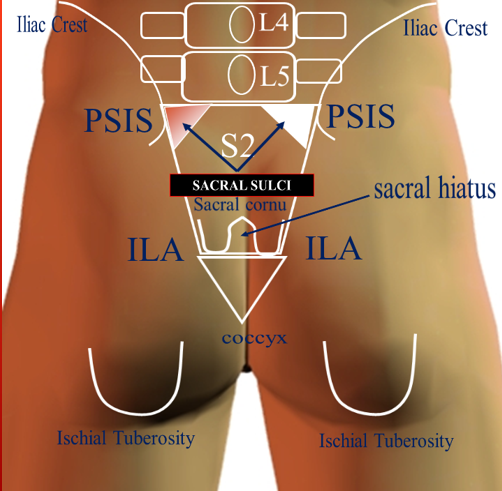
Sacral axis of rotation
Transverse axes
superior (3)
middle (4)
inferior (5)
Oblique axes
right (2)
left (6)

Superior transverse axis
located at S2
posterior to SI joint
respiratory + craniosacral motion:

Middle transverse axis (sacroiliac axis)
located at anterior convexity + S2 sacral body
postural flexion + extension
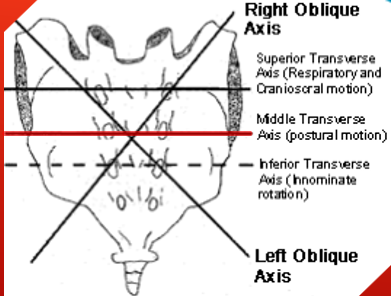
Inferior transverse axis
posterior inferior part of the inferior limb of SI joint
ilial (innominate) rotation
Sacral flexion
base of sacrum moves anterior for anatomic flexion
motion is about middle transverse axis
Oblique axes
right + left
named for superior start location
most likely a combination of side-bending + rotation
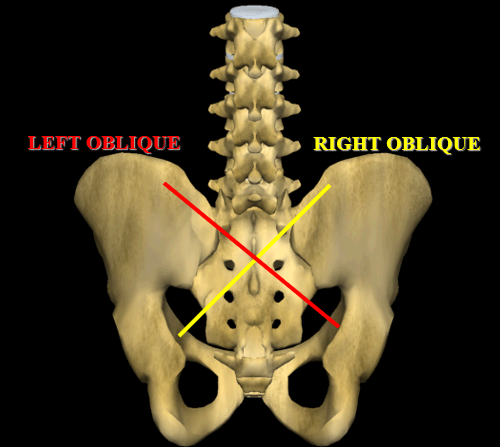
Sacral extension
base of sacrum moves posteriorly
movement about middle transverse axis
Sacral rotation
about vertical axis
more of a theoretical consideration
Side-bending
about A-P axis
Standing flexion test
pt shoulder width apart
palpate + hook under PSIS w thumb on pt
slowly bends forward
Results
pos → PSIS moves superiorly → iliosacral dysfunction
but if both seated + standing flexion tests are positive → fs sacroliliac dysfunction but possible iliosacral dysfunction
neg → PSIS moves symmetrically
Seated flexion test
pt seated
palpate + hook under PSIS w thumb on pt
pt slowly bends forward
Results
pos → PSIS moves superiorly → sacroiliac dysfunction
neg → PSIS moves symmetrically
Spring test
find sacral base
place hand over lumbosacral juction
apply rhythmic gentle + rapid downward pressure
Results
neg → good spring
nice + normal + negative
eg forward torsion + uni/bilateral flexion
pos → bad spring
posterior + painful + positive
eg backward torsion + uni/bilateral extension
Left on left torsion (left torsion about left oblique axis)
deep sulcus → R
seated flexion test → R
inferior/posterior ILA → L
sacrotuberous ligament taught → L
Spring test → neg

Right on right torsion (right torsion about right oblique axis)
deep sulcus → L
seated flexion test → L
inferior/posterior ILA → R
sacrotuberous ligament taught → R
Spring test → neg
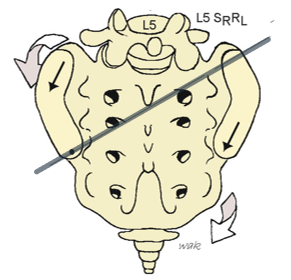
Forward sacral torsions (2)
left on left torsion
right on right torsion
Backward sacral torsions
left rotation on right axis
right rotation on left axix
Left on right torsion (left rotation on right oblique axis)
deep sulcus → R (shallow on left)
seated flexion test → L
inferior/posterior ILA → L
sacrotuberous ligament taught → L
Spring test → pos

Right on left torsion (right rotation on left oblique axis)
deep sulcus → L (shallow on right)
seated flexion test → R
inferior/posterior ILA → R
sacrotuberous ligament taught → R
Spring test → pos

Unilateral sacral flexion
left unilateral
right unilateral
Left unilateral sacral flexion
deep sulcus → L
inferior/posterior ILA → L
sacrotuberous ligament taught → L
seated flexion test → pos L
Right unilateral sacral flexion
deep sulcus → R
inferior/posterior ILA → R
sacrotuberous ligament taught → R
seated flexion test → pos R
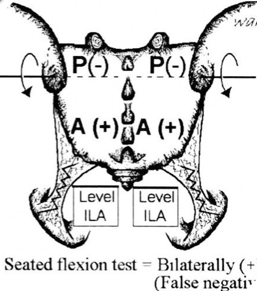
Bilateral flexion
Motion decreased bilaterally
sacrum flexes
but is restricted in extension
spring test → negative
seated flexion test → positive bilaterally
or false negative bc symmetrical

Bilateral extension
motion decreased bilaterally
sacrum extends
but is restricted in flexion
spring test → postive
Backward Bending test (sphinx test)
Motion about an oblique axis test
Motion about transverse axis test
pt laying prone
put hands over sacrum
first hand pointing cephalad
top hand pointing caudad
apply alternating pressure (rocking hands top and bottom)
assess quality of motion
Sacral rocking tx
Indications: Dysmenorrhea, Pelvic congestion syndrome, Sacroiliac dysfunction
Patient prone
Physician at either side
Place the heel of the cephalad hand on the base with the fingers pointing caudad (or cephalad with the other hand opposite)
Place the caudad hand in the opposite direction on top of the other hand
Exert a ventral force to engage the sacrum
Introduce a rocking motion to the sacrum synchronous with the patient’s respiration
Sacral extension (base moves posterior) – inhalation
Sacral flexion (base moves anterior) – exhalation
Continue for several minutes
Counterstrain sacral locations
Common causes of sacroiliac dysfunction (10)