EAns Promo
 Call Kai
 Learn
Learn Practice Test
 Spaced Repetition
 Match
Match Flashcards
 Knowt Play
1/9

There's no tags or description
Looks like no tags are added yet.
Name | Mastery | Learn | Test | Matching | Spaced | Call with Kai | Chat |
|---|
No analytics yet
Send a link to your students to track their progress
10 Terms
Tax rebate = subsidy
ANY AE
Overproduction
Initial and final WL
In each case, explain how the above events would have affected consumer expenditure
In each case = 2 diagrams (one for DD, one for SS factor) NOT the combined one
DOUBLE MAP (MUST have keywords = shortage, pressure, price increase, new eq as argued above)
Affordability = reduce price of goods (methods and eval?)
Transfer payments/vouchers = NOT allowed
Eval: Depends on how severe the rise in price is + how urgent the issue is + government economic priorities
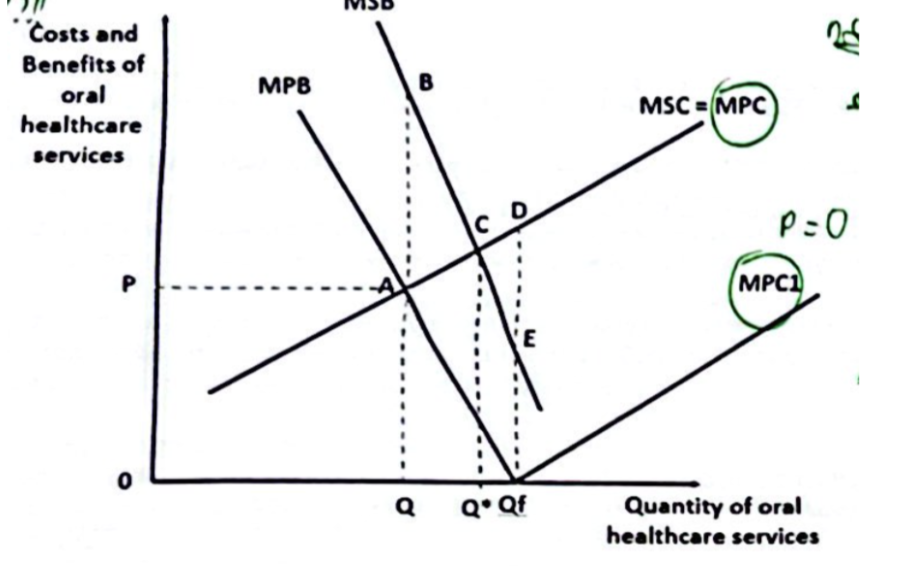
Consumer ignorance (Give EXAMPLE on what ignorance) (Eg. oral health)
For example, oral health checks would allow individuals to detect and treat oral illnesses earlier and save on healthcare costs in the future. However, since potential savings in oral healthcare are in the future, they are uncertain and difficult to estimate accurately -> individuals underestimate true MPB
Free provision (100% subsidy) + graph
MPC will fall and shift to MPC1 where it coincides with the MPB at P = 0
Where P = 0, output will increase from Q to Qf
New overconsumption
Assuming Qf closer to Q* than Q, new welfare loss less than original
Antithesis: why SG may not adopt Thailand’s approach
Opportunity cost
High fiscal cost
Strain on government budget -> raise taxes -> impacts efficiency, households
Measure not sustainable in long term
Missing: Explain market structure
Internal EOS -> lower unit cost and create a high MES -> potential entrants with small market shares and a lower scale of production cannot match cost efficiencies -> difficult to compete -> increase BOE -> few dominant firms
Extent to which consolidation of firms is beneficial for consumers and society
Label AC + AC can only intersect MC ONCE
(BENEFICIAL eg. + EVAL)
Example: Large capital expenditures on infrastructure such as cables and technology can be spread over a larger output -> lower unit cost
Eval: Lower prices and increase CS assumes that firms pass on their lower costs to consumers. But if they retain their cost savings as higher profits, then the above benefits will not be achieved. Firms may also decide to re-invest profits into innovation -> if it improves the welfare of consumers, it could still be beneficial in the long run for consumers
Extent to which consolidation of firms is beneficial for consumers and society
Label AC + AC can only intersect MC ONCE
(NOT BENEFICIAL)
Consumers: lower CS, fewer choices and worsened inequity (ALL 3)
Larger supernormal profits will exacerbate inequity -> as the gains go to shareholders of the firm while consumers bear the burden of higher prices
Fewer firms -> produce variety and consumer choice worsen as remaining firms may not provide the full range of services desired
Whether firms have high market power
High VS low market power
Consolidation of firms
Before VS after