Mission Ground Eval CI Hook GK CAO 14 Jan 2026
 Call Kai
 Learn
Learn Practice Test
 Spaced Repetition
 Match
Match Flashcards
 Knowt Play
1/23

There's no tags or description
Looks like no tags are added yet.
Name | Mastery | Learn | Test | Matching | Spaced | Call with Kai | Chat |
|---|
No analytics yet
Send a link to your students to track their progress
24 Terms
b. What is crew rest?
- Commanders and supervisors will ensure aircrew are provided a 12-hour rest opportunity prior to beginning the flight duty period. (T-3)
- Crew rest is free time and includes time for meals, transportation, and an opportunity for at least 8 hours of uninterrupted sleep.
- Crew rest cannot begin until after the completion of official duties.
- Crew rest is compulsory for aircrew
members prior to performing any duties involving aircraft operations and is a minimum of 12 non-duty hours before the flight duty period (FDP) begins
b. What if crew rest is interrupted? What's the exception?
- Aircrew members must inform the PIC or mission execution authority if not sufficiently rested for flight duties. (T-3)
- If crew rest is interrupted, individuals will immediately inform the PIC or mission execution authority and will either begin a new crew rest period or not perform flight duties. T-1)
-An interruption is any official business conducted after crew rest.
- Exception: PIC (or designee) may initiate mission-related communication with official agencies without interrupting crew rest.
b. What is offical business?
(AETC) "Official business" includes any digital communication (e.g., cellular phone, text message, communication application, scheduling application) used to contact aircrew
members. Aircrew members will consider crew rest interrupted due to any official digital
notification or alert (e.g., mandatory recall, schedule change, etc.) (T-3)
Exception: Aircrew members may voluntarily check official digital communications
b. Can crew rest be waived?
- The authority waiving the 12-hour crew rest period must ensure that the PIC is notified prior to beginning crew rest. (T-2)
- The PIC is not required to accept reduced crew rest, even if waiver has been granted by the appropriate waiver authority
b. Can crew rest be reduced?
- When three or more consecutive flight duty periods of at least 12 hours duration are scheduled, crew rest may be reduced by the PIC to a minimum of 10 hours in order to
maintain a 24-hour work/rest schedule. The 10-hour crew rest authorization is only used to keep crews in 24-hour clock cycles, not for scheduling convenience or additional sortie generation.
- (AETC) Aircrew members must have a minimum of 24 hours of crew rest following three (3) consecutive flight duty periods (FDPs) of 16 hours or more with minimum crew rest between flights. (T-3)
- (AETC) When the same crew will fly together on subsequent sorties, crew rest for multi-place aircraft will not begin sooner than when the last crewmember leaves after completing assigned official duties (T-3).
- Any reduction from 12-hour crew rest requires pre-coordination for transportation, meals, and quarters so that aircrew members are provided an opportunity for at least 8 hours of uninterrupted sleep.
b. What is the Flight Duty Period?
- Mission execution authority shall schedule FDPs in accordance with Table 3.1. (T-3)
- The FDP begins when an aircrew member first reports for official duty and ends at final
engine shutdown after the final flight of the completed mission.
- The PIC is authorized to extend FDP a maximum of 2 hours to compensate for unplanned mission delays.
- If official post-flight duties are anticipated to exceed 2 hours, consider reducing the FDP to ensure safe completion of those duties
- (Added-AETC) Students in a formal course of training must complete all training events in the first 12 hours of the FDP (T-3).
- (Added-AETC) Student training and continuation training sorties in T-6 and T-38 aircraft are limited to a maximum FDP of 10 hours when any portion of the training will occur
at night (T-2). Following an appropriate risk assessment, wing commanders (WG/CCs) (or as delegated) may authorize up to 12 hours on a case-by-case basis
c. Aircrew will not fly when:
- When appropriate crew rest was not obtained (T-3)
- If any alcohol was consumed within 12 hours prior to takeoff or if impaired by alcohol or any other intoxicating substance, to include the effects or after-effects. (T-1)
- Anytime a physical or psychological condition is suspected or known to be detrimental to the safe performance of flight duty. (T-1)
-While self-medicating unless cleared in accordance with paragraph 3.7.2.
- Within 72 hours after donating blood, plasma, or bone marrow. (T-1)
- Within 24 hours of compressed gas diving including SCUBA, surface supplied diving, aircraft pressurization checks exceeding 10 minutes in duration below sea level or
hyperbaric (compression) chamber exposure. (T-1)
- As an exception to paragraph 2.4.2.6, following helicopter emergency egress device system (HEEDS) training, aircrew may only fly if the aircraft's maximum altitude remains below 10,000 feet mean sea level (MSL). (T-1)
- As an exception to paragraph 2.4.2.6, Air Force divers on aeronautical orders will follow guidelines in accordance with SS521-AG-PRO-010, U.S. Navy Diving Manual for flying and diving restrictions. (T-0)
e. i. What weather is required to file IFR flight?
- Do not depart IFR unless the weather conditions at the destination, from 1 hour before to 1 hour after the estimated time of arrival (ETA), is forecast to be at or above the lowest
compatible published approach minimums. (T-1)
- For a straight-in or sidestep approach, the forecast weather must meet required visibility minimums. (T-1)
- For a circling approach, the forecast weather must meet both the ceiling and prevailing visibility minimums. (T-1)
e. ii. All legal airfield types and why
- MAJCOMs may authorize filing to or landing at civil airfields. Use of civil facilities not governed by agreement or law may result in landing and facility fees.
A. P coded
1. ATC volume training LOA list. Airports listed with a Fixed-Base Operator (FBO) on the AETC volume training LOA list are approved for remain overnight (RON). Note: WG/CCs may authorize RON at airports without an FBO listed). Aircrews may also fly instrument approaches to a low approach under IFR at P-coded civil airport not on the AETC volume training LOA list on a non-interference basis
2. In an emergency;
3. Flying a helicopter or C-coded aircraft (e.g., C-130, C-12, C-40);
4. Necessary in the recovery of active air defense interceptor aircraft;
5. An alternate is required and no other suitable airport is available;
6. The wing commander or higher authority approves the flight and the airport manager grants permission in advance; or,
7. A U.S. Government tenant unit (e.g., ANG, U.S. Coast Guard) is listed for the airport of intended landing and airport facilities or ground support equipment can support
the aircraft concerned.
B. Aircrew may file to and land at U.S. military and Joint- Use (e.g., MIL/CIV) fields. A joint use airport is defined as a military airport that authorizes civilian use (e.g., Charleston AFB). A joint use airport is not, by definition, a P-coded civil airport. A civil airport with a military or US Coast Guard tenant is a P-coded civil airport, not a joint use
airport. Flying unit commanders must approve fixed-wing aircraft operations from other than established landing surfaces (e.g., highways, pastures).
e. What is a P-coded airfield?
P-Coded Civil Airports—U.S. civil airport wherein permit covers use by transient military aircraft.
f. When MUST you file an alternate?
- A compatible instrument approach procedure is not available at the destination airfield. (T-0) [14 CFR Part 91.169]; or,
- Weather forecasts indicate, from 1 hour before to 1 hour after the estimated time of arrival at the destination airfield, including TEMPO conditions, are less than indicated below.
Note: Alternate requirement may be cancelled en route if weather conditions improve at destination to exceed these requirements:
1. A ceiling of 2,000 feet above the airfield elevation and a visibility of 3 statute miles [14 CFR Part 91.169]. (T-0)
2. Forecast crosswinds are outside aircraft limitations. (T-3)
3. (Added-AETC) When denial of accommodation to reduced vertical separation minimum (RVSM) airspace would prevent a non-RVSM compliant aircraft or flight from
reaching its planned destination
f. When SHOULD you file an alternate?
PIC discretion
- (Added-AETC) all compatible approaches require radar or GPS;
- (Added-AETC) required navigational aids will be unmonitored;
- (Added-AETC) the destination has no weather reporting capability;
- (Added-AETC) the airfield's lowest compatible approach weather minimums are greater than or equal to a 1,500 ft. ceiling or three (3) statute miles visibility
g. What DQs an alternate?
- Do not depart IFR unless the prevailing weather at the
alternate, from 1 hour before to 1 hour after the estimated time of arrival, including TEMPO conditions (except those caused by thunderstorms, rain showers, or snow showers), is forecast to be at or above a ceiling of 1000 feet, or 500 feet above the lowest compatible approach minimums, whichever is higher; and a visibility of 2 statute miles or 1 statute mile above the lowest compatible approach minimums, whichever is higher. (T-1)
- All compatible approaches require an unmonitored NAVAID. (T-1)
- The airfield does not report weather observations. (T-1)
- Alternate not authorized ( NA) on all compatible approaches. (T-1)
- Any note disqualifying the airfield or all compatible approaches in the " IFR Alternate Minimums" section. (T-1)
- (Added-AETC) Forecast winds exceed aircraft limits ±1 hour of estimated time of arrival (ETA) (T-2).
- (Added-AETC) Regardless of weather, access to RVSM airspace is required to reach the alternate for RVSM non-compliant aircraft (T-2)
- Pilots operating GNSS navigation systems with fault detection and exclusion (FDE) capability may file using a GNSS-based instrument approach at either the destination or the required alternate airfield, but not both. Note: If utilizing this provision, pilots must perform a preflight RAIM prediction at the airfield where the RNAV (GPS) or RNAV (GNSS) approach is planned, have proper knowledge, required training, and approval to conduct a GNSS-based
instrument approach.
g. Will it DQ an alternate if there is no compatible instrument procedure published or available at the alternate?
No if the weather forecast, from 1 hour before to 1 hour after the estimated time of arrival, including TEMPO conditions, permit a descent from the minimum en route altitude, approach and landing under basic VFR
h. FIH NORDO procedures
1. Exercise good judgement, don't be reluctant to use the emergency actions contained in the flying regulations
2. Sqawk 7600 on Mode 3/A
3. Listen to ATC on guard and frequencies on NAVAIDs
4. VMC - If able to maintain flight in VMC continue flight under VFR and land as soon as practicable and notify ATC
5. IMC - Route (in order)
a. By the route assigned in the last ATC clearance received;
b. If being radar vectored, by the direct route from the point of radio failure to the fix, route, or airway specified in the vector clearance;
c. In the absence of an assigned route, by the route that ATC has advised may be expected in a further clearance; or
d. In the absence of an assigned route or a route that ATC has advised may be expected in a further clearance, by the route filed in the flight plan
6. IMC - At the highest of the following altitudes or flight levels for the route segment being flown:
a. The altitude or flight level assigned in the last ATC clearance received;
b. The minimum altitude (converted, if appropriate, to minimum flight level) for IFR operations (see Section B, Altimeter Changeover Procedures); or
c. The altitude or flight level ATC has advised may be expected in a further clearance
i. i. IFR departure methods
1. Standard Instrument Departure (SID): simplify clearance delivery procedures and assist in meeting environmental, capacity, and ATC requirements.
2. ATC Instructions: include a heading and an altitude. Note: These instructions are not considered radar vectors. Do not apply wind drift corrections.
3. Diverse Departure: departure method for a runway if no obstacles, other than low close-in obstacles, penetrate the 40:1 OIS. ATC does not specifically clear pilots for a diverse departure nor can pilots file it on a flight plan
4. MAJCOM procedure: In restricted areas or during contingency operations, For specific aircraft at specific locations. MAJCOM training required
5. Obstacle Departure Procedure (ODP): procedure printed for pilot use in textual or graphic form to provide obstruction clearance
6. Omnidirctional departure [ICAO]: smilar to the FAA's diverse departure but may be published even with OIS penetrations.
7. Diverse Vector Area: radar vectors to be used in lieu of an ODP at some locations where an ODP has been established. No specific ground track
i. ii. ODP types
1. Reduced Takeoff Runway Length Procedure (RTRL): If all obstacles penetrate the OIS by 35 feet or less, can limit the takeoff runway length available to achieve a standard climb gradient of 200 feet per NM
2. Non-standard IFR takeoff minimums: provided for pilots to "see and avoid" obstacles during departure when obstacles penetrate the 40:1 OIS within 3 statute miles from the DER. Weather must be equal to or better than the published ceiling and visibility to depart using non-standard IFR takeoff minimums and climb at 200 feet/NM or higher if published.
3. Any combination of different ODPs
4. Visual Climb Over Airport (VCOA): operating in VMC equal to or greater than the specified visibility and ceiling, to visually conduct climbing turns over the airfield to the published "climb-to" altitude. Upon reaching this
altitude, the aircraft may proceed with the instrument portion of the departure. Must get ATC approval, cannot construct own VCOA, can't fly at night without MAJCOM approval, VCOA minimum ceiling is 250 feet above the highest obstacle in the visual climb area
5. Specific Routing: Specific routing to avoid obstacles under the "DEPARTURE PROCEDURE" section of the ODP
i. iii. Define and identify low-close in obstacles
Obstacles that require a climb gradient greater than 200 feet per nautical mile for a very short distance, only until the aircraft is 200 feet above the DER, are referred to as "low, close-in obstacles."
i. iv. Relationship between low-close in obstacles & ODPs
low-close in obstacles alone do not constitute an ODP
Published or ATC climb gradients do not account for low close-in obstacles. Therefore, low close-in obstacle clearance is not assured when complying with IFR climb gradients. Ensure the aircraft can vertically or laterally clear applicable published low close-in obstacles along the planned ground track.
i. v. IFR DER crossing heights
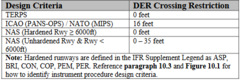
- For FAA and United States Army (USA) hardened runways greater than or equal to 6,000 feet, USAF, and United States Navy (USN) departure climb gradients begin at 0 feet above the DER elevation unless published otherwise.
- FAA and United States Army (USA) departure climb gradients for unhardened runways and runways less than 6,000 feet begin between 0 feet and 35 feet above the DER
elevation. There is no consistent method for a pilot to determine the required DER crossing restriction for these FAA or USA departure procedures
- The departure climb gradient begins at 0 feet above the DER elevation under current U.S. Terminal instrument procedures (TERPS) criteria; however, some procedures developed under older U.S. TERPS criteria for unhardened runways and runways shorter than 6,000 feet still have an
unpublished DER crossing restriction of 35 feet
- If in doubt, cross the DER at least 35 feet above the DER elevation, or if a 35 foot restriction limits mission capability, contact the MAJCOM TERPS office for the actual
DER crossing restriction
- the required obstacle clearance for all departures,
including diverse departures, is based on the pilot crossing the DER in accordance with Table 5.1 or at least 35 feet above the DER elevation, climbing to 400 feet above the DER elevation before making the initial turn, and maintaining a minimum climb gradient of 200 feet per nautical mile, unless required to level off by a crossing restriction, until the
minimum IFR altitude
j. i. TOLD Definitions
1. Max abort speed: Assumes 3s to recognize the issue and 3s to apply the brakes; speed may increase up to 20 knots
Max speed at which the takeoff can be aborted and stopped within the remaining runway length. When max abort speed is greater than rotate speed, rotate speed becomes abort speed. Max braking without skidding tires, hard runway, obsesrve max braking speed.
2. Takeoff distance (Flaps T/O): Ground run distance and obstacle clearance distance (up to 50') with the flaps set T/O. Take-off power, landing gear retracted after lift-off, dry, level, hard surface runway
3. Heavy Wight No-Flap landing distance: 3-deg approach to 50' at approach speed, idle power at 50', max braking without skidding tires, hard surface runway
j. iii. Declared Distances
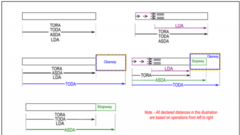
1. Takeoff run available (TORA) is the runway length declared available and suitable for the ground run of an airplane taking off. The TORA is typically the physical length of the
runway, but it may be shorter than the runway length if necessary to satisfy runway design standards
2. Takeoff distance available (TODA) is the takeoff run available plus the length of any remaining runway or clearway beyond the far end of the takeoff run available. Note: Pilots will not use TODA for takeoff performance calculations without specific MAJCOM authorization and training
3. Accelerate-stop distance available (ASDA) is the runway plus stopway length declared available and suitable for the acceleration and deceleration of an airplane aborting a takeoff. The ASDA may be longer than the physical length of the runway when a stopway has been designated available by the airfield operator, or it may be shorter than the physical length of the runway if necessary to use a portion of the runway to satisfy runway design standards
4. Landing distance available (LDA) is the runway length declared available and suitable for a landing airplane. The LDA may be less than the physical length of the runway or the length of the runway remaining beyond a displaced threshold if necessary to satisfy runway design standards; for example, where the airfield operator uses a portion of the runway to achieve the runway safety area requirements
k. Fuel Planning
- The PIC will ensure sufficient fuel is available onboard the aircraft to safely conduct the flight.
- Before takeoff or immediately after in-flight refueling, the aircraft must have enough usable fuel to complete the fligh to a final landing, either at the destination airport or alternate airport (if required), plus fuel reserves
- When an alternate airport is required, fuel required for an approach and missed approach at the intended destination must be included in the total flight plan fuel if visibility-only weather criteria is used at the destination. (T-1) Fuel required for a missed approach is not required if both ceiling and visibility criteria are used.
- Ensure the aircraft is carrying enough usable fuel on each flight to increase the total planned flight time between refueling points by 10 percent (up to a maximum of 45 minutes) or 20 minutes, whichever is greater.
- Reserve fuel burn: For turbine-powered aircraft use fuel consumption rates that provide best endurance at 10,000 feet MSL
l. Cold Weather Corrections
FIH D-18, 202v3 4.51
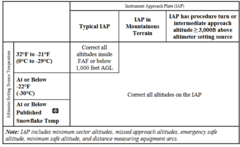
1. When departing from an aerodrome with a temperature of 32°F/0°C or less, aircrew will temperature correct all altitudes (including the 400 feet. above departure end of runway (DER)) to a temperature corrected minimum safe altitude
2. Do not apply a temperature correction to an ATC-assigned altitude. (T-0) Radar vectoring altitudes assigned by ATC may or may not be temperature compensated and should be queried or refused if obstacle clearance is in doubt
3. When flying over mountainous terrain when outside air temperature is colder than ISA minus 10° C, and aircraft unable to display true altitude, apply cold weather corrections to altitudes that are used to avoid terrain.
4. Pilots must advise ATC of the corrected altitude when applying altitude corrections on any approach segment with the exception of the final segment
5. Pilots must not make an altimeter change to accomplish an altitude correction
6. (Added-AETC) During low-level flights at locations where temperatures are 0° C or below, aircrews will adjust minimum safe altitudes, emergency safe altitude, night enroute, and NVD enroute altitudes in accordance with the Temperature Correction Chart and notify the controlling agency of the correction