StemUp: AQA A level Physics 3.7.2 Gravitational fields
 Call Kai
 Learn
Learn Practice Test
 Spaced Repetition
 Match
Match Flashcards
 Knowt Play
1/75

There's no tags or description
Looks like no tags are added yet.
Name | Mastery | Learn | Test | Matching | Spaced | Call with Kai | Chat |
|---|
No analytics yet
Send a link to your students to track their progress
76 Terms
What is gravity? (2)
- Gravity is a force that acts on any object with mass.
- It is always attractive.
When does an object experience gravity? (1)
Any object with mass experiences gravity when placed in the gravitational field of another object.
How do larger masses affect gravitational fields? (1)
Larger masses produce stronger gravitational fields that have a greater effect on other bodies.
What does Newton's law of gravitation state? (2)
- Newton's law of gravitation states that any two masses experience an attractive force directly proportional to the product of their masses.
- They also experience an inversely proportional force to the square of the distance between them.
What direction does the gravitational force act according to Newton's law? (2)
- Gravitational force acts along the line joining the centres of the two masses.
- It is always attractive.
What is the formula for gravitational force between two objects? (2)
- The formula for gravitational force is F = Gm₁m₂ / r².
- Where F is gravitational force (N), G is the gravitational constant (N·m²/kg²), m₁ and m₂ are the masses (kg), and r is the distance between their centres (m).
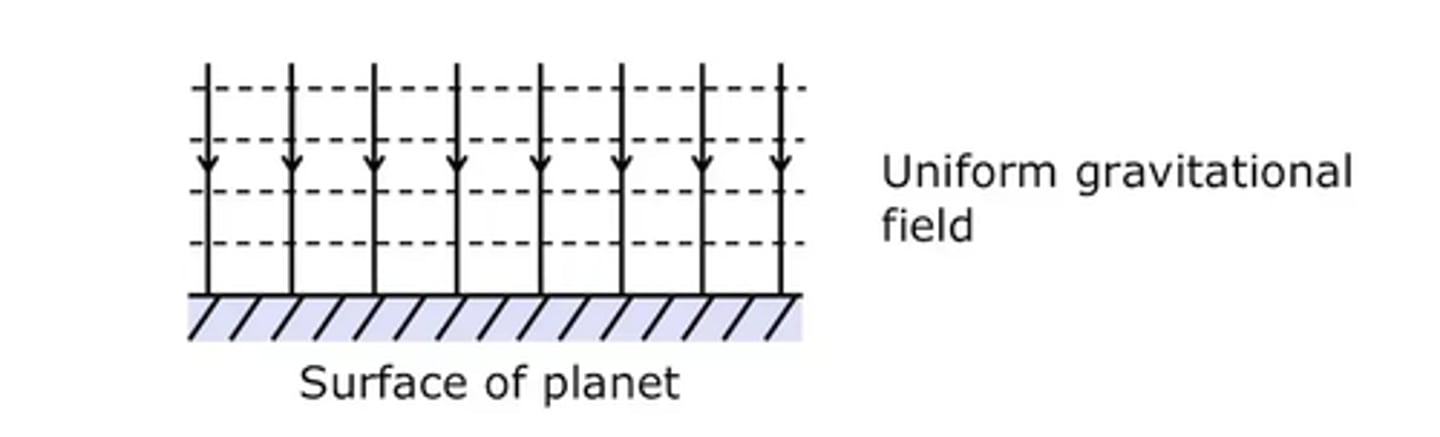
What is a uniform gravitational field? (1)
A uniform gravitational field applies the same gravitational force on a mass at every point in the field.
How are field lines arranged in a uniform gravitational field? (2)
- Field lines are parallel and equally spaced.
- This shows constant strength and direction.
What does a uniform gravitational field look like? (2)
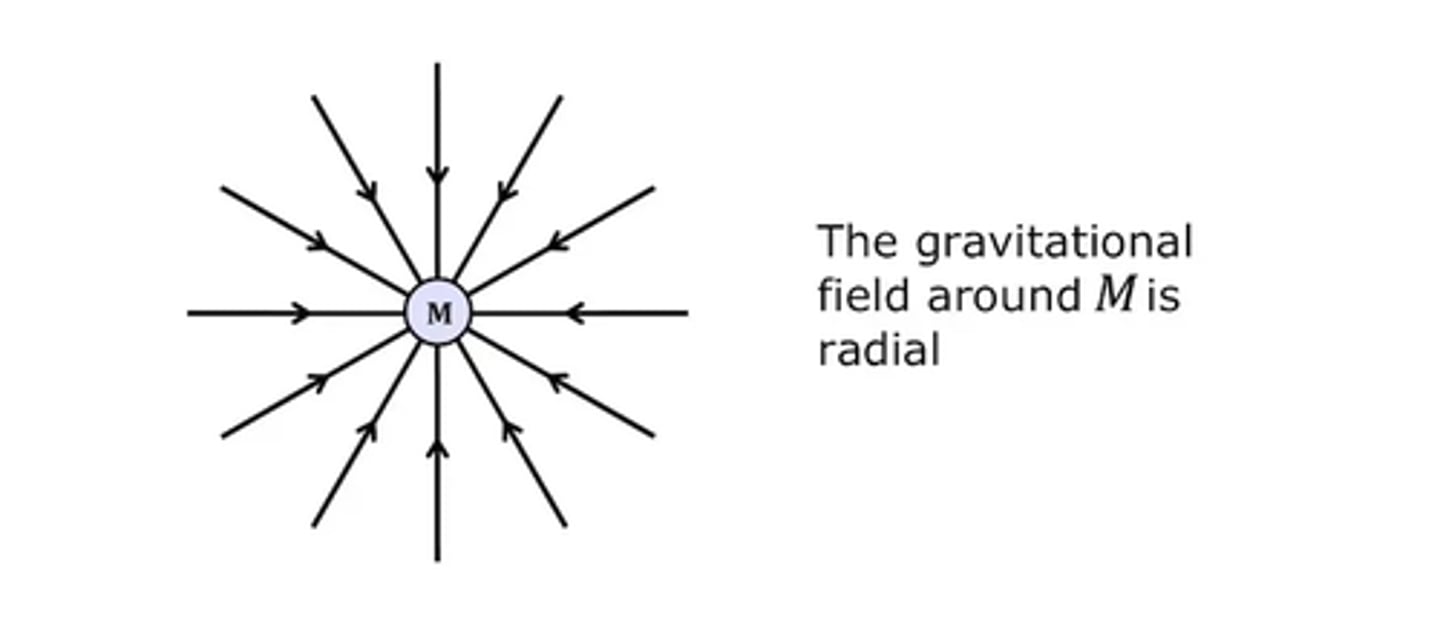
What is a radial gravitational field? (1)
A radial gravitational field applies a gravitational force that decreases with distance from the centre.
How are field lines arranged in a radial gravitational field? (2)
- Field lines spread out from the centre.
- Their spacing increases with distance.
What does a radial gravitational field look like? (2)
What kind of gravitational field does Earth have near its surface? (1)
almost uniform with parallel equally spaced lines.
What kind of gravitational field does Earth have far from its surface? (2)
- Far from the surface, Earth's gravitational field is radial.
- It is weaker with increasing distance.
What is gravitational field strength (g)? (1)
Gravitational field strength is the force per unit mass at a point in a gravitational field.
What is the value of gravitational field strength at Earth's surface? (1)
9.81 N/kg.
Which direction does gravitational field strength point in a field? (1)
Gravitational field strength is a vector that points towards the centre of the mass producing the field.
What does gravitational field strength represent in terms of motion? (1)
Gravitational field strength is the acceleration of a mass in a gravitational field (acceleration due to gravity).
How does gravitational field strength behave in a uniform field? (1)
Gravitational field strength remains constant throughout the field.
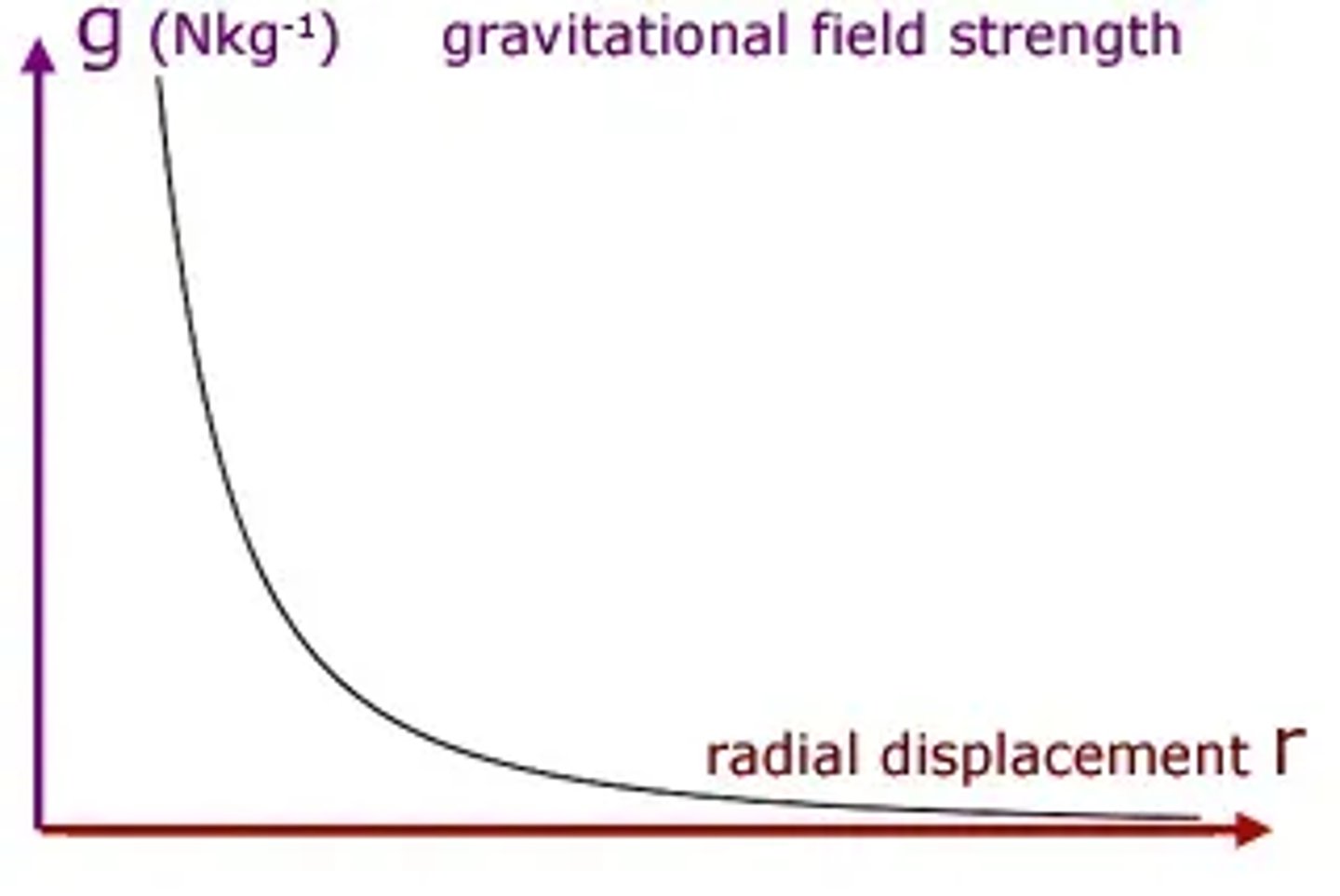
How does gravitational field strength behave in a radial field? (1)
Gravitational field strength decreases as the distance from the source increases.
What is the equation for gravitational field strength using force and mass? (2)
- The equation for gravitational field strength is g = F / m.
- Where g is gravitational field strength (N/kg), F is gravitational force (N), and m is mass (kg).
What is the equation for gravitational field strength in a radial field? (2)
- The equation for gravitational field strength in a radial field is
g= GM / r².
- Where g is field strength (N/kg), G is the gravitational constant, M is the mass producing the field (kg), and r is distance from the centre (m).
What does a graph of gravitational field strength against radius for the Earth look like? (2)
What is gravitational potential at a point? (1)
Gravitational potential is the work done per unit mass to move an object from infinity to a point in a gravitational field.
What is the gravitational potential at infinity? (1)
Gravitational potential at infinity is defined as zero.
How does gravitational potential behave in a radial field? (2)
- Gravitational potential in a radial field is always negative.
- It becomes less negative as distance from the mass increases.
What is the equation for gravitational potential in a radial field? (2)
- The equation for gravitational potential in a radial field is
V = -GM/r.
- Where V is gravitational potential (J/kg), G is the gravitational constant, M is the mass producing the field (kg), and r is distance from its centre (m).
Why is gravitational potential negative? (1)
Gravitational potential is negative because work must be done against the gravitational field to move an object out of it.
How is the equation for gravitational potential energy in a radial field obtained? (2)
- The equation for gravitational potential energy in a radial field is given by multiplying the gravitational potential equation by mass.
- E_p = m × V.
What is the equation for gravitational potential energy in a radial field? (2)
- The equation is E_p = -GMm / r.
- Where E_p is gravitational potential energy (J), G is the gravitational constant, M and m are the interacting masses (kg), and r is distance between them (m).
What is gravitational potential difference? (1)
Gravitational potential difference is the energy required to move a unit mass between two points in a gravitational field.
How is work done related to gravitational potential difference? (2)
- Work done = mΔV
- Where work done is energy transferred (J), m is mass (kg), and ΔV is change in potential (J/kg).
What are equipotential surfaces in a gravitational field? (1)
Equipotential surfaces are surfaces where the gravitational potential is the same at every point.
How much work is done moving along an equipotential surface? (2)
- No work is done moving along an equipotential surface.
- This is because there is no change in gravitational potential.
How does gravitational potential vary with distance in a radial field? (2)
- Gravitational potential is inversely proportional to distance.
- Given as V ∝ -1 / r.
What happens to gravitational potential as distance increases? (1)
Gravitational potential becomes less negative as distance increases.
How can a graph of gravitational potential against distance be described in a radial field? (1)
The curve becomes shallower as distance increases.
What does a graph of gravitational potential against distance look like in a radial field? (2)
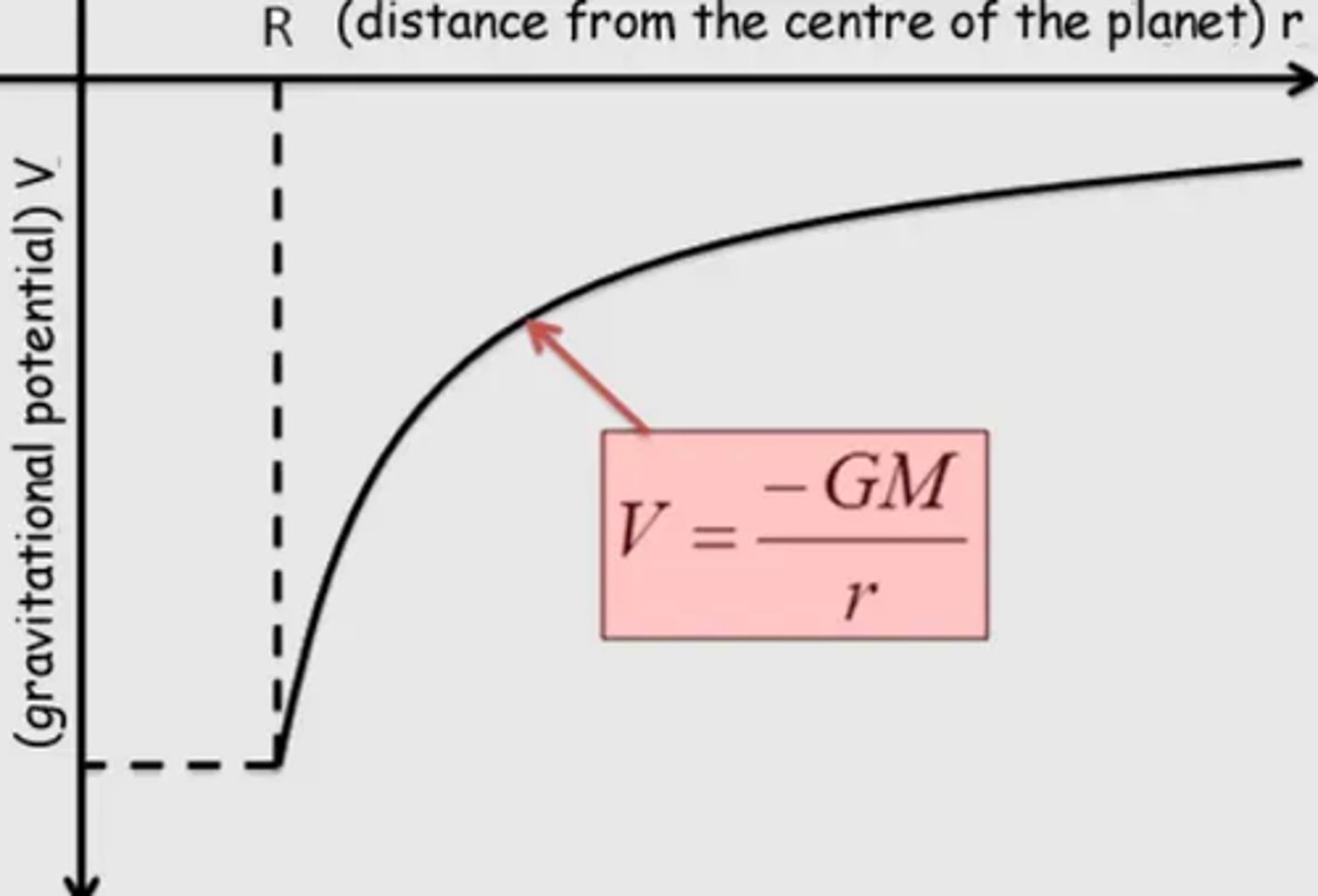
What does the gradient of a gravitational potential against distance graph represent? (1)
The gradient represents the magnitude of the gravitational field strength.
What is the equation to calculate gravitational field strength from gravitational potential? (2)
- The equation is g = -ΔV / Δr.
- Where g is gravitational field strength (N/kg), ΔV is change in potential (J/kg), and Δr is change in distance (m).
How do you derive the work done equation from gravitational field equations? (2)
- Start with g = -ΔV / Δr = F / m.
- Rearrange to give mΔV = -FΔr which is the work done.
How can gravitational potential difference be found from a gravitational field strength against distance graph? (1)
Gravitational potential difference is the area under the graph of gravitational field strength (g) versus distance (r).
What does the area under a gravitational field strength against distance graph represent? (1)
The area under the graph represents the energy per unit mass required to move between two points in the field.
What does Kepler's third law state? (1)
Kepler's third law states that the square of the orbital period (T²) is directly proportional to the cube of the radius (r³) of the orbit.
What is the logarithmic form of Kepler's third law? (1)
The logarithmic form of Kepler's third law is log(T) ∝ log(r).
What force acts on an object in orbit? (2)
- The object experiences a gravitational force towards the centre of the mass it orbits.
- This is the centripetal force of an object which gives circular motion.
How is Kepler's third law derived? (5)
- The gravitational force is set equal to the centripetal force:
mv² / r = GMm / r².
- Rearrange to find v squared:
v² = GM / r
v = 2πr / T (from circular motion), so v² = 4π²r² / T².
- Substitute v squared into the gravitational expression so:
4π²r² / T² = GM / r.
- Rearranging gives:
T² = (4π² / GM) × r³.
- Where T is orbital period (s), G is the gravitational constant, M is the central mass (kg), and r is orbital radius (m).
How is angular speed ω derived from centripetal and gravitational forces? (4)
- Equating mω²r = GMm / r².
- Cancel m and divide by r
ω² = GM / r³.
- Rearrange for angular speed
ω = √(GM / r³).
- Where ω is angular speed (rad/s), G is the gravitational constant, M is mass (kg), r is orbital radius (m).
What is the velocity equation for a satellite? (2)
- The equation is v = √(GM / r).
- Where v is satellite speed (m/s), G is the gravitational constant, M is the central mass (kg), r is the orbital radius (m).
What is the proportionality of satellite speed to radius? (1)
Speed is inversely proportional to the square root of the orbital radius.
What is the total energy of an orbiting satellite? (2)
- The total energy of an orbiting satellite is the sum of its kinetic energy and gravitational potential energy.
- Total energy = kinetic energy + potential energy.
Why does total energy stay constant in circular orbit? (1)
Total energy is constant because both speed and radius remain constant.
What happens to energy when a satellite moves to a lower orbit? (2)
- When a satellite moves to a lower orbit, gravitational potential energy decreases.
- Kinetic energy will increase.
What happens to energy when a satellite moves to a higher orbit? (2)
- When a satellite moves to a higher orbit, kinetic energy decreases.
- Gravitational potential energy will increase.
What is escape velocity? (1)
Escape velocity is the minimum velocity needed for an object to escape a gravitational field from the surface of a mass.
When does an object achieve escape velocity? (1)
An object achieves escape velocity when its kinetic energy equals the magnitude of its gravitational potential energy.
How do you derive the escape velocity from energy? (4)
- Set the kinetic energy equal to the gravitational potential energy so ½mv² = GMm / r.
- Rearrange for v squared so v² = 2GM / r.
- And so the escape velocity is v = √(2GM / r).
- Where v is escape velocity (m/s), G is the gravitational constant, M is mass (kg), and r is radius (m).
What is a synchronous orbit? (1)
A synchronous orbit is where the satellite's orbital period equals the rotational period of the body it orbits.
What is one example of a synchronous orbit? (1)
A satellite orbiting Earth with a 24-hour period.
What is the period of a geostationary satellite? (1)
24-hours
Where does a geostationary satellite orbit? (1)
A geostationary satellite orbits directly above the equator.
What is the angular speed of a geostationary satellite? (1)
The angular speed of a geostationary satellite matches the Earth's angular speed.
Why does a geostationary satellite stay above the same point on Earth? (2)
- A geostationary satellite stays above the same point on Earth because it orbits at the same angular speed.
- It also lies on the equatorial plane.
What are geostationary satellites used for? (1)
Geostationary satellites are ideal for communications and broadcasting.
Why are fixed transmitters suitable for geostationary satellites? (2)
- Fixed transmitters are suitable for geostationary satellites because they stay above the same point on Earth.
- This means that no repositioning is needed.
How do you calculate orbital radius for a geostationary satellite? (2)
- Use T² = (4π² / GM) × r³.
- Rearrange to r³ = GMT² / 4π².
What values are used in calculating geostationary orbital radius? (3)
- G = 6.67×10 ⁻ ¹¹ (Gravitational constant).
- M = 5.97×10²⁴ (mass of the earth).
- T = 86400 s (24 hours).
What is the result of the orbital radius calculation for a geostationary satellite? (2)
- The orbital radius calculation is
r = 4.2 × 10⁷ m.
- Which is 36,000 km above Earth's surface.
What is the equation to find orbital radius from orbital period? (2)
- The equation is r³ = GMT² / 4π².
- Where r is orbital radius (m), G is the gravitational constant, M is central mass (kg), and T is period (s).
How high above Earth are low-orbit satellites? (1)
Low-orbit satellites are between 180-2000 km above the Earth.
How do low-orbit satellites move compared to high-orbit ones? (2)
- Low-orbit satellites move faster.
- They have shorter orbital periods.
Why are low-orbit satellites cheaper to launch? (1)
Low-orbit satellites require less energy and lower-power transmitters.
What advantage do low-orbit satellites have in surface coverage? (2)
- Low-orbit satellites cover a new part of Earth.
- This allowing global scanning.
What is typical about the orbital planes of low-orbit satellites? (1)
The orbital planes of low-orbit satellites often include passes over the North and South Poles.
What are low-orbit satellites used for? (3)
- Weather monitoring.
- Scientific research.
- Surveillance.
Why may multiple low-orbit satellites be needed? (1)
Multiple low-orbit satellites may be needed to ensure continuous coverage due to their fast movement.