IB Biology HL A1.2 Nucleic Acids
 Call Kai
 Learn
Learn Practice Test
 Spaced Repetition
 Match
Match Flashcards
 Knowt Play
1/23

There's no tags or description
Looks like no tags are added yet.
Name | Mastery | Learn | Test | Matching | Spaced | Call with Kai |
|---|
No analytics yet
Send a link to your students to track their progress
24 Terms
What is the full name of DNA, and what is it?
Deoxyribonucleic acid, and it's the hereditary material in all living organisms. It contains genetic instructions for the function, development, and reproduction of organisms.
What are the building blocks of RNA and DNA called?
Nucleotides
What 3 parts are nucleotides made up of? What type of bonds are in between each part?
A pentose sugar with 5 carbons, Negativley charged phosphate, and a Nitrogenous base. Covalent Bonds
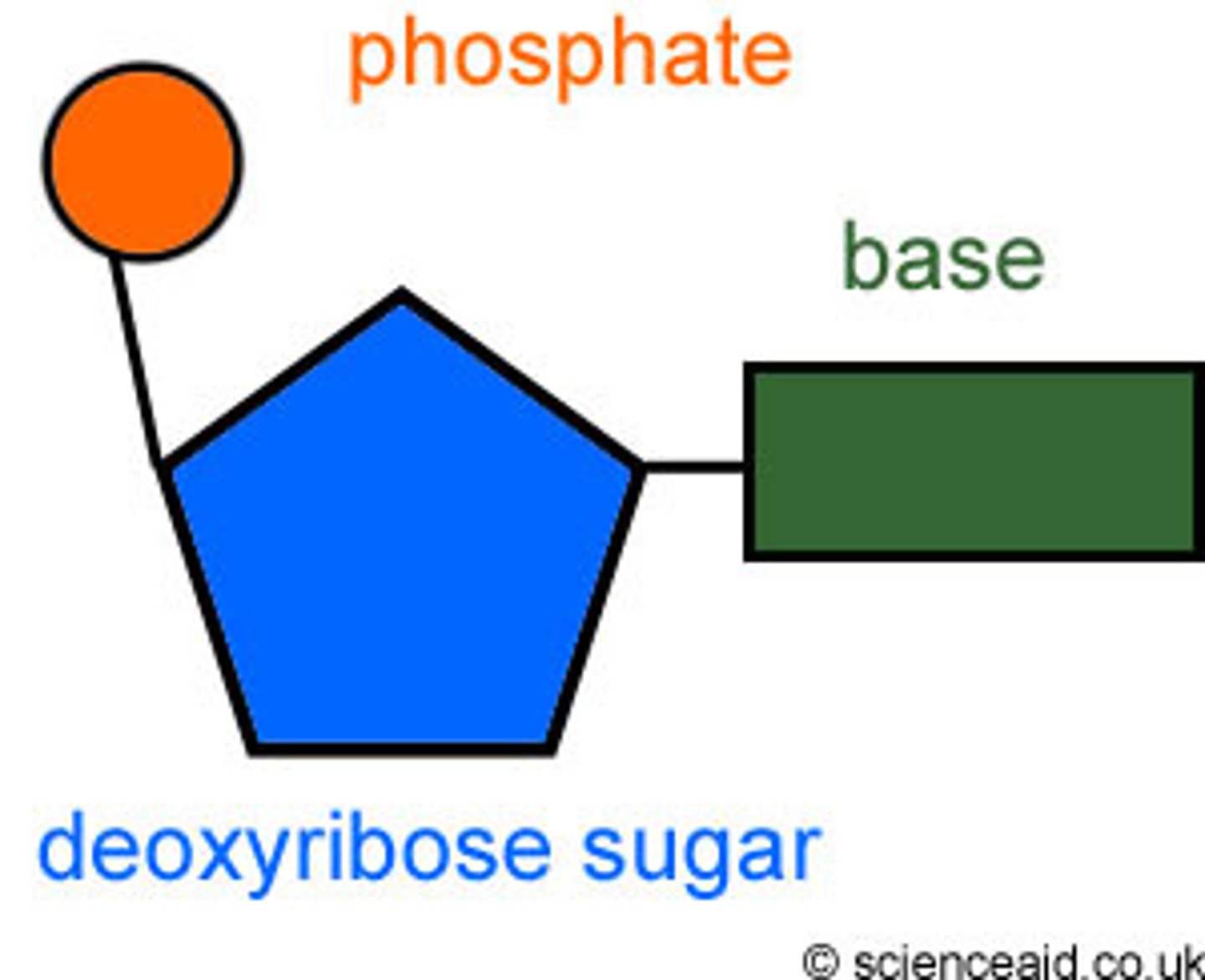
What helps create the continuous chain of nucleotides (polymer)?
Sugar-phosphate bonding forms a backbone.
What are the four bases of DNA correctly paired?
Adenine - Thymine, Cytosine - Guanine
What are the four bases of RNA correctly paired?
Adenine - Uracil, Cytosine - Guanine
Explain some traits of the bases.
The bonds between each of the bases to each other to create the double helix are weak hydrogen bonds. This is because the bases need to be able to easily attach or break apart when duplicating DNA.
What's a monomer vs. polymer?
A monomer is one molecule that can be bonded to other molecules to create a polymer, or a chain of monomers?
Explain condensation reaction.
When two monomer nucleotides want to to combine to form a polymer, the OH of the sugar and OH of the phosphate to combine leaving water on the outside and oxygen as the result.
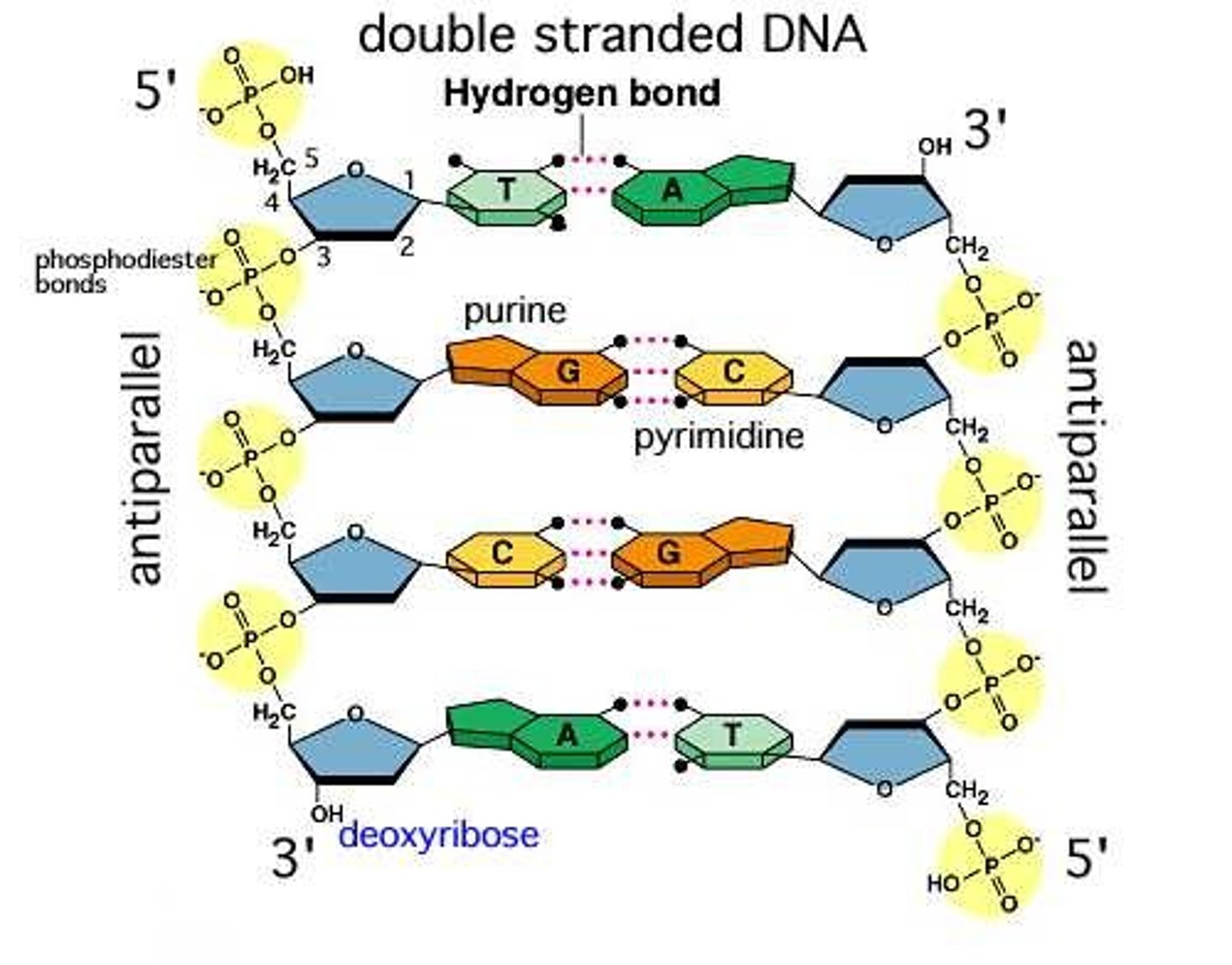
Explain helix traits of DNA.
DNA has a double helix and the two strands run anti-parallel from each other. One strand ends phosphate the other deoxyribose sugar.
Compare DNA to RNA (3)
1. DNA has 2 polymers making it a double helix while RNA has 1 polymer making it a single helix.
2. DNA has A, T, C, G as its bases while RNA has A, U, C, G
3. DNA's sugar is deoxyribose sugar while RNA's is ribose sugar.
What is the term for "adenine only pairing with thymine".
Complementary base pairing
Explain how DNA's structure affects its replication.
Complementary base pairing allows DNA to replicate because one strand of DNA will serve as a guide because the same bases will pair up with its partner. DNA replication is semi-conservative.
Is there a limit to the DNA configurations?
No, there are over a million possibilities for the configurations of the 4 bases. 4^n.
What direction are the carbons numbered in a pentose sugar?
Clockwise starting to the right.
What are the labeled carbons referred to as?
1 prime, 2 prime, etc.
What direction does DNA replication occur?
5' to 3'
What are pyrimidines?
Pyrimidine bases are cytosine and thymine because they only have one ring of atoms.
What are purines?
Purine bases are adenine and guanine because they have two rings of atoms.
How do purines and pyrimidines affect DNA's structure?
DNA has a stable double helix structure because the sizes of the bases are always equal throughout. A double ring is always paired with a single ring making the structure stable.
Explain the structure of a nucleosome.
A nucleosome is the way DNA is organized in eukaryote cells. A strand of DNA is wrapped twice around eight histone proteins. This "bead" is sealed by additional H1 histone protein. All other DNA connecting the bead together are called linker DNA.
What's the Hershey-Chase experiment question?
Hershey and Chase were wondering what genetic material was, proteins or DNA?
Explain the Hershey-Chase experiment
1. They used a bacteriophage virus, a simple "organism" that could transfer hereditary material to create more copies of itself
2. DNA only has phosphate and Protein only has sulfur so they added radioactivity to the phosphate and sulfur so they could track where radioactivity was measured.
3. They let the viruses infect other bacteria.
4. They took the infected bacteria and blended it to separate the virus from the bacteria.
5. They centrifuged it allowing a pellet of infected bacteria and a supernatant of virus on top. (the dense bacteria sunk)
6. They found radioactivity in the supernatant for the radioactive sulfur/protein meaning that the virus didn't transfer the protein.
7. They found radioactivity in the pellet for the radioactive phosphate/DNA meaning that DNA was what was transferred. This makes DNA the hereditary material.
Explain Chagraff's Data.
Scientists believed that there was a repeating sequence of bases known as the tetranucleotide hypothesis; four nucleotides occurred in equal numbers. Chagraff proved this was false because there were similar amounts of the complementary base pairs that matched each other in a variety of organisms.