Anatomy and Physiology of the Fallopian Tubes
 Call Kai
 Learn
Learn Practice Test
 Spaced Repetition
 Match
Match Flashcards
 Knowt Play
1/20

There's no tags or description
Looks like no tags are added yet.
Name | Mastery | Learn | Test | Matching | Spaced | Call with Kai | Chat |
|---|
No analytics yet
Send a link to your students to track their progress
21 Terms
The fallopian tubes may be referred to as —
oviducts, uterine tubes, or salpinges
The primary purpose of the fallopian tube is to provide an area for
fertilization (conception) to occur and to offer a means of transportation for the products of conception to reach the uterine cavity
The fallopian tubes consist of three layers: —
the outer serosa, middle muscular layer, and inner mucosal layer
Because the tube experiences peristalsis, within its lumen, small, hairlike structures referred to as — shift, thereby offering a mechanism for the transportation of the fertilized ovum
cilia
The — paired fallopian tubes extend from the cornu of the uterus, travel within the broad ligaments, and are composed of five parts
7- to 12-cm
the proximal segment of the fallopian tube is located —
closest to the uterus
the most distal part of the fallopian tube is within the
adnexa or closer toward the ovary
Within the cornu of the uterus lies the intramural extension of the fallopian tube known as the
interstitial segment
—, which literally means bridge, is a short and narrow segment of the tube connecting the interstitial area to the ampulla
The isthmus
The ampulla is the
longest and most tortuous segment of the tube
the ampulla is a significant portion of the tube because it is the location of —
fertilization and the area where ectopic pregnancies often embed
The distal portion of the tube is termed the —, which provides an opening to the peritoneal cavity within the pelvis
infundibulum
The fingerlike projections that extend from the infundibulum are the —
fimbria
The primary role of the fimbria is to draw the —
unfertilized egg into the tube
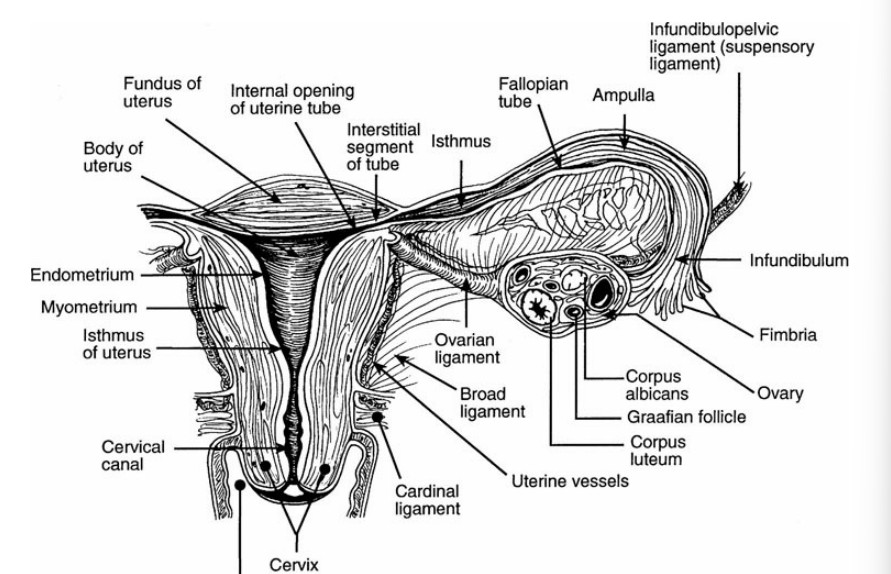
Fallopian tube anatomy.
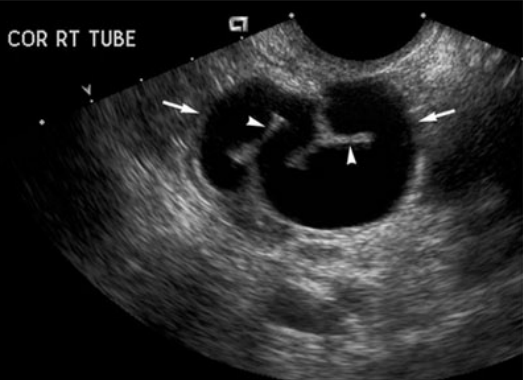
Hydrosalpinx. Coronal image of a dilated right fallopian tube (between arrows) filled with anechoic fluid. Note the folds (arrowheads) of the tortuous tube.
Cancer of the fallopian tubes is rare and is typically in the form of —.
adenocarcinoma
The sonographic appearance of fallopian tube carcinoma is that of a
solid mass within the adnexa
Simple serous fluid within the tube is termed —
hydrosalpinx
The fallopian tubes may also become inflamed due to infection, which is termed —, a common issue caused by pelvic inflammatory disease.
salpingitis
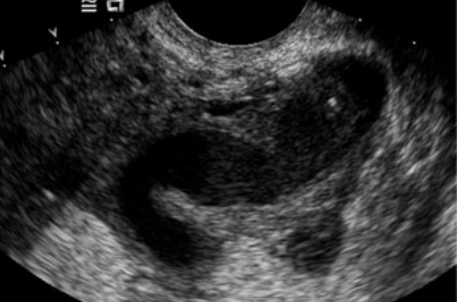
Pyosalpinx. Echogenic debris or pus is noted within this dilated and inflamed fallopian tube.