Newton's Laws
 Call Kai
 Learn
Learn Practice Test
 Spaced Repetition
 Match
Match Flashcards
 Knowt Play
1/11

There's no tags or description
Looks like no tags are added yet.
Name | Mastery | Learn | Test | Matching | Spaced | Call with Kai | Chat |
|---|
No analytics yet
Send a link to your students to track their progress
12 Terms
Newton’s 1st law
The velocity of an object will not change unless a resultant force acts on it
If forces aren’t balanced on an object, what happens
The object accelerates
Newton’s 2nd law
Acceleration is proportional to the force
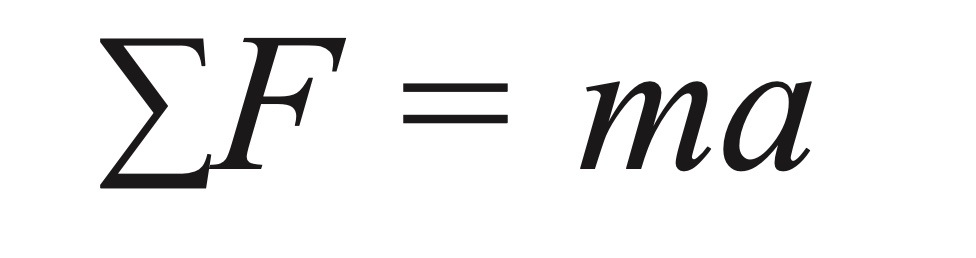
Newton’s Second Law equation
ΣF = ma
What happens if you apply more force to an object
It will accelerate more
For a given force, increasing mass means what
Less acceleration
What does ΣF mean
Vector sum of all forces (resultant force)
Which direction does acceleration due to Newton’s second law occur
In the same direction as the resultant force
Explain how Newton’s 1st and 2nd Law are related
When ΣF=0, for any object with a mass acceleration must = 0, so an object with no resultant force will have a constant velocity
Galileo’s law of falling bodies
All objects fall at the same rate if you ignore air resistance
Ignoring air resistance, explain which object falls faster- a heavy ball, or a light ball
Neither- weight (W=mg) is the only force acting on the balls, so for each mg = ma
The m cancels out, so a = g for both balls so a = a
Newton’s 3rd Law
If an object A exerts a force on object B, then object B exerts an equal but opposite force on object A