L12-Diagenesis
 Call Kai
 Learn
Learn Practice Test
 Spaced Repetition
 Match
Match Flashcards
 Knowt Play
1/53

Earn XP
Description and Tags
Discusses sandstone, mudstone, and carbonate diagenesis processes and zones in both terrestrial and marine environments.
Name | Mastery | Learn | Test | Matching | Spaced | Call with Kai | Chat |
|---|
No analytics yet
Send a link to your students to track their progress
54 Terms
What is Diagenesis?
Any chemical, physical, biological change after deposition. Which DOES NOT include weathering and metamorphism.
Where do Diagenetic processes occur in terms of temperature and pressure?
These processes occur at relatively low temperatures and pressures and cause changes in minerology and texture.
What is the boundary between Diagenesis and Metamorphism?
It is not clearly defined
What is authigenesis?
When new minerals grow.
In broad terms, how does diagenesis occur?
Occurs when sediments are compacted when buried. Some mineral recrystallize or dissolve. Authigenesis occurs (new minerals form). Cementation occurs from minerals that ppt from solutions moving through pore spaces.
Compaction → Recrystallization → Dissolution → Authigenesis → Cementation
What is porosity?
The spaces within the rock.
What is Permeability?
The interconnectedness of pores. this is expressed with “K”
How does porosity change during diagenesis?
Porosity decreases during diagenesis due to the ppt of minerals from solutions.
What is one important reason for understanding diagenesis?
It’s important to understand the various processes that convert organic material in sediments to oil and gas.
What are the two terrestrial zones of diagenesis?
Vandose Zone
Phreatic Zone
Where is the Vandose Zone?
It is the position at which the groundwater(water in the sediment pores) is at atmospheric pressure. Vandose is Latin for “shallow“.
Where is the Phreatic Zone?
This is the zone of saturation, which is below the water table where pores and fractures are saturated with water. Note that this zone may fluctuate during wet and dry periods.
What are the steps for sandstone diagenesis?
In the Vandose Zone
Clay infiltration
Minerals solution (unstable components degrade)
Growth of Authigenic Minerals
Diagenetic reddening of sediments (infiltration of hematite)
In the Phreatic Zone
Continued alteration and dissolution of grains
Mechanical Compaction of framework grains
Growth of cement
How does clay infiltration occur?
Clay is carried in by pore waters that run through the rock.
What does clay infiltration change?
Changes the porosity and permeability of the sandstone. At this step we can have a change from arenite to wackestone (more matrix).
What minerals are more susceptible to to being converted to mineral solutions?
Unstable components such as pyroxene, amphiboles, and plagioclase. they may degrade and become pitted or etched.
What are the most common minerals to grow during sandstone Anthogenesis?
Illite and Kaolinite. These are two separate types of clays
What could a lack of clays at the contacts between Sandstone grains suggest?
Indicates that they were not deposited with the sandstone but grew after the deposition of the sandstone.
How can red rims of hematite form?
Occur primarily as a depositional feature in desert sands and also occur during diagenesis.
How does Diagenetic reddening of sediments occur?
Occurs when hematite being washed in the sediment following deposition or from altercation/ dissolution of unstable minerals within the sediment that lead to the release of iron and the formation of diagenetic hematite.
How can you distinguish Diagenetic hematite from primary hematite rims?
The absence of hematite at grain contacts in the case of diagenetic hematite.
What is Pressure Solution or pressure dissolution?
Dissolution of minerals at grain to grain contacts into an aqueous pore fluid. This releases silica into pore fluid which can then be re-precipitated as silica cement.
What are the sources of silica in the Phreatic Zone?
Pressure dissolution, silica dust, and silicate minerals undergoing dissolution.
How are Silica cements displayed?
Silica is often displayed as quartz overgrowths in optical continuity.
When can Calcite form in cement?
Calcite can ppt in both EARLY and LATE. Early cements form very soon after deposition. Early ppt can inhibit the growth of quartz cement.
How does Calcite form in late cements?
Late calcite cements form from the release of ions during mineral dissolution in later diagenesis.
What are the Zones in Marine mudstone diagenesis (both by numbers and what occurs) and their associated depths?
Zone 1 (0-0.5m): Oxidation of organics by aerobic bacteria forming CO2
Zone 2 (0.5-10m): Zone of Bacterial sulfate reduction.
Zone 3 (10-1000m): Zone of Organic Fermentation
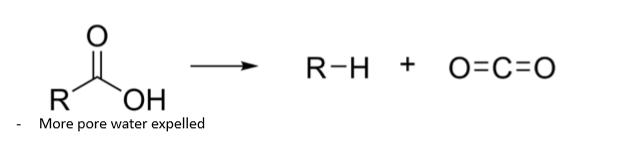
Zone 4 (1-2.5km): Decarboxylation (Breakdown of remaining organic matter)
Zone 5 (2.5-7km): Zone of Hydrocarbon Generation
Zone 6 (>7km): Zone of Metamorphism
What is one of the most important economic processes that is covered in this class?
The diagenesis of organically rich mudstones.
What are some features of Zone 1 of Mudstone diagenesis? What are the depths?
Depth of 0-0.5m
Features:
Pore waters are oxic
Porosity is around 80%
organic matter is oxidized by bacteria to produce CO2
Bioturbation (allows to keep oxic)
What are some processes of Zone 2 of Mudstone diagenesis? What are the depths?
Depths: 0.5-10m
Features:
Bacterial sulfate reduction (SO4 → S generally by Desulphovibro Vulgaris)
Sulfate (SO4) comes from marine water
Sulfer reacts with Iron to produce pyrite
CO2 from reduction may form calcite concretions
What are some processes of Zone 3 of Mudstone diagenesis? What are the depths?
Depths: 10m-1km
Features:
All sulfate is reduced therefore, pyrite and calcite production stops
Organic fermentation occurs (Free Fe is available to react with CO2 to form Siderite (FeCO3))
Further compaction expells pore waters and density of sediment increases.

What are some processes of Zone 4 of Mudstone diagenesis? What are the depths?
Depths: 1-2.5km
Processes:
Remaining organic matter is broken down further by decarboxylation
Pore Water continues to expel
What are some processes of Zone 5 of Mudstone diagenesis? What are the depths?
Depths:2.5-7km
Processes:
Zone of Hydrocarbon Generation (about 70-90 degrees Celsius). The remaining organic matter (called Kerogen) is “cracked“ generating petroleum
Breakdown of unstable mineral components releases H2O (Bound water to clay minerals)
Released H2O “migrates“ carrying SiO2 Mg2+,Fe2+, and any generated petroleum
As Temp. increases Gas rather than liquid petroleum is produced
What are some processes of Zone 5 of Mudstone diagenesis? What are the depths?
Depths: >7km
Processes:
Zone of metamorphism
illite → Sericite → Muscovite (at 300 degrees Celsius)
Kaolinite → Dickite/ Nacrite → Chlorite (at 200 degrees Celsius)
What happens if Mudstone Diagenesis is Marine?
freshwater = no sulfate; therefore, skips sulfate reducing steps and goes rapidly into bacterial fermentation.
CO2 produced reacts with Fe in the groundwater to produce siderite (FeCO3)
Where is the place that has exceptional fossil preservation? An example of non-Marine Diagenesis.
The Mazon Creek fossil beds in illinois. Represent the freshwater delta system. Siderite concretions grew around dead organisms in the sediment, allowing soft and hard tissues of animals and plants.
What are the Major processes in Carbonate Diagenesis?
Cementation: factors CO2,Mg/Ca ratio, CO3 supply
Neomorphism: Aggrading and calcitization
Dissolution
Compaction
Dolomitization: conversion of CaCO3 → CaMg(CO3)2
What are the main factors of cementation?
The Mineralogy of the cement in carbonates depends on a number of factors including amount of dissolved CO2 in the pore waters, the Mg/Ca ratio, and the supply of carbonate.
What is Neomorphism?
The “new growth“ or recrystallization processes.
What are two important processes of Neomorphism?
Aggrading Neomorphism
Calcitization
What is aggrading Neomorphism?
When fine grained micrite is recrystallized into slightly coarser sparite.
What is calcitization?
Where aragonite is recrystallized into more stable calcite. Often with a loss of internal detail in the case of shell material.
What is dissolution? What is it commonly associated with?
In the meteoric zone and is generally caused by slightly acidic groundwater preferentially dissolving cracks in the bedrock. Can be accompanied with cementation where pores present from dissolution are rapidly filled with cement.
What is dolomitization?
The conversion of calcite into dolomite soon after deposition.
What conditions does Dolomization prefer?
High ratios of Mg/Ca
high temperatures
What is the process of dolomization called?
Penecontemporaneous
What are the names of the dolomization models? (There are 5)
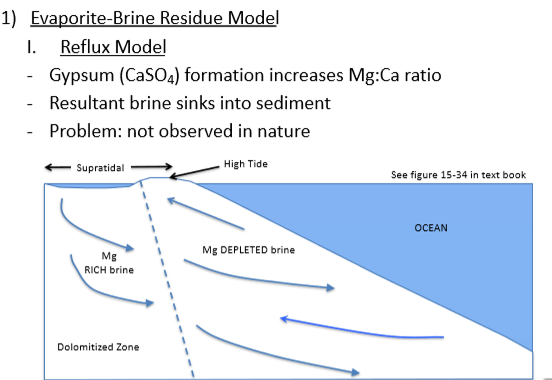
Evaporite-Brine Residue Model (reflux model)
Evaporite pumping
Groundwater mixing model
Sea water model
Deep burial
Explain the brine residue model (reflux model)
Sea water close to shore evaporates causing the ppt of gypsum (CaSO4). Removal of Ca from water concentrates Mg. Brine then sinks into the sediment, creating dolomite as it moves down into the limestone.
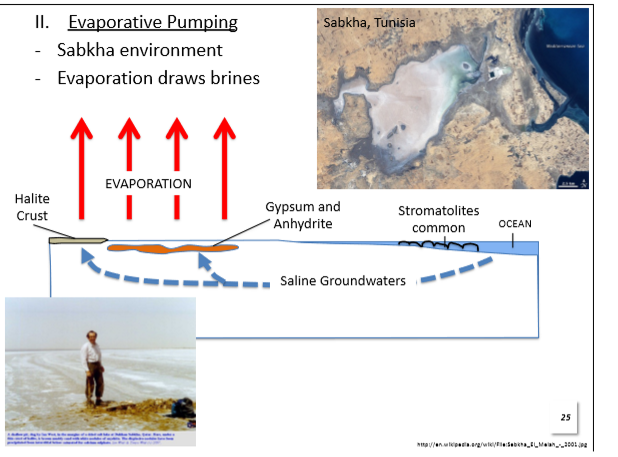
Explain the Evaporite pumping model
Intense evaporation draws saline out of the ground water through the limestone causing the ppt of gypsum and increases the concentration of Mg compared to Ca which allows for the formation of dolomite.
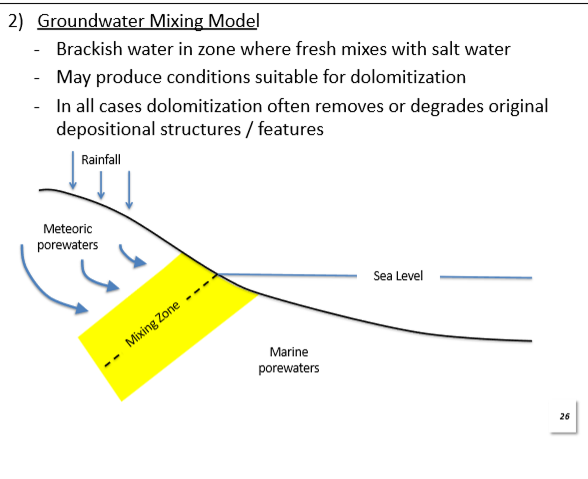
Explain the groundwater Mixing Model
Freshwater is mixed with up to 30% marine water and brakish groundwater is produced. May be conductive to the production of dolomite within the mixing zone.
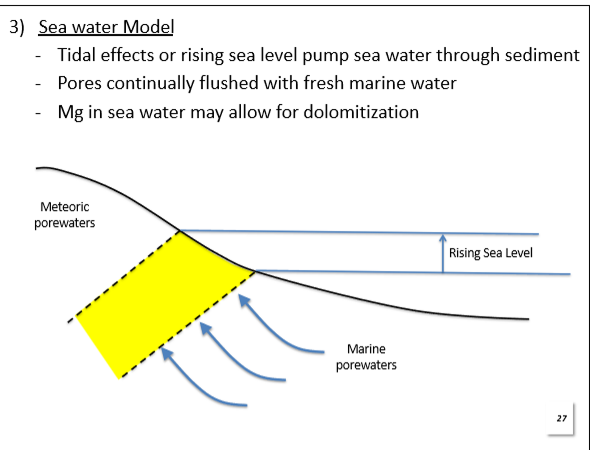
Explain the seawater model
Sea water is continuously flushed through the sediment pores, bringing the calcite into contact with higher levels of Mg, which is continuously being replenished by sea water. Can be accomplished with rising tides.
Explain deep burial dolomization
Mg rich pore waters and limestone with sufficient porosity to permit the passage of these fluids.
Where does a majority of dolomites form?
PROBABLY form by the alteration of limestones in deep burial settings
At what depths did the Western Canada Sedimentary Basin Dolomitic Devonian limestones form?
At depths between 500-3000m over millions of years.