59 - post and core restoration
 Call Kai
 Learn
Learn Practice Test
 Spaced Repetition
 Match
Match Flashcards
 Knowt Play
1/10

There's no tags or description
Looks like no tags are added yet.
Name | Mastery | Learn | Test | Matching | Spaced | Call with Kai | Chat |
|---|
No analytics yet
Send a link to your students to track their progress
11 Terms
sections
use of post and core?
Components of post and core
Dowel
Dowel materials
Classification of dowels via mechanism of retention
Factory made dowels/posts
stages of preparation of post and core
ferrule rule
direct and indirect post and core restorations
advantages + disadvantages
use of post and core?
used to stabilize a weakened/broken down tooth that may have been damaged by fracture or decay or to provide tooth structure to retain a crown
Components of post and core
Core - is a substitution of the missing hard dental tissues of the tooth crown. It replaces fractured or missing coronal structure and retains the final restoration or crowns.
Dowel/post – is a rigid restorative material that connects the core to the root inside the root canal. It is placed within the body of the root of a tooth that has been treated with root canal treatment (non-vital).
Dowel
Longer the dowel/post length, the greater the retention.
dowel length equals or exceeds the length of the crown, the success rate of dowel-treated teeth can be more than 97.5%
Dowel is ¾ the length of the crown or shorter, has less chance of success than a tooth that has no dowel.
dowel increases resistance to lateral forces applied to the crown from 15% to 48%
Dowel materials
: stainless steel, titanium, brass, or a chromium-containing alloy
Recent years, carbon fiber and fiberglass has been used in manufacturing of dowels.
Ceramic dowels are used for anterior teeth as metal dowels could lead to darkening of the root and overlying gingiva.
Fiber dowel exhibit poor torsional resistance because of poor torsional stiffness of the dowel itself.
Torsional resistance is poor with zirconia dowels because of a lack of bonding.
Classification of dowels via mechanism of retention
Cemented)
Active (threated)
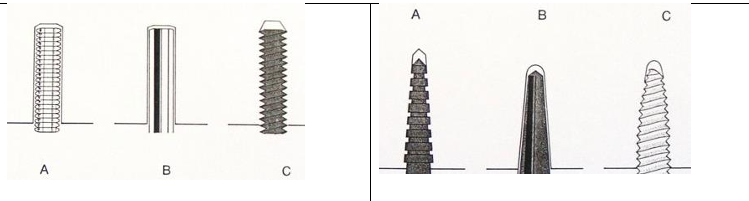
Factory made dowels/posts
Parallel sided - A-Serrated (least retentive), B-Smooth, C-Threaded (most retentive)
Tapered side - A-Serrated (least retentive), B-Smooth, C-Threaded (most retentive)
longest possible post ensures that the forces transmitted from the crown are distributed over as much of the root as possible giving greater retentions.
appropriate diameter post ensures that as much natural tooth structure is left to support the post and absorb the transmitted forces.
parallel post ensures the greatest retention
smooth-surfaced post, although less retentive than either serrated or threaded post surfaces, transmits the least amount of force to the tooth structure.
stages of preparation of post and core
Preparation of the margins (a crown preparation): weaker residual walls are eliminated; the cavity is cleaned up and all healthy dentin is preserved.
Preparation of the root canal: Root part of the post-and-core is prepared with calibrated mechanical burs. The post reaches 3-5mm of the orificium, taking up 2/3 of canal’s length; thus, creating the most favorable ratio of root post to crown length as 2:1. Post diameter – the width of the middle root section is 1.2-2.0mm smaller than the one at the cervical area. The diameter of the post in the cervical zone must not exceed the width of the tooth wall on any side. The preparation for the post has a slightly ellipsoidal shape, which is preferable than the round configuration.
Preparation of the contrarotational elements.
Removal of the thin walls less than 1mm.
Ferrule rule
metal band or a ring used to fit the root or crown of a tooth;
At least 1mm of dental tissues should be above the preparation junction in order for a ferrule effect. When there is a ferrule effect, the artificial crown clamps the tooth as a ring and increases its fracture resistance.
direct and indirect post and core restorations
Direct post-and-core restoration:
Factory made post (metal or fibre-reinforced glass) composite or cement
usually used for single tooth restoration.
Indirect post-and-core restoration:
Preparation, impression is taken → sent to dental lab→undergoes process of cementation.
Materials used are metal alloy or/and ceramics; usually used for multiple teeth or tooth with multiple canals.
advantages + disadvantages
+
Allows restoration of severely damaged teeth and provides support for the crown.
Can be used for certain corrections of improperly inclined teeth.
-
Can be used only in endodontically treated teeth.
Increase the risk of root fractures.
High risk of root perforation or root resorption.