NUR215 Gas Exchange and Oxygenation
 Call Kai
 Learn
Learn Practice Test
 Spaced Repetition
 Match
Match Flashcards
 Knowt Play
1/64

There's no tags or description
Looks like no tags are added yet.
Name | Mastery | Learn | Test | Matching | Spaced | Call with Kai |
|---|
No analytics yet
Send a link to your students to track their progress
65 Terms
What is ventilation?
Movement of air in and out of the alveoli.
What is perfusion?
The ability of the CV system to pump oxygenated blood to the tissues and return deoxygenated blood to the heart.
What is diffusion?
Movement of respiratory gases from one area to another via concentration gradients.
Where does diffusion occur?
Diffusion of gases occurs in the alveoli.
What is inspiration?
Active process of drawing air into the lungs.
What is Expiration?
Passive process of forcing air out of the lungs.
Know chemical/neural control of respiration.
Know chemical/neural control of respiration.
What is "work of breathing"?
The effort required to expand and contract the lungs.
True or False?
Client's with certain respiratory diseases have decreased surfactant production, which may cause atelectasis.
True.
What is atelectasis?
Collapse of alveoli.
What is lung compliance?
Ability of lungs to stretch and expand.
What happens at S1?
When AV valves close.
What happens at S2?
When semilunar valves close.
What is Cardiac Output (CO)?
The amount of blood ejected from the left ventricle every minute.
What is normal Cardiac Output (CO) range?
4-6 L/min at rest.
How do you calculate Cardiac Output (CO)?
CO = SV x HR
What is Stroke Volume (SV)?
The amount of blood ejected from the left ventricle with each contraction.
What is normal Stroke Volume (SV) range?
50-75 mL/contraction.
What is preload?
Amount of blood in the left ventricle at the end of diastole before contraction.
What is afterload?
The resistance to the ejection of blood from left ventricle; the pressure that must be overcome so that blood can leave the heart.
True or False?
HYPOVOLEMIC patients will have decreased preload because they don't have the amount of blood needed to stretch the ventricle.
True.
True or False?
HYPERTENSIVE patients will have an increased afterload because the heart has to beat harder (greater pressure) to overcome clogged arteries.
True.
SA node fires at how many bpm?
60-100 bpm.
What is the conduction system of the heart?
SA node > AV node > Bundle of His > Purkinje network.
What occurs at the P wave?
Atrial contraction (depolarization).
What occurs at the QRS complex?
Ventricular contraction (depolarization) AND Atrial relaxation (repolarization).
What occurs at the T wave?
Ventricular relaxation (repolarization).
How do we assess a clients’ oxygenation? What do we look at? What is normal/abnormal?
How do we assess a clients’ oxygenation? What do we look at? What is normal/abnormal?
What is hyperventilation (alkalosis)?
Increase in rate/depth of respirations.
What occurs during hyperventilation?
Decreased CO2, increased pH.
What are signs of respiratory alkalosis (6)?
(1) Weakness, (2) Dizziness, (3) Headaches, (4) Anxiety, (5) Increased HR, and (6) Difficulty breathing.
What is hypoventilation (acidosis)?
Decrease in rate/depth of respirations; slow, shallow breathing/
What occurs during hypoventilation?
Increased CO2, decreased pH.
What are signs of respiratory acidosis (6)?
(1) Anxiety, (2) Difficulty breathing, (3) Confusion, (4) Weird sleep patterns; Sleep apnea, (5) Weakness, and (6) Cough.
What is Hypoxemia?
Decreased amount of oxygen in the blood.
What is Hypoxia?
Inadequate tissue oxygenation at the cellular level.
What are the clinical signs and symptoms of Hypoxia (4)?
(1) Apprehension, (2) Restlessness, (3) Inability to concentrate, and (4) Dizziness.
True or False?
Patients with Hypoxia cannot lay flat and appears really fatigued and agitated.
True.
True or False?
Patients with Hypoxia may present with an increased HR, and increased rate/depth of breathing.
True.
What is a late sign of Hypoxia?
Cyanosis.
What are eight (8) types of patients (disease processes) that are at higher risk for Hypoxia?
(1) COPD, (2) Emphysema, (3) Smoke inhalation, (4) Anemia, (5) Low Hgb, (6) Low RBCs, (7) those at higher altitudes, and (8) those on medications that decrease respiratory drive.
What are signs/symptoms of left-sided heart failure?
Blood backs up into lungs, respiratory symptoms of heart failure (inability of heart to pump efficiently) such as (1) Dyspnea, (2) Crackles, and (3) Cyanosis.
What are signs/symptoms of right-sided heart failure?
Blood backs up into periphery, causing (1) Edema of the hands and feet as well as (2) Enlarged organs.
Impaired valvular function causes _______ and _______.
Regurgitation; Stenosis.
What are four (4) types of oxygen therapy?
(1) Nasal cannula, (2) Simple mask, (3) Non-rebreather mask, and (4) Venturi mask.
What flow rate is used for nasal cannula?
1-6 L/min.
What flow rate is used for simple mask?
6-12 L/min.
For what type of patients is a simple mask used?
Mouth breathers.
What flow rate is used for a non-rebreather mask?
10-15 L/min.
For what type of patients is a non-rebreather mask used?
Acutely-ill patients.
True or False?
Non-rebreather masks are short-term.
True.
True or False?
Venturi masks deliver a precise percentage of oxygen.
True.
For those that need more airway support, what type of airway treatment is used?
Positive Airway Pressure Treatment.
What are the two types of Positive Airway Pressure Treatment?
CPAP and BiPAP.
What do Positive Airway Pressure Treatments do?
Force air into the airway and keep alveoli open.
True or False?
CPAP is single pressure, gives a constant flow of steady air, and treats sleep apnea (OSA).
True.
True or False?
BiPAP has an increased pressure among inhale, and a decreased pressure when the client exhales.
True.
What is the biggest complication of oxygen therapy?
Oxygen toxicity.
What are five (5) acute signs of oxygen toxicity?
(1) Muscle twitching, (2) Seizures, (3) Nausea, (4) Dysphoria, and (5) Tinnitus.
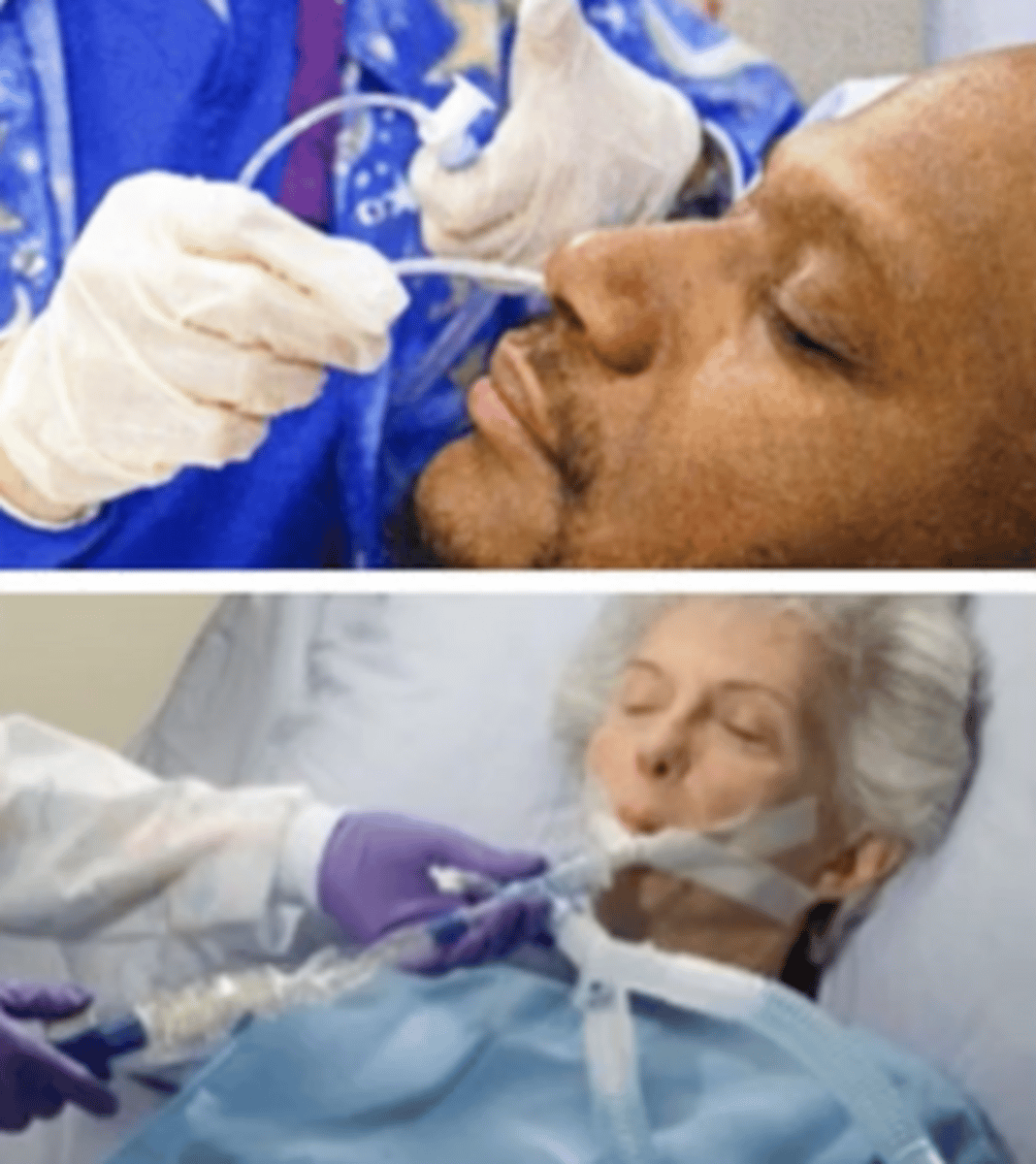
What are three (3) types of suctioning?
(1) Oro/Nasopharyngeal, (2) Nasotracheal, and (3) Tracheal.
When is Oro/Nasopharyngeal suctioning used?
Used when the patient can cough effectively but is not able to spit out or swallow secretions.
When is Nasotracheal suctioning used?
Used when the client does not cough effectively; Cannot cough their secretions up.
When is Tracheal suctioning used?
Used with an artificial airway.
True or False?
Oro/Nasopharyngeal = Clean procedure.
Nasotracheal = Sterile procedure.
Tracheal = Sterile Procedure.
True.
What are two (2) suctioning techniques?
(1) Open and (2) Closed.