Central Nervous System
 Call Kai
 Learn
Learn Practice Test
 Spaced Repetition
 Match
Match Flashcards
 Knowt Play
1/69

There's no tags or description
Looks like no tags are added yet.
Name | Mastery | Learn | Test | Matching | Spaced | Call with Kai | Chat |
|---|
No analytics yet
Send a link to your students to track their progress
70 Terms
two parts of central nervous sytem vs peripheral nervous system
central: brain and spinal chord
peripheral: cranial nerves and spinal nerves
afferent vs efferet
afferent: to/towards aka info moving toward the CNS
efferent: info moving away from the CNS
what kind of input is afferent? what about efferent?
afferent: sensory
efferent: motor
what are the four major functions of the CNS
receiving and processing external sensory info (afferent)
integrating info form a wide range of sources, processing it, acting on it, and/or storing it in memory
sending signals that contro the main functions of body tissues (efferent)
consciousness, perception of language, reason, and memory, emotion, etc.
two divisions of nervous sytem
peripheral and central nervous sytem
what is a group of neuron cell bodies called in CNS vs PNS
CNS: nucleus
PNS: ganglion
what is a bundle of axons called in a CNS vs PNS
CNS: tract
PNS: nerve
what are the seven main parts of CNS?
spinal chord
medulla oblongata
pons
cerebellum
midbrain
diecencephalon
cerebral hemisphere

what are the two cell types of the nervous system?
neurons and glia
three types of glia
endymal cells, microglia, and astrocyte
what are the three ways we classify neurons
morphologically
functionally
NT released
three morphological classifications
pseudounipolar (only one process/not seen in humans/splits into two but ultimately only comes from one source/goes one direciton)
bipolar (two axon terminals that can go in opp directions
multipolar: multiple axon terminals that go in different directions

three functional classifications for neurons
interneuron, afferent neuron, and efferent neuron
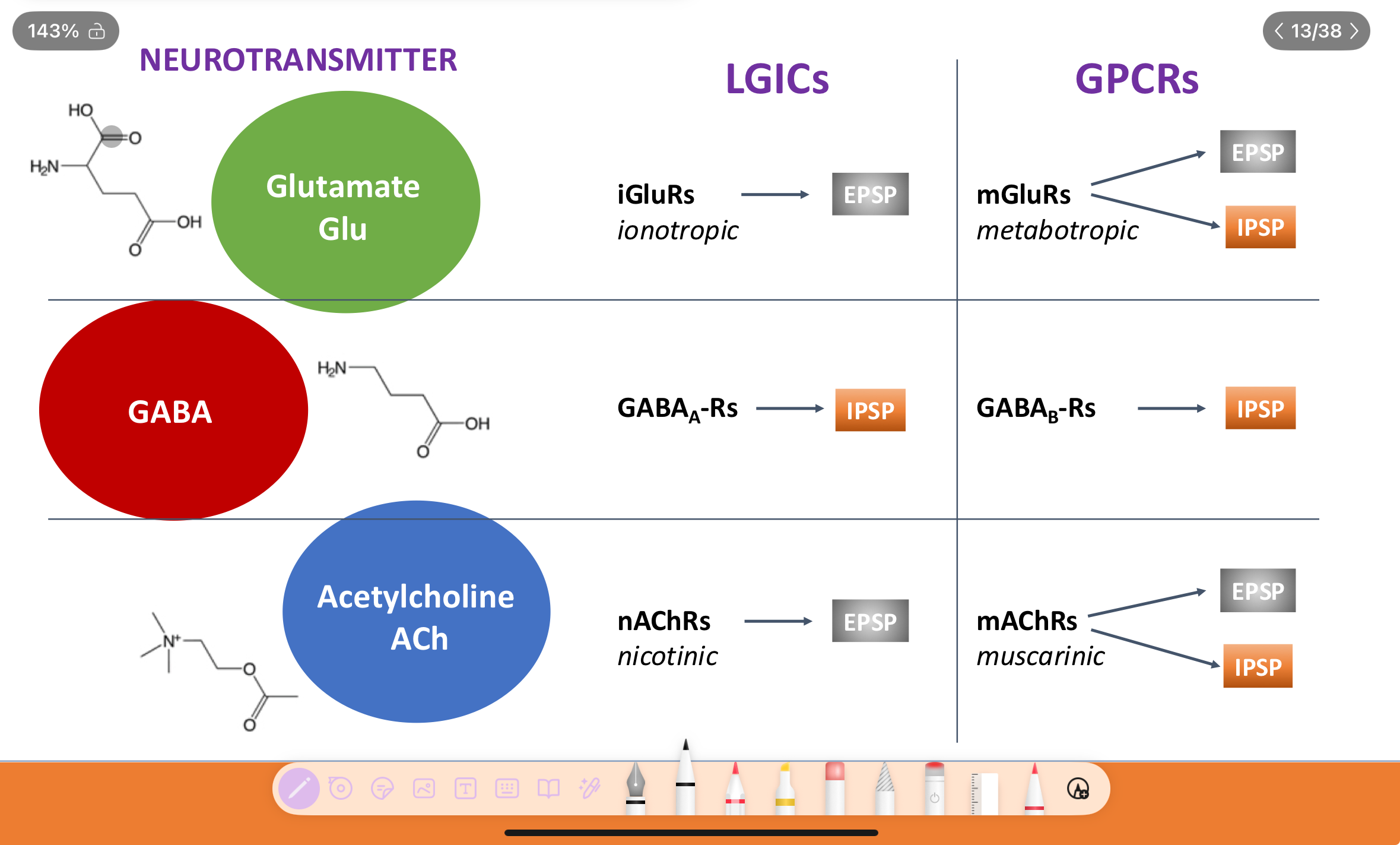
what are the three NTs we focus on for classifying neurons
glutamate (Glu): commonly an EPSP in post synaptic cell
GABA: mainly an IPSP in postsynapitc
Acetylcholine (ACh): epsp vs ipsp depends on the receptor
list all 7 parts of CNS in order from most superior (very top) to most inferior (lowest position)
most superior: cerebrum
diencephalon
midbrain
cerebellum
pons
medulla (oblongata)
most inferior spinal chord
what are the two parts of a forebrain
cerebrum and diencephalon
what are the four parts of the cerebrum
cerebral cortex, basal ganglia, hippocampus, amygdala
what are the two parts of the diencephalon
thalamus and hypothalamus
what is the phenomenon when impulses that cannot generate an action potential alone aggregate from different locations on a neuron to cause depolarization?
spatial summation
afferent vs efferent effectors just directionality
afferent goes IN
efferent goes OUT
SAME DAVE acronym
Sensory
Afferent
Motor
Efferent
Dorsal
Afferent
Ventral
Efferent
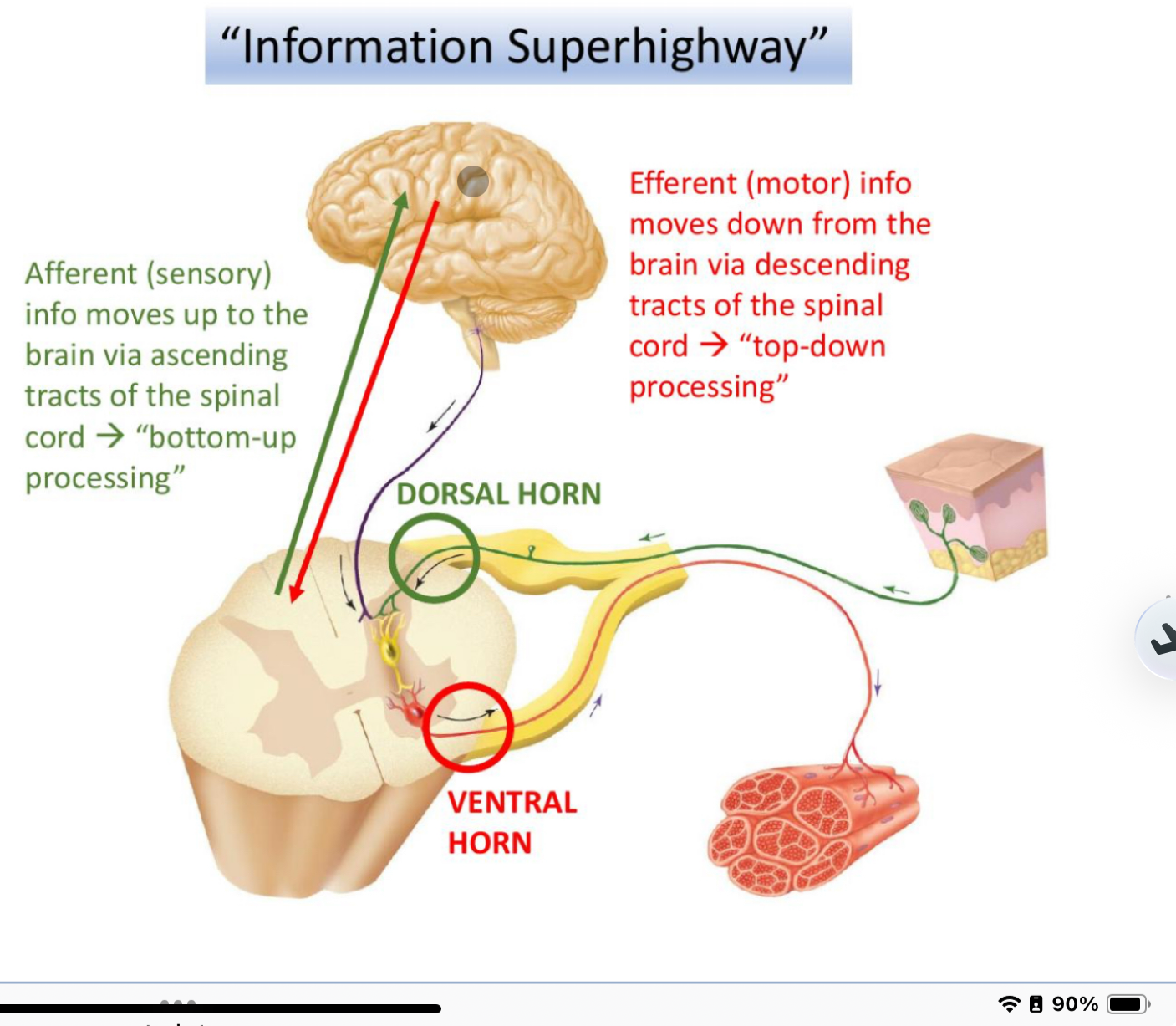
what is the information superhighway
brain ←> spinal chord
where is the gray matter in the brain vs spinal chord
brain: outer
spinal chord: central
dorsal vs ventral
dorsal: back
ventral: front
what are the parts of the central gray matter in the spinal chord
two dorsal horns in the back
two ventral horns in the front
what direction is afferent info going and where does it come in? what type of info?
direction: bottom up/ascending tracts (but comes in through dorsal/back)
sensory ingo
what direction is efferent info going and where does it go out? what type of info?
it is going out from the ventral and top down control/descending tracts
motor information
how does the CNS stimulate skeletal muscle contraction?
efferent pathways of the somatic motor system
which lobe does efferent/afferent info go?
efferent (out): frontal lobe (because motor control)
afferent (in): parietal, occipital, and temporal (all somatosensory)
describe the ascending tracts/afferent pathways
joint stretch/touch/pain/temperature receptor → medulla oblongata (crossing over) → thalamus → postcentral gyrus (somatosensory map)
what kind of neurons are the receptors composed of?
pseudounipolar
where does crossing over occur for the afferent pathway
medulla oblongata
describe the descending tracts/efferent pathways
*In corticospinal tract (aka spinal chord)
primary motor area of cerebral cortex (usually frontal lobe)→medulla oblongata (crossing over) → skeletal muscle (outward motor info)
where does crossing over occur for efferent pathways?
medulla oblongata
what are the five parts of the extrapyramidal tract (do not worry about name just other parts besides spinal chord) that are helpful for movement?
brain stem
primary motor cortex
thalamus
cerebellum
basal ganglia
(and spinal chord)
which gyrus is above the central sulcus? below?
above: precentral gyrus
below: postcentral gyrus
what is the postcentral gyrus for vs precentral
postcentral: somatosensory (afferent)
precentral gyrus: motor area (efferent)
which gyrus is responsible for the primary motor cortex? primary somatosensory gyrus?
motor: precentral gyrus
somatosensory: postcentral
why do we use a homonculus to represent the topagraphical maps/the different gyrus’s?
because it corresponds to the cortical area devoted towards that specific sensory input/motor output

what side and lobe does somatosensory info go if it is coming from the left side?
it goes to the right side parietal lobe
what side and lobe of the brain controls the motor movement on the right side of the body?
the left frontal lobe
decussation meaning?
crossing over of fibers
summarize information superhighway (SAME DAVE)
sensory information (afferent) coming in via the dorsal horns via ascending tracts of spinal chord (bottom up processing)
motor information (efferent) leaving via the ventral horns of the spinal chord. goes down top down processing of descending tracts
do ventral root ganglia exist?
no
what is the soma?
cell body
what are gangila
collection of cell bodies
what kind of neurons are primary sensory (afferent) neurons?
pseudounipolar
what kind of neurons are motor (efferent) neurons?
multipolar

what does the single green or red line? what does the circle represent? what does the line represent? what does the yellow structure represent?
single green or red line: one representative axon/neuron
circle: soma of neuron
line: axon
yellow structure: PNS and many neuronal cell bodies (ganglia) and collections of many axons (nerves)
what do we call a group of neuron cell bodies (gray matter) in CNS vs PNS?
CNS: nucleus
PNS: ganglion
what do we call a bundle of axons (white matter) in CNS vs PNS?
CNS: tract
PNS: nerve
what is in the gray matter vs white matter
gray: cell bodies (nucleus CNS or ganglion PNS)
white: axons (tracts CNS nerves PNS)
what are the names for the peaks and valleys of the brain convolutions
peaks: gyrus
valley: sulcus
what are the four lobes of the cerebrum
frontal, parietal, occipital, and temporal
what are the three subcortial regions of the cerebrum
basal gangila, hippocampus, and amygdala
describe the anatomy of the cerebral cortex
central sulcus divides frontal and parietal lobe
precentral gyrus (motor) is above the central sulcus in frontal lobe (closer to eyes) and postcentral (sensory) is below central sulcus in parietal lobe
lateral sulcus separates temporal lobe from frontal, parietal, and occipital
occipital is on far bacl
longitudinal fissure divides brain in half vertically
eyes→frontal→parietal→occipital

what does contralateral mean? ipsilateral?
contralateral: cross other side
ipsilateral: stay on its side
what is the corpus callosum
the tracts that connect/allow for communication between hemisphere

precentral gyrus function
primary motor cortex involved with control of voluntary muscles
postcentral gyrus function
somatosensory cortex (for the senses)
brief description of frontal vs. temporal vs. parietal vs. occipital function
frontal: houses prefrontal cortex; high cognitive function
temporal: learning/memory/hearing
occipital: visual cortex
parietal: comprehension of language is one aspect
where is the broca’s area? Wernicke’s area? function of both? (include left or right side)
broca: frontal lobe for outputting language (motor makes sense with precentral gyrus in the same lobe) (left side)
Wernicke’s: parietal and temporal lobe for language comprehension (left side)
describe what we would see if we did a cross section of the cerebral cortex?
cell layering!
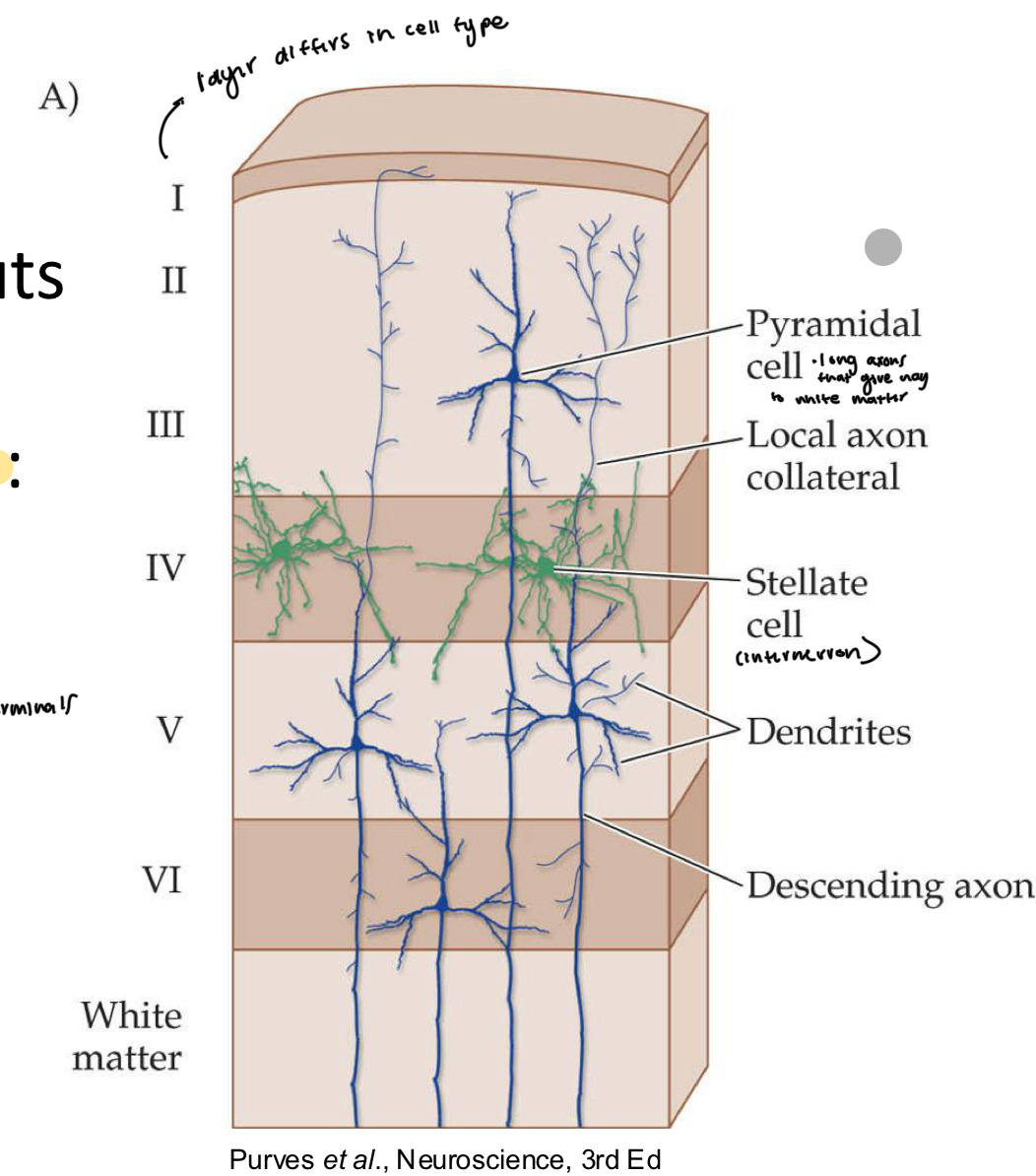
the two broadest cellular categories are neuronal and glial cells. what are two major neuron types
projection neurons and local interneurons
describe projection neurons
pyramidal cells and are typically glutamatergic (mostly excitatory/release glutamate from nerve terminals)
describe local interneurons
they are in all cell layers and are GABA-ergic (release GABA → always IPSP/hyperpolarization)
what are the functions of the three subcortical regions of the cerebrum? (HAB)
hippocampus: learning and memory
amygdala: emotion and memory (part of limbic system→memory based)
basal ganglia: control of voluntary movement

what kind neurons are interneurons
inhibitory multipolar
how do we classify afferent neurons
pseudounipolar or bipolar and excitatory
how do we classify efferent neurons
multipolar and depends