BIO 181 exam 2 notes
 Call Kai
 Learn
Learn Practice Test
 Spaced Repetition
 Match
Match Flashcards
 Knowt Play
1/85

There's no tags or description
Looks like no tags are added yet.
Name | Mastery | Learn | Test | Matching | Spaced | Call with Kai | Chat |
|---|
No analytics yet
Send a link to your students to track their progress
86 Terms
Amino acid
A small molecule that is the building block of proteins.
Alpha helix
A coiled shape in a protein’s structure, held together by hydrogen bonds.
Cholesterol
A waxy, fat-like substance your body needs to build cells and make hormones.
Condensation reaction
A chemical reaction that joins two molecules together while removing a water molecule.
Lipid
A type of molecule that includes fats, oils, and waxes and helps store energy and form cell membranes.
Fatty acid
A type of molecule that is a main building block of fats and oils and provides energy.
Fibrous protein
A protein that forms long, strong fibers and provides structure and support to the body.
Nucleotide
The basic building block (monomer) of DNA and RNA.
Globular protein
A protein folded into a compact, rounded shape that helps it perform specific functions in the body.
Glycerol
A 3-carbon alcohol that forms the backbone of fats and oils (lipids).
Hydrolysis reaction
A chemical reaction that uses water to break a larger molecule into smaller molecules.
Peptide bond
A chemical bond that joins two amino acids together to form a protein.
Phospholipid
A type of fat that makes up the main structure of cell membranes.
Polymer
A large molecule made of many smaller repeating units called monomers
Polypeptide
A chain of amino acids linked together.
Polyunsaturated
A fat that has two or more double bonds in its fatty acid chain.
Primary structure
The specific sequence of amino acids in a protein chain.
Protein quaternary structure
The arrangement of multiple protein chains (subunits) that work together as one protein.
Saturated
Completely filled or containing as much as possible.
Secondary structure
The coiled or folded shape of a protein’s amino acid chain, such as an alpha helix or beta sheet.
Tertiary structure
The overall 3D shape of a protein, formed by the interactions between its amino acid side chains.
triacylglycerol
A type of fat made of glycerol + 3 fatty acids; it stores energy in the body.
unsaturated nucleic acid
A nucleic acid containing one or more double bonds in its structure.
nitrogenous base
A nitrogen-containing part of DNA and RNA that helps store genetic information.
Purine
A type of nitrogen-containing compound found in DNA and RNA.
Pyrimidine
A type of nitrogen-containing base found in DNA and RNA. Examples are cytosine, thymine, and uracil.
Cytosine
A nitrogen-containing base found in DNA and RNA; it pairs with guanine (G).
Thymine
A nitrogen base in DNA that pairs with adenine (A).
Uracil
A nitrogen base found in RNA that pairs with adenine.
Guanine
A nitrogen-containing base found in DNA and RNA.
Adenine Coagulation
A nitrogen-containing base found in DNA and RNA; it pairs with thymine in DNA and uracil in RNA.
Coagulation: The process of blood clotting to stop bleeding.
Denaturation
When a protein loses its normal shape due to heat, chemicals, or changes in pH.
For each type of organic molecule, be able to describe general structure and function and give an example of each
Carbohydrates: Sugars; provide quick energy. Example: glucose.
Lipids: Fats and oils; store long-term energy and form cell membranes. Example: fat.
Proteins: Chains of amino acids; help with structure and body processes. Example: enzymes.
Nucleic acids: DNA/RNA; store and transmit genetic information. Example: DNA.
Draw and fully label the structure of a phospholipid. Explain why this is
important in membrane structure. Which part is hydrophobic, which hydrophilic?
How does it differ from a triacylglycerol?
Why important: Phospholipids form the cell membrane’s bilayer, creating a barrier that controls what enters and leaves the cell.
Difference from triacylglycerol:
Phospholipid: 2 fatty acid tails + phosphate head → makes membranes.
Triacylglycerol: 3 fatty acid tails → mainly stores energy.
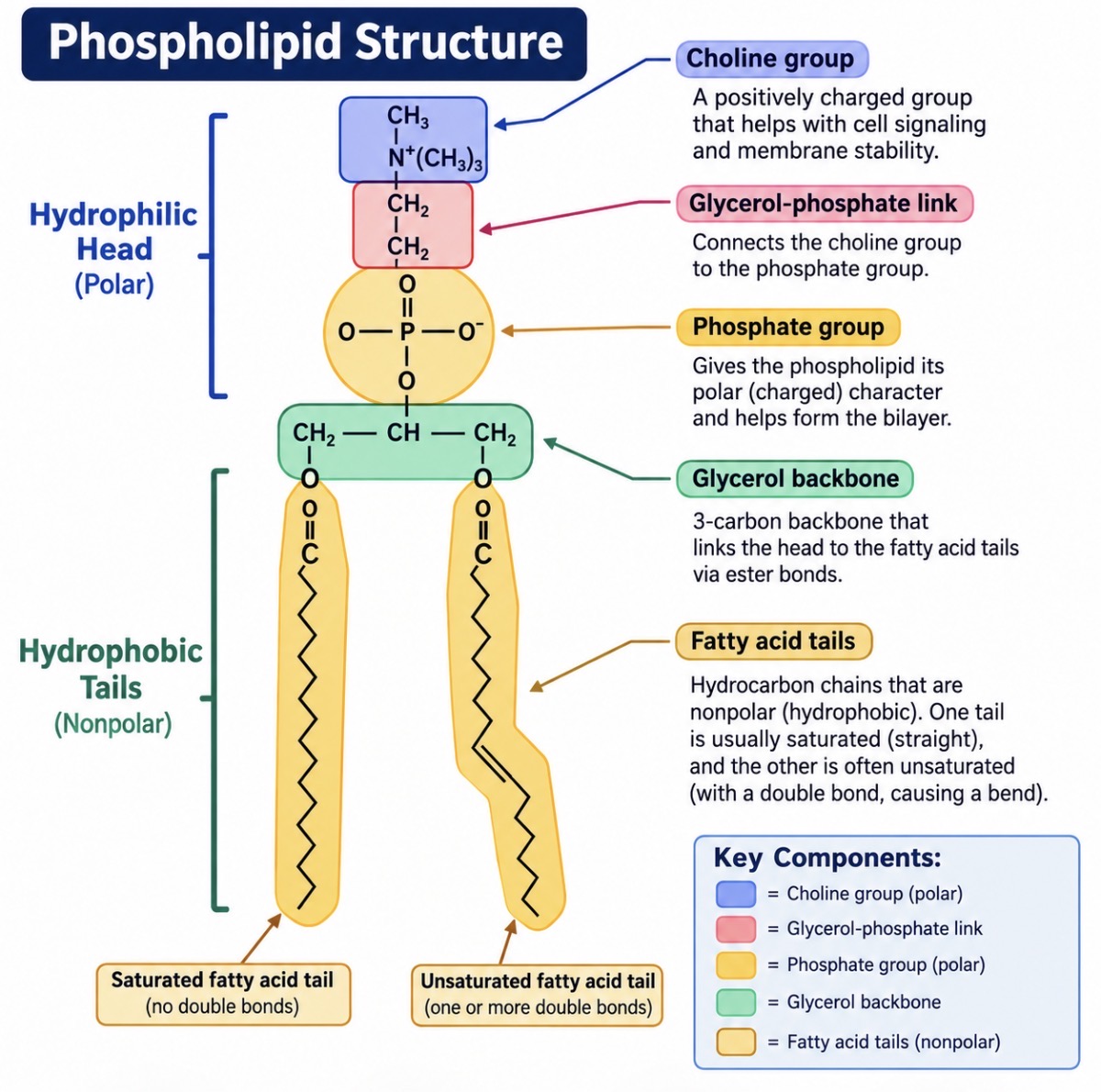
Explain how the monomers of proteins (amino acids) differ from each other.
Amino acids differ by their R group (side chain), which gives each amino acid its unique properties.
Be able to draw and label the basic structure of the amino acid
H
|
H₂N — C — COOH
|
R
H₂N = Amino group
COOH = Carboxyl group
C = Central (alpha) carbon
H = Hydrogen
R = Variable side chain (determines the type of amino acid)
Describe the four levels of protein structure. What type of bonds are involved in each level?
Primary: Amino acid sequence — peptide bonds.
Secondary: Coils and folds (α-helix, β-sheet) — hydrogen bonds.
Tertiary: Overall 3D shape — hydrogen, ionic, disulfide, and hydrophobic interactions.
Quaternary: Multiple protein chains joined together — hydrogen, ionic, hydrophobic interactions, and sometimes disulfide bonds.
Compare Globular and Fibrous proteins. What is the basis for this difference?
Globular proteins: Compact, round proteins that are usually soluble in water and perform functions like enzymes and transport.
Fibrous proteins: Long, strong, strand-like proteins that provide structure and support, such as collagen and keratin.
Basis of difference: Their shape and amino acid arrangement/folding.
Define a nucleotide. What are the differences between ribonucleotides and deoxyribonucleotides? Between a nucleotide and a nucleoside?
Nucleotide: The basic building block of DNA and RNA. It contains a sugar + phosphate group + nitrogenous base.
Ribonucleotide: Has ribose sugar and is found in RNA.
Deoxyribonucleotide: Has deoxyribose sugar and is found in DNA.
Nucleotide vs. nucleoside: A nucleotide = sugar + base + phosphate; a nucleoside = sugar + base only.
What is complementary base pairing?
The specific pairing of bases in DNA or RNA: A pairs with T (or U in RNA), and C pairs with G.
Describe the structure of DNA. Name the 4 nitrogenous bases.
A double helix (twisted ladder) made of nucleotides. Its sugar-phosphate backbone holds four nitrogenous bases:
Adenine (A)
Thymine (T)
Cytosine (C)
Guanine (G)
Base pairs: A pairs with T, and C pairs with G.
List the three types of RNA and describe the function of each.
mRNA (messenger RNA): Carries genetic instructions from DNA to the ribosome.
tRNA (transfer RNA): Brings amino acids to the ribosome to make proteins.
rRNA (ribosomal RNA): Makes up ribosomes and helps build proteins.
What type of bonds hold DNA together?
hold the two DNA strands together between complementary bases.
cytoskeleton
A network of protein fibers that gives a cell shape, support, and helps with movement.
vesicle vacuole
Vesicle: A small sac inside a cell that stores or transports substances.
Vacuole: A cell structure that stores water, nutrients, and waste.
endomembrane system
A group of membranes inside a eukaryotic cell that make, modify, and transport proteins and lipids.
organelle
A small structure inside a cell that performs a specific job.
microtubule
A tiny, hollow structure in cells that helps maintain cell shape and move materials inside the cell.
membrane
A thin layer that surrounds and protects a cell, controlling what enters and leaves it.
cytoplasm
The jelly-like substance inside a cell where many chemical reactions happen.
microfilament
A thin protein fiber in cells that helps with cell shape, movement, and muscle contraction.
What is spontaneous generation?
The old belief that living things can come from nonliving matter.
Describe the cell theory?
All living things are made of cells, cells are the basic unit of life, and all cells come from pre-existing cells.
How do components of membrane structure facilitate the activities of a cell?
control what enters and leaves the cell, communicate with other cells, and help maintain the cell’s shape and stability.
Be able to describe the pathway for protein synthesis for proteins either exported from the cell or trafficked to other areas of the cell.
DNA → mRNA → ribosome on the rough ER → protein is made → transported in vesicles to the Golgi apparatus → packaged and sent to its final destination, such as outside the cell or another part of the cell.
List similarities and points of difference between prokaryotes and eukaryotes and
similarities and points of differences between plant and animal cells.
Prokaryotes vs. Eukaryotes
Similarities: Both have DNA, ribosomes, a cell membrane, and cytoplasm.
Differences:
Prokaryotes: No nucleus; smaller and simpler.
Eukaryotes: Have a nucleus and membrane-bound organelles; larger and more complex.
Plant vs. Animal Cells
Similarities: Both have a nucleus, cell membrane, cytoplasm, mitochondria, and DNA.
Differences:
Plant cells: Have a cell wall, chloroplasts, and a large central vacuole.
Animal cells: Do not have a cell wall or chloroplasts and usually have smaller vacuoles.
active transport
Movement of substances across a cell membrane using energy (ATP), usually from low to high concentration.
concentration gradient
The difference in the amount of a substance between two areas.
diffusion
The movement of particles from an area of high concentration to low concentration until evenly distributed.
facilitated diffusion
Movement of molecules across a cell membrane from high to low concentration using transport proteins, without using energy.
hypertonic
A solution with a higher concentration of solutes than another solution, causing water to move out of the cell.
turgor
The pressure of water inside a plant cell that helps keep the plant firm.
hypotonic
A solution with less solute (more water) than the cell, causing water to move into the cell.
integral protein
A protein that is permanently attached to or embedded in the cell membrane.
isotonic
A solution with the same concentration of solutes as another solution.
osmosis
The movement of water across a semipermeable membrane from an area of high water concentration to low water concentration.
peripheral protein
A protein attached to the surface of a cell membrane that helps with cell communication and support.
lysed
Lysed means broken down or dissolved, usually when a cell breaks open.
phospholipid bilayer
A double layer of phospholipids that forms the main structure of a cell membrane.
ATP
A molecule that stores and provides energy for cells.
plasma membrane
The thin outer layer of a cell that controls what enters and leaves the cell.
solute
The substance that gets dissolved in a solution.
simple diffusion
Movement of molecules from an area of high concentration to low concentration without using energy.
solution
A mixture where one substance dissolves in another.
solvent
A substance that dissolves another substance.
channel/carrier proteins
Proteins in the cell membrane that help substances move into or out of the cell.
plasmolysis
When a plant cell loses water and the cell membrane pulls away from the cell wall.
central vacuole
A large storage space in a plant cell that holds water, nutrients, and waste.
Describe the organization of cell membranes. Draw a membrane showing all the representative components.
A phospholipid bilayer with proteins, cholesterol, and carbohydrates embedded in it. The heads face water, while the tails face inward.
Main components:
🟢 Phospholipids
🔵 Membrane proteins
🟡 Cholesterol
🟣 Carbohydrate chains
Identify two types of membrane proteins; discuss roles played by these
proteins.
Two types of membrane proteins:
Transport proteins – Move substances across the cell membrane.
Receptor proteins – Receive signals and help cells respond to them.
Define a semipermeable membrane.
A semipermeable membrane is a barrier that lets some substances pass through while blocking others.
Describe simple diffusion and osmosis.
Simple diffusion: Movement of molecules from an area of high concentration to low concentration.
Osmosis: Movement of water across a membrane from high water concentration to low water concentration.
Determine the net direction water moves if a cell is placed in a hypertonic,
hypotonic or isotonic solution.
Hypertonic: Water moves out of the cell.
Hypotonic: Water moves into the cell.
Isotonic: Water moves in and out equally (no net movement).
Explain the differences between simple diffusion and facilitated diffusion, and between facilitated diffusion and active transport.
Simple diffusion: Molecules move from high → low concentration directly through the cell membrane; no protein or energy needed.
Facilitated diffusion: Molecules move high → low concentration through a transport protein; no energy needed.
Active transport: Molecules move low → high concentration using a transport protein and energy (ATP).
Compare water balance circumstances between plant and animal cells.
Plant cells: Water enters → cell becomes firm (turgid); too much water is controlled by the cell wall.
Animal cells: Water enters → cell may burst; water leaves → cell shrivels.
Explain how the Na-K ATPase pump works. Why is it necessary?
Na⁺/K⁺ ATPase pump: Uses ATP energy to move 3 Na⁺ out of the cell and 2 K⁺ into the cell.
Why it’s necessary: It maintains the proper balance of ions needed for nerve signals, muscle contraction, and normal cell function.