3.1.9 Rate equations
 Call Kai
 Learn
Learn Practice Test
 Spaced Repetition
 Match
Match Flashcards
 Knowt Play
1/31

There's no tags or description
Looks like no tags are added yet.
Name | Mastery | Learn | Test | Matching | Spaced | Call with Kai | Chat |
|---|
No analytics yet
Send a link to your students to track their progress
32 Terms
State the general rate equation and define its terms. (4 marks)
• Rate = k[A]m[B]n
• k is the rate constant.
• m is the order with respect to A and n is the order with respect to B.
• The orders are restricted to 0, 1 or 2, and are found experimentally, not from the balanced equation.
![<p>• Rate = k[A]m[B]n</p><p>• k is the rate constant.</p><p>• m is the order with respect to A and n is the order with respect to B.</p><p>• The orders are restricted to 0, 1 or 2, and are found experimentally, not from the balanced equation.</p>](https://assets.knowt.com/user-attachments/38424abf-cad1-4082-b707-9fa84e55899c.png)
Define the order of a reaction with respect to a reactant. (2 marks)
• The power to which the concentration of that reactant is raised in the rate equation.
• It shows how the rate depends on that reactant's concentration.
Define the overall order of a reaction. (1 mark)
• The sum of the individual orders in the rate equation.
Define the rate constant. (2 marks)
• The constant of proportionality linking the rate to the concentration terms in the rate equation.
• It is constant only at a fixed temperature, and increases as temperature increases.
Describe what zero order means. (2 marks)
• Changing the concentration of that reactant has no effect on the rate.
• The reactant does not appear in the rate equation.
Describe what first order means. (1 mark)
• If the concentration of that reactant is doubled, the rate doubles.
Describe what second order means. (1 mark)
• If the concentration of that reactant is doubled, the rate increases by a factor of four.
Describe the shape of a rate-concentration graph for a zero order reactant. (2 marks)
• A horizontal straight line.
• The rate is independent of the concentration.
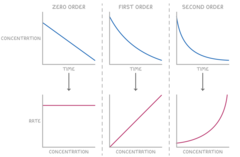
Describe the shape of a rate-concentration graph for a first order reactant. (2 marks)
• A straight line through the origin.
• The rate is directly proportional to the concentration.

Describe the shape of a rate-concentration graph for a second order reactant. (2 marks)
• An upward curve through the origin.
• The rate is proportional to the square of the concentration.

Describe the shape of a concentration-time graph for a zero order reactant. (2 marks)
• A straight line with a constant negative gradient.
• The gradient gives the rate directly, and the rate constant equals that gradient.
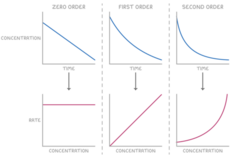
Describe the shape of a concentration-time graph for a first order reactant. (2 marks)
• A downward curve with a constant half-life.
• The concentration takes the same time to halve however far through the reaction you start.
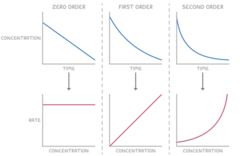
Describe the shape of a concentration-time graph for a second order reactant. (2 marks)
• A steeper downward curve that tails off more slowly than a first order one.
• The half-life increases as the reaction proceeds.

Explain how the rate at a given time is found from a concentration-time graph. (2 marks)
• Draw a tangent to the curve at that time.
• The gradient of the tangent is the rate at that moment.
Describe the initial rates method for finding an order. (4 marks)
1. Carry out several experiments, changing the concentration of one reactant at a time and holding the others constant.
2. Measure the initial rate of each, from the gradient of the tangent at time zero.
3. Compare two experiments: if doubling the concentration doubles the rate, it is first order; if it quadruples the rate, second order; if the rate is unchanged, zero order.
4. Repeat for each reactant in turn to build the full rate equation.
Describe how to calculate the units of the rate constant. (3 marks)
1. Rearrange the rate equation to make k the subject.
2. Substitute the units: rate is mol dm⁻³ s⁻¹ and each concentration is mol dm⁻³.
3. Cancel the units that appear on both the top and the bottom.
State the units of the rate constant for a zero, first and second order reaction. (3 marks)
• Overall zero order: mol dm⁻³ s⁻¹.
• Overall first order: s⁻¹.
• Overall second order: mol⁻¹ dm³ s⁻¹.
Define the rate determining step. (2 marks)
• The slowest step in a multi-step reaction mechanism.
• It determines the overall rate of the reaction.
Explain the relationship between the rate equation and the reaction mechanism. (3 marks)
• Only species involved up to and including the rate determining step appear in the rate equation.
• The order with respect to a species gives the number of molecules of it involved in that step.
• A species that appears in the balanced equation but not the rate equation must react after the rate determining step.
State the Arrhenius equation and define its terms. (5 marks)
• k = Ae⁻Ea/RT
• k is the rate constant and A is the Arrhenius constant, a measure of the frequency and orientation of collisions.
• Ea is the activation energy in J mol⁻¹.
• R is the gas constant and T is the temperature in kelvin.
• The equation and the value of R are given in the exam.

State the logarithmic form of the Arrhenius equation. (2 marks)
• ln k = -Ea ÷ RT + ln A
• This has the form y = mx + c, so plotting ln k against 1/T gives a straight line.

State what the gradient and intercept represent on a graph of ln k against 1/T. (3 marks)
• The y-axis is ln k and the x-axis is 1/T.
• The gradient is -Ea/R, so Ea is found by multiplying the gradient by -R.
• The y-intercept is ln A.
Explain the effect of increasing temperature on the rate constant. (3 marks)
• Raising the temperature increases k.
• A larger proportion of molecules have energy greater than or equal to the activation energy.
• Since rate = k[A]m[B]n and the concentrations are unchanged, the rate increases.
Example: doubling [A] doubles the rate; doubling [B] quadruples the rate; doubling [C] leaves the rate unchanged. Write the rate equation and state the overall order. (3 marks)
1. A is first order, B is second order and C is zero order.
2. Rate = k[A][B]²
3. Overall order = 1 + 2 = 3.
Example: for rate = k[A][B]², rate is 3.0 × 10⁻⁴ mol dm⁻³ s⁻¹ when [A] = 0.10 and [B] = 0.20 mol dm⁻³. Calculate k and its units. (4 marks)
1. k = rate ÷ ([A][B]²).
2. k = (3.0 × 10⁻⁴) ÷ (0.10 × 0.20²) = (3.0 × 10⁻⁴) ÷ 0.0040.
3. k = 0.075.
4. Units: (mol dm⁻³ s⁻¹) ÷ (mol dm⁻³)³ = mol⁻² dm⁶ s⁻¹.
Explain whether a catalyst can appear in a rate equation. (3 marks)
• Yes, if it takes part in or before the rate determining step.
• For the iodination of propanone the rate equation is rate = k[propanone][H⁺], so the acid catalyst appears.
• Iodine is zero order and does not appear, even though it is a reactant in the overall equation.
Explain, using the Arrhenius equation, why a catalyst increases the rate constant. (3 marks)
• A catalyst provides an alternative route with a lower activation energy.
• In k = Ae⁻Ea/RT, a smaller Ea makes the exponent less negative.
• The value of e⁻Ea/RT therefore increases, so k increases and the rate increases at the same temperature.
Explain how to predict a rate equation from a given rate determining step. (3 marks)
• Every species in the rate determining step appears in the rate equation.
• The order with respect to each is the number of molecules of it in that step.
• So if the rate determining step is 2A + B → X, the rate equation is rate = k[A]²[B].
Example: for NO2 + CO → NO + CO2 the rate equation is rate = k[NO2]². Explain why the mechanism cannot be a single step. (3 marks)
1. A single step would mean one NO₂ colliding with one CO, giving rate = k[NO₂][CO].
2. The experimental rate equation is second order in NO₂ and zero order in CO.
3. Two NO₂ molecules must therefore react in the rate determining step, and CO must react in a later step.
Explain why a reaction is usually fastest at the start. (2 marks)
• The concentrations of the reactants are at their highest.
• There are therefore more frequent successful collisions, so the gradient of a concentration-time graph is steepest at time zero.
Explain why one reactant is placed in large excess when investigating the order of another. (3 marks)
• The concentration of the reactant in excess barely changes during the reaction.
• It is therefore effectively constant, and its concentration term can be absorbed into the rate constant.
• Any change in rate can then be attributed to the reactant whose concentration is being varied.
Explain why raising the temperature can affect the rate far more than raising a concentration by the same factor. (3 marks)
• Increasing a concentration changes only the concentration term in the rate equation, so the rate changes by that factor raised to the order.
• Increasing the temperature changes the rate constant k itself.
• In k = Ae⁻Ea/RT the dependence on temperature is exponential, so even a small rise can multiply k several times over.